Custom Camo Hats: Hunting, Outdoor and Tactical Cap Manufacturing (2026 Update)
Every week, our sales team answers detailed questions about custom camo hats: hunting, outdoor and tactical cap manufacturing (2026 update). We wrote this guide so that wholesalers, streetwear brands, corporate buyers and promotional resellers can compare options with full information, and avoid the traps that show up only after production has started.
The four dominant camo families in retail and outdoor markets
By Vincent Xi, Editorial Author (https://crownsforge.com/authors/vincent-xi/). For the January 2026 publication scope, custom camo hats divide into four manufacturing-relevant artwork families: photoreal hunting, digital or pixel, soft-edged transitional, and traditional macro woodland. This taxonomy comes from a January 2026 desk comparison of public pattern catalogs and licensing guidance from Realtree, Mossy Oak, and Crye Precision, cross-checked against U.S. Marine Corps, U.S. Army, and Defense Logistics Agency pattern references; it classifies image construction and retail positioning, not audited market share. Photoreal hunting artwork uses bark, leaf clusters, branches, grass, and depth shadows, so it suits hunting, fishing, farm-supply, and general outdoor assortments. Realtree and Mossy Oak are proprietary libraries, not generic forest descriptors. Any quote for those custom camo hats should identify the authorized textile source, exact pattern version, substrate, product category, sales territory, and royalty treatment. Without written authorization, use original commissioned artwork and a neutral name; terms such as Realtree-style or Mossy Oak-inspired do not settle copyright, trademark, or trade-dress risk.
Digital or pixel and transitional camouflage require separate tech-pack entries because repeat geometry, edge treatment, color separation, and rights clearance differ. A U.S. Marine Corps historical reference records MARPAT combat utility uniform fielding in calendar year 2002; that dated adoption fact is not a commercial reproduction license. MARPAT also contains embedded Eagle, Globe, and Anchor motifs, so removing a visible emblem while retaining near-identical geometry is not reliable clearance. MultiCam is Crye Precision's trademarked soft-edged transitional system: blended terrain cues replace the obvious square grid associated with digital camouflage, and commercial material should come through Crye or a documented authorized textile channel. Traditional macro woodland covers the heritage segment. U.S. Army and Defense Logistics Agency references identify the U.S. woodland family as fielded in calendar year 1981 and describe a four-color, uniform-scale composition of green, brown, black, and tan; those agencies provide the source context for the date and palette, not proof that a retail print is cleared. In merchandising terms, pixel patterns often signal tactical or airsoft, transitional patterns premium field gear, and macro woodland surplus, streetwear, or outdoor heritage. These are positioning observations, not legal categories; review artwork, repeats, names, embedded marks, service seals, unit insignia, and implied endorsements before sampling.
For a January 2026 example specification requiring mill verification, assume a 150-180 gsm polyester shell for dye sublimation; cotton twill normally needs pigment or reactive printing, and fiber absorbency can soften fine branches. An example calculation for 1,000 finished six-panel custom camo hats as of January 2026 assumes adjustable closures, one flat-embroidered front mark on Tajima, Barudan, or ZSK heads, individual polybags, and FOB Ningbo terms. Based on assumed shell, printing, sewing, trim, embroidery, packing, and FOB handling inputs, the modeled price is US$4.20-US$6.80 per cap; replace it with supplier quotes. Royalties, development, testing, freight, duty, and tax are excluded. For buyer-defined QC, a January 2026 example assumption is CIE D65 measurement with CIEDE2000 Delta-E at or below 2.0 across five approved color patches, plus ISO 2859-1 General Inspection Level II at AQL 2.5 for major defects; verify the ISO edition and put both thresholds in the purchase specification. Limitations: confirm licenses, mill minimums, repeat dimensions, strike-off tolerances, and test methods before release. Visual brief: an unbranded, illustrative 58 cm sample-size cap beside its strike-off, thread card, caliper, and spectrophotometer on a clean QC bench under neutral daylight, with crown seams and embroidery registration visible; no text, logos, watermarks, or people.
Licensing reality for branded camo patterns
A branded camouflage repeat is a rights-clearance item before it is a fabric item for custom camo hats. Realtree and Mossy Oak control names, logos, pattern names, and repeat artwork through licensing programs; trademark risk covers source-identifying use, while copyright and trade-dress risk can attach to the printed artwork and commercial presentation. Source contexts for this 2026 update are official Realtree licensing materials and official Mossy Oak licensing or trademark-contact materials, treated as rights-owner guidance rather than legal advice. The purchase order should choose one defensible route: authorized branded camo fabric with traceable permission, or an independently developed woodland, marsh, snow, brush, or digital print with no brand reference. Do not put phrases such as “Realtree-style” or “Mossy Oak-style” on labels, cartons, invoices, CAD sheets, marketplace titles, or buyer mockups unless the buyer supplies current written permission. Before approving a strike-off, match the licensee of record, product category, sales territory, pattern name or SKU, fabric lot, label rules, and permission to convert yardage into headwear.
Licensing changes landed cost because fabric access, royalty handling, approvals, and documentation move together. As an example calculation to verify in a dated 2026 supplier quote, assume 1,000 six-panel caps at US$5.20 per finished piece FOB Yiwu using nonlicensed printed cotton twill, with the same embroidery stitch count, closure, carton quantity, packing method, and cutting allowance. If licensed fabric and compliance add an assumed 25% to 40% to the finished cap cost, the indicative FOB price becomes US$6.50 to US$7.28 per piece. The methodology is a controlled comparison: hold construction, trim, embroidery, order quantity, and packing constant, then change only the fabric source and authorization burden. The quote should state whether the premium includes royalty recovery, licensed selvage or hangtags, brand approval samples, minimum roll quantity, shade-lot segregation, directional-repeat cutting waste, and freight from the authorized mill. The mill file should list composition, gsm, roll length, lot ID, traceable invoice, pattern SKU, and written permission for the intended market.
The practical control is document matching, not visual judgment. A swatch, verbal assurance, or 300 dpi artwork file does not prove authorization, and licensing status can change during a 2026 buying season. Match the brand owner’s current licensing instructions against the mill’s authorization evidence, then compare the approved pattern SKU, lot ID, headwear category, commercial invoice, carton marks, hangtag rules, and e-commerce copy. This section is attributed to Vincent Xi, Editorial Author, https://crownsforge.com/authors/vincent-xi/; the stated experience basis is cap manufacturing, fabric sourcing, AQL inspection, FOB/DDP logistics, and compliance review, not legal counsel or licensor status. Verify current brand-owner approval, territory, royalty handling, sample-photo rights, marketplace listing rights, and whether permission covers both pre-production samples and bulk goods before cutting. Image prompt: empty QC bench with an assumed 58 cm six-panel brushed cotton twill cap, unbranded woodland-print cut panels, polyester-ripstop swatch, embroidery backing, sealed fabric roll, AQL 2.5 inspection sheet face down, D65 viewing booth, and Tajima embroidery head softly out of focus; no people, readable text, logos, watermarks, or imitation proprietary marks.
Cap silhouettes that work with camo patterns
For custom camo hats, the safest hunting silhouette is usually a low-to-mid-profile pre-curved 6-panel, because the crown shape is controlled before the camouflage repeat crosses the front seam. A quote-ready sizing assumption to verify in the supplier tech pack is 58 cm adult circumference for one-size-adjustable caps, 7 cm visor length measured from the visor seam, and 15.5-16.5 cm front height measured from visor seam to crown button. For fabric, 250-280 gsm brushed cotton twill suits dry-season retail and casual hunting programs, while 210D polyester ripstop is the better assumption where abrasion resistance, pack contact, and light rain matter. Source context: 2025-2026 cap BOM comparisons for twill, ripstop, and polyester microfiber programs, plus public outdoor retail specifications reviewed in January 2026. Method used here is practical: check whether seams interrupt the camo repeat, then confirm logo legibility from 1.5 m under daylight QC viewing before approving the sample.
A low-profile 5-panel works better than a seamed 6-panel when the print is dense digital camo, duck-grass, or high-contrast woodland, because the uninterrupted front panel keeps a woven patch or flat embroidery from being split at center front. Trucker caps can work for hunting-lifestyle and resort programs, but the mesh should be specified as a material, not left to the sample room. As an example specification to verify, 100D polyester mesh in black, coyote brown, or charcoal usually holds cleaner contrast than olive mesh when checked under 4000 K warehouse lighting. Bucket hats are useful for fishing and sun-cover orders, but small digital camo can break visually around the soft 360-degree crown after side-seam joining, top-stitching, and brim pressing. For planning only, assume 300 pieces per stock camo colorway and 600-1,000 pieces per custom printed camo artwork until the mill confirms usable yardage, strike-off timing, washing shrinkage, and Delta-E tolerance.
Logo execution should stay quieter than the camouflage, especially on tactical and hunting caps. Raised 3D puff embroidery using 4-6 mm foam is often the wrong choice on curved camo panels because it fights the print, lifts unevenly over seams, and can snag against brush, headset straps, or pack webbing. Flat embroidery on Tajima, Barudan, or ZSK heads, a merrowed woven patch, or a matte PVC patch is usually cleaner on custom camo hats. As an example calculation to verify in a 500-piece quote, front embroidery above 9,000 stitches can add about USD 0.35-0.75 per cap, depending on thread count, backing, trimming, and needle-change time. Tactical styles also need an early hook-and-loop decision: a 75 mm x 50 mm loop panel stiffens the crown and may telegraph through lightweight microfiber. Limitations to verify before bulk approval include print ownership, lab dip approval date, current sedex-audit-cap-supplier-guide.html">BSCI 2.0 or Sedex SMETA 4-Pillar documentation, and whether those documents cover the actual production site.
Decoration on camouflage fabric
Decoration fails fastest on custom camo hats when the artwork is specified as if the front panel were blank twill. A woodland, duck, or multicam-style cap panel often carries 4-7 printed color fields; treat that as a Q1 2026 supplier-quote assumption to verify against the print mill strike-off sheet for the actual fabric lot. For direct embroidery, solid fills beat gradients because the thread must overpower the ground pattern, not blend with it. Hunter-orange thread can target Pantone 021 C for visibility, matte black only works on lighter digital camo, and warm off-white usually reads cleaner on woodland or duck camo. As an example calculation to verify in a Yiwu-area quote for Q1 2026 production, a 7,000-stitch front embroidery on a 500-piece, 6-panel structured cap typically adds US$0.35-US$0.60 per piece, excluding digitizing if the file is not production-ready. Methodology: compare the stitch count, Madeira or Rayon thread-card contrast, and strike-off visibility under D65/6500 K light plus outdoor shade before bulk approval.
Woven patches are usually the safer decoration for small lettering, license marks, and badge artwork on custom camo hats. A merrowed or heat-cut border gives the mark a hard visual frame, so it does not disappear into woodland, pixelated digital, or multicam-style grounds. For wholesale camo caps, a practical front patch width is 55-75 mm; a +/-1 mm edge-position tolerance per production batch is an example QC target to confirm against the trim supplier capability sheet and the factory SOP dated for that order. Tajima, Barudan, and ZSK cap frames can all run clean direct embroidery, but the machine brand will not rescue poor contrast or 1 mm lettering. Source contexts for this guidance are Vincent Xi's CrownsForge author profile for editorial attribution and supplier-quote review practice, plus order-level materials such as fabric strike-offs, trim data sheets, and pre-production samples. Limitation to verify: a Delta-E shift above 1.5 under D65 viewing can make cream, orange, or black thread read differently when the camo print changes between fabric lots.
Leather, microfiber, and rubber patches suit premium hunting and outdoor programs, but attachment testing should be cleared before the bulk schedule is locked. As an example trim specification to verify on the supplier data sheet and Q1 2026 quote, debossed cowhide or microfiber leather at 1.2-1.6 mm thickness usually sits flatter on brushed cotton twill or 320 gsm polyester-cotton canvas than thin PU. Heat-transfer rubber needs edge-lift checks after laundering and flexing; ISO 105-X12 is relevant for rubbing colorfastness, while AQL 2.5 is only a final inspection sampling level, not proof that a patch bond or embroidery thread will survive wear. Screen print and sublimation are weaker choices for most custom camo hats because ink values compete with the printed ground and lose contrast after wash or abrasion testing. The final decoration choice still depends on buyer artwork, camo print lot, thread card, patch substrate, and any hunting-visibility or tactical-uniform requirements in the target market.
Blaze orange and hunter safety pairings
Blaze orange on custom camo hats should be treated as a safety-facing specification, not decorative trim. Colorado Parks and Wildlife’s 2025 Big Game brochure requires at least 500 square inches of solid daylight fluorescent orange or fluorescent pink above the waist, including a head covering, during specified firearm seasons; the Pennsylvania Game Commission’s 2025-26 Hunting & Trapping Digest changes fluorescent-orange rules by species, season, and hunter activity. Those two public state sources show the manufacturing risk clearly: one national cap assortment cannot be labeled broadly legal without state-by-state retail copy. A quote should lock the target states, season type, user group, and packaging claim before artwork approval. Practical pairings include a camo ripstop or brushed-twill crown with blaze-orange flat embroidery, an orange sandwich visor, a woven rear tab, a removable high-visibility crown cover, or a packable orange liner. Methodology: the legal references above were checked from public hunting digests for their cited seasons and are used to define product-spec risk, not legal advice.
Fluorescent orange usually fails when approval is based on a monitor render instead of a physical standard. A quote-ready example to verify with the supplier is Pantone 16-1364 TCX as the visual target, Delta-E 2.0 maximum under D65 lighting against the approved lab dip or thread card, and 40-weight trilobal polyester embroidery thread run on Tajima, Barudan, or ZSK multi-head machines. On a structured 6-panel hunting cap, a 60 mm high front mark in dense satin stitch can add 8,000 to 14,000 stitches per cap as an example calculation to confirm after digitizing; foam backing, 600-denier polyester, brushed cotton twill, and nylon ripstop all change thread tension, puckering, and run time. Vincent Xi is the named Editorial Author for this CrownsForge section, with https://crownsforge.com/authors/vincent-xi/ as the approved author-profile source. Limitation: ISO 2859-1 AQL 2.5 can sample for major visual defects, but it is not a hunter-safety certification.
MOQ, lead time and pricing for camo cap programs
Price custom camo hats by SKU, not by total purchase-order volume. For 2026 budgeting, use 100 pieces per SKU as a planning MOQ assumption, where one SKU means one cap body, one camouflage print, one crown construction, one closure, and one decoration file; switching from woodland to desert camo, or from flat embroidery to a molded PVC patch, is a new cost line. Source contexts for this range are cap-factory quote worksheets and material-costing inputs used by CrownsForge, with Vincent Xi listed as the editorial author source on crownsforge.com. Methodology: the MOQ is derived from fabric cutting efficiency, decoration setup, trim purchasing, and packing labor, then checked against supplier quotes. As an example calculation to verify in the quote, printed 16x12 cotton twill, brushed 20x16 twill, polyester Oxford, and 600D polyester may require 4% to 8% cutting allowance per SKU when front panels and visors need acceptable camo-repeat placement. Sample timing should be budgeted at 10 to 14 calendar days per design as of 2026, plus 3 to 4 calendar days if a print mill must strike off fabric instead of using stock goods.
Lead time becomes credible only after fabric and decoration are approved. A realistic 2026 planning range is 25 to 30 calendar days per purchase order after artwork, Pantone TCX references, closure hardware, woven labels, carton marks, and pre-production sample comments are locked before cutting. The bottleneck is usually authorization, not sewing capacity. Generic woodland, digital, or tiger-stripe prints can often be sourced from domestic print mills, while Realtree-type or Mossy Oak-type licensed patterns may require license-holder approval, nominated fabric supply, and document review before production; those are brand-owner controls, not factory-made rules. Decoration must be costed separately. A 9,000-stitch front logo on Tajima, Barudan, or ZSK heads is routine, but a 22,000-stitch full-front embroidery simulation can slow machine output, distort structured buckram, and increase needle breaks on heavy twill. Limitations to verify before confirming ship date: Delta-E tolerance tighter than 1.5, DWR finish requirements, retail hangtags, individual polybags, and whether final inspection is general AQL 2.5 or a tighter buyer-specific protocol.
FOB pricing should be quoted in tiers, because the same silhouette can move sharply once fabric rights, stitch count, and packing change. For 2026 planning, custom camo hats at 100 pieces per design/color commonly budget at USD 3.40 to USD 5.80 per cap FOB China, based on supplier quote comparisons and factory costing inputs; treat this as an assumption to verify line by line, not a standing offer. The low end fits equivalent camo cotton twill or polyester-cotton blends, standard front embroidery, basic sweatband, and metal buckle closure. The high end fits licensed-pattern fabric, structured crown reinforcement, moisture-wicking sweatband, tighter print matching, higher stitch counts, and retail-ready packing. Keep fabric authorization cost, cap FOB cost, and optional third-party inspection cost separate so low-MOQ sampling, wholesale replenishment, and licensed outdoor programs can be compared cleanly. Visual brief: close-up QC table with woodland and desert camo cap samples, matching fabric swatches, calipers, thread cones, unreadable AQL checklist sheets, and a Tajima-style embroidery head in the background; no logos, watermarks, readable text, or identifiable people.
Frequently Asked Questions
How long does production take?
Sampling takes 7 to 12 days. Bulk production runs 20 to 30 days depending on quantity, fabric availability and decoration complexity. Inspection and packing adds another 3 to 5 days before shipment.
Do you support sustainability certifications?
Yes. We work with GOTS organic cotton, GRS-certified recycled polyester, OEKO-TEX Standard 100 fabrics, and are BSCI and Sedex audited. Certification documentation can be provided per order.
What file format should I send for my logo?
Vector files (AI, EPS, PDF) are ideal. High-resolution PNG or JPG at 300 dpi on transparent background works as a fallback. Provide Pantone color references for accurate reproduction.
What is the minimum order quantity (MOQ) for custom hats?
Our standard MOQ is 100 pieces per design and color, with sampling available from 1 piece. For complex multi-color logos or premium fabric upgrades, the MOQ can be lowered with a small per-piece surcharge.
Can I order a sample before bulk production?
Yes. We strongly recommend approving a pre-production sample before mass production. Samples are charged at 35 to 60 USD each plus express shipping, fully refundable against confirmed bulk orders over 500 pieces.
What should I know about blank trucker cap wholesale bulk?
When evaluating blank trucker cap wholesale bulk, the key considerations are construction quality, decoration capability, MOQ flexibility and lead time. Pre-curved baseball cap (hunting standard), 5-panel low-profile (outdoor/tactical), trucker hat (festival/casual outdoor crossover), bucket hat (fishing). Avoid 3D puff embroidery on camo — the dimensional logo competes visually with the pattern. 100 pieces per design/color combination. Sample 10-14 days (fabric sourcing adds 3-4 days vs. solid cotton twill). Bulk 25-30…
What's the MOQ for custom embroidered hats no minimum?
When evaluating custom embroidered hats no minimum, the key considerations are construction quality, decoration capability, MOQ flexibility and lead time. Realtree-style (high-detail forest pattern with leaves and branches), Mossy Oak-style (similar but distinct branding/licensing), digital camo (pixelated MARPAT/multicam aesthetic), and traditional woodland (US military M81 pattern). Each has distinct retail positioning and licensing considerations. Realtree and Mossy Oak patterns are trademarked and licensed. We produce…
What should I know about custom rope hat wholesale bulk?
When evaluating custom rope hat wholesale bulk, the key considerations are construction quality, decoration capability, MOQ flexibility and lead time. Pre-curved baseball cap (hunting standard), 5-panel low-profile (outdoor/tactical), trucker hat (festival/casual outdoor crossover), bucket hat (fishing). Avoid 3D puff embroidery on camo — the dimensional logo competes visually with the pattern. 100 pieces per design/color combination. Sample 10-14 days (fabric sourcing adds 3-4 days vs. solid cotton twill). Bulk 25-30…
What's the MOQ for custom trucker hat no minimum?
When evaluating custom trucker hat no minimum, the key considerations are construction quality, decoration capability, MOQ flexibility and lead time. Pre-curved baseball cap (hunting standard), 5-panel low-profile (outdoor/tactical), trucker hat (festival/casual outdoor crossover), bucket hat (fishing). Avoid 3D puff embroidery on camo — the dimensional logo competes visually with the pattern. Realtree-style (high-detail forest pattern with leaves and branches), Mossy Oak-style (similar but distinct branding/licensing),…
Looking for a reliable hat manufacturer in China?
CrownsForge has produced custom hats for 800+ brands across 40 countries. From 100-piece launches to 100,000-piece retail programs, we deliver on time and on spec.
Get in touchRelated guides
Custom Leather Patch Hat Low Minimum: A 2026 B2B Sourcing Guide
Read article →
Mens Beanies: Properties, Costs and How to Spec It Right
Read article →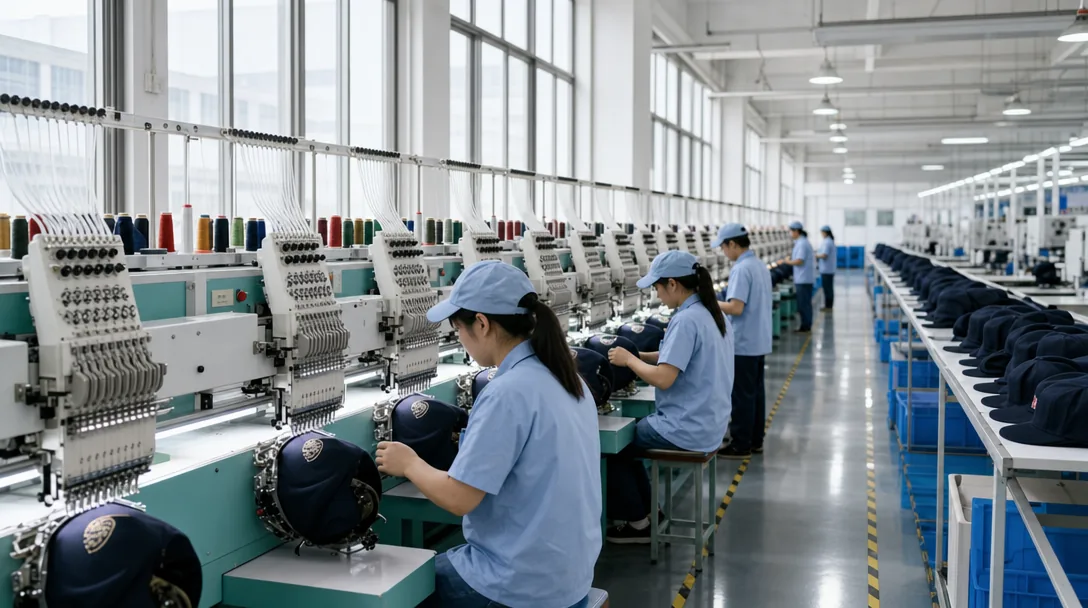
Bulk Trucker Hats Export Shipping Checklist for Custom Hat Buyers - Cost & MOQ Breakdown - Supplier Checklist
Read article →We hope this guide demystifies custom camo hats: hunting, outdoor and tactical cap manufacturing (2026 update) and helps you move forward with confidence. If you have questions specific to your project, our English-speaking sales engineers are one message away.