
What's in a Cap Tech-Pack: A Specification Template for Buyers
What's in a Cap Tech-Pack: A Specification Template for Buyers is one of the most-asked questions we receive from international buyers, and for good reason. With dozens of factories competing for your order and an alphabet soup of technical terms in every supplier quote, even experienced importers can feel lost. This guide consolidates what we have learned producing custom hats for clients in 40+ countries.
Why a tech-pack saves you weeks of email back-and-forth
A good cap tech pack template stops the usual chaos before the first sample is cut. Without it, the factory fills gaps with assumptions: crown height gets rounded off, visor curvature is guessed, stitch counts are changed to suit the machine operator, and the trim colors drift because nobody locked Pantone TCX or thread shade. I have seen a buyer say “mid-profile” in email and mean 58 mm front height, while the factory interpreted it as 70 mm because that’s the local standard. A proper hat specification sheet eliminates those arguments by fixing the bill of materials, measurements, artwork placement, closure type, and tolerance range in one document instead of ten scattered messages.
Once the details are written into a headwear tech pack, sampling turns into execution instead of negotiation. On a clean first-round spec, a factory can cut, stitch, embroider, and assemble the proto in about 7 days instead of the 14 days that usually disappear into clarification emails, photo approvals, and corrected measurements. Revision rounds also collapse because the factory is not guessing where the 3D puff should sit, whether the sweatband is 35 mm or 38 mm, or if the rear closure is self-fabric strap, plastic snap, or metal buckle. In practice, that means one clean correction sheet instead of four back-and-forth cycles.
The cheapest mistakes in cap production are the ones caught on paper, not after 500 pieces are sewn. A serious custom cap spec sheet should call out panel count, fabric weight in gsm, eyelet type, visor core, embroidery size, backing material, label method, and inspection standard such as AQL 2.5. It should also show the cap design specification with flat sketches, top and side views, logo coordinates, and color targets for fabric, thread, and trim. For any tech pack for hat manufacturer, the goal is simple: remove interpretation. When the factory has no room to invent details, you get fewer sample revisions, fewer color disputes, and a production run that matches the buyer’s intent instead of the sewing line’s habit.
The seven sections of a complete cap tech-pack
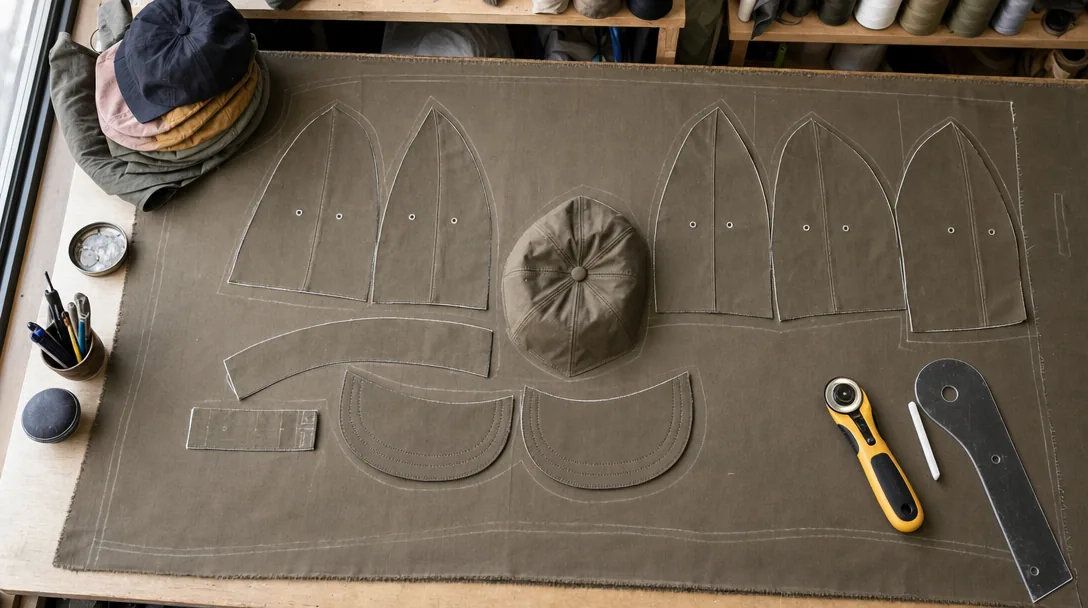
A usable cap tech pack template starts with the tech sketches and doesn’t work without them. I want front, side, back, and top views with stitch lines, panel seams, brim curve, closure position, and any special details like contrast underbrim or piping. A flat sketch is better than a fashion illustration because it tells the factory exactly where the 6-panel seams land, whether the crown is structured or unstructured, and how the visor should be built. If the buyer only sends a logo mockup, the sample room spends time guessing, and guessing is where costs creep up. For a custom cap spec sheet, the drawing should also call out dimensions in millimeters: crown height, brim length, panel width, and embroidery placement from center front and from the brim edge. The fabric spec and color spec come next, and these two pages usually decide whether production stays clean or turns into damage control. A proper hat specification sheet lists shell fabric, composition, weight, weave, and finish: for example, 100% cotton twill at 280 gsm, 2/1 weave, enzyme washed, or 100% polyester brushed twill at 240 gsm with moisture-wicking finish. Color should not be described as “navy” or “cream” unless the buyer wants disputes; use Pantone TCX, and for critical brand colors I ask for a physical lab dip target with acceptable Delta-E, usually under 2.0 for retail programs. If the hat uses multiple fabrics, specify each one separately, including underbrim, sweatband face, and lining, because those parts often get substituted when the tech pack for hat manufacturer is vague. Decoration and construction specs are where most headwear tech pack errors show up, because these details are easy to assume and expensive to fix. Embroidery needs stitch type, thread brand or at least thread shade reference, logo size, and placement tolerance; for 3D puff, the foam thickness and border underlay matter, and for woven labels or patches, the exact dimensions and edge finish matter even more. Construction should define panel count, crown shape, front buckram type, eyelet count and whether they are sewn or embroidered, sweatband material and width, closure type, and brim insert: plastic, cardboard, or recycled board. A complete cap design specification also states whether top button is metal or wrapped, whether seam tape is needed, and what seam allowance the factory should use so the sample matches the approved silhouette instead of drifting by 3 to 5 mm.
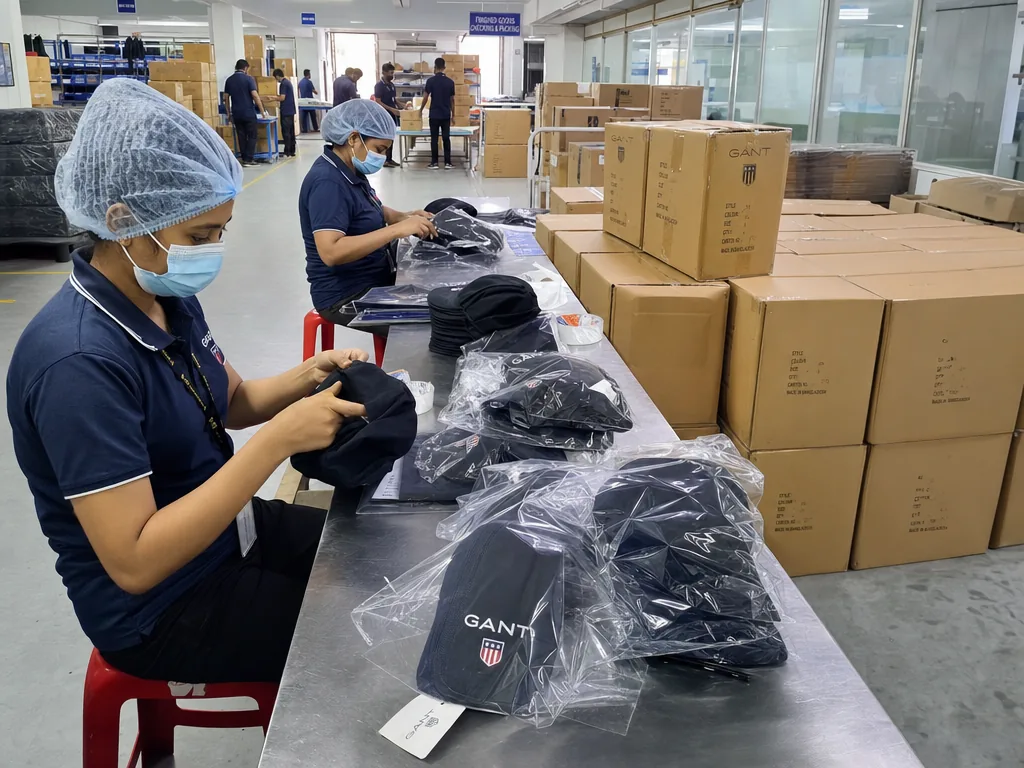
Packaging and label/hangtag specs are the last section, but they are not afterthoughts. If the buyer leaves packaging blank, factories will default to the cheapest safe option, which is usually a polybag with no barcode, no size sticker, and no country-of-origin marking beyond the carton. A proper cap tech pack template should specify individual bag type and thickness, carton packing ratio, inner box if any, silica gel, carton mark format, and whether caps should be shipped brim-flat, crown-stuffed, or in shape-retaining inserts. For e-commerce or retail programs, even the fold direction matters because a bad fold leaves a crease in the front panel and triggers avoidable rejects at AQL 2.5. Label and hangtag details need the same level of precision as the fabric page. State woven label size, fold type, placement, heat transfer or neck print content, care label language, and whether the label must include fiber content, RN/CA number, or importer information for the destination market. If there is a hangtag, specify stock weight, finish, string type, and barcode standard, usually EAN-13 or UPC-A. In a real tech pack for hat manufacturer, I also want artwork placement files in vector format, approval photos of pre-production samples, and a revision history so the factory knows which page controls when the buyer changes a logo or packaging line. That avoids the common problem where the sample matches one page of the headwear tech pack and production follows another.
Tech sketches: front, side, back, optional underbrim
A usable cap tech pack template starts with vector sketches, not product photos. Photos hide distortion, perspective, and lighting; a manufacturer needs line art drawn at scale, usually in AI, PDF, or SVG, with clear front, side, back, and optional underbrim views. On the tech sketch itself, mark every seam line, panel junction, eyelet, button, visor stitch row, sweatband join, and closure component. If the cap is a 5-panel, 6-panel, flat brim, or curved brim style, the sketch should make that obvious at a glance. A proper hat specification sheet is not decoration; it is the place where style decisions become something a factory can actually cut and sew without guessing.
Measurement points must be drawn directly onto the sketch, not buried in a note block. The non-negotiables are crown height or depth, brim length, brim width at the root, brim curve radius or bend spec, front panel width, side panel height, back opening size, and closure placement. For structured caps, also show buckram height and stiffness zone; for unstructured caps, show the relaxed crown profile. In a tech pack for hat manufacturer review, I want the measurement arrows placed from exact reference points, like CF to CB, HPS to underbrim edge, or center seam to side seam, so there is no argument later about how the sample was measured. A cap design specification that only says “normal brim” or “mid crown” is too vague to cost or sample correctly.
If there is an underbrim print, contrast stitch, sandwich edge, or special visor construction, include a separate underbrim view instead of crowding the front sketch. That view should show print placement, seam allowances, stitch density, and any hidden reinforcement such as cardboard, PE board, or recycled plastic insert. For embroidery-heavy styles, mark logo placement on the sketch with dimensions from center front and the brim seam, because a 5 mm shift changes the whole look on the head. In practice, the best headwear tech pack files are the ones a pattern maker can read without asking follow-up questions, and that is exactly why the cap tech pack template should treat sketches as engineering drawings, not mood-board art.
Fabric and color spec: GSM, weave, Pantone references
Fabric line items need to be written like a buyer expects the mill and the cutter to read them, not like a mood board. In a solid cap tech pack template, specify the exact fabric family first — for example 100% cotton twill, 20s/2 x 16s, 260 gsm, enzyme-washed, or a 70/30 wool-poly blend at 320 gsm with a brushed finish. We care about weave because it changes hand feel, seam behavior, and how a visor holds shape: twill is the default for structured six-panels, canvas is stiffer and more rustic, and plain weave is cheaper but usually less forgiving on high-density embroidery. If you leave out GSM, you invite substitution. A 220 gsm twill and a 280 gsm twill may look similar on a PDF, but they do not sew or wear the same. The cap design specification should also note whether shrinkage has been pre-tested; 3% to 5% warp shrink is normal on cotton if no compaction is done.
Color control is where most hat specification sheet failures happen, because buyers write “navy” and expect consistency across seasons and mills. Use Pantone TCX whenever possible, not just a screen reference, and state whether the factory must strike lab dips against a physical chip or only the digital code. For a tech pack for hat manufacturer, I would always include both: Pantone 19-3921 TCX on paper plus an actual chip or swatch approved under daylight D65. Dark colors are especially risky because a Delta-E of 1.5 may look fine on a monitor but read visibly off on a finished cap under retail lighting. If the fabric is dyed after weaving, ask for the dye lot tolerance and whether the supplier can hold shade within the same lot; if it is piece-dyed, note that panel-to-panel variation is usually tighter but costlier.
The best custom cap spec sheet also tells the factory what not to change. List whether the fabric must be reactive-dyed, garment-washed, or piece-dyed, and say if the trim colors — undervisor, sweatband, eyelets, tape — must match or intentionally contrast. A decent cap tech pack template should separate fabric color from thread color, because a matching cap body can still fail if the topstitch comes out two shades lighter than the shell. Our standard practice is to attach a physical color standard, then lock it with an internal approval sample before bulk cutting; that saves a lot of arguments later. If the buyer is sourcing multiple factories, the hat specification sheet should also note accepted tolerances for shade banding, with a visual standard card and a written rule like “no noticeable contrast at 1 meter under standard showroom light.”
Decoration spec: technique, placement, dimensions, color count
Decoration spec is where most buyer files fail, because they say "logo on front" and leave the factory to guess the rest. A usable cap tech pack template needs the decoration method called out first: flat embroidery, 3D puff, woven patch, leather patch, silicone patch, or applique. If it is embroidery, include stitch count if you know it, because that changes machine time and density; a 6,500-stitch front logo and an 11,000-stitch logo are not the same quote or the same hand-feel. On a headwear tech pack, I also want the logo artwork version, whether the art is intended for a structured crown or an unstructured dad cap, and whether the finish should sit flush or stand off the panel. That one line saves a lot of back-and-forth with a tech pack for hat manufacturer team.
Placement needs to be measured on the actual cap panel, not described vaguely in relation to "the front." Write front center, left side, right side, back arch, or under-brim, then give dimensions in centimeters or inches: for example, 5 cm wide × 3 cm tall on the front panel, 2.5 cm wide side mark, or 8 cm back arch above the closure. A good custom cap spec sheet also states the distance from seam lines or the visor stitch line when the logo has to sit in a precise spot, because panel curvature changes the visual size. If the design is a patch, include edge type, shape, and whether it should follow the panel curve or stay straight-cut. That is the difference between a clean sample and a cap that looks off-center on production.
Color count should be written as both thread or print colors and Pantone references, usually Pantone TCX for fabric-adjacent references and Pantone solid coated for print or patch artwork. If the logo uses 3 colors, name each one and lock it to a code, for example Pantone 19-4052 TCX navy, Pantone 11-0601 TCX white, and Pantone 18-1664 TCX red, then note any acceptable Delta-E tolerance if your brand is strict. For embroidery, list the thread color system if your supplier uses Madeira, Gunold, or similar, because a "navy" thread can shift under different lighting and ruin consistency across runs. In a proper hat specification sheet, I also note whether metallic thread, matte thread, or a tonal-on-tonal effect is expected, since that changes the look more than buyers usually expect. This is the part of the cap design specification that keeps sampling and bulk orders aligned.
If the decoration is complex, add one more line for construction notes: 3D puff foam thickness, patch border width, merrowed edge versus laser cut, and whether the logo must stay within a safe zone so it does not run into seams or eyelets. For a front embroidery on a structured six-panel cap, we usually treat 9 to 12 cm wide as the practical working range, but the exact final dimension depends on crown height and panel shape. On CrownsForge jobs, we insist on a marked artwork placement map before sampling, because even a good logo can look wrong if it is too low or too close to the seam. A solid cap tech pack template does not just name the decoration technique; it gives the factory enough data to quote accurately and hit the sample on the first pass.
Packaging and label spec: polybag, hangtag, sticker, carton
Packaging is not a throwaway line item in a cap tech pack template; it affects freight, retail presentation, and compliance. For the polybag, specify exact size in millimeters, film type, and thickness, because a 130 mm x 250 mm bag for a low-profile cap is very different from a 160 mm x 300 mm bag for a structured 6-panel with a cardboard insert. Common practice is 25–30 micron PE or PP film, with a recycle mark printed in the corner if your market requires it. If you want a suffocation warning or barcode label, say where it goes and what language it uses. In a proper hat specification sheet, I also expect you to state whether the bag is individual, paired, or master-packed by dozen, since that changes the packing labor and carton cube.
Hangtags should be treated like print production, not decoration. Put the finished size, paper stock, lamination, corner radius, Pantone references, and dieline in the headwear tech pack so the factory does not guess. If the artwork has metallic foil, spot UV, or a QR code, define the print method and minimum line weight; otherwise the logo that looks fine on screen may fail on press. Attachment method matters too: cotton string, polyester cord, plastic tag pin, or loop fastener all change the look and the labor time. A custom cap spec sheet should also say whether the hangtag is applied through the seam, the sweatband loop, or the hang loop, because some buyers want the tag hidden and others want it visible at retail.
Sticker and carton details are where a tech pack for hat manufacturer either stays clean or turns into a mess. For brim or under-brim stickers, specify diameter or dimensions, stock, adhesive strength, finish, and whether the placement is centered 15 mm from the front edge or aligned to embroidery. If the sticker carries a hologram, UPC, or edition number, note the data source and serialization rule. For cartons, define the pack count by dozen or by piece, gross weight limit, carton dimensions, and outside markings in full text: style number, color, size ratio, destination, and PO. Our standard practice is to call out master carton construction too, usually 5-ply corrugated for export, because a weak carton on a 40-foot container shows up as crushed brims and rejected goods at AQL 2.5.
Frequently Asked Questions
Which shipping methods do you support?
We support FOB, CIF and DDP shipping. Air express for samples and small orders, sea LCL for 100 to 500 pieces, sea FCL for 5,000+ pieces. Door-to-door DDP available for US, EU, UK, Canada and Australia.
What is the minimum order quantity (MOQ) for custom hats?
Our standard MOQ is 100 pieces per design and color, with sampling available from 1 piece. For complex multi-color logos or premium fabric upgrades, the MOQ can be lowered with a small per-piece surcharge.
How long does production take?
Sampling takes 7 to 12 days. Bulk production runs 20 to 30 days depending on quantity, fabric availability and decoration complexity. Inspection and packing adds another 3 to 5 days before shipment.
Can I order a sample before bulk production?
Yes. We strongly recommend approving a pre-production sample before mass production. Samples are charged at 35 to 60 USD each plus express shipping, fully refundable against confirmed bulk orders over 500 pieces.
What logo decoration techniques do you offer?
3D puff embroidery, flat embroidery, woven patch, leather patch, PVC patch, screen printing, sublimation, applique and laser etching, all in-house with no subcontracting.
How does ordering custom patch trucker hat work?
When evaluating custom patch trucker hat, the key considerations are construction quality, decoration capability, MOQ flexibility and lead time. Technique (3D puff / flat embroidery / patch), placement (front center, side, back), dimensions (e.g. 5cm wide × 3cm tall), stitch count if known, color count and Pantone references. Without a tech-pack, your factory invents details that contradict your assumptions. With one, sampling lead time drops from 14 days to 7 and revision rounds drop from 4 to 1.
How does ordering baseball cap custom work?
When evaluating baseball cap custom, the key considerations are construction quality, decoration capability, MOQ flexibility and lead time. Without a tech-pack, your factory invents details that contradict your assumptions. With one, sampling lead time drops from 14 days to 7 and revision rounds drop from 4 to 1. Tech sketches, fabric spec, color spec, decoration spec, construction spec (panels, closure, eyelets, sweatband), packaging spec, label/hangtag spec.
How does ordering custom baseball cap motorcycle helmet work?
When evaluating custom baseball cap motorcycle helmet, the key considerations are construction quality, decoration capability, MOQ flexibility and lead time. Without a tech-pack, your factory invents details that contradict your assumptions. With one, sampling lead time drops from 14 days to 7 and revision rounds drop from 4 to 1. Tech sketches, fabric spec, color spec, decoration spec, construction spec (panels, closure, eyelets, sweatband), packaging spec, label/hangtag spec.
How does ordering custom bucket hat embroidered work?
When evaluating custom bucket hat embroidered, the key considerations are construction quality, decoration capability, MOQ flexibility and lead time. Without a tech-pack, your factory invents details that contradict your assumptions. With one, sampling lead time drops from 14 days to 7 and revision rounds drop from 4 to 1. Tech sketches, fabric spec, color spec, decoration spec, construction spec (panels, closure, eyelets, sweatband), packaging spec, label/hangtag spec.
Ready to start your custom hat project?
Send us your tech-pack, sketch or even just an inspiration photo. We will respond with a detailed quotation and digital mock-up within 24 hours.
Request a free quoteRelated guides
US Tariff Section 301 on Chinese Caps: Import Cost Planning for 2026
Read article →
Acrylic Beanie: Properties, Costs and How to Spec It Right
Read article →Baseball Hats Men's: A Vertical-Specific Sourcing Guide
Read article →We hope this guide demystifies what's in a cap tech-pack: a specification template for buyers and helps you move forward with confidence. If you have questions specific to your project, our English-speaking sales engineers are one message away.