
How to Vet a China Hat Manufacturer Before You Wire the Deposit - Cost & MOQ Breakdown
How to Vet a China Hat Manufacturer Before You Wire the Deposit - Cost & MOQ Breakdown is one of the most-asked questions we receive from international buyers, and for good reason. With dozens of factories competing for your order and an alphabet soup of technical terms in every supplier quote, even experienced importers can feel lost. This guide consolidates what we have learned producing custom hats for clients in 40+ countries.
Business license verification (5 minutes, free)
Use the live SAIC record, not the PDF business license a sales rep drops into WhatsApp. On China’s National Enterprise Credit Information Publicity System (国家企业信用信息公示系统), you can screen a supplier in about five minutes at zero cost, and it is still the fastest way to vet hat manufacturer china before wiring the standard 30% deposit. Match the legal Chinese name character-for-character against the proforma invoice, contract chop, bank beneficiary, and export documents. If the quotation comes from one entity but payment goes to a different mainland company, a Hong Kong shell, or worse, a personal account, treat that as a controls failure until the relationship is documented in writing. For a real cap maker, the business scope should reference manufacturing terms such as 服装制造, 纺织品制造, 针织品, 服饰, or 帽类相关 wording. If the scope leans toward 信息咨询, 跨境电商, sourcing, or general trading, you are probably talking to a broker that will outsource your 6-panel snapbacks, dad caps, or bucket hats to an unknown workshop.
The filing also tells you whether the entity is sized for the orders it is quoting. In Zhejiang, a genuine headwear factory commonly shows 8 to 15 years of operating history and registered capital around RMB 1 million to 5 million; a company formed in the last 6 to 12 months with only RMB 100,000 on record deserves a much tougher audit trail. Registered capital is not cash on hand, but it should roughly fit the production claims—especially if they are quoting 3,000 to 5,000 pieces with custom metal trims, Pantone TCX color approvals, woven labels, and mixed decoration such as flat embroidery plus 3D puff on Tajima or Barudan heads. While you are in the record, check registration status, administrative penalties, shareholder changes, and any 经营异常 listing. If the company is not marked 存续, or you see repeated address changes and unresolved penalties, stop and verify. The best cross-check is the factory address on a sedex-audit-cap-supplier-guide.html">BSCI 2.0 or Sedex SMETA 4-Pillar report: if that site does not match the invoicing entity, the audited factory and the company taking your deposit may not be the same business.
Audit history: what should be on file?
The quickest way to vet hat manufacturer china is to ask for the audit report reference, not a glossy certificate PDF. A real cap factory should produce a current amfori BSCI 2.0 audit ID or Sedex SMETA 4-Pillar report tied to the exact legal company name, unified social credit code, and production address. Check the audited site, not just the entity name: the address on file should be the same facility cutting panels, sewing crowns, attaching sweatbands, and finishing packed caps. In Yiwu, Dongguan, and Quanzhou, a common trick is a trading company showing an audit from a partner factory while the order is actually pushed into an unreviewed workshop. If the report is more than 12 months old, the audit status is “in progress,” or the beneficiary bank account belongs to a different company, treat that as a deposit-stop issue, not a minor paperwork delay. The findings page matters more than the grade. Read open and closed nonconformities around excessive overtime, payroll accuracy, social insurance enrollment, fire-exit clearance, extinguisher inspection tags, evacuation drill logs, age-verification controls, and grievance channels. For hat production, push deeper: confirm the audit scope actually covered the embroidery room, sewing lines, trimming tables, needle-control records, broken-needle logs, and any chemical storage for inks, adhesives, or washing agents. If a supplier quotes 50,000 caps per month on Tajima, Barudan, or ZSK lines, but the audit shows fewer than 25 production workers, one small sewing floor, and no finishing section, the capacity claim is shaky. Compare headcount, machine count, and shift pattern against quoted MOQ, lead time, and monthly output before wiring a cent.
Do not stop at receiving a PDF; verify the report through the platform. If you have Sedex or amfori access, pull the record yourself, or have a third-party QA firm confirm the audit reference directly with the database. Then cross-check the audited entity against the business license, export customs registration, and the RMB or USD bank account named on the proforma invoice. If the supplier sells through Alibaba Trade Assurance, confirm the audited factory and the order-signing entity are the same company. When those entities do not match, your leverage disappears fast because the audited factory is not necessarily the party taking your payment or owning the production risk. For orders above about $8,000 to $10,000, an onsite verification visit in East China usually costs $250 to $450 and is cheap insurance compared with a bad first deposit. A competent auditor will count embroidery heads, inspect stitching lines, review payroll samples, check metal-detection or needle-control procedures, and sanity-check output claims against actual floor layout. One 12-head Tajima does not deliver the same throughput as four 20-head Barudan units running two shifts, and the audit trail should support whatever capacity number is being quoted. At CrownsForge, the most common red flag is still simple document mismatch: audited site, legal entity, and receiving bank account do not line up cleanly.
Video factory tour: what to look for
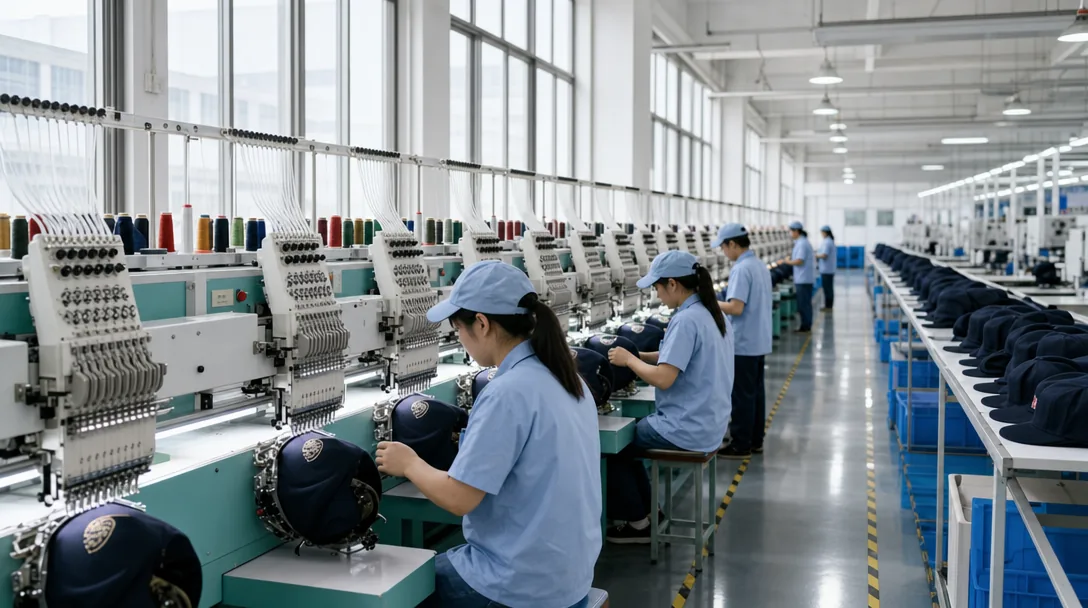
A live walk-through will tell you more than any PDF capability deck. If you need to vet hat manufacturer china suppliers before wiring a standard 30% deposit, insist on a real-time tour on WhatsApp, WeChat, or Zoom in one continuous shot. Start at the building entrance and company sign, then have them walk straight through cutting, sewing, embroidery, finishing, inspection, and packing without camera breaks. On a real cap floor, you should see fabric lays on spreading tables, straight-knife or band-knife cutting, crown panels bundled by size and color, visor inserts stacked by style, and cap embroidery running on Tajima, Barudan, or ZSK heads with actual work in progress loaded on cap frames. If the camera keeps circling back to a sample room, certificate wall, or showroom, treat that as a warning: trading companies can borrow samples, but they cannot fake production flow for long.
Watch the line behavior, not the decor. A functioning factory has visible friction: thread cones on floor stands, sweatbands tied in bundles, buckram and visor boards staged near sewing lines, and WIP tickets showing PO number, style code, color, quantity, and ship date. Ask them to zoom in on eyelet setting, seam taping, top-button attaching, brim binding, and loose-thread trimming. Material storage should be traceable by lot, fiber content, and shade; if they quote 260 gsm brushed cotton twill, 16x12 canvas, or 150D recycled polyester, they should find the rolls immediately and show mill labels. Also check the basics buyers forget: marked fire exits, clear aisles, accessible electrical panels, needle-control logs, and cartons separated between pass, hold, and rework status.
Use the tour to test process control, not just machine ownership. Ask the supplier to pull one live order and show the tech pack, approved Pantone TCX reference, embroidery DST file, in-line QC station, measurement sheet, and final packing area working to AQL 2.5. A competent team can explain why 3D puff embroidery needs foam density matched to satin stitch coverage, how crown height tolerance is usually held within 3-5 mm, and how bulk fabric shade is managed with a Delta-E target, typically under 1.5 to 2.0 against the approved standard. Then push traceability to carton close-out: size breakdown, carton markings, inner packing method, finished-goods staging, and any metal detection or final needle-log release. If they cannot connect sample approval to bulk controls, the risk is simple: good prototype, bad shipment.
Sample evaluation: what physical and functional checks?
A physical sample tells you more than any factory deck because weak process control shows up in structure first. On a retail 6-panel baseball cap, topstitching should run a clean 10-12 stitches per inch with no skipped stitches at the front rise, visor seam, eyelet area, or back opening. Press both front panels with your thumbs: they should rebound evenly, not cave on one side, which usually means inconsistent buckram weight, poor lamination temperature, or uneven fusing pressure. Check eyelet alignment side to side; more than 1.5 mm drift is sloppy cutting or panel matching. The center seam should land straight into the button, and seam tape should cover joins fully without twisting. For embroidery, inspect the sample under raking light. On a Tajima, Barudan, or ZSK run, puckering after de-hooping is usually bad digitizing, too much fill density, or unstable front-panel backing—not something a serious factory should dismiss as normal cap behavior.
Then inspect the visor and inside finishing like an auditor, not a buyer scrolling photos. Set the cap on a verified flat surface and measure brim corner lift; on a flat bill, anything above 2 mm is a red flag for bad board forming, uneven moisture content, or rushed post-press cooling. Flex the brim 10 times by hand; bubbling, edge-tape separation, or a crackling sound usually points to low-grade PE board or poor adhesive bonding. Turn out the sweatband and check stitch capture depth, seam-tape joins, and closure box stitching. If the needle barely catches the sweatband edge, it will fail early in wear. To vet hat manufacturer china properly, ask for macro photos of the same sample 24 hours after packing, plus inside shots of the crown, sweatband join, and back closure. Fresh steam-finished photos hide tension problems that appear once the cap relaxes.
Cosmetics are not enough; run one simple use test before approving. Hand-wash the sample at 30°C, air-dry flat for 24 hours, then apply a firm pull at the side seams, sweatband join, and back closure. On cotton twill, brushed chino, or washed canvas, this is where shrinkage mismatch shows up: the sweatband tunnels, seam tape lifts, or the hook-and-loop box stitch distorts because sewing tension was wrong. Snapbacks should engage cleanly across every notch with no whitening at the posts, and a metal buckle strap should not slip under a hard hand pull. Color also needs objective control. Use an approved Pantone TCX or lab dip for shell, sweatband, visor sandwich, button, and embroidery thread, then verify Delta-E at 3.0 or below under D65 light; for black, charcoal, ecru, or tonal logos, 2.0 is a safer limit because thread sheen exaggerates mismatch. A factory that cannot tie sample approval to measured specs and AQL 2.5 bulk inspection is not ready for your deposit.
Payment terms: 30% deposit / 70% balance is standard. Be wary of any variation
Thirty percent deposit and 70% balance against passed pre-shipment inspection is still the most defensible payment structure in custom cap manufacturing. If a factory asks for 50% to 100% upfront, treat it as a credit-risk question, not a negotiation detail. On a normal run of 1,200 to 3,000 caps, 30% usually covers the supplier’s real exposure: fabric booking, Pantone TCX-matched woven labels, embroidery digitizing, brim boards, sweatbands, and trim procurement. Even with 108x56 cotton twill, brushed chino, or 600D polyester, that advance is generally enough unless the order uses unusually expensive components such as die-cast metal badges at $0.60 to $1.20 per piece, custom-milled 12 oz canvas, or licensed artwork with nonrefundable approval fees. A disciplined factory does not need full payment before PPS approval because that shifts development risk to the buyer. Tie the deposit to a signed proforma invoice and an approved pre-production sample, not to a salesperson’s assurance that bulk will "match the photo." Once cutting starts, mistakes get expensive fast: wrong crown height, incorrect visor curve, or a black embroidery file running on navy panels can wipe out several thousand dollars in materials, labor, and machine time on Tajima or Barudan heads. Our standard practice is simple: deposit after PPS sign-off, balance after final inspection and before shipment release. If you are trying to vet hat manufacturer china properly, this payment sequence tells you whether the factory has internal controls or is using your deposit to finance its own operating cash flow.
The bank details deserve the same scrutiny as the sample room. T/T should go to a company account whose beneficiary name matches the legal entity on the proforma invoice, Chinese business license, packing list, and export declaration. If the supplier suddenly changes the payee to a personal account, a Hong Kong shell, or an unrelated company in Fujian or Guangdong while the factory claims to operate in Zhejiang, stop and verify before wiring a dollar. Ask for the beneficiary name, account number, SWIFT copy, and unified social credit code, then match those against the business license and any audit records. If they cite BSCI 2.0, Sedex SMETA 4-Pillar, or Disney FAMA, those documents should trace back to the same entity receiving funds. Payment method also signals whether you are dealing with a real production supplier or a trading layer with weak controls. PayPal is fine for a $100 to $300 sample invoice; it is not normal for a $12,000 order of 3,000 embroidered snapbacks with 3D puff, woven loop labels, and inside taping. A serious factory will define when the 70% balance is released: typically after passing AQL 2.5 inspection, carton count confirmation, and approval of final packing photos or a third-party report from SGS, Intertek, or QIMA. Put those milestones in writing on the PI. That paper trail is one of the fastest ways to vet hat manufacturer china before the deposit becomes an expensive lesson.
Third-party inspection: when worth the $300
Once your PO clears about $10,000, a third-party Final Random Inspection is usually the cheapest insurance in the deal. In Yiwu and Dongguan, an SGS, Intertek, QIMA, or Bureau Veritas FRI typically runs $280 to $380 per man-day, plus local transport if the factory is outside the main district. That fee is trivial next to reworking 1,500 caps because the crown came in 5 mm lower than the approved sample, the 3D embroidery is drifting off center, or the shell color misses the approved Pantone by a visible margin. Buyers still skip it, wire the remaining 70 percent, and only learn the real quality level when cartons are already at Ningbo or Yantian. If you want to vet hat manufacturer china options properly, an independent FRI shows whether the factory can hold bulk production to the sealed sample, not just stage 20 clean pieces for QC photos.
A useful cap inspection is not a carton-count exercise. The agency should sample to ANSI/ASQ Z1.4 at General Inspection Level II, with agreed AQLs such as 2.5 for major defects and 4.0 for minor, then check crown height, visor curvature, panel seam symmetry, eyelet alignment, sweatband attachment, inside taping, top-button centering, back-strap fixation, embroidery registration, stitch density, and packed assortment by carton. For color-sensitive programs, require comparison against approved Pantone TCX or solid-coated references under D65 lighting and define an acceptable Delta-E before bulk starts, otherwise "close enough" becomes a payment dispute. Timing matters just as much: book the FRI only when 100 percent of units are finished and at least 80 percent are packed, because open cartons make it easy to reshuffle better goods into the sample lot. Send the inspector the tech pack, approved sample photos, point-of-measure chart, logo placement file, carton marks, and defect classification list in advance; a report that records logo deviation in millimeters, skipped stitches, fabric gsm variance, and actual carton counts gives you usable leverage, while "workmanship acceptable" is almost worthless.
Frequently Asked Questions
Can I order a sample before bulk production?
Yes. We strongly recommend approving a pre-production sample before mass production. Samples are charged at 35 to 60 USD each plus express shipping, fully refundable against confirmed bulk orders over 500 pieces.
Do you support sustainability certifications?
Yes. We work with GOTS organic cotton, GRS-certified recycled polyester, OEKO-TEX Standard 100 fabrics, and are BSCI and Sedex audited. Certification documentation can be provided per order.
What logo decoration techniques do you offer?
3D puff embroidery, flat embroidery, woven patch, leather patch, PVC patch, screen printing, sublimation, applique and laser etching, all in-house with no subcontracting.
What file format should I send for my logo?
Vector files (AI, EPS, PDF) are ideal. High-resolution PNG or JPG at 300 dpi on transparent background works as a fallback. Provide Pantone color references for accurate reproduction.
What is the minimum order quantity (MOQ) for custom hats?
Our standard MOQ is 100 pieces per design and color, with sampling available from 1 piece. For complex multi-color logos or premium fabric upgrades, the MOQ can be lowered with a small per-piece surcharge.
How does ordering custom trucker hat bar work?
When evaluating custom trucker hat bar, the key considerations are construction quality, decoration capability, MOQ flexibility and lead time. Look up the supplier on the Chinese government's business registration site (国家企业信用信息公示系统). Confirm legal name, registered capital, year founded, scope of business includes textile/garment manufacturing. A real manufacturer has at least a current BSCI or Sedex SMETA report. Ask for the report ID and verify via the certifying body. 'Coming next month' is a soft-fail.
What should I know about wholesale custom baseball cap?
When evaluating wholesale custom baseball cap, the key considerations are construction quality, decoration capability, MOQ flexibility and lead time. Look up the supplier on the Chinese government's business registration site (国家企业信用信息公示系统). Confirm legal name, registered capital, year founded, scope of business includes textile/garment manufacturing. A real manufacturer has at least a current BSCI or Sedex SMETA report. Ask for the report ID and verify via the certifying body. 'Coming next month' is a soft-fail.
How does ordering custom dad hat embroidery work?
When evaluating custom dad hat embroidery, the key considerations are construction quality, decoration capability, MOQ flexibility and lead time. Live tour (not pre-recorded), walk through cutting / sewing / embroidery / QC / packing. Look for actual workers at workstations, organized fabric inventory, posted safety signage. Look up the supplier on the Chinese government's business registration site (国家企业信用信息公示系统). Confirm legal name, registered capital, year founded, scope of business includes textile/garment…
How does ordering custom baseball cap motorcycle helmet work?
When evaluating custom baseball cap motorcycle helmet, the key considerations are construction quality, decoration capability, MOQ flexibility and lead time. Look up the supplier on the Chinese government's business registration site (国家企业信用信息公示系统). Confirm legal name, registered capital, year founded, scope of business includes textile/garment manufacturing. A real manufacturer has at least a current BSCI or Sedex SMETA report. Ask for the report ID and verify via the certifying body. 'Coming next month' is a soft-fail.
Which country makes the best hats?
The combination of centuries-old craftsmanship and modern-day fashion has made Italy one of the best countries for hats. From classic fedoras to straw panamas, Italian milliners produce some of the world's finest headwear.
Are 47 brand hats made in China?
47 Brand caps are manufactured and imported mostly from countries such as Vietnam, China, Bangladesh due to cheaper labor costs and material costs. The 47 Brand company contracts with factories overseas to produce the hats, which are then shipped to distribution locations and warehouses in the United States.
Ready to start your custom hat project?
Send us your tech-pack, sketch or even just an inspiration photo. We will respond with a detailed quotation and digital mock-up within 24 hours.
Request a free quoteRelated guides
First Custom Hat Order: 10 Mistakes That Cost First-Time Buyers Money
Read article →
Buckram vs Foam vs Unstructured: Cap Crown Construction Compared
Read article →Country Hats For Men Export Shipping Checklist for Custom Hat Buyers
Read article →We hope this guide demystifies how to vet a china hat manufacturer before you wire the deposit - cost & moq breakdown and helps you move forward with confidence. If you have questions specific to your project, our English-speaking sales engineers are one message away.