
Buckram vs Foam vs Unstructured: Cap Crown Construction Compared
For brand owners, wholesalers and procurement teams entering the custom headwear category, buckram vs foam vs unstructured: cap crown construction compared is one of the highest-leverage decisions you will make. Get it right and your unit economics, retail story and reorder cycle all improve. Get it wrong and you carry the cost for years.
What buckram is and why it matters
Buckram is the stiff support layer that decides whether a cap keeps a clean, retail shape or collapses like a cheap promo hat after a few wears. In buckram cap construction, the material is fused to the inside of the front panels, usually before the crown is closed, so the front panel construction holds a defined rise and a stable surface for embroidery or woven patches. Polyester buckram is the standard now because it is more consistent in heat fusion and moisture resistance; cotton buckram still shows up in heritage or premium retail programs, but it is less forgiving in production and can vary more lot to lot.
Thickness matters more than people expect. Most buckram runs about 0.4 to 0.7 mm, and that difference changes the cap crown structure noticeably: 0.4 to 0.5 mm gives a softer structured vs unstructured cap look, while 0.6 to 0.7 mm pushes into a firmer, more boxy front that reads as retail-grade on shelf. On the factory floor, thicker buckram also improves embroidery registration because the needle path has a stable base, especially on dense logos stitched at 9,000 to 10,000 stitches per panel. If the buyer wants the front panel to stand up cleanly under overhead lighting and keep its shape after packing, this is where the decision gets made.
The real tradeoff is not just stiffness, it is how the cap feels in use. A foam front cap can look puffier and softer in the hand, but foam behaves differently under heat, pressure, and repeated wear; it is common in promotional styles, less so in fashion headwear that needs a crisp silhouette. Buckram gives a flatter, more controlled face to the crown, which is why most structured 5-panel and 6-panel caps still rely on it. For brands comparing buckram cap construction to unstructured cap construction, the question is simple: do you want the front panel to hold architecture, or do you want the crown to drape naturally and break in over time?
Foam-front construction (trucker caps)
Foam-front construction is what gives a trucker cap its tall, square profile. Instead of the woven cotton or polyester canvas used in buckram cap construction, you fuse a 3 to 5 mm closed-cell foam pad behind the front panel fabric, usually polyester mesh with a woven front. That foam acts like a lightweight shell: it holds the front upright, sharpens the edge line above the bill, and makes the crown look larger than a comparable unstructured cap construction. On the factory floor, 3 mm is the common promotional spec because it is easier to sew and cheaper to ship, while 5 mm is the aggressive version when a buyer wants a stiffer silhouette and more visible decoration. The tradeoff is obvious: more foam means a cleaner front shape, but also more sensitivity to heat, needle puncture, and poor folding.
Decoration behavior is where a foam front cap differs most from other cap crown structure options. A 5 mm foam layer gives 3D puff embroidery real height, because the thread sits on top of a compressible base and the stitch field stays visually separated from the fabric. At 3 mm, puff still works, but small lettering can collapse if the digitizing is too dense or the stitch angle is wrong. For flat embroidery, foam tolerates larger logos well, but you have to avoid over-tensioning the hoop or you will crush the crown and leave permanent impressions. In practice, foam-front panels are less forgiving than a standard structured vs unstructured cap setup because the foam can delaminate, wrinkle under heat, or telegraph needle holes if the sewing line is too close to the edge.
If you compare foam-front to buckram cap construction, the functional difference is in memory and recovery. Buckram is a woven support layer that behaves more like a fabric stiffener; foam is a compressible pad that creates volume first and structure second. That is why trucker caps usually look taller and softer in the hand even when they appear rigid from a distance. For production, our standard practice is to confirm foam density, thickness tolerance, and heat resistance before cutting, because some low-cost EVA or PU foams collapse after steam pressing or during carton compression. Buyers who want a crisp retail look should specify 5 mm foam with tested panel recovery and a front panel construction template that keeps stitch lines away from the edge by at least 3 to 4 mm.
Unstructured construction (dad hats)
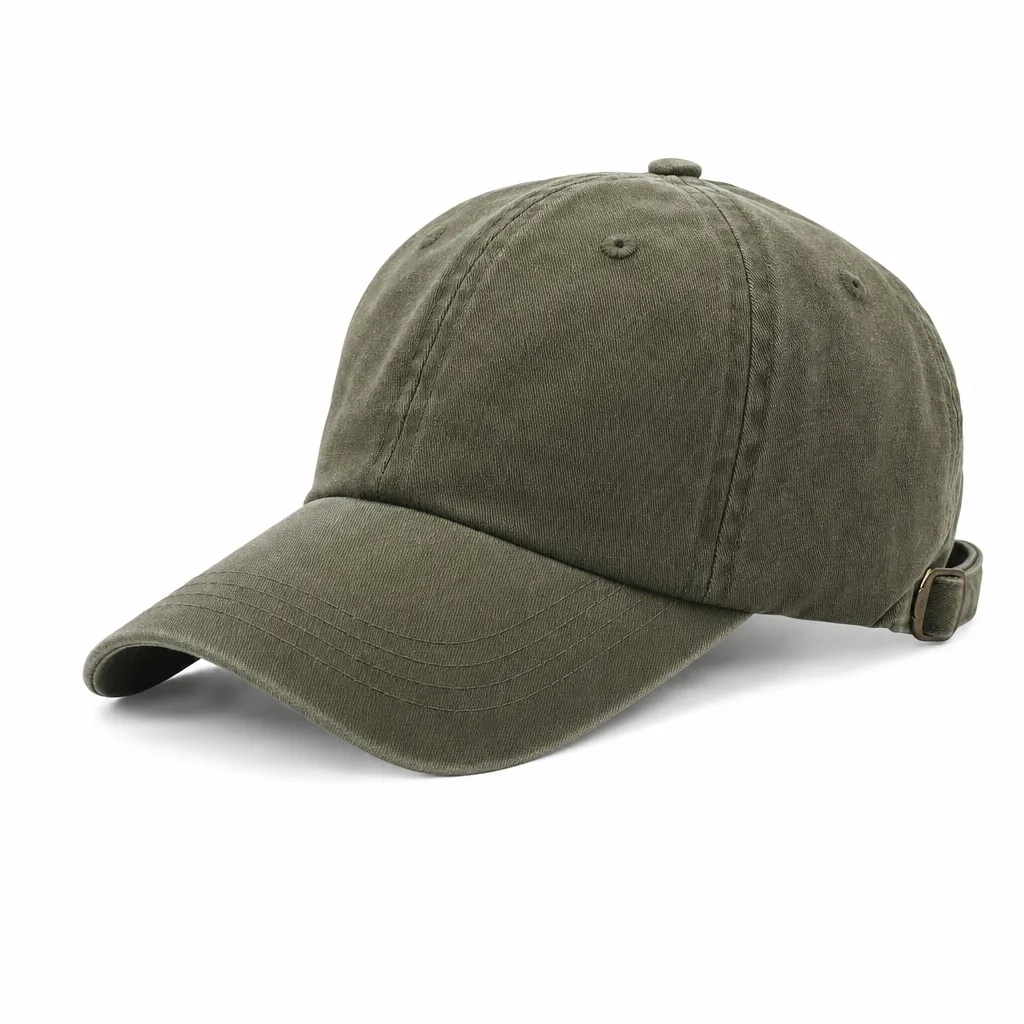
Unstructured cap construction is the simplest cap crown structure you can make: no buckram, no foam, and usually no heavy fusible in the front two panels. That means the front panel construction stays soft and collapsible instead of standing tall like a structured vs unstructured cap comparison you’d see on a snapback. When the cap is off the head, the crown folds slightly and the front loses its shape, which is exactly why dad hats look relaxed rather than boxy. In production, this also saves a full material line item and removes one heat-press fusing step, so the sewing line moves faster and rejects from bad buckram bonding simply do not exist here. For a basic cotton twill dad hat, the factory cost difference versus buckram cap construction is usually small but real: roughly $0.10 to $0.30 per piece on material and labor, depending on fabric and order size.
The tradeoff is decoration support. A foam front cap or a buckram-backed front can hold 3D puff embroidery, dense chenille patches, and larger woven labels because the panel has enough stiffness to resist pull and distortion. Unstructured panels do not. If you try to run a big puff logo on a soft front, the stitches will sink into the fabric, the panel will ripple, and the crown can pucker after washing or heavy wear. Standard flat embroidery is fine, especially a small left-chest-style logo or a light front hit, but once you push stitch density too high, the shape starts collapsing. On the factory floor, we usually keep unstructured caps to lighter decoration: 5,000 to 8,000 stitches, thin merrowed patches, or direct embroidery with low underlay tension to avoid warping the panel.
For buyers, the decision is mostly about use case, not just cost. If the cap is for lifestyle retail, resort merch, brewery giveaways, or a washed vintage program, unstructured cap construction is the right call because the soft hand and broken-in silhouette are the product. If the artwork needs a stiff, elevated front panel or you want a logo that reads from 10 feet away, then structured construction or buckram cap construction is the better platform. Our standard practice is to confirm decoration method before sampling, because cap front panel construction and artwork spec have to match; otherwise you end up approving a sample that looks fine in hand but fails on a production machine. For most dad hats, a 100% cotton twill crown with a low-profile curved brim gives the expected look, but the front will always feel softer, flatter, and more casual than a foam front cap or structured snapback.
How crown construction interacts with decoration
Decoration has to match the cap crown structure, or you end up fighting the panel instead of decorating it. Buckram cap construction gives you the stiffest front, so it handles 3D puff embroidery, dense flat embroidery, woven patches, and leather patches with the least distortion. On a proper six-panel structured cap, the front stays upright after stitching, which matters when the design has tight outlines or heavy fill. If the crown is too soft, the needle pull starts collapsing the panel and your logo looks crooked before it even leaves sewing. In practice, I use buckram when the artwork needs a clean face, a sharp edge, and repeatable placement across a full production run.
A foam front cap behaves differently because the foam itself adds loft under the stitches. That is why 3D puff embroidery looks strongest on foam, especially with thicker merrowed or satin borders, but flat embroidery can also read well if the digitizing is adjusted for lower stitch density and wider underlay. Foam panel construction is also the better choice when the design includes sublimation print directly on the front panel, since the print sits on a smooth, consistent surface before assembly. The tradeoff is that foam does not forgive bad needle work; too much tension or a weak backing choice will leave puckering around the seams, especially near the center seam of a cap front panel construction.
Unstructured cap construction is the least tolerant of heavy decoration, and that is exactly why people overdo it and get bad results. Without buckram or foam support, the crown collapses under dense stitches, so flat embroidery is usually the limit unless the logo is very small and open. A small woven label, leather patch, or tonal embroidery is safer because it adds visual detail without loading the panel. For a structured vs unstructured cap decision, I tell buyers to think about the intended hand feel first and the decoration second: if you want a soft premium silhouette, keep the art light and let the fabric drape. On unstructured hats, heavy front decoration almost always looks stiff in the wrong way, because the fabric wants to move and the embroidery does not.
Per-piece cost differential by construction
On a clean FOB comparison, buckram cap construction is usually the baseline for a standard 6-panel twill cap with midweight cotton, sewn eyelets or metal eyelets, and a full front lining package. Once you move to a foam front cap, the per-piece cost typically drops by about $0.15 to $0.30, mainly because the front panel uses low-cost PE or EVA foam instead of woven buckram and the back half is usually polyester mesh at a lower fabric cost. In a factory setting, that saving is real but not dramatic; the labor content is still there, especially if the foam needs clean edge binding, heat cutting, or a more precise front seam to keep the crown shape consistent.
Unstructured cap construction is usually the cheapest of the three, and the gap comes from what is not there: no buckram, no fusible, no added front panel stiffener, and fewer process steps in the cap front panel construction. Depending on fabric weight and closure type, the reduction is often $0.20 to $0.40 per cap versus a buckram-structured build. That is why a flat 6-panel cotton dad hat can sit in a very different cost band from a structured vs unstructured cap even when the outer shell fabric looks similar at first glance. The buyer is not paying for cloth only; they are paying for reinforcement, handling time, and reject risk from crown distortion.
The mistake I see most often is treating construction as a cosmetic choice instead of a cost lever tied to channel strategy. If you are comparing a $3 retail-grade program to a $5 streetwear-grade cap, the delta is not just embroidery or wash treatment; cap crown structure changes BOM, sewing minutes, and inspection tolerance. A tighter buckram front gives better logo hold and cleaner silhouette for high-density embroidery, while a foam front cap can win on trucker pricing but usually has a less premium hand feel. Our standard practice is to quote construction separately from decoration so buyers can see where the money is actually going, especially when switching between structured and unstructured cap programs.
Durability and wash characteristics
Buckram cap construction is the most predictable option when you care about long-term crown shape after repeated laundering, but the material spec matters more than the label. A real cotton buckram or a high-quality fusible nonwoven can hold a front panel well past 30 wash cycles if the cap was built with proper stitch density and enough adhesive activation during fusing. Cheap polyester buckram is where buyers get burned: it often starts to relax after 10 to 15 washes, especially if the hat was sewn with low-topstitch tension or the front panel was over-steamed during finishing. In practice, the cap crown structure only stays crisp if the interfacing, seam allowance, and crown height are balanced from the start.
A foam front cap behaves differently because the foam is doing the work, not woven fibers or heavy interfacing. Closed-cell PE or EVA foam does not absorb water the way fabric does, so the front panel keeps its molded shape indefinitely under normal washing, assuming the outer shell fabric is stable and the embroidery density is not crushing the face. The weak point is not the foam itself; it is the cover fabric, glue line, and any heat exposure. Put one through repeated hot washes or a dryer cycle and you may see surface delamination or edge distortion, but the front profile usually survives better than a low-grade structured cap built on soft buckram. That is why foam-front construction remains common in promotional caps where consistent billboard shape matters more than softness.
Unstructured cap construction is the opposite philosophy: it is designed to lose shape a little and stay relaxed, so wash softening is not a defect, it is the intended outcome. A good unstructured cap should recover without puckering, but it will never look like a structured vs unstructured cap comparison where the front stands upright on its own. After washing, the crown collapses closer to the head and the panel lines become less defined, which is exactly what buyers want for dad hats and casual lifestyle pieces. From a production standpoint, you avoid heavy buckram, reduce stiffness at the seams, and use lighter cotton twill or washed chino with minimal front panel construction. If a customer expects a sharp silhouette after laundering, unstructured is the wrong build; if they want a broken-in hand feel that gets softer with use, it is the correct one.
Frequently Asked Questions
What logo decoration techniques do you offer?
3D puff embroidery, flat embroidery, woven patch, leather patch, PVC patch, screen printing, sublimation, applique and laser etching, all in-house with no subcontracting.
Can I order a sample before bulk production?
Yes. We strongly recommend approving a pre-production sample before mass production. Samples are charged at 35 to 60 USD each plus express shipping, fully refundable against confirmed bulk orders over 500 pieces.
Which shipping methods do you support?
We support FOB, CIF and DDP shipping. Air express for samples and small orders, sea LCL for 100 to 500 pieces, sea FCL for 5,000+ pieces. Door-to-door DDP available for US, EU, UK, Canada and Australia.
What is the minimum order quantity (MOQ) for custom hats?
Our standard MOQ is 100 pieces per design and color, with sampling available from 1 piece. For complex multi-color logos or premium fabric upgrades, the MOQ can be lowered with a small per-piece surcharge.
How long does production take?
Sampling takes 7 to 12 days. Bulk production runs 20 to 30 days depending on quantity, fabric availability and decoration complexity. Inspection and packing adds another 3 to 5 days before shipment.
How does ordering baseball cap custom logo work?
When evaluating baseball cap custom logo, the key considerations are construction quality, decoration capability, MOQ flexibility and lead time. Buckram-structured 6-panel: baseline cost. Foam-front trucker: -$0.15 to -$0.30 per cap (cheaper foam + cheaper mesh back). Unstructured dad hat: -$0.20 to -$0.40 per cap (no buckram, no fusing). Construction is a meaningful cost lever for buyers comparing $3 retail-grade vs $5 streetwear-grade. Buckram is a stiff woven fabric impregnated with adhesive, fused to the inside…
What should buyers know about cotton twill baseball cap?
When evaluating cotton twill baseball cap, the key considerations are construction quality, decoration capability, MOQ flexibility and lead time. Buckram is a stiff woven fabric impregnated with adhesive, fused to the inside of front panels to maintain the crown's structured shape. Polyester buckram is the modern standard; cotton buckram still appears in heritage/retail brands. Buckram thickness ranges 0.4-0.7 mm; thicker = stiffer = more retail-grade feel. Buckram-structured 6-panel: baseline cost. Foam-front…
What should buyers know about nike heritage cotton twill cap?
When evaluating nike heritage cotton twill cap, the key considerations are construction quality, decoration capability, MOQ flexibility and lead time. Buckram is a stiff woven fabric impregnated with adhesive, fused to the inside of front panels to maintain the crown's structured shape. Polyester buckram is the modern standard; cotton buckram still appears in heritage/retail brands. Buckram thickness ranges 0.4-0.7 mm; thicker = stiffer = more retail-grade feel. Buckram-structured 6-panel: baseline cost. Foam-front…
What should buyers know about vintage washed baseball cap?
When evaluating vintage washed baseball cap, the key considerations are construction quality, decoration capability, MOQ flexibility and lead time. Buckram-structured 6-panel: baseline cost. Foam-front trucker: -$0.15 to -$0.30 per cap (cheaper foam + cheaper mesh back). Unstructured dad hat: -$0.20 to -$0.40 per cap (no buckram, no fusing). Construction is a meaningful cost lever for buyers comparing $3 retail-grade vs $5 streetwear-grade. Buckram is a stiff woven fabric impregnated with adhesive, fused to the inside…
Need a low-MOQ test order?
We help emerging brands launch with as few as 100 pieces. Premium fabric, in-house embroidery, retail-ready packaging.
Start a small orderRelated guides
Switching Hat Manufacturers Mid-Program Without Losing Quality
Read article →
Embroidery Stitch Count & Thread Density: A Cost-and-Quality Reference
Read article →
Custom Embroidered Hat: The 2026 Sourcing & Manufacturing Playbook
Read article →Sourcing custom hats does not have to be complicated. With the right manufacturing partner, clear specifications and a small upfront investment in sampling, you can launch a retail-quality product in 30 to 45 days.