
Switching Hat Manufacturers Mid-Program Without Losing Quality
Every week, our sales team answers detailed questions about switching hat manufacturers mid-program without losing quality. We wrote this guide so that wholesalers, streetwear brands, corporate buyers and promotional resellers can compare options with full information, and avoid the traps that show up only after production has started.
Why brands switch manufacturers (real reasons)
Brands usually switch hat manufacturers for three boring reasons that matter a lot in practice: the quote creeps up every season, the repeat quality gets worse, or the factory simply cannot keep up when the order count jumps from 3,000 pieces to 20,000. A first run might land at $2.10 FOB for a 5-panel cotton twill cap, then the second and third orders quietly move to $2.35 or $2.50 once the supplier knows the program is sticky. At the same time, stitching density, crown shape, and embroidery registration can drift just enough to miss a buyer's standard, especially when the line is busy and the operator changes. That is when a brand decides to switch hat manufacturer rather than keep arguing over every carton. The trigger is often not a disaster, just the accumulation of small misses that make the program harder to defend internally.
Capacity is the other hard limit. A custom hat manufacturer that can handle one seasonal drop may not have enough Tajima or Barudan heads, blocking space, or finishing labor to absorb reorders, rush replenishment, and private-label variants at the same time. Once a brand starts adding trucker, dad cap, snapback, and performance styles in multiple colorways, the old supplier can become a bottleneck. That is when moving production new factory stops being theoretical and becomes a schedule decision. Buyers also use a dual sourcing hat manufacturer setup when they do not want a single point of failure for a retail launch or a licensed sports program. In real terms, a second source cap supplier is insurance against missed ship windows, holiday congestion, and one factory's machine breakdown taking the whole line offline.
Geographic risk matters more after the supply-chain shocks of 2024, when freight volatility, port delays, and regional disruptions forced brands to rethink where they concentrated production. A brand may not be unhappy with the existing factory at all; it may simply want a second source cap supplier in Vietnam, Bangladesh, or another part of China to reduce exposure to a single lane, a single port, or a single customs pattern. Others switch because they want a step up in capability: cleaner embroidery digitizing, tighter shade control on Pantone TCX targets, better crown consistency, or stronger audit coverage under sedex-audit-cap-supplier-guide.html">BSCI 2.0 or Sedex SMETA 4-Pillar. In those cases, the move is less about cost and more about reducing AQL 2.5 fallout, limiting color variance, and giving the buying team a factory that can handle more complex programs without constant intervention.
The tech-pack handoff protocol
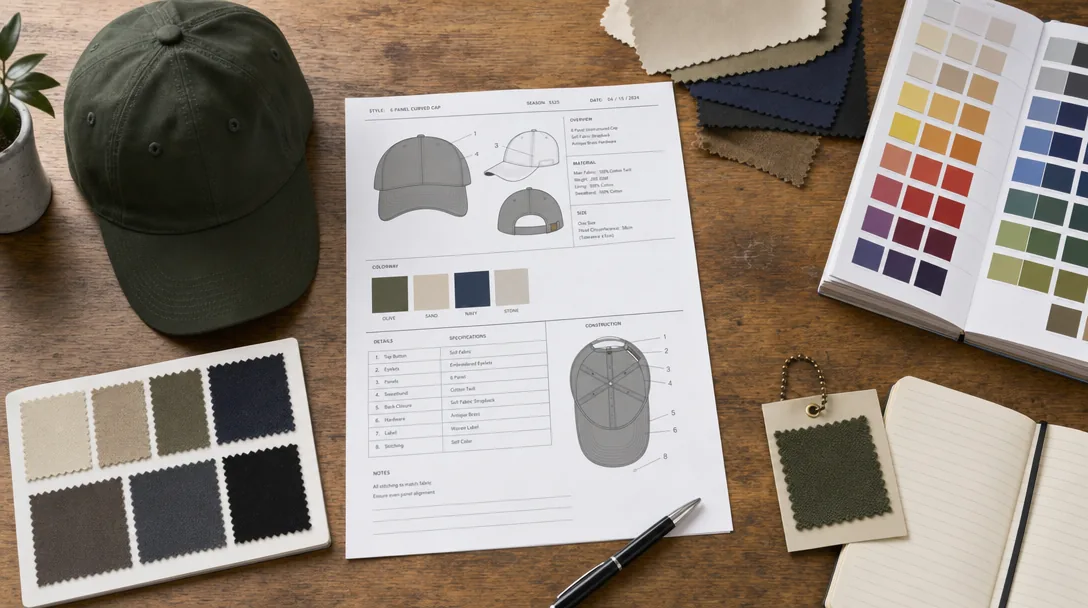
Do not just email the old tech-pack to a new factory and call it a handoff. Build a matching brief: the original tech-pack, physical production samples from each colorway, trim cards, thread codes, seam maps, label placements, and photos taken under daylight and controlled indoor light. Treat the existing sample as the reference standard, not the PDF. When you switch hat manufacturer, the real risk is not whether the dimensions are written down; it is whether the factory interprets the same spec the same way. Matching is a calibration problem, not a redesign. If the brief does not include pre-approved tolerances for crown height, brim curve, stitch density, and logo placement, the new line will invent its own version of acceptable.
Add the test evidence that proves the old product was already stable: OEKO-TEX for materials, CPSIA if the cap is for children, wash or crocking data if the decoration is sensitive, and any color approval notes tied to Pantone TCX or Delta-E targets. At CrownsForge, the practical move is to compare the incoming sample against the master sample before bulk cutting, then lock every deviation that is allowed in writing. That means no silent substitutions for buckram, visor board, sweatband tape, or thread count. If you are moving production new factory, the matching brief should also state what can be changed without re-approval and what triggers a fresh lab dip, a new strike-off, or a full PP sample signoff.
For dual sourcing hat manufacturer programs, create one acceptance matrix that both factories have to follow, then separate cosmetic variation from functional failure. A second source cap supplier should know exactly which tolerances are tight enough to reject: panel topstitch spacing within plus or minus 1 mm, visor curve within plus or minus 2 mm, embroidery registration within 0.5 mm, and label position within 2 mm. A custom hat manufacturer can usually match the look faster than the feel, so define hand feel, stiffness, and sweatband recovery in measurable terms instead of adjectives. That is the clean way to change cap supplier without letting the new source rewrite the product. If the SKU is high risk, keep the incumbent on the first run and phase the switch hat manufacturer by style complexity, not by optimism.
Color reference transfer is the hardest part
The hardest part of a color handoff is that a Pantone TCX callout is only the starting point. Two factories can read the same reference and still land in different places because the dye recipe, fabric blend, greige cloth lot, resin finish, and heat-setting curve all push the final shade around. If you switch hat manufacturer and only send artwork or a lab dip card, you are guessing. The practical move is to ship a physical approved cap from the old run, unwashed and stored out of sunlight, and make that the target. A custom hat manufacturer should also measure under the same light source, typically D65, and record both the target and the incoming sample against the same spec, not just eyeball it on the sewing floor.
When you change cap supplier, expect 2 to 3 lab dip rounds before the new factory gets within Delta-E 2.0 of the approved sample, sometimes 4 if the fabric is a brushed cotton twill, pigment-dyed canvas, or recycled poly blend. That is normal, not a failure. The real risk in moving production to a new factory is that finishing can shift the color after dye approval, especially with enzyme wash, silicone softener, or heavy garment wash. For dual sourcing hat manufacturer setups, I insist on a written color tolerance, wash test results, and a retained physical standard from the first buy. If the old and new factories cannot match under the same spec, then the second source cap supplier needs its own approved shade rather than pretending the mismatch will disappear in bulk.
Sample-matching deliverables checklist
The first fit sample from the new factory should be treated as a control part, not a courtesy sample. Before anyone talks about bulk, measure crown circumference at the same reference points used by the original custom hat manufacturer and hold it within ±0.3 cm, check brim curve against the original blocking sample within ±2 mm, and verify fabric GSM within ±5% against the approved spec sheet. For embroidery, compare stitch count and density against the old production file and keep it within ±5%, because a clean logo can still fail if the underlay or pull compensation changes. Color is where a lot of change cap supplier programs drift: require Delta-E under 2.0 versus the production master, measured under controlled lighting, not by eye on the factory floor. If you are planning to switch hat manufacturer mid-program, this is the point where you lock the sample approval in writing, with sign-off on paper or email from both sides before any cutting order is released.
A proper checklist also needs process controls, not just final measurements. Ask the new factory to submit the exact panel pattern, needle program, backing type, sweatband spec, and thread brand used on the sample so the bulk run can be matched line by line. If you are moving production new factory after a quality issue, request a pre-production review on the same machine class, ideally Tajima, Barudan, or ZSK for embroidery, and confirm that the operator is running the same hoop size, tension range, and trim settings as the reference run. For dual sourcing hat manufacturer setups, keep a retained master sample, a spec sheet with tolerances, and an approval record tied to the PO. A second source cap supplier is only useful if the first bulk lot can be audited back to the signed sample, with no exceptions on material substitutions, seam allowance, or finishing details.
Dual-sourcing strategy: when to keep both
Mature brands usually do not try to switch hat manufacturer in one clean break. The safer move is dual sourcing: keep the incumbent factory on proven colorways, fit blocks, and reorder SKUs while the new factory takes fresh development work, seasonal launches, and extra volume. That split lowers the risk of a bad color match, stitch-density drift, or a delayed trim set killing the whole program. In practice, a 70/30 starting split is common, then it moves toward 60/40 or 50/50 once the new line has passed wash tests, measurement checks, and packaging audits. The commercial advantage is real too. Two factories quoting the same panel shape, buckle spec, and carton format will sharpen pricing, especially on programs with 10,000 to 50,000 units per color. It is a better answer than a hard cutover when the brand cannot tolerate a missed replenishment window.
The best dual-sourcing hat manufacturer setup is not about splitting everything evenly; it is about assigning risk by product type. The incumbent plant can keep legacy embroidery setups, Pantone TCX-approved colors, and repeat trims on lock, while the second source cap supplier builds capacity on new orders and absorbs demand spikes. That is how moving production new factory becomes manageable instead of chaotic. At CrownsForge, our standard practice is to treat the first 2 to 3 PO cycles as a calibration period: confirm crown height, visor curve, sweatband handfeel, and AQL 2.5 inspection results before shifting more volume. A dual sourcing hat manufacturer structure also gives leverage on lead times, because one factory can cover air-freight emergencies while the other stays on sea-freight planning. If the brand is seasonal or license-driven, that redundancy is often worth more than a small unit-cost difference.
What the old factory will and won't share
The old factory should release the production package you already paid to develop: the tech-pack, the approved pre-production sample, measurement sheet, trim callouts, color approvals, and the embroidery DST files if the logo was digitized on your dime. If you switch hat manufacturer, treat this as a document transfer, not a negotiation. A clean handoff usually includes crown panel dimensions, visor curve spec, sweatband width, seam allowance, stitch density, thread codes, and placement marks so the next factory is not reverse-engineering your cap from a photo. For decorated caps, ask for the exact DST version used on the approved sample, plus any revision notes from the sampling round. That saves time when you are moving production to a new factory and trying to keep the same stitch count, density, and logo footprint.
What the old factory will not share is just as important: their internal SOP, machine calibration files, needle bar timing, tension settings, adhesive mix, and dye recipes. Those are their process IP, and in a serious operation they are not supposed to hand that over. The same applies to source lists for proprietary trims or private-label fabric treatments. If you are trying to dual source a hat manufacturer or set up a second source cap supplier, do not waste time asking for their shop-floor playbook. You do not need their entire method; you need the output spec, the approved sample, and enough dimensional control to reproduce it elsewhere. Push too hard on internal controls and you usually get silence, delays, or a defensive attitude that makes the transfer worse.
The practical move is to get the files into a form the new custom hat manufacturer can actually use: editable artwork, DST, PDF tech-pack, approved photos, and a written color standard with Pantone TCX references and a Delta-E target. If the old factory has already run the cap on Tajima, Barudan, or ZSK heads, note the machine type, needle count, and any stabilizer used, because the new shop may need to adjust hooping or backing to match the same hand feel. I would also ask for QC records, not because they are IP, but because they show what passed at AQL 2.5 and where the first factory had trouble. That tells you whether the problem was the pattern, the sewing line, or just a weak setup.
First repeat order signals
The first repeat order, usually 60 to 90 days after you switch hat manufacturer, tells you more than the showroom sample ever will. A factory can hit the spec on 300 pieces with hand-picked material and its best QC pair on the line; that does not prove it can hold the same crown height, brim curve, stitch density, and panel alignment on a real production run. I watch for the same tolerances as the approved PP sample: embroidery registration within about 0.5 to 1.0 mm, Delta-E under 2.0 on solid-color panels, brim symmetry within 2 mm, and sweatband placement that does not wander after blocking. If those numbers stay stable on the second batch, the move is probably genuine. If they start drifting, you are usually looking at sample-quality, not production-quality, which is exactly where a lot of buyers get burned when they change cap supplier.
The second order is also where subcontracting shows up. A new custom hat manufacturer may send the first lot from its main line, then quietly move production new factory behavior starts — faster lead time, looser QC, different thread lot, cheaper buckram, or a different embroidery frame setup. On hats, that often shows up as needle tension variation, puckering on structured fronts, or inconsistent dye shade on the same Pantone TCX reference because they swapped fabric rolls. The best check is boring but effective: compare the first and second batches under the same AQL 2.5 inspection, same lighting, same measurement jig, and same approved sample. If the second run changes in a way that cannot be explained by normal finishing variance, the supplier likely does not control its own line tightly enough to be trusted as a stable second source cap supplier.
If you are dual sourcing hat manufacturer capacity, the first repeat order should be treated like a production audit, not just a reorder. Ask for the same material COA, trim lot numbers, and embroidery machine log if you are running logos on Tajima, Barudan, or ZSK heads. On knit or washed styles, check whether shrinkage after steam blocking stays within the original spec; on cotton twill, look for panel twist, seam slippage, and crown collapse after packing. Our standard practice is to compare the reorder against the sealed golden sample and keep a photo record of every defect class, because small drift on a 1,000-piece run usually gets worse on the third run. If the supplier can survive the second batch without hiding work behind a sample room finish, then the switch is probably real; if not, you have a production-control problem, not a sourcing problem.
Frequently Asked Questions
How long does production take?
Sampling takes 7 to 12 days. Bulk production runs 20 to 30 days depending on quantity, fabric availability and decoration complexity. Inspection and packing adds another 3 to 5 days before shipment.
What file format should I send for my logo?
Vector files (AI, EPS, PDF) are ideal. High-resolution PNG or JPG at 300 dpi on transparent background works as a fallback. Provide Pantone color references for accurate reproduction.
Which shipping methods do you support?
We support FOB, CIF and DDP shipping. Air express for samples and small orders, sea LCL for 100 to 500 pieces, sea FCL for 5,000+ pieces. Door-to-door DDP available for US, EU, UK, Canada and Australia.
What logo decoration techniques do you offer?
3D puff embroidery, flat embroidery, woven patch, leather patch, PVC patch, screen printing, sublimation, applique and laser etching, all in-house with no subcontracting.
Do you support sustainability certifications?
Yes. We work with GOTS organic cotton, GRS-certified recycled polyester, OEKO-TEX Standard 100 fabrics, and are BSCI and Sedex audited. Certification documentation can be provided per order.
What should buyers know about cotton twill army cap kangol?
When evaluating cotton twill army cap kangol, the key considerations are construction quality, decoration capability, MOQ flexibility and lead time. Even with identical Pantone TCX references, dyeing chemistry, fabric blend and finishing process produce different results at different factories. Send a physical cap from the old production as the target. Expect 2-3 lab dip iterations before new factory matches old within Delta-E 2.0. Most common: pricing creep over multiple orders, quality drift on repeats, capacity…
How does ordering custom snapback new era work?
When evaluating custom snapback new era, the key considerations are construction quality, decoration capability, MOQ flexibility and lead time. Don't just email the old tech-pack to the new factory. Build a 'matching brief' that includes: original tech-pack, physical samples from the existing production (one from each colorway), test reports (OEKO-TEX, CPSIA if applicable), and a list of pre-approved tolerances. Treats matching as a calibration problem, not a re-design. Even with identical Pantone TCX references,…
How does ordering best custom baseball cap work?
When evaluating best custom baseball cap, the key considerations are construction quality, decoration capability, MOQ flexibility and lead time. Even with identical Pantone TCX references, dyeing chemistry, fabric blend and finishing process produce different results at different factories. Send a physical cap from the old production as the target. Expect 2-3 lab dip iterations before new factory matches old within Delta-E 2.0. Most common: pricing creep over multiple orders, quality drift on repeats, capacity…
How do I find a reliable baseball cap manufacturers usa?
When evaluating baseball cap manufacturers usa, the key considerations are construction quality, decoration capability, MOQ flexibility and lead time. Even with identical Pantone TCX references, dyeing chemistry, fabric blend and finishing process produce different results at different factories. Send a physical cap from the old production as the target. Expect 2-3 lab dip iterations before new factory matches old within Delta-E 2.0. Most common: pricing creep over multiple orders, quality drift on repeats, capacity…
Looking for a reliable hat manufacturer in China?
CrownsForge has produced custom hats for 800+ brands across 40 countries. From 100-piece launches to 100,000-piece retail programs, we deliver on time and on spec.
Get in touchRelated guides
Custom Hats for Corporate, Business and Branded Merchandise Programs
Read article →
Negotiating with a China Hat Manufacturer: 12 Tactics That Actually Work
Read article →
Ball Caps for Women: A 2026 Sourcing Playbook for International Buyers
Read article →If you are ready to take the next step on switching hat manufacturers mid-program without losing quality, our team can put a tailored quotation and digital mock-up in your inbox within 24 hours. Send the inquiry form on our contact page or message us directly on WhatsApp.