
Snapback vs Fitted vs Adjustable: Cap Closure Systems Compared - Supplier Checklist - Supplier Checklist - 2026 Buyer's Guide
Every week, our sales team answers detailed questions about snapback vs fitted vs adjustable: cap closure systems compared - supplier checklist - supplier checklist - 2026 buyer's guide. We wrote this guide so that wholesalers, streetwear brands, corporate buyers and promotional resellers can compare options with full information, and avoid the traps that show up only after production has started.
The five closure systems in commercial production
Plastic snap is still the default commercial answer in the snapback vs fitted conversation because one SKU can cover most adult heads without looking like a disposable promo cap. A normal 7-hole PP snap should finish around 56-60 cm; an 8-hole or XL snap can reach 62 cm only if the rear opening, sweatband length, and crown block are drafted for it. PE snaps feel softer but deform more easily in container heat, especially after 30-40 days in a summer consolidation warehouse, so PP is safer for streetwear, team retail, and licensed programs. Stock black, white, navy, gray, and tonal snaps usually keep MOQ at 144-300 pieces per colorway. Custom logo snaps are a different job: expect 3,000-5,000 pieces per color, $0.08-$0.18 per cap, and a separate mold charge. Rear embroidery must clear the snap bridge; arch text should sit above the snap line, with enough hoop clearance so Tajima or Barudan frames do not twist the back panels during stitching.
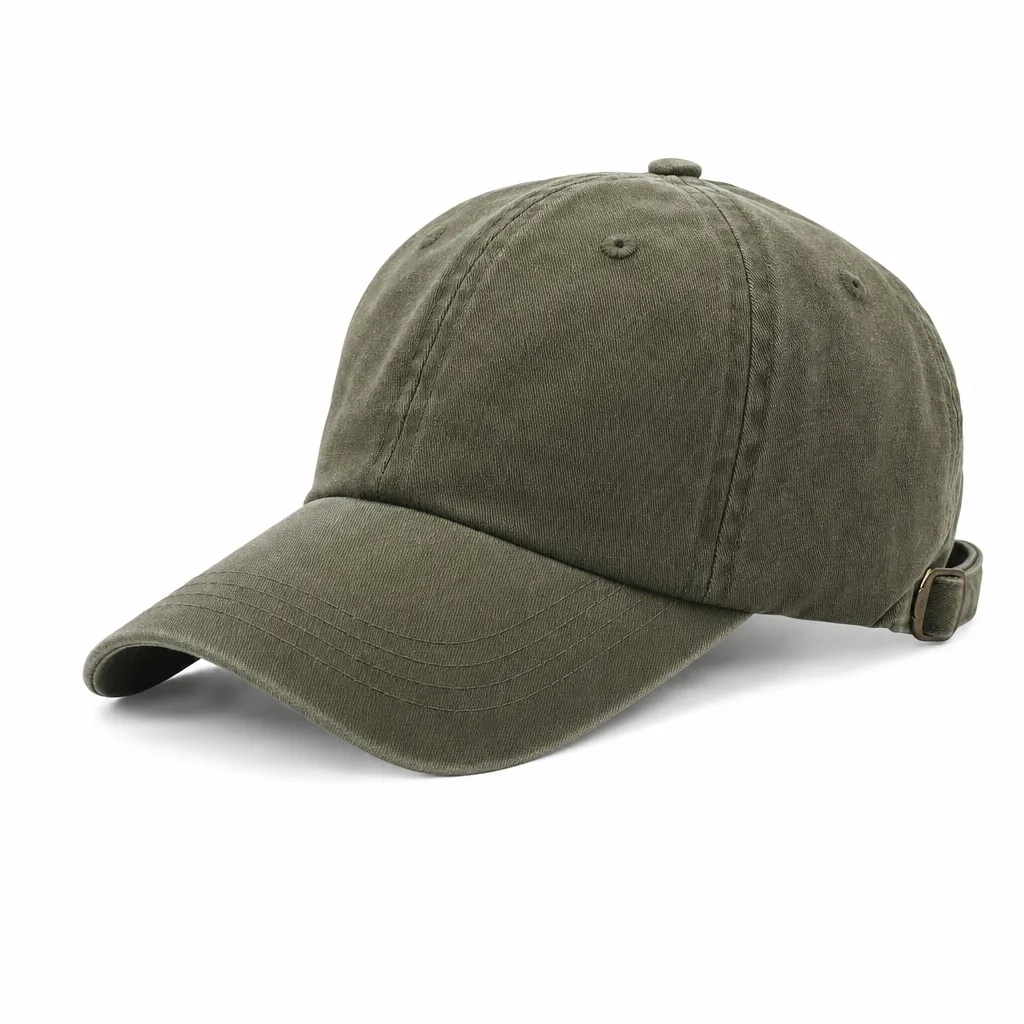
Fabric strap closures are really two systems, not one: exposed slide buckles and tuck-buckles. A metal slide buckle is the safer choice for chino twill, brushed cotton, washed canvas, and 280-320 gsm cotton duck because it absorbs small sewing variation without making the rear opening look collapsed. It normally adjusts across 55-61 cm, which is enough for corporate, resort, golf, and outdoor caps where comfort matters more than a perfectly clean rear view. A tuck-buckle looks more refined because the strap tail disappears into the sweatband tunnel, but the tunnel width has to stay within roughly 1.0-1.5 mm. Too tight, and customers fight the strap; too loose, and the rear panel wrinkles after washing. Strapbacks also give better real estate for woven flag labels, laser-etched buckles, and small flat embroidery. Avoid 3D puff near the rear opening because 2-3 mm foam lift can distort the adjustment zone. Our standard practice is 24-hour salt spray testing on plated buckles for nickel-free, low-lead, and Prop 65-sensitive orders.
Hook-and-loop and fitted caps sit at opposite ends of the risk curve. Hook-and-loop is practical for kids' caps, uniforms, fishing, medical promos, and workwear because fast adjustment matters more than retail polish. Cheap hook tape catches lint and loses grip after about 2,000-3,000 cycles; YKK or Aplix tape usually adds $0.06-$0.12 per cap but cuts AQL 2.5 failures from weak closure bite, frayed edges, and uneven stitch-down. Fitted caps remove the closure completely, giving the cleanest silhouette, but every size becomes its own inventory position, commonly 6 7/8 through 8 in 1/8 increments. For wool blend, polyester serge, or performance stretch fitted caps, finished circumference should hold within +/-0.5 cm after steam blocking and relaxation. Buyers comparing snapback vs fitted should not treat fitted as just the premium-looking option; it needs a market-specific size curve, fabric-lot shrinkage testing, and consistent crown blocking across every size run.
Plastic snap (snapback) economics
Plastic snap is usually the lowest-risk closure when the buyer wants one adult cap to cover the retail middle without buying a fitted size curve. A standard 7-hole PE or PP male/female snap set gives roughly 54–62 cm usable circumference on an adult block, but that number is not only the strip length. Crown depth, sweatband stretch, rear-arch height, and seam allowance at the back opening can move the fit by 0.5–1.0 cm; I have seen shallow rear arches make a “one size” cap feel tight even when the snaps are on the last hole. In Zhejiang, stocked black or white snap sets normally add $0.035–$0.055 per cap, including the extra bartack operation. Common stock colors such as navy, red, gray, beige, royal, and bottle green are close. Pantone-matched plastic is a separate job: expect $0.08–$0.14 per cap, 500–1,000 sets per color, and approval against a molded master chip rather than fabric alone.
The real economics are in SKU control, not the nickel of trim cost. A 300-piece order in three cap colors stays at three sellable SKUs with snapback; the same program in fitted can become 18–24 SKUs if the buyer carries 6 7/8 through 8 in eighth-size increments. In a snapback vs fitted cost sheet, that inventory simplification usually outweighs small factory-price differences, especially for streetwear drops, campus stores, brewery merchandise, trucker caps, and event programs where nobody has reliable size-level history. Fitted still earns its place for league-style baseball caps, cleaner rear silhouettes, and buyers who dislike the visible gap. But a poor size curve creates dead stock at 6 7/8 and 8 while 7 1/4 and 7 3/8 sell out first. Our standard practice at CrownsForge is to steer low-data launch orders toward snap unless the brand has proven fitted sell-through by size.
The quality risk is molding consistency, color control, and attachment, not basic closure strength. A decent snap should pass 3,000 open-close cycles without hinge whitening, hold stud engagement under normal wearing tension, and show no sharp flash along either strip edge. Color tolerance of Delta-E 1.5–2.0 against Pantone TCX, Pantone Plastic Standard, or an approved master chip is realistic; demanding Delta-E below 1.0 between plastic, cotton twill, and polyester mesh wastes approval time because the substrates reflect light differently. Before bulk release, measure circumference at first and last engaged positions, check snap pull after steam shaping or a wash test if the cap is garment-washed, and keep back-opening symmetry within 3 mm. Under AQL 2.5 final inspection, cracked tabs, loose rivet heads, wrong snap color, weak stud engagement, and sharp molding flash should be major defects. Cheap closures only stay cheap when the defect list is not vague.
Fabric strap with metal buckle (dad hat aesthetic)
Use a fabric strap with a metal slide buckle when the cap is supposed to look like a low-profile dad hat, washed resort cap, golf shop piece, or premium merch—not a team-issue uniform cap. For adult unstructured 6-panel bodies, the safest spec is an 18 mm self-fabric strap; 15 mm can look cheap on heavy cotton, while 20 mm starts crowding a small rear opening. Typical shells are 10–12 oz cotton twill, washed chino, 8-wale corduroy, 70D nylon taslan, or 220–260 gsm canvas. The strap should be folded, edge-stitched with a 2-needle operation, and bar-tacked into the back opening; a raw single-layer strap will twist, fray, and come back as a claim. On a properly graded adult pattern, the usable circumference should cover roughly 54–63 cm. In a snapback vs fitted discussion, this is the commercial middle ground: adjustable like a snapback, cleaner than a plastic seven-hole strip, and easier to inventory than fitted sizes.
Budget the closure as a real trim system, not a decorative afterthought. A decent zinc-alloy or brass-plated slide buckle usually lands around $0.10–$0.22 per cap in antique brass, matte black, gunmetal, or brushed nickel, with another $0.06–$0.10 in sewing labor versus a plastic snapback strip. The buckle is rarely the first failure point; bad strap construction is. I reject twisted straps, exposed raw edges, topstitch wandering more than 2 mm, weak bar tacks, buckle burrs, and strap tails that creep because the slider angle or spring tension is wrong. For garment-washed caps, shrink-test the strap fabric with the shell before bulk cutting. A 2–3% mismatch after enzyme wash, stone wash, or heavy silicone softener will pucker the rear arch. Approve plated hardware from a physical trim card or sealed pre-production sample; “antique brass” can shift from yellow to almost black depending on bath chemistry, tumbling time, and lacquer.
Inspection needs measurement, pull testing, and finish control, not just a quick glance at the back closure. I measure minimum and maximum circumference on a hat gauge, then pull the strap-and-buckle assembly at 2.5–3.0 kgf; it should not slip under normal wear simulation. Under AQL 2.5, common defects are crooked buckle alignment, loose slider tension, strap tail too short to tuck, mismatched plating, sharp burrs, broken bar-tack stitches, and rear opening distortion after pressing. Do not judge metal and textile color under one Delta-E rule: use Pantone TCX or lab-dip tolerance for fabric and thread, and a separate approved standard for plated trims. If the cap also has metal eyelets, a top button shell, clip label, or back buckle loop, lock all hardware to one finish. Fabric strapbacks work best with curved brims, unstructured crowns, washed panels, and tonal embroidery run on Tajima, Barudan, or ZSK heads.
Velcro (lowest cost, widest range)
Velcro is the lowest-cost closure I still approve, but only when the trim spec is locked before sampling. A 20–25 mm sew-on hook-and-loop set from Yiwu usually adds $0.025–$0.045 per cap including one straight bartack; dyed-to-match tape, rounded die-cut ends, or 30 mm width pushes it to roughly $0.06–$0.08. The real advantage is size coverage: one adult adjustable cap can normally fit 54–63 cm, which lets promo distributors, schools, resorts, and workwear buyers avoid fitted size runs like 7 1/8, 7 1/4, 7 3/8, and 7 1/2. In a snapback vs fitted comparison, Velcro wins when the buyer values easy handout, low SKU count, and fast on-site adjustment more than retail presentation. I use it mostly on kids’ caps, fishing caps, cadet caps, staff uniforms, and low-cost cotton twill promos where the end user may wear the cap hard and replace it within a season.
The weakness is perceived value and aging, not basic function. Cheap hook tape catches hair, fills with lint, curls at the corners after laundering, and looks especially bad on brushed cotton twill under about 220 gsm. Square-cut tape with fuzzy edges is an immediate inspection warning because it makes a new cap look disposable before it leaves the polybag. Our standard practice at CrownsForge is rounded-corner loop tape, 40/2 polyester thread matched to Pantone TCX or lab dip within Delta-E 1.5 where possible, and 12–14 SPI bartacks placed through the sweatband seam allowance without puckering the rear opening. I would not put Velcro on structured streetwear caps, licensed sports programs, wool-blend fitted caps, or styles with dense 3D puff embroidery from Tajima, Barudan, or ZSK machines; a cheap rear closure makes the front decoration feel downgraded.
The PO must say more than “Velcro closure.” Specify sew-on nylon or polyester hook-and-loop, width, color, rounded or square end, stitching thread, and minimum grip requirement; reject adhesive-backed tape because heat pressing, washing, and humid sea freight can soften the adhesive and cause edge lift. At pre-shipment inspection under AQL 2.5, check closure alignment within 2 mm, bartack security, edge fraying, hook contamination, rear-opening puckering, and grip after repeated cycling. For riskier orders, I ask the inspector to open and close sampled caps 50 times, condition them for 24 hours, then recheck peel hold and corner lift. For U.S. kids’ caps, require CPSIA chemical compliance; for tactical, cadet, or outdoor programs, specify matte black, coyote, or olive drab tape if shine is unacceptable. Velcro gives the widest adjustment and lowest inventory risk, but compared with snapback vs fitted closures, it is the weakest choice for resale value and long-term appearance.
Fitted: why some brands accept the operational cost
Fitted caps earn their clean rear silhouette by pushing cost into size management. A credible adult fitted range is usually 6 7/8 to 7 3/4, with size 8 added for U.S. licensed sports or big-box retail. Most smaller brands try to run only five to seven sizes, but every size still needs a separate SKU, UPC/EAN, woven size label, carton ratio, cutting ticket, and final circumference check. This is where a snapback vs fitted RFQ gets mispriced: a 300-piece MOQ per color for a snapback can turn into 1,500–2,100 pieces when the factory treats each fitted size as a sub-lot. Some suppliers will mix sizes inside one fabric dye lot, but they still need enough units per size for cutting efficiency and AQL 2.5 sampling. A PO that says “assorted sizes” without a written ratio such as 7 1/8–10%, 7 1/4–25%, 7 3/8–30%, 7 1/2–20%, 7 5/8–15% is not production-ready; it will delay barcode setup, packing, and warehouse receiving.
The sewing tolerance on fitted caps is much less forgiving than on adjustable closures. A snapback can hide 4–6 mm of variation through the plastic strap; a fitted cap exposes every stretched sweatband, loose back seam, and over-steamed crown. Our standard practice at CrownsForge is to measure finished circumference with steel tape and 3D head-form blocks, holding about ±3 mm for commercial fitted programs and ±2 mm on licensed sports work when the buyer pays for the extra inspection time. Sweatband construction changes the result: a 35 mm cotton twill band, poly-spandex moisture-wicking band, and branded jacquard band all recover differently after sewing and pressing. Shell fabric adds another variable. An 80/20 acrylic-wool serge, 280 gsm cotton twill, polyester mini-ripstop, and washed chino twill will not shrink or stretch the same after panel fusing, Tajima or Barudan embroidery, and steam blocking. Never approve a size 7 1/4 sample in acrylic-wool and assume the same block will fit correctly in washed cotton.
Brands accept fitted caps when the retail channel pays for exact sizing. MLB-style licensed caps, premium streetwear drops, golf pro shops, and club merchandise can justify the operational drag because customers read size specificity as authenticity, similar to footwear. The real cost is not just factory MOQ; it is exchange handling, size-curve forecasting, slow-moving tails, and replenishment complexity. One adult snapback can cover most heads and move between channels, while fitted inventory must match demand by region, sport, and customer profile. U.S. buyers often overbuild 7 1/4 and 7 3/8 because those sizes look “average” on a spreadsheet, then find 7 5/8 and 7 3/4 selling faster in team retail or Southern outdoor channels. My rule on any snapback vs fitted decision is simple: choose fitted only when you have POS history, a tested size curve, and enough order volume to cut proper size lots. Without that, the clean back panel becomes an expensive warehouse problem.
MOQ implications by closure type compared
The MOQ gap in snapback vs fitted programs is driven by SKU multiplication, not by sewing complexity. A snapback, nylon strapback, PU strap with metal buckle, tri-glide, or Velcro hook-and-loop cap can usually be scheduled at 100–144 pieces per style/color because one adjustable back covers most adult ranges, roughly 56–60 cm. Production stays clean: one fabric shade lot, one Tajima, Barudan, or ZSK embroidery file, one packing method, and one retail barcode. The closure supply chain is the only catch. Generic plastic snaps are often stocked in black, white, navy, red, khaki, and gray, but custom Pantone-matched snaps may require 1,000–3,000 sets per color. Metal buckles usually start at 500–1,000 sets per plating finish, and debossed genuine-leather straps commonly need 300–500 pieces. CrownsForge treats a 100-piece adjustable order as one style/color SKU; fit is controlled through crown block, rear opening width, sweatband length, buckram stiffness, and steam shaping, not through size inventory.
Fitted caps break that logic because each circumference is effectively a separate production lot. A simple five-size run — 7, 7 1/8, 7 1/4, 7 3/8, and 7 1/2, about 55.8–59.6 cm — is rarely practical at 100 pieces total. Most factories quote 100 pieces per size per design, so one colorway becomes 500 pieces before you add a second fabric or embroidery variation. Add 6 7/8 and 7 5/8 and the inventory curve gets worse. This is not padding the order; the cutting dies, sweatband lengths, inner taping, rear seam allowance, and blocking pressure all change by size. QC has to measure circumference after steaming and full cooling, usually to ±0.5 cm. If pigment washing, sublimation heat, fused buckram, or dense 3D puff embroidery shrinks a fitted cap by 0.8 cm, it is not “a snug fit.” It is the wrong size and will come back as a return, exchange, or markdown.
For a new label, adjustable versus fitted is usually a cash-flow decision before it becomes a branding decision. A 100-piece snapback or strapback test in 16s cotton twill, 80/20 acrylic-wool, 260–300 gsm polyester twill, or washed canvas may land around USD 5.80–12.00 FOB per cap, depending on stitch count, 3D puff height, side embroidery, woven labels, hangtags, individual polybags, and carton requirements. A similar fitted launch across five sizes can tie up USD 3,000–6,000 FOB before ocean freight, duty, customs brokerage, DDP delivery, and unsold size risk. Strapback hardware may add USD 0.20–0.80 versus a standard plastic snap, especially with real leather and antique brass, but it still avoids the size-by-size MOQ wall. My blunt recommendation for most streetwear startups: validate crown profile, visor curve, fabric handfeel, and artwork on adjustable caps first, then open fitted sizing only when sell-through data proves which sizes deserve inventory.
How to spec the right closure for your retail positioning
Start with the retail promise, then choose the back closure; do not copy whatever the sample room used on last season’s block. For streetwear, licensed lifestyle, and most stadium retail, a plastic snapback on a structured 5-panel or 6-panel crown gives the flat, square back profile buyers recognize and keeps the SKU count sane. One adult OSFA snapback normally fits about 56–61 cm when the cap uses a 30–35 mm sweatband and a standard mid/high crown. Basic 7-hole PP tabs are acceptable for mid-market programs, but I would not use cheap PP on cold-weather, heavy-use, or color-critical orders; it can stress-whiten at the bend and loosen after 20–30 adjustment cycles. POM or nylon tabs cost more but hold shape better and take custom color matching closer to Pantone TCX, usually within Delta-E 1.5–2.0 if the resin masterbatch is controlled. In a snapback vs fitted decision, snapback buys inventory flexibility; fitted buys authenticity but forces disciplined size planning.
A real fitted program is not one size with the back closed. It normally runs 6 7/8 through 8 in 1/8-size increments, and the buy plan must reflect actual demand, not equal quantities across the grid. Poor forecasting leaves dead cartons of 7 7/8 while 7 1/4 and 7 3/8 sell out first. Fitted caps also need size-by-size pattern grading, stable buckram, consistent crown volume, and embroidery placement checked on more than a single 7 1/4 salesman sample. After steam blocking and 24-hour conditioning, finished circumference should hold within about ±3 mm; a cap labeled 7 3/8 that measures like 7 1/4 will create returns, especially for team and collector customers. For premium on-field inspired merchandise, that risk can be justified. For broad wholesale, it often is not. CrownsForge’s standard rule is simple: use fitted only for hero SKUs with demand history, not for first-season experiments.
Promotional, campus, resort, and event caps should usually be adjustable unless the audience has been measured or the order is tied to a controlled team roster. PP snap tabs add roughly $0.08–$0.18 FOB Yiwu depending on resin grade, thickness, mold quality, and whether the color is stock black/white or custom matched. Hook-and-loop sits in a similar range and works better for children, volunteers, warehouse crews, and short-use campaigns because it adjusts continuously instead of jumping between 7 holes. I avoid metal slide buckles on mass giveaways unless the buyer specifically wants a strapback look; they slow inline inspection, may require nickel-release documentation for EU programs, and can scratch adjacent caps when factories use thin 0.025 mm polybags. For washed dad hats and softer retail assortments, however, a self-fabric strap with antique brass, matte black, or gunmetal hardware suits 260–320 gsm cotton twill, 10–12 wale corduroy, and wool-blend herringbone better than plastic. At final inspection under AQL 2.5, check tab burrs, engagement strength, stiffness, bend whitening, strap stitching, and centered alignment, not only appearance.
Frequently Asked Questions
How long does production take?
Sampling takes 7 to 12 days. Bulk production runs 20 to 30 days depending on quantity, fabric availability and decoration complexity. Inspection and packing adds another 3 to 5 days before shipment.
Do you support sustainability certifications?
Yes. We work with GOTS organic cotton, GRS-certified recycled polyester, OEKO-TEX Standard 100 fabrics, and are BSCI and Sedex audited. Certification documentation can be provided per order.
What file format should I send for my logo?
Vector files (AI, EPS, PDF) are ideal. High-resolution PNG or JPG at 300 dpi on transparent background works as a fallback. Provide Pantone color references for accurate reproduction.
What is the minimum order quantity (MOQ) for custom hats?
Our standard MOQ is 100 pieces per design and color, with sampling available from 1 piece. For complex multi-color logos or premium fabric upgrades, the MOQ can be lowered with a small per-piece surcharge.
Can I order a sample before bulk production?
Yes. We strongly recommend approving a pre-production sample before mass production. Samples are charged at 35 to 60 USD each plus express shipping, fully refundable against confirmed bulk orders over 500 pieces.
What should buyers know about cotton twill baseball cap?
When evaluating cotton twill baseball cap, the key considerations are construction quality, decoration capability, MOQ flexibility and lead time. Universal sizing 54-62cm with 8 snap positions. Single SKU per design covers most adults. Adds ~$0.05 per cap for hardware. Industry-standard for retail snapback hats, trucker caps, casual baseball caps. Available in 8 stocked colors; custom Pantone-matched snaps at 500+ pieces. Plastic snap (snapback), fabric strap with metal slide buckle, fabric strap with tuck-buckle,…
What should buyers know about flat bill hats snapback?
When evaluating flat bill hats snapback, the key considerations are construction quality, decoration capability, MOQ flexibility and lead time. Universal sizing 54-62cm with 8 snap positions. Single SKU per design covers most adults. Adds ~$0.05 per cap for hardware. Industry-standard for retail snapback hats, trucker caps, casual baseball caps. Available in 8 stocked colors; custom Pantone-matched snaps at 500+ pieces. Plastic snap (snapback), fabric strap with metal slide buckle, fabric strap with tuck-buckle,…
How does ordering custom flat bill hat embroidery work?
When evaluating custom flat bill hat embroidery, the key considerations are construction quality, decoration capability, MOQ flexibility and lead time. Universal sizing 54-62cm with 8 snap positions. Single SKU per design covers most adults. Adds ~$0.05 per cap for hardware. Industry-standard for retail snapback hats, trucker caps, casual baseball caps. Available in 8 stocked colors; custom Pantone-matched snaps at 500+ pieces. Soft fabric strap (1.5-2cm wide) with antique brass slide buckle. Fits 54-63cm. Adds ~$0.15 per…
What should buyers know about baseball hats women?
When evaluating baseball hats women, the key considerations are construction quality, decoration capability, MOQ flexibility and lead time. Universal sizing 54-62cm with 8 snap positions. Single SKU per design covers most adults. Adds ~$0.05 per cap for hardware. Industry-standard for retail snapback hats, trucker caps, casual baseball caps. Available in 8 stocked colors; custom Pantone-matched snaps at 500+ pieces. Plastic snap (snapback), fabric strap with metal slide buckle, fabric strap with tuck-buckle,…
Is a fitted hat a snapback?
Comparing Style and Fit Snapbacks have an adjustable snap closure, usually made from plastic, that you can use to adjust the size of the cap to fit your head perfectly. A fitted cap is just a hat, with no adjustable sizing. The snapback design is bolder, with a more structured high crown and a flat brim.
Do baseball players wear snapbacks or fitted?
The snaps are usually plastic even if the cap is made of wool, cotton, or other material. Popularized by New Era, the official hat supplier to the MLB, the snapback cap is de rigueur for Major League baseball players.
Are snapbacks better than fitted?
Fitted hats are a great choice if you know your size and want to build a collection of caps for casual wear, while snapback caps are ideal for streetwear fashion enthusiasts and make a bold statement. Both hats come in a range of colors and designs, so the right choice for you all comes down to your own personal style.
What does it mean if a hat is fitted?
Fitted hats are called “fitted” because they're designed to fit the wearer's head snugly without adjustable snaps or straps. That means these hats are sized specifically to the wearer's head, ensuring a natural fit. This modern-day baseball cap comes in 20 sizes to fit nearly any head shape or size.
Why do they call it a snapback?
The name “snapback” comes from the way the plastic strap snaps together to adjust the fit. Unlike fitted caps, which come in fixed sizes, snapback hats are usually designed as one size fits most, making them a popular choice for bulk orders, team hats, promotional merchandise, and custom branding.
Looking for a reliable hat manufacturer in China?
CrownsForge has produced custom hats for 800+ brands across 40 countries. From 100-piece launches to 100,000-piece retail programs, we deliver on time and on spec.
Get in touchRelated guides
Custom Leather Patch Hat Low Minimum: A 2026 B2B Sourcing Guide
Read article →
Mens Beanies: Properties, Costs and How to Spec It Right
Read article →
Bulk Trucker Hats Export Shipping Checklist for Custom Hat Buyers - Cost & MOQ Breakdown - Supplier Checklist
Read article →We hope this guide demystifies snapback vs fitted vs adjustable: cap closure systems compared - supplier checklist - supplier checklist - 2026 buyer's guide and helps you move forward with confidence. If you have questions specific to your project, our English-speaking sales engineers are one message away.