
Custom Hat Order Lead Time: From Sample to Delivery Explained - 2026 Buyer's Guide
Every week, our sales team answers detailed questions about custom hat order lead time: from sample to delivery explained - 2026 buyer's guide. We wrote this guide so that wholesalers, streetwear brands, corporate buyers and promotional resellers can compare options with full information, and avoid the traps that show up only after production has started.
The 4 phases of a hat order
The first phase is sampling, which typically takes 7 to 14 business days depending on complexity. A basic 6-panel unstructured cap with a single-color flat embroidery can be turned around in 7 days, while a structured trucker with a puffed 3D logo, mesh back, and side patches often pushes to 12–14. At CrownsForge, we run a parallel process: the digitizing team preps the embroidery file while the fabric cutter pulls greige goods from stock. We always send a pre-production photo before shipping the physical sample — this catches 90% of design issues before the needle hits the fabric. The sample lead time is the most variable part of the custom hat lead time, because it includes back-and-forth revisions. Buyers who provide a clean vector file (AI or EPS) and a Pantone TCX reference cut this phase by 3–4 days. We also recommend requesting a "strike-off" for embroidered logos — a small test stitch-out on the actual fabric — to verify thread tension and color match against a Delta-E target of ≤ 2.0.
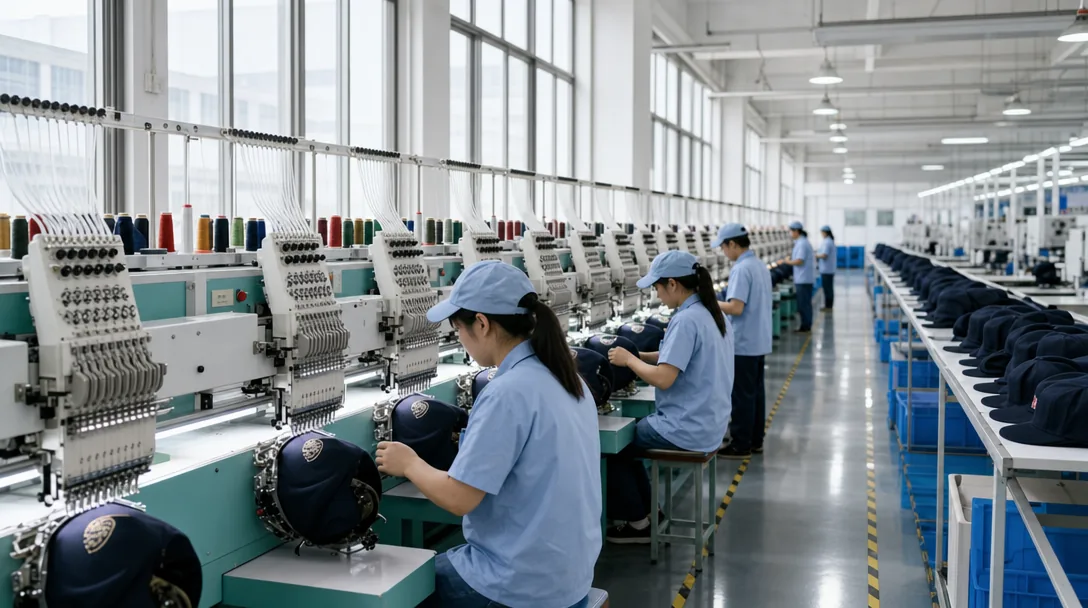
Bulk production is the longest block, running 25 to 35 business days for a standard custom trucker hat bulk order of 500–2,000 pieces. The hat production schedule depends on two bottlenecks: embroidery head availability and curing time for structured fronts. A 12-head Tajima machine can stitch about 180 caps per shift at 750 stitches per minute, but switching between thread colors adds 45 minutes per color change. Structured caps require a buckram front that is heat-pressed and left to cure for 24 hours before assembly — skipping this step causes warping under warehouse lights. For orders over 5,000 units, we split production across two shifts and stagger the fabric dye lots to ensure color consistency. The bulk cap production days also include a mandatory 48-hour "rest period" after assembly, where the finished hats hang on racks to let the visor curve settle. We do not compress this phase — rushed curing leads to returns. A realistic China hat factory lead time for bulk is 30 business days, not including weekends or Chinese national holidays, which can add 5–7 days if the order lands near Golden Week.
Inspection and packing take 3 to 5 business days. We follow AQL 2.5 for normal-level inspection — 200 pieces out of a 1,000-piece lot get pulled, and if more than 7 have a major defect (misaligned embroidery, loose seams, color deviation beyond Delta-E 3.0), the entire lot is re-sorted. The packing phase is often underestimated: each hat gets a plastic dome, a size strip, and a polybag, then is packed into export cartons with a maximum of 24 pieces per carton to avoid crushing. We use a moisture barrier liner for sea freight shipments to the US or EU. Shipping itself adds 15–35 days depending on mode: air freight (3–5 days) for urgent reorders at $4.50–$6.00/kg, sea freight LCL (25–35 days) for bulk orders at $0.30–$0.50/kg. Buyers who use DDP terms see a single landed cost, but the total custom hat lead time from sample approval to warehouse delivery is realistically 55–70 business days. The only way to shrink this is to approve the sample on the first round and choose air freight — but that triples the shipping cost.
Sampling: 7-12 days realistic
A realistic custom hat lead time for sampling starts with digitizing, not sewing. A clean vector logo usually takes 1-2 business days to convert into a production file; messy art with tiny lettering, gradient cleanup, or stitch-path edits can take 2-3 days before the first head even runs. After that, the sample still has to move through panel cutting, buckram prep, visor board selection, sweatband sizing, eyelet placement, and closure construction to the exact spec. If the first fit is wrong - deeper front crown, flatter brim, tighter rear opening, or a different six-panel block - the pattern has to be adjusted and the clock starts again. Seven to 12 days is the honest sampling window when the artwork is usable and the core materials are in stock. Claims of 3-4 days usually depend on a near-perfect file, no revisions, and no material substitutions, which is not how most real orders behave.
Embroidery sampling is only fast when the machine setup and substrate are already matched. A Tajima, Barudan, or ZSK head can all produce a clean sewout, but the result still depends on stitch density, underlay, pull compensation, and how the logo lands on a structured six-panel crown. A 100% cotton twill cap does not behave like 210D polyester, 300D polyester, acrylic-wool blend, or mesh; each fabric changes needle penetration, thread tension, and crown recovery. If the sample requires matched Pantone TCX fabric, custom seam tape, a specific visor insert, or branded sweatband, add 2-4 days for sourcing and cut-room confirmation. In custom hat lead time terms, that is normal prototype work, not a delay. Our standard practice is to keep sampling separate from bulk-line materials so the buyer approves the real hand feel, not a cheap substitute that only looks right in a photo.
Courier time is the part buyers forget when they compare factories on paper. Once the sample passes internal inspection, measurement check, labeling, and export packing, that still only covers the factory side; express transit usually adds 3-7 days depending on the route, carrier, and customs handling. For urgent approvals, photo proof should go out before shipment so the buyer can catch thread-color drift, logo shift, panel balance, visor curve, or closure errors before paying for a second express box. The right way to read custom hat lead time is simple: sampling includes digitizing, material confirmation, sewing, inspection, and freight. Bulk production does not start until the sample is signed off, and that boundary is where most schedule claims break down.
Bulk production: 20-30 days
The bulk clock starts when approved fabric is physically in the warehouse, not when the PO is signed. For a standard trucker cap run, 20-30 working days is realistic only if crown height, visor shape, closure type, mesh color, and decoration method are frozen before release. A real production schedule has four gates: material inbound, cutting, embroidery or patch setup, sewing and assembly, then finishing. If the buyer changes seam tape, top-stitch count, undervisor color, or logo placement after sampling, the custom hat lead time moves immediately because that reset can require new machine settings, different thread lots, and a fresh trim buy. On the floor, one late revision usually costs 2-5 working days before a single finished cap comes off the line. The only way to protect schedule is to lock the tech pack, sign off the sample, and release bulk with no open points.
Fabric availability is usually the first bottleneck. Stock cotton twill at 240-260 gsm moves fast; washed twill, corduroy, pigment-dyed cotton, and nylon mesh often add 3-7 days because mills do not keep every Pantone TCX shade ready on the rack. If the order needs Delta-E under 2.0 across crown, visor, and undervisor, shade approval has to happen before cutting, not after. A bad dye lot on 5,000 panels is not something you “adjust” later; it becomes scrap or a downgrade. Structured caps also need buckram, visor board, and sweatband specs matched early, because a 1 mm variance in stiffness or board thickness changes how the front panel sits once it is formed and stitched. That is why lead time slips often begin with material control, not sewing capacity.
The middle of production is where the schedule usually slips hardest. Cutting is quick; the real drag is embroidery digitizing and machine setup on Tajima, Barudan, or ZSK heads, especially when the logo needs density correction, satin underlay changes, or more than 12,000-15,000 stitches per cap. After that, sewing and finishing are more predictable, usually 8-12 working days for a 3,000-5,000 piece order if the line is not being reset for different closures, sweatbands, or tape widths. Final packing, carton marking, AQL 2.5 inspection, and export prep usually need another 2-4 days. CrownsForge treats this as a chain of controlled handoffs, because the custom hat lead time is never one fixed number; it is the sum of each approval, each material receipt, and each machine changeover.
Inspection & packing: 3-5 days
Inspection is what keeps a custom hat lead time at 3 to 5 days instead of drifting into a week or more. The checking starts on the line, not at the end: embroidery registration on Tajima, Barudan, or ZSK heads, crown seam alignment, visor stitch count, closure attachment, sweatband placement, and loose-thread trim all get looked at before the hats ever reach cartons. A proper final check also includes color control against Pantone TCX references and a Delta-E target around 1.5 to 2.0 for approved body fabrics, prints, and thread lots. On mixed-SKU trucker orders, the biggest failure is usually sorting, not sewing. One swapped snapback closure, one wrong size sticker, or one mixed patch version can contaminate an entire carton and force a resort, which is exactly how a “fast” order loses half a day or more.
AQL is the part buyers often wave off as paperwork, but it is the only sampling method that scales on a bulk run. For headwear, AQL 2.5 for major defects and 4.0 for minor defects is the normal reference point, with sample size tied to lot size under the standard inspection table. If the line is stable, the final inspection and release usually takes 0.5 to 1 day; if it turns up crooked embroidery, skipped topstitching, missing bar-tacks, oil stains, or mixed colorways, the clock stops for quarantine and rework. The practical rule is simple: once the same defect repeats across multiple cartons, keep the lot sealed and sort it at the source, because reopening pallets and rechecking every unit burns more labor than fixing the problem while the run is still fresh.
Packing is where finished caps become exportable inventory, and it is more specific than slipping hats into polybags. Typical instructions can include individual polybags, barcode or size stickers, tissue paper, silica gel, hangtags, carton labels, and 5-ply or 7-ply master cartons with PO-specific shipping marks. That is why inspection and packing usually land in a 3 to 5 day window for a clean order, assuming the sample was signed off and the production line stayed consistent. A 3,000-piece single-color run with one closure style moves faster than an 8,000-piece order split across multiple sizes, retailer packouts, and destination labels, because every added touch point creates handling time and another chance for rework. Late artwork changes, carton mark revisions, and packing list edits are what usually stretch custom hat lead time at this stage, not the sewing itself.
Sea vs air shipping timelines
Air freight is the fastest way to protect a custom hat lead time when the launch date is fixed, but the clock does not start until cartons are packed, the export declaration is cleared, and pickup is booked. For DHL, FedEx, or UPS, a clean door-to-door move from Yiwu or Shenzhen to the U.S. West Coast or major EU hubs is usually 4-7 calendar days; add 1-3 days if customs flags the commercial invoice, HTS code, or formal entry paperwork. That speed makes sense for 100-500 piece test runs, influencer drops, and replenishment orders, but the freight cost is steep: a 500-piece shipment of structured six-panel caps often lands around $1.80-$4.50 per cap by air, and molded crowns, dense polybags, or oversized master cartons can push the bill higher once volumetric weight kicks in. You are paying for elapsed time, not transport efficiency.
Sea freight is slower, but the numbers are usually easier to defend on bulk orders. LCL commonly runs 30-40 days door to door because the cargo waits for consolidation, vessel cutoff, destination devanning, and final truck delivery; FCL is typically 25-35 days door to door and tends to be less erratic because the container moves as one unit instead of sitting in a mixed-cargo pool. That gap matters less when production is the bottleneck: a factory can finish 3,000 embroidered caps in roughly 12-18 working days, so the ocean leg often decides whether the shipment lands this month or rolls into the next one. On larger orders, sea freight usually pulls logistics from about 8%-15% of product value down to low single digits, which is why it stays the default when the order is dense, the schedule has slack, and landed cost matters more than speed.
The practical split is simple: use air when the custom hat lead time is tied to a fixed event, a retail drop, or a late artwork approval that leaves no buffer; use sea when MOQ, carton count, and unit economics matter more than speed. A common hybrid is to air 100-200 urgent caps for launch photos and first-week sell-through, then move the balance by ocean. That approach keeps the market warm without paying air rates on the whole PO. The real mistake is quoting only sewing time and ignoring transit, customs, and warehouse handoff. For a buyer, the relevant number is not factory lead time alone but the full door-to-door lead time, because a 14-day production run plus a 35-day ocean move is a very different buying decision from a 14-day production run plus a 6-day air move.
How to compress lead time in a rush
The fastest way to compress custom hat lead time is to stop treating the order as one queue. Fabric booking, trim approval, digitizing, sampling, and bulk sewing can run in parallel only if the buyer sends final artwork, Pantone TCX references, panel count, closure spec, and stitch construction on day one. The real delay is usually not needle time; it is a missing vector, a color correction, or a dye-lot mismatch. For rush work, the practical starting point is warehouse stock: 250-280 gsm cotton twill for structured six-panels, 1000D polyester for a stiffer front, or an acrylic-wool blend for winter caps. If the material is already in hand, a 5-7 day sample cycle is realistic for a 3D puff embroidery cap, and bulk can start the moment sample approval is locked. Buyers who approve thread cards, visor shape, sweatband type, and closure in one pass cut at least one revision loop, which matters more than any promise about machine speed.
Parallel processing is what actually shortens custom hat lead time. A normal China factory schedule drags because sample digitizing waits for artwork, bulk cutting waits for sample sign-off, and packing waits for final inspection. In a rush file, those steps should overlap: once the logo is stable, the embroidery program goes to Tajima, Barudan, or ZSK heads while cutting tables are already nesting panels and QC is checking label placement, stitch density, seam allowance, and Delta-E against the approved standard. The cleanest way to protect the schedule is to put one style in its own production lane so unrelated jobs do not steal setup time. That usually adds 10-20 percent to factory pricing, but it is cheaper than missing a retail drop, sports launch, or trade-show deadline because the order sat behind routine production.
Air freight is the last-mile fix when the calendar is tight, but it only works if the shipping plan is set before bulk cutting starts. Split the shipment so the first 20-40 percent of finished cartons moves by air, then send the balance by ocean or rail once production clears. On a 2,000-piece order, that can save 5-8 days versus waiting for full-container departure, especially when the factory finishes in waves and the forwarder can pre-book space. The paperwork has to be tight: carton dimensions, HTS code, consignee details, carton marks, and DDP or FOB handoff terms should be confirmed early, because one customs error can erase every day saved in production. In practice, the fastest custom hat lead time comes from tight inputs, pre-booked fabric, one approved sample, and a buyer who accepts that speed is bought with fewer changes and a higher unit rate, not with wishful scheduling.
Frequently Asked Questions
How long does production take?
Sampling takes 7 to 12 days. Bulk production runs 20 to 30 days depending on quantity, fabric availability and decoration complexity. Inspection and packing adds another 3 to 5 days before shipment.
Do you support sustainability certifications?
Yes. We work with GOTS organic cotton, GRS-certified recycled polyester, OEKO-TEX Standard 100 fabrics, and are BSCI and Sedex audited. Certification documentation can be provided per order.
What file format should I send for my logo?
Vector files (AI, EPS, PDF) are ideal. High-resolution PNG or JPG at 300 dpi on transparent background works as a fallback. Provide Pantone color references for accurate reproduction.
What is the minimum order quantity (MOQ) for custom hats?
Our standard MOQ is 100 pieces per design and color, with sampling available from 1 piece. For complex multi-color logos or premium fabric upgrades, the MOQ can be lowered with a small per-piece surcharge.
Can I order a sample before bulk production?
Yes. We strongly recommend approving a pre-production sample before mass production. Samples are charged at 35 to 60 USD each plus express shipping, fully refundable against confirmed bulk orders over 500 pieces.
How does ordering baseball cap custom embroidery work?
When evaluating baseball cap custom embroidery, the key considerations are construction quality, decoration capability, MOQ flexibility and lead time. Fabric procurement, panel cutting, embroidery, sewing, finishing. Sampling, bulk production, inspection & packing, shipping.
How does ordering custom embroidered baseball hats work?
When evaluating custom embroidered baseball hats, the key considerations are construction quality, decoration capability, MOQ flexibility and lead time. Sampling, bulk production, inspection & packing, shipping. Digitizing, fabric prep, hand-sewing the sample, courier shipping to client.
How does ordering custom embroidered trucker hat work?
When evaluating custom embroidered trucker hat, the key considerations are construction quality, decoration capability, MOQ flexibility and lead time. Sampling, bulk production, inspection & packing, shipping. Digitizing, fabric prep, hand-sewing the sample, courier shipping to client.
What should I know about bulk custom trucker hats?
When evaluating bulk custom trucker hats, the key considerations are construction quality, decoration capability, MOQ flexibility and lead time. Sampling, bulk production, inspection & packing, shipping. Digitizing, fabric prep, hand-sewing the sample, courier shipping to client.
What is the turnaround time for custom hats?
Most custom embroidered hats take about 7–21 business days from ordering to delivery.
How long does it take to get hats from custom lids?
On average, your order should be completed and shipped within 10 to 15 business days from the time you approve your design proof. We strive to ensure a timely delivery so you can enjoy your purchase without any unnecessary delays. #FAQ #CustomLids #Lids #HatDrop #Manufacturing #BTS #CustomMade #PersonalStyle #Design.
How long does it take to make an embroidered hat?
While simple designs with minimal stitch count can be completed in as little as 14-21 minutes, more detailed logos can take over 31 minutes. By considering these factors and utilizing efficient embroidery methods, the overall time spent on embroidering hats can be reduced.
Is a custom hat business profitable?
Custom hats are a great business idea! You can make a good profit, especially when you offer unique and high-quality designs. Custom hats can have profit margins as high as 50% to 70%, depending on your pricing and production costs.
Looking for a reliable hat manufacturer in China?
CrownsForge has produced custom hats for 800+ brands across 40 countries. From 100-piece launches to 100,000-piece retail programs, we deliver on time and on spec.
Get in touchRelated guides
Custom Leather Patch Hat Low Minimum: A 2026 B2B Sourcing Guide
Read article →
Mens Beanies: Properties, Costs and How to Spec It Right
Read article →Bulk Trucker Hats Export Shipping Checklist for Custom Hat Buyers - Cost & MOQ Breakdown - Supplier Checklist
Read article →We hope this guide demystifies custom hat order lead time: from sample to delivery explained - 2026 buyer's guide and helps you move forward with confidence. If you have questions specific to your project, our English-speaking sales engineers are one message away.