
Custom Flat Brim Snapback Bulk: A 2026 B2B Sourcing Guide - 2026 Buyer's Guide
Every week, our sales team answers detailed questions about custom flat brim snapback bulk: a 2026 b2b sourcing guide - 2026 buyer's guide. We wrote this guide so that wholesalers, streetwear brands, corporate buyers and promotional resellers can compare options with full information, and avoid the traps that show up only after production has started.
Custom Sun Visor Cap Bulk
Sun visors go wrong in bulk when the buyer treats them like a cap with the crown removed. The fit geometry is different: the pressure point sits on the forehead band, not the crown, so brim substrate, band height, and closure tension matter more than panel shape. For custom sun visor cap bulk, I would freeze five specs before sampling: brim length, brim curve radius, front band height, sweatband fiber content and gsm, and closure type. Most factories build a firmer sports visor on 1.8-2.5 mm PE board, while softer golf or resort styles often use EVA for more flex. Shell fabrics usually sit in the 210-260 gsm range for cotton twill, brushed microfiber, or 85/15 poly-spandex performance knit. If one of those inputs is left vague, the PP sample and bulk production will drift, especially on wearable balance and forehead fit. Decoration has tighter limits on visors than many buyers expect. Flat embroidery on Tajima, Barudan, or ZSK heads is stable on medium-weight twill, but dense fills over about 10,000-12,000 stitches can cause tunneling on lightweight polyester and visibly pull the front band out of shape. For retail programs that sit alongside a custom flat brim snapback bulk order, color control needs to be locked at the collection level, not style by style. Use Pantone TCX references for textile matching, require bulk fabric lots within Delta-E 1.5 under D65 lighting, and confirm sweatband, shell, and closure tape shades separately. Shade split on a visor band is far more obvious at shelf level than many procurement teams assume because the product has almost no crown volume to hide mismatch.
MOQ and FOB cost are driven more by trim complexity and decoration setup than by the visor silhouette itself. A stock brushed-twill visor with hook-and-loop closure usually starts at 144-300 pieces per color; once you move into sublimated polyester, molded sandwich brims, woven label wraps, or branded metal buckle closures, the practical MOQ usually shifts to 300-500 pieces because of transfer setup, trim sourcing, and short-run wastage. In Yiwu or Dongguan, a basic promo visor normally lands around FOB China $1.45-$2.20 at 500 pieces. A better golf or tennis visor with moisture-management sweatband, microfiber shell, undervisor contrast, and raised embroidery is more realistically $2.60-$4.10. If the buyer wants retail packing, barcode stickers, and inner-carton ratio sorting, add another $0.18-$0.40 per piece. The main bulk risk is symmetry, not stitch count. I would inspect custom sun visor cap bulk at AQL 2.5, with specific checkpoints for left-right brim balance, brim length tolerance within +/-3 mm, closure pull strength, sweatband puckering, and fabric shading under D65 light box conditions. Dark sweatbands should be tested for crocking, especially if the fabric is reactive dyed cotton, and microfiber shells need close checking for needle cuts and edge rippling after binding. Our standard practice is to hold bulk release until the counter sample is approved against the signed spec sheet, because visor fit complaints are expensive to unwind after sewing starts, and they become even harder to contain when the same shipment also includes matching custom flat brim snapback bulk styles.
Custom Dad Hat Low Minimum
Low-MOQ dad hats should be quoted as a separate construction program, not as a downsized version of custom flat brim snapback bulk. Your RFQ needs build data that actually affects yield and sewing balance: 6-panel unstructured crown, front crown height at 15-16 cm, visor length around 7 cm, pre-curve angle, self visor or sandwich visor, closure type, eyelet finish, sweatband material, and exact decoration position measured from center front seam and visor edge. Fabric specs also need to be tight. Ask for fiber content, weave, and weight, such as 100% cotton twill 108 x 56 at 260-280 gsm, washed chino twill at 230-250 gsm, or brushed canvas around 240 gsm, then lock shell and thread colors to Pantone TCX references. If the factory offers garment wash or pigment wash, require a lab dip or previous bulk swatch because shade swing after wash is where small runs go wrong fastest.
Embroidery is usually the technical failure point on low-minimum dad hats because soft front panels behave nothing like structured snapbacks. A file digitized for a buckram-backed crown often puckers, tunnels, or collapses when run on an unstructured panel unless the shop rebuilds the underlay, density, and pull compensation for that softer face. Ask what machines they run—Tajima, Barudan, or ZSK heads are all fine if the operator knows how to reduce panel distortion—and whether they use backing changes by logo size rather than one standard recipe. In Yiwu, a realistic MOQ is 48-144 pieces per colorway with stock fabric and standard buckle or tuck strap. FOB on a washed cotton dad hat with flat embroidery is commonly $2.20-$3.60 at 144 pieces; add leather straps, felt applique, metal badges, or heavy wash and the number moves to roughly $4.20-$5.80. Below 48 pieces, you usually pay in fewer fabric options, trim wastage, and weaker shade consistency.
Inspection standards on small dad hat runs should be stricter than most buyers assume, because low volume does not excuse poor shape control. The defects that matter are brim asymmetry, twisted back straps, off-center top buttons, uneven crown washing, embroidery skew, and seam grin around the sweatband join. Set AQL 2.5, head circumference tolerance at +/-0.5 cm, visor alignment tolerance, and require crocking checks on washed dark colors plus shade-band review under D65 lighting. If the supplier cannot talk about Delta-E control, wash lot segregation, or how they check closure riveting and buckle plating, they are probably assembling samples well and bulk poorly. That matters even if your current need is a 72-piece dad hat order. A factory that cannot keep a small unstructured run consistent usually struggles later when your custom flat brim snapback bulk program moves to 1,000 pieces and crown profile, visor stiffness, and color repeatability become contractual rather than cosmetic.
Custom Bucket Hat Small Batch
Small-batch bucket hats look straightforward, but they expose pattern and sewing discipline faster than a standard six-panel cap. The weak points are not the crown pieces; they are circular seam feeding, brim symmetry, and edge control after fusing. For a stable shape, I would spec 240-280 gsm cotton twill, brushed twill, or washed canvas with medium-weight woven fusible interlining. Once you drop into 180-220 gsm fabric, the handfeel gets softer, but brim waviness, seam grin, and edge rippling become much more visible, especially after washing or packing compression. If you are developing a custom bucket hat small batch alongside custom flat brim snapback bulk, align both programs to the same Pantone TCX standard and approve color under D65 light, because black, olive, khaki, and stone can shift noticeably between mills and dye lots. At 100 pieces, the real approval points are fabric handfeel, brim stiffness, SPI, embroidery strike-off, and a pre-production sample signed against a sealed trim card before bulk cutting starts.
The spec sheet drives the outcome more than MOQ. Lock top diameter, crown height, brim width, brim angle, eyelet type, sweatband material, seam tape width, label positions, and stitch density before the first marker is made; otherwise the factory will “balance” the shape during sewing and every size point drifts. Embroidery also needs its own setup. Artwork digitized for a flat snapback front on Tajima or Barudan heads rarely runs clean on a bucket hat side wall without resizing, pull compensation, and converting 3D puff into flat satin or tatami fills. In China, 100-150 pieces per colorway is a realistic MOQ for custom fabric and trims; 48-72 pieces only works if you stay with stock shell fabric, stock sweatbands, and limited branding changes. FOB pricing for a basic 240 gsm cotton twill bucket hat is usually $3.20-$5.80 at 100 pieces, while garment wash, woven patch application, contrast piping, or all-over print can move it to $6.50-$8.50. QC should be inline plus final at AQL 2.5, with special attention to brim width tolerance within ±3 mm, crown-to-band puckering, skipped topstitch rows, off-center embroidery, and shade variation controlled to an agreed Delta-E standard if the shipment sits with custom flat brim snapback bulk.
Custom Fitted Cap No Minimum
A fitted cap is a grading job, not just a snapback with the closure removed. Once you replace a plastic snap with fixed sizes—usually 6 7/8 to 7 5/8, roughly 55 to 61 cm—you add size-graded crown patterns, size-specific sweatbands, separate cutting markers, and tighter blocking control at visor joining. The sewing operations are standard enough: single-needle crown assembly, post-bed eyelet stitching, sweatband setting, and brim pressing with PE board or EVA insert. What changes is tolerance sensitivity. On fitted styles, a 2 to 3 mm miss between crown circumference and sweatband length is enough to create fit complaints, front-panel torque, or a visor that sits visibly off-center after packing. That is why factories that run efficiently on custom flat brim snapback bulk usually schedule fitted caps as a separate production lane, with their own grading, bundling, and in-line measuring checkpoints.
When a buyer asks for a custom fitted cap with no minimum, the realistic answer is usually sample-room pricing, not production pricing. Even one cap still requires pattern grading, size labels, logo placement checks by size, and separate bundles with no cutting efficiency. In practice, workable MOQ is normally 144 to 300 pieces across 4 to 6 sizes, with at least 24 to 48 pieces per size to keep sewing, finishing, and carton assortment stable. Below that threshold, cost escalates fast: a development fitted cap in 260 gsm cotton twill or 80/20 acrylic-wool at 285 gsm can land at $25 to $60 per piece before DHL or FedEx freight, while a balanced bulk order is more often $4.80 to $7.20 FOB China. The spec sheet also has to be tighter than for adjustable headwear: fabric build, buckram stiffness, sweatband composition, visor curve, seam taping, Pantone TCX callout, and acceptable shade tolerance—typically Delta-E 1.5 to 2.0—should all be locked before sampling. For inspection, AQL 2.5 is fine for appearance defects, but fitted caps also need circumference checks at every size break; otherwise you miss the defects that actually trigger returns.
Foam Front Trucker Hat Custom
A foam-front trucker is not a cheap substitute for a structured twill snapback; it is a different construction with its own failure points. The front panel usually pairs 3-5 mm EVA or PU foam with polyester tricot, then adds a non-woven fusible to keep the crown from collapsing after embroidery and packing. Side and back panels are typically polyester mesh in the 75D-150D range, with either a high-profile A-frame or standard 5-panel block, a PE visor board, PVC snap closure, and sweatband in cotton twill or polyester terry. If you want to fold this style into a custom flat brim snapback bulk program, lock the build before sampling starts: crown height in millimeters, flat-brim dimensions, visor board thickness, foam tolerance of +/-0.3 mm, mesh aperture, and whether the front panel is center-seam or seamless. Buyers who leave those points vague usually get the same predictable defects—crushed crowns, twisted visors, and inconsistent front-panel stiffness between cartons.
Decoration is where most foam trucker projects go wrong. Foam does not tolerate oversized fills or aggressive tension the way chino twill does, so embroidery has to be digitized around the material, not forced onto it. A practical logo height is usually 55-60 mm; push toward 65 mm with dense tatami fill and you start seeing tunneling, panel waviness, and crown distortion. Ask for a digitizing sheet that shows stitch count, underlay type, backing spec, and target run speed on Tajima, Barudan, or ZSK heads; needle size, hoop pressure, and tension settings matter more than brand name alone. Heat-applied patches need the same discipline: once platen temperature climbs above about 145-150 C, or dwell time runs too long, the foam can dimple permanently. For bulk buying, expect workable MOQs around 144-300 pcs per colorway, with FOB China pricing around $2.10-$3.80 for basic embroidery and closer to $4.20-$6.50 when you add rope trims, woven patches, premium mesh, or printed seam tape.
Inspection needs to be tighter than many importers assume because foam truckers show defects immediately. Set final inspection at AQL 2.5, then add item-specific checks for panel symmetry, visor alignment, snap engagement, top-button centering, logo placement within 3 mm, and needle cuts or drag marks on the foam face. Color should be controlled by Pantone TCX or coated references for each visible component, with a Delta-E target under 1.5 on shell materials, while visor length and width should stay within +/-2 mm. The failures that kill sell-through are rarely subtle: puckering at the lower crown seam, rebound loss in the foam after compression, and ripples above the embroidery window usually come from over-hooping, poor carton loading, or warehouse stacking pressure rather than random sewing error. If your core business is custom flat brim snapback bulk, foam-front truckers make sense as a summer or promo companion SKU, but only when the factory manages crown architecture, decoration tension, and packing compression as tightly as it manages stitch quality.
Blank Flat Bill Snapback Wholesale
The shell decides whether a blank snapback is usable; decoration only exposes weak construction faster. For dependable custom flat brim snapback bulk, lock the spec before sampling: 6-panel high-profile crown, buckram-backed front panels, 3.0-3.5 mm PE visor board, 8-row visor stitching, 58-60 cm finished circumference, and a PP or HDPE snap with clean tooth engagement and no mold-line flash. Fabric should be written by composition and weight, not vague terms like premium twill. A standard streetwear blank usually lands best in 80/20 acrylic-wool at 360-400 gsm because it holds crown memory after blocking; 100% cotton twill at 250-280 gsm feels softer but loses shape sooner in humid retail storage. Also confirm sweatband material, seam tape width, crown height, top button diameter, and whether the block is true high-profile or only a raised mid-profile, because that changes both front embroidery height and how the cap sits on head.
Repeatability is where most suppliers get exposed. If you expect the same navy or off-black across reorders, lock Pantone TCX references, approve lab dips, and set a Delta-E tolerance of 1.5-2.0 under D65 lighting; anything looser will show when cartons from different dye lots hit the same shelf. MOQ and cost also shift quickly once you move past stock materials. In China, blank flat bill snapback wholesale is commonly 144-300 pcs per color with stock fabric and trims, while exclusive shell patterns, custom visor molds, or non-stock shades usually start at 500-1,000 pcs. A realistic FOB China range at 300-500 pcs is about $1.85-$2.90 for cotton twill and $2.10-$3.40 for acrylic-wool; melton blends, suede visors, woven interior taping, branded snaps, or custom labels can push the shell above $4.00 before decoration.
The real failure point is bulk inspection, not the salesman’s pre-production sample. On a flat bill program, the common defects are visor twist, asymmetrical crown height, center-front seam drift, uneven topstitch SPI, cracked snaps after cold transit, and front-panel bubbling after embroidery backing is removed on Tajima or Barudan runs. AQL 2.5 works for most wholesale orders, but licensed retail programs should tighten visual checkpoints around brim angle, crown symmetry, and level seating on a cap block. Buyers should also confirm whether the quoted price includes carton ratio, size stickers, barcode labels, desiccant, polybag spec, and transit replacement allowance; those small lines add $0.08-$0.30 per cap and distort margin planning if they surface late. If a supplier cannot hold blank consistency, every downstream step—3D puff embroidery, patch placement, heat transfer, and private-label finishing—gets slower and more expensive than the FOB quote suggested.
Working with CrownsForge for custom flat brim snapback bulk programs
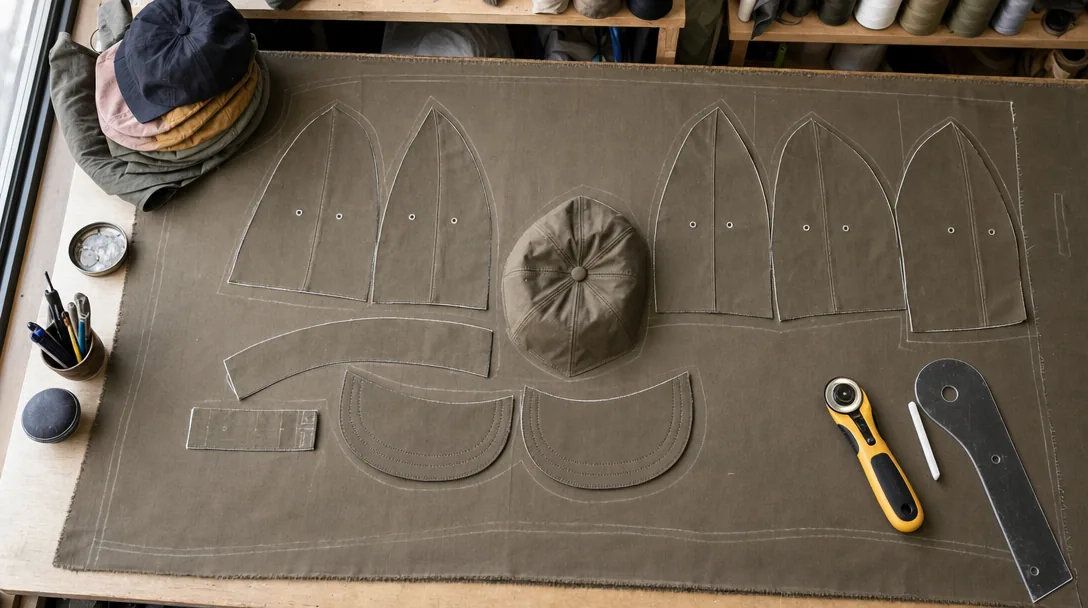
The fastest way to de-risk a custom flat brim snapback bulk program is to lock the build sheet before digitizing starts. On a structured 6-panel cap, the expensive mistakes are almost always in pattern and materials, not logo art: crown height at 11 to 12 cm, visor board thickness at 2.8 to 3.2 mm, front-panel buckram stiffness, and snap closure gauge all affect fit and sell-through more than a late thread-color tweak. A realistic calendar is 3 to 5 working days for tech pack review and digital mockup, 7 to 10 days for a blank fit sample, then 10 to 14 days for a PPS with embroidery, labels, sweatband print, and packaging. Once fabric is cut, changing front-panel proportion or brim shape means re-cutting, re-sewing, and often scrapping decorated goods; changing a Madeira or Gunold thread code is trivial by comparison. MOQ needs to be discussed against fabric and trim reality, not wishful target pricing. For acrylic-wool or 80/20 wool-blend stock programs, 144 pieces per colorway is common if the shell fabric and plastic snap are available in-house. Move into custom-dyed cotton twill, 21W corduroy, brushed canvas, or 600D polyester, and the workable booking usually rises to 300 to 500 pieces per color because dye lots, custom woven labels, printed seam tape, and visor-sandwich trims all carry minimums. In China today, a clean FOB price for a basic structured snapback with flat embroidery typically lands around $2.60 to $4.20 depending on fabric, stitch count, and closure, while specialty fabrics, 3D puff, and custom inside branding can push the cap well above $5.00 before freight and duty.
Decoration control is where weak suppliers get exposed. If the factory runs Tajima, Barudan, or ZSK heads in-house, it can actually manage stitch density, underlay, pull compensation, cap-frame tension, and foam behavior instead of blaming a subcontractor when logos distort. On flat brim snapbacks, 3D puff works best on firm buckram-backed front panels using roughly 0.5 to 0.8 mm EVA foam with column widths wide enough to hold a clean satin edge after steaming. Too little foam and the puff collapses; too much foam on narrow lettering creates ragged borders and frequent thread breaks. For applique, chain stitch, or woven patches, you also need to confirm seam allowance clearance at the front-center join, because that seam is where misalignment shows first. Color and compliance should be agreed before bulk, not argued over after cartons are sealed. Fabric lab dips should be approved to Pantone TCX or coated references with a defined Delta-E tolerance; in practice, under 1.5 for dyed shell fabric and under 2.0 for embroidery thread is a workable standard. Our standard control flow at CrownsForge is BOM confirmation, trim sign-off, PPS approval, in-line inspection, final inspection at AQL 2.5, carton drop testing, and document review before shipment ex Ningbo or Shanghai. Buyers running licensed, retail, or promotional programs should also ask for sedex-audit-cap-supplier-guide.html">BSCI 2.0 or Sedex SMETA 4-Pillar audit reports, needle-control records, azo and REACH screening where relevant, and confirmation that PVC, metal trims, inks, and sweatband materials meet the destination market's restricted-substance requirements.
Frequently Asked Questions
What is the minimum order quantity (MOQ) for custom hats?
Our standard MOQ is 100 pieces per design and color, with sampling available from 1 piece. For complex multi-color logos or premium fabric upgrades, the MOQ can be lowered with a small per-piece surcharge.
Which shipping methods do you support?
We support FOB, CIF and DDP shipping. Air express for samples and small orders, sea LCL for 100 to 500 pieces, sea FCL for 5,000+ pieces. Door-to-door DDP available for US, EU, UK, Canada and Australia.
Do you support sustainability certifications?
Yes. We work with GOTS organic cotton, GRS-certified recycled polyester, OEKO-TEX Standard 100 fabrics, and are BSCI and Sedex audited. Certification documentation can be provided per order.
Can I order a sample before bulk production?
Yes. We strongly recommend approving a pre-production sample before mass production. Samples are charged at 35 to 60 USD each plus express shipping, fully refundable against confirmed bulk orders over 500 pieces.
What file format should I send for my logo?
Vector files (AI, EPS, PDF) are ideal. High-resolution PNG or JPG at 300 dpi on transparent background works as a fallback. Provide Pantone color references for accurate reproduction.
What's the MOQ for custom leather patch hat low minimum?
When evaluating custom leather patch hat low minimum, the key considerations are construction quality, decoration capability, MOQ flexibility and lead time. Cover everything buyers ask about custom dad hat low minimum: how it's manufactured, what specs to request from a factory, typical MOQ and pricing, common quality issues to inspect for, and how this ties back to the broader custom flat brim snapback bulk sourcing decision. Cover everything buyers ask about custom bucket hat small batch: how it's manufactured, what specs to…
What should I know about custom rope hat wholesale bulk?
When evaluating custom rope hat wholesale bulk, the key considerations are construction quality, decoration capability, MOQ flexibility and lead time. Cover everything buyers ask about custom dad hat low minimum: how it's manufactured, what specs to request from a factory, typical MOQ and pricing, common quality issues to inspect for, and how this ties back to the broader custom flat brim snapback bulk sourcing decision. Cover everything buyers ask about custom bucket hat small batch: how it's manufactured, what specs to…
What should I know about custom corduroy dad hat bulk?
When evaluating custom corduroy dad hat bulk, the key considerations are construction quality, decoration capability, MOQ flexibility and lead time. Cover everything buyers ask about custom dad hat low minimum: how it's manufactured, what specs to request from a factory, typical MOQ and pricing, common quality issues to inspect for, and how this ties back to the broader custom flat brim snapback bulk sourcing decision. Cover everything buyers ask about custom bucket hat small batch: how it's manufactured, what specs to…
How does ordering custom flat brim hat work?
When evaluating custom flat brim hat, the key considerations are construction quality, decoration capability, MOQ flexibility and lead time. Cover everything buyers ask about custom dad hat low minimum: how it's manufactured, what specs to request from a factory, typical MOQ and pricing, common quality issues to inspect for, and how this ties back to the broader custom flat brim snapback bulk sourcing decision. Cover everything buyers ask about custom bucket hat small batch: how it's manufactured, what specs to…
Need a low-MOQ test order?
We help emerging brands launch with as few as 100 pieces. Premium fabric, in-house embroidery, retail-ready packaging.
Start a small orderRelated guides
Camouflage Bucket Hat: Properties, Costs and How to Spec It Right (2026 Update)
Read article →
Refreshing a Hat Collection: A Repeat-Order Playbook for Established Brands
Read article →
Embroidery Hats Machine: When to Use It, Costs, and What to Ask Your Factory - Cost & MOQ Breakdown
Read article →We hope this guide demystifies custom flat brim snapback bulk: a 2026 b2b sourcing guide - 2026 buyer's guide and helps you move forward with confidence. If you have questions specific to your project, our English-speaking sales engineers are one message away.