
What's in a Cap Tech-Pack: A Specification Template for Buyers - Cost & MOQ Breakdown - Cost & MOQ Breakdown
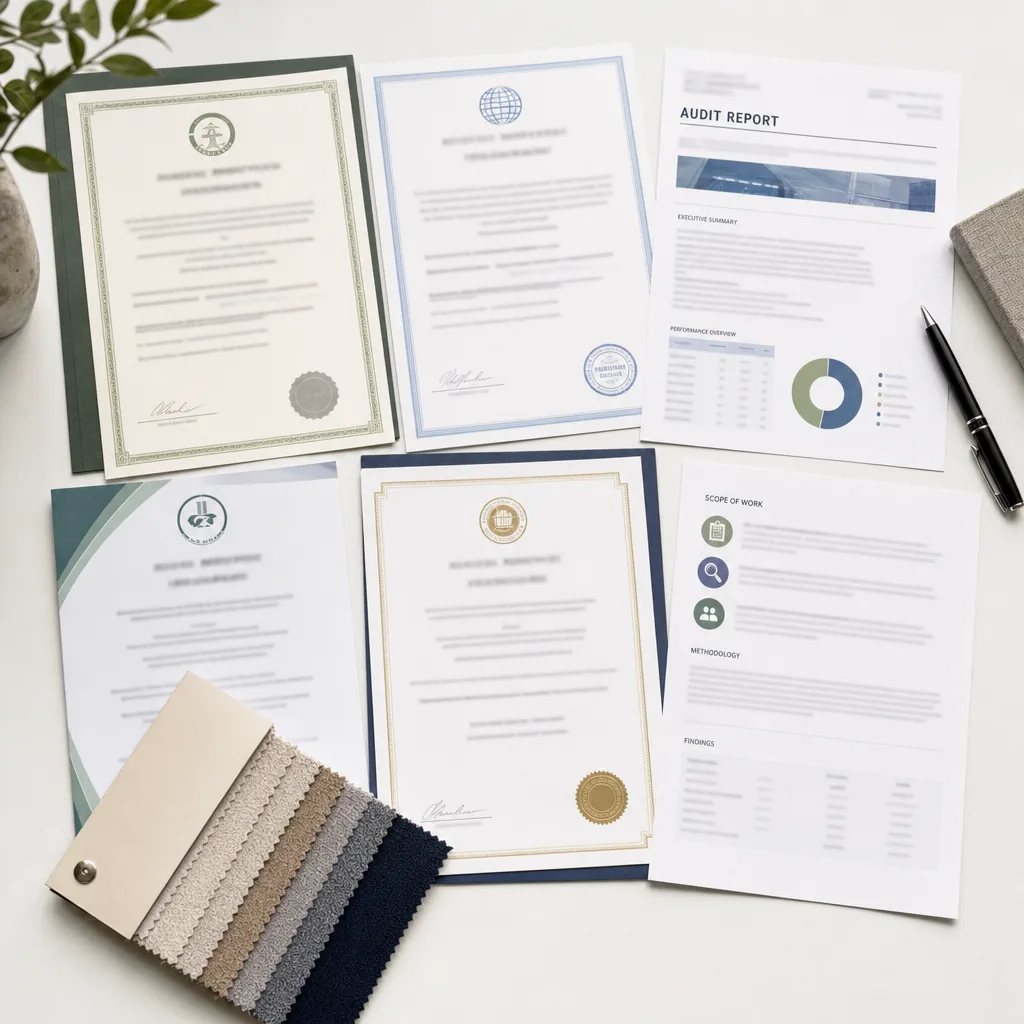
Every week, our sales team answers detailed questions about what's in a cap tech-pack: a specification template for buyers - cost & moq breakdown - cost & moq breakdown. We wrote this guide so that wholesalers, streetwear brands, corporate buyers and promotional resellers can compare options with full information, and avoid the traps that show up only after production has started.
Why a tech-pack saves you weeks of email back-and-forth
The fastest way to lose 10 to 14 days on a cap program is to send only an Illustrator logo and a few reference photos. The sample room will fill the gaps with whatever standard block and trims are already running: a 6-panel baseball shape instead of a 5-panel camper, hard front with 0.8 mm PE buckram instead of soft-structured, 3 mm sandwich bill instead of 5 mm, hook-and-loop instead of an 18 mm antique brass buckle, or a stock pre-curve visor pulled from the wrong mold. A good cap tech pack template prevents that kind of silent substitution before the first panel is cut. It gives pattern making, marker planning, embroidery digitizing, trim purchasing, and QC one controlled spec instead of six separate email chains with conflicting answers. On the factory floor, that usually cuts first-sample lead time from roughly 12-14 calendar days to 6-8 because the technician is not stopping every shift to ask about crown depth, eyelet finish, seam tape artwork, underbill color, or whether the visor board should be 1.8 mm recycled PE or 2.2 mm virgin PE.
Most sample revisions come from missing tolerances and undefined construction, not bad sewing. If the pack states crown height 9.0 cm +/- 0.3 cm, visor length 7.0 cm +/- 0.2 cm, sweatband 32 x 4 cm in 180 gsm cotton twill, and thread color matched to Pantone 19-4052 TCX within Delta-E 1.5 under D65 lighting, the sample room can execute without guesswork. Embroidery needs the same discipline: front logo 58 mm wide centered on the seam, side hit 35 mm above visor seam, 3D puff digitized for brushed cotton twill on Tajima or Barudan heads, with underlay and density adjusted so the fill does not sink into the nap. A usable cap tech pack template should also freeze post-sew details that often cause rework and price drift: polybag size, silica gel requirement, carton packout, barcode placement, and inspection standard such as AQL 2.5. When those points are locked early, revision rounds usually drop from three or four to one, and the quote stays tied to a real BOM instead of padded assumptions.
The other thing buyers underestimate is how quickly vague specs distort cost and MOQ. Fabric alone can move FOB by US$0.45 to US$1.20 per cap before trims: 260 gsm cotton chino, 75D polyester microfiber, 16-wale corduroy, and 80/20 acrylic-wool melton cut differently, shrink differently, and behave very differently under embroidery. Then the trim minimums start to bite. Molded PVC patches commonly require 500 pieces per design, custom metal buckles 300-500 pieces, woven labels 1,000 pieces, and printed seam tape enough yardage for about 500-1,000 caps depending on width and repeat. If those items are not specified in the pack, the factory has no choice but to quote protective assumptions. Our standard practice is to cost from actual consumption—visor board thickness, closure construction, stitch type, needle count, label method, and packaging—because a JPEG cannot tell purchasing what to source or QC what to inspect. That is the practical value of a cap tech pack template: fewer clarification emails, fewer surprise surcharges after sampling, and a first prototype that is close enough to approve.
The seven sections of a complete cap tech-pack
A cap tech pack template fails the minute it stops at a pretty front-view mockup. A factory needs seven sections locked down before quoting or sampling: technical sketch, measurements, materials and color, decoration, construction, trims and labels, and packing. The sketch should show front, both sides, back, top view, underbill, and interior, with seam lines, panel breaks, eyelets, visor curve, button position, and closure type called out. For a standard 6-panel baseball cap, don’t write “adult size”; give a base head circumference of 58 cm, finished tolerance of +/-0.5 cm, crown height 16.8-17.2 cm, brim length 7.0 cm, brim width 18.0 cm, rear opening width, sweatband finished height, and top button diameter. Most fit disputes come from missing dimensions, not bad sewing. Materials and color are where consistency is either engineered or left to chance. Each component needs its own line item: shell fabric, underbill, sweatband, seam tape, closure strap, buckle, and visor insert. Write composition, construction, weight, and finish clearly: 100% cotton twill 270 gsm, brushed chino 285 gsm, recycled polyester microfiber 120 gsm, or 228T nylon taslon with PU coating. If the front panel is structured, specify buckram type and weight—150-220 gsm fusible or non-fusible—because sampler assumptions change both hand feel and stitch performance. For shade control, use Pantone TCX for textiles and define acceptable lot variance, typically Delta-E <=1.5 under D65 lighting against an approved standard. Decoration needs the same discipline: flat embroidery, 3D puff, woven patch, TPU badge, screen print, sublimated applique, or heat transfer should include placement, finished size, artwork format, and machine notes. On Tajima, Barudan, and ZSK heads, 3D puff usually performs best at 2-3 mm foam height; anything higher raises the risk of edge collapse and inconsistent coverage on curved fronts.
Construction, trims, and packing are where unit cost and MOQ usually move. A vague note like “snapback” or “clean finish” leaves too much to the factory. Call out panel count, stitch class, seam finish, eyelet type, visor stitch rows, button material, sweatband attachment, and closure hardware. “PP snap, 7-hole, matte black” is usable; “snapback” is not. “301 lockstitch with taped internal seams” is usable; “premium inside finish” is not. Specify whether eyelets are embroidered or metal, whether the visor insert is PE or recycled board, and the insert thickness if brim stiffness matters. These details can swing cost by $0.35 to $1.20 per cap and push MOQ from 144 pieces to 500, especially when custom closures, metal trims, or special boards require separate purchasing lots. Labels and packaging deserve the same precision as the shell because they affect compliance, freight cube, and warehouse handling. A complete cap tech pack template should state main label type, material, and fold method—damask woven center-fold, printed satin loop-fold, or heat-transfer neck print if the style allows it. Add care label language, country-of-origin line, barcode format, hangtag stock, FSC requirement if any, string type, and attachment point. Packaging should answer operational questions the sample room will otherwise decide on its own: individual polybag yes or no, tissue stuffing, cap clip, inner quantity, master carton dimensions, carton burst strength, and shipping marks. For retail export programs, I’d also add carton weight limits under 15 kg and drop-test requirements. Our standard practice is to treat visor symmetry, closure placement, and embroidery centering as critical checkpoints because they are common AQL 2.5 failures in final inspection.
Tech sketches: front, side, back, optional underbrim
Most cap sampling mistakes are baked into the sketch, not discovered at sewing. A usable cap tech pack template needs true vector views with measurable geometry: front, left side, back, and top as the minimum, plus an underbrim view whenever the style includes a contrast undervisor, sandwich visor, brim binding, hidden embroidery, printed seam tape, or underbill label. Photos are fine for inspiration, but they are useless for pattern work because perspective distorts crown height, visor pitch, and panel proportion. The sketch must immediately show whether the cap is a 5-panel camp, 6-panel structured snapback, low-profile dad cap, high-profile trucker, or a hybrid block. Draw the center-front seam, panel joins, eyelet locations, button, sweatband line, closure opening, visor stitch rows, and interior taping path. If the sample room has to guess whether the back is a half-moon opening with tuck strap or a full strap gap with snap closure, you have already created avoidable risk before cutting, embroidery digitizing, or heat-transfer placement starts.
Dimension callouts only work when they are tied to fixed reference points. Mark front crown height at center front, side crown depth, visor length from crown seam to tip, visor width at its widest point, back opening width, strap length, and finished head-size range such as 56-60 cm. For curved bills, specify both flat length and formed profile; a 7.0 cm visor on 1.8 mm PE board pressed to 12 degrees does not wear like the same visor pressed to 18 degrees or built on heavier 2.0 mm stock. State tolerances instead of assuming the factory standard: typically +/-0.3 cm on crown dimensions and +/-0.2 cm on visor dimensions, tighter if fit is critical. Decoration placement should also be locked to seams, not cap edges. A side logo placed 2.5 cm above the visor seam and 1.8 cm back from the front panel join gives a Tajima or Barudan operator a stable datum even if the block changes slightly. The same rule applies to back arch embroidery, woven tabs, underbrim prints, labels, and hanger loops. At CrownsForge, once the sketch is signed off, those same coordinates flow straight into the sampling sheet and final AQL 2.5 QC checklist, which usually cuts one sample round and avoids $35-$80 in unnecessary proto cost per style.
Fabric and color spec: GSM, weave, Pantone references
Fabric specs in a cap tech pack template must be quoteable by a mill and enforceable at inspection. “100% cotton” is useless; “100% cotton 3/1 twill, 16s x 12s ring-spun, 108 x 56, 240 gsm ±5%, reactive dyed, enzyme washed, pre-shrunk” is a real purchasing spec. Those numbers directly affect hand feel, crown collapse, fusing performance, and embroidery stability. A 280 gsm 12 x 12 canvas and a 240 gsm brushed twill may both be sold as cotton, but they cut differently, absorb buckram differently, and can shift FOB by roughly $0.20 to $0.60 per cap at a 144-piece MOQ. For unstructured dad caps, 230-260 gsm peach twill is the safe range; for structured baseball caps, 180-220 gsm polyester twill or 280-320 gsm wool-acrylic holds front-panel shape better after fusing and repeated hooping on Tajima or Barudan heads. Weave and finish belong in the same line item because defect risk usually comes from what buyers leave out. Twill is forgiving on curved seams and masks needle marks, which is why it dominates promo and team programs. Plain weave canvas gives a flatter face for screen print or woven patches, but it wrinkles more at side seams and feels harsher unless softened. For outdoor five-panels, specify nylon by denier and finish: 70D, 140D, or 210D ripstop with WR, PU coating, or cire. Those finishes change seam slippage, needle heat response, and whether backing needs to be upgraded before embroidery. A usable cap tech pack template should also state fabric width and test thresholds, such as 58/60 inch usable width, azo-free compliance, colorfastness to crocking minimum grade 3-4, and shrinkage under 3% after washing when the style is meant to be laundered.
Color approvals fail when the reference standard is vague. For dyed fabric, Pantone FHI/TCX is the correct callout, not Pantone C, because textile dyeing is matched to a substrate and finish, not to coated paper. If the spec says Pantone 19-3921 TCX approved against a physical chip or strike-off, the dye house has a defensible target. If the buyer sends only a PDF or JPEG, expect arguments as soon as the sample is viewed under D65, TL84, and store lighting. In production, I would set lab dip tolerance at Delta-E <1.5 to approved standard and bulk fabric at Delta-E <2.0, with tighter scrutiny on black, navy, and red because metamerism shows up quickly across shell fabric, webbing, seam tape, and hook-and-loop. Color should be mapped by component, not by style name. “Black cap” is not a spec when the crown fabric, underbill, top button, eyelets, sweatband, seam tape, closure strap, and embroidery thread come from different suppliers and dye systems. Our standard practice is to list each component with its own Pantone TCX reference, finish, and approval method, then note where exact match is required and where visual blend is acceptable. That matters most on mixed-material styles such as polyester crown plus cotton strap or wool-acrylic crown plus nylon webbing, where one supplier can hit the chip and another can still look off by half a shade. If you want clean approvals and fewer shade claims at AQL 2.5, the cap tech pack template should also state whether contrast stitching, undervisor color, and thread sheen are intentional or must tone-on-tone match.
Decoration spec: technique, placement, dimensions, color count
Decoration is where a cap tech pack template either locks the sample room down or leaves enough ambiguity to create chargebacks later. “Front logo embroidery” is not a spec. State technique, exact placement, finished size, orientation, color count, and the measurement datum. A production-grade callout reads like this: front center, 3D puff embroidery, 50 mm W × 32 mm H, target 8,500–10,000 stitches, 3 thread colors, Madeira 40 wt polyester matched to Pantone 186 C / Black C / White, artwork baseline 12 mm above visor seam, centered to front panel seam, max seam clearance 3 mm each side. For side and back hits, use wearer’s left, wearer’s right, and rear center only; viewer-left artwork notes still get misread in Chinese sample rooms. Tie the logo size to the crown profile as well. On a structured 6-panel cap with 12–14 mm buckram, anything much above 58–60 mm wide on the front starts fighting seam curvature; on youth sizes or low-profile shapes, that limit is often closer to 52–55 mm.
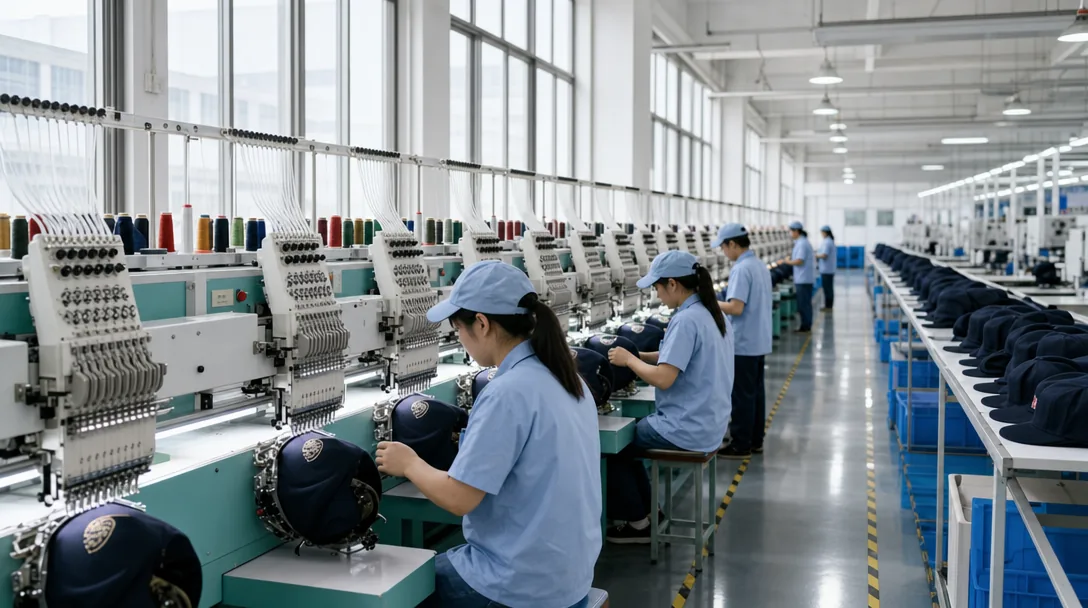
Technique drives cost, sewability, and defect risk more than most buyers expect. Flat embroidery is the safest default and usually adds about $0.18–$0.45 per position at 3,000 pcs, depending on stitch count, thread trims, and machine time. Puff embroidery needs satin columns wide enough to wrap 2 mm or 3 mm EVA foam; strokes under 2.5 mm typically sink, and small counters close up unless the art is simplified before digitizing. If line weight drops below 1.0 mm, stop forcing embroidery and switch to a woven patch, TPU badge, or sublimated patch; then specify edge finish and attachment method clearly: merrow, laser-cut, stitch-down, heat seal, or 3M adhesive. On Tajima, Barudan, or ZSK multi-heads, a 12,000-stitch front logo runs materially slower than a 5,000-stitch file and can move decoration cost by $0.08–$0.20 per cap, so include estimated stitch count in the cap tech pack template whenever possible.
Color count needs the same discipline. Every additional thread color adds machine stops, trims, and another approval variable, so list the exact number of colors, the Pantone standard being referenced, and the approval method: physical thread card, embroidery strike-off, or sealed bulk sample. Use Pantone Coated for graphics and Pantone TCX for dyed fabric references, but do not pretend thread on brushed cotton twill, acrylic wool, or heather jersey will hold Delta-E under 2.0 against the base fabric; in headwear, physical approval beats screen review every time. If the style carries multiple decorations, break each one out separately with its own dimensions and keep-out zone: rear arch embroidery 90 mm W × 28 mm H max, bottom edge 8 mm above closure opening, clear of Velcro, snapback strap, or metal clasp. Our standard practice is to define centerline, seam clearance, and pull compensation up front because a logo that looks clean on a single-head sample machine can still distort in bulk on a 12-head production line.
Packaging and label spec: polybag, hangtag, sticker, carton
Packaging errors rarely show up at inline inspection; they surface at the 3PL or retailer DC, where relabeling and re-cartoning can cost more than the trims you were trying to save. A good cap tech pack template should freeze the polybag spec with the same precision as the crown pattern: material, dimensions, thickness, venting, flap, print, and pack method. For a standard adult 6-panel baseball cap, 280 x 320 mm LDPE or OPP at 40–50 microns works; for truckers, high-crown A-frames, or flat-brim snapbacks, 300 x 340 mm is safer so the front buckram does not take a compression set. Call out two 6 mm vent holes for suffocation compliance, permanent self-adhesive flap, recycle symbol, country-of-origin line, and whether the bag is clear, frosted, or anti-static. If retailer rules permit bulk packing, state the exact ratio—say 12 pcs per master poly with tissue between visors—because most factories will otherwise default to one cap per bag to protect crown shape and embroidery.
Hangtags, stickers, and cartons need the same level of control because small omissions create chargebacks fast. For hangtags, specify size, paper, print method, finish, hole size, string type, and attachment point: 55 x 90 mm, 350 gsm C1S, 4/4 CMYK, matte lamination, 5 mm punch hole, and a 150 mm black nylon loop fastener is a practical retail setup. Attach through the rear sweatband label or closure; attaching through an eyelet often scratches plated metal hardware or distorts lightweight 75D microfiber panels. Stickers should be defined by function, not artwork alone: 45 mm metallic size sticker on top visor, branded under-visor decal, or removable barcode label. For barcode stickers, call out low-tack adhesive so brushed cotton, corduroy, suede-finish bills, and peach twill do not fiber-pull on removal.
Carton specs are where freight cost and damage risk get decided. Put units per carton, inner-pack quantity, carton style, board grade, gross-weight limit, outer dimensions, and shipping-mark layout directly into the cap tech pack template. For structured caps, 72 pcs per export carton is usually efficient; for rope caps, high-profile crowns, or styles with metal trims, 48–60 pcs is safer to prevent sidewall collapse and visor distortion. Keep gross weight under 12 kg for courier or mixed-channel distribution and under 15 kg for standard FOB ocean shipments. Specify 5-ply corrugate, K=A or equivalent, and if transit includes 25–35 days in humid containers, ask for ECT performance rather than vague wall-count language. Shipping marks should list PO, style, color, quantity, carton number, COO, and any FNSKU or GS1-128 label position. At CrownsForge, we usually cap baseball-cap cartons around 60 x 45 x 45 cm; larger cartons save little and produce more crushed crowns, scan failures, and AQL 2.5 rejects on arrival.
Frequently Asked Questions
Do you support sustainability certifications?
Yes. We work with GOTS organic cotton, GRS-certified recycled polyester, OEKO-TEX Standard 100 fabrics, and are BSCI and Sedex audited. Certification documentation can be provided per order.
Can I order a sample before bulk production?
Yes. We strongly recommend approving a pre-production sample before mass production. Samples are charged at 35 to 60 USD each plus express shipping, fully refundable against confirmed bulk orders over 500 pieces.
What is the minimum order quantity (MOQ) for custom hats?
Our standard MOQ is 100 pieces per design and color, with sampling available from 1 piece. For complex multi-color logos or premium fabric upgrades, the MOQ can be lowered with a small per-piece surcharge.
How long does production take?
Sampling takes 7 to 12 days. Bulk production runs 20 to 30 days depending on quantity, fabric availability and decoration complexity. Inspection and packing adds another 3 to 5 days before shipment.
What logo decoration techniques do you offer?
3D puff embroidery, flat embroidery, woven patch, leather patch, PVC patch, screen printing, sublimation, applique and laser etching, all in-house with no subcontracting.
How does ordering custom patch trucker hat work?
When evaluating custom patch trucker hat, the key considerations are construction quality, decoration capability, MOQ flexibility and lead time. Technique (3D puff / flat embroidery / patch), placement (front center, side, back), dimensions (e.g. 5cm wide × 3cm tall), stitch count if known, color count and Pantone references. Without a tech-pack, your factory invents details that contradict your assumptions. With one, sampling lead time drops from 14 days to 7 and revision rounds drop from 4 to 1.
How does ordering baseball cap custom work?
When evaluating baseball cap custom, the key considerations are construction quality, decoration capability, MOQ flexibility and lead time. Without a tech-pack, your factory invents details that contradict your assumptions. With one, sampling lead time drops from 14 days to 7 and revision rounds drop from 4 to 1. Tech sketches, fabric spec, color spec, decoration spec, construction spec (panels, closure, eyelets, sweatband), packaging spec, label/hangtag spec.
How does ordering custom baseball cap motorcycle helmet work?
When evaluating custom baseball cap motorcycle helmet, the key considerations are construction quality, decoration capability, MOQ flexibility and lead time. Without a tech-pack, your factory invents details that contradict your assumptions. With one, sampling lead time drops from 14 days to 7 and revision rounds drop from 4 to 1. Tech sketches, fabric spec, color spec, decoration spec, construction spec (panels, closure, eyelets, sweatband), packaging spec, label/hangtag spec.
How does ordering custom bucket hat embroidered work?
When evaluating custom bucket hat embroidered, the key considerations are construction quality, decoration capability, MOQ flexibility and lead time. Without a tech-pack, your factory invents details that contradict your assumptions. With one, sampling lead time drops from 14 days to 7 and revision rounds drop from 4 to 1. Tech sketches, fabric spec, color spec, decoration spec, construction spec (panels, closure, eyelets, sweatband), packaging spec, label/hangtag spec.
Ready to start your custom hat project?
Send us your tech-pack, sketch or even just an inspiration photo. We will respond with a detailed quotation and digital mock-up within 24 hours.
Request a free quoteRelated guides
Ball Caps for Women: A 2026 Sourcing Playbook for International Buyers
Read article →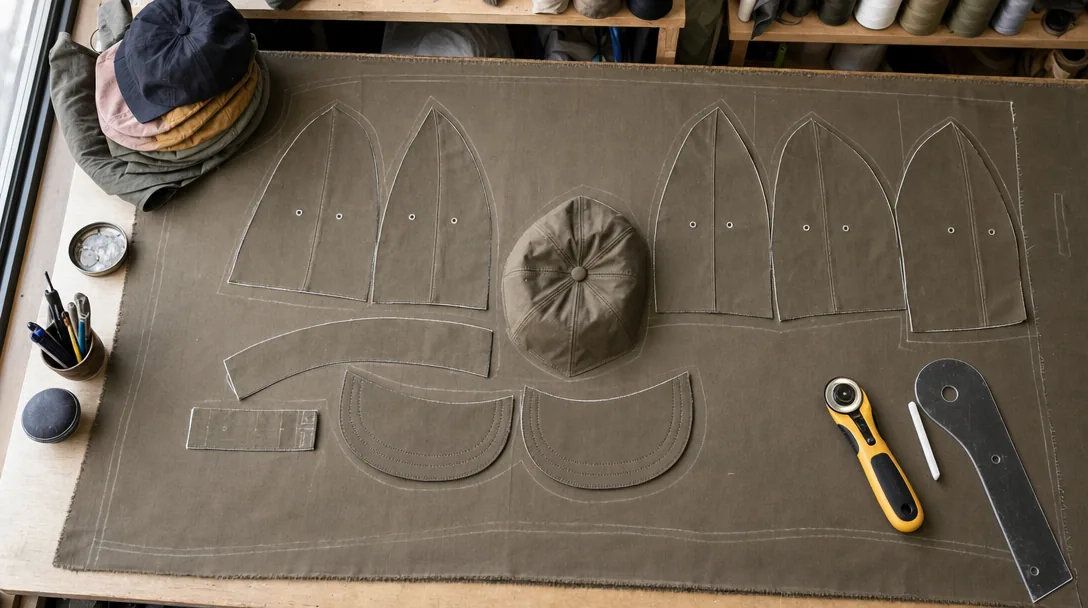
5-Panel vs 6-Panel Caps: Construction, Use Cases and Cost Compared
Read article →
Custom Made Trucker Hat: The 2026 Sourcing & Manufacturing Playbook (2026 Update) (2026 Update) - 2026 Buyer's Guide - 2026 Buyer's Guide
Read article →Sourcing custom hats does not have to be complicated. With the right manufacturing partner, clear specifications and a small upfront investment in sampling, you can launch a retail-quality product in 30 to 45 days.