
Baseball Hats For Men Export Shipping Checklist for Custom Hat Buyers (2026 Update)
Every week, our sales team answers detailed questions about baseball hats for men export shipping checklist for custom hat buyers (2026 update). We wrote this guide so that wholesalers, streetwear brands, corporate buyers and promotional resellers can compare options with full information, and avoid the traps that show up only after production has started.
Why baseball hats for men export shipping checklist needs a separate sourcing plan
A baseball hats for men export shipping checklist needs its own sourcing plan because the risk sits in the pack-out as much as in the cap. Export buyers are not shopping for the lowest FOB; they are trying to avoid rollovers, relabeling, and retailer chargebacks after cargo leaves the factory. That means key decisions must be frozen before pre-production sample approval: shell fabric composition, sweatband fiber content, country-of-origin wording, HS code logic, carton dimensions, and whether caps ship pre-curved, nested, or flat-packed. Change any of those after sampling and your freight model moves immediately. A structured 6-panel cap with 2.0 mm PE front support and pre-curved visor can ship 72 pcs per 60 x 45 x 58 cm carton; an unstructured washed twill cap may reach 96 pcs in the same cube, but crush performance is different. Patch type matters too: a 2.5 mm PVC patch or heavy merrowed woven badge increases face pressure in nested packing and raises deformation risk during long-haul ocean transit.
Generic cap sourcing fails on export orders because the product spec and the shipping spec are mechanically tied together. If the buyer wants Pantone TCX matching on crown fabric and embroidery thread, the tolerance should be written as a measurable target—typically Delta-E under 1.5 for dyed fabric lab dips and under 2.0 where thread substitution is unavoidable—not approved by loose visual judgment under warehouse lighting. On Tajima or Barudan heads, embroidery time may only be 3 to 6 minutes per cap, but that is not where export orders usually go wrong. Problems come later from inconsistent brim curvature, mixed size stickers, wrong barcode placement, or a sweatband construction that forces repacking when retail hangtags and polybags are added. Our standard practice is to lock inner pack ratio, barcode format, polybag warning text, and carton stacking limit before bulk cutting, because changing from bulk pack to individual retail bagging can add $0.08 to $0.22 per cap and 1 to 2 extra labor days on a 5,000-piece order.
Compliance is the part most often underestimated, and it belongs inside the baseball hats for men export shipping checklist from day one, not after booking space. For U.S. and EU shipments, fiber content, origin marking, and outer carton marks must match the PO, commercial invoice, and final packing list exactly before sealing cartons. Canada adds bilingual labeling risk, and broker corrections there can easily cost more than the trim itself. If the cap uses PU coating, heat-transfer branding, printed seam tape, laminated patches, or silicone labels, buyers should confirm whether REACH SVHC, California Proposition 65, or client-specific restricted substance declarations are required. Inspection ownership should also be explicit: AQL 2.5 is still the practical benchmark for visual defects and workmanship, but barcode scan rate, assortment ratio, carton count, and master carton drop condition need named sign-off points. Once those controls are treated as production gates rather than freight paperwork, the shipment is far less likely to stall at ex-factory handover or trigger destination-side rework.
Factory capability checks before quoting
The fastest way to kill a bad quote is to verify what the factory actually makes in-house. For custom caps, I want a process map tied to equipment: structured 6-panel sewing, visor forming, eyelet setting, 3D puff embroidery, flat satin text below 2.5 mm, patch attachment, and closure assembly. Ask for machine counts and realistic output, not “high capacity.” A shop running Tajima, Barudan, or ZSK heads should be able to tell you standard speed by decoration type—typically 850 to 1,000 stitches per minute on flat embroidery, dropping to around 600 to 750 on dense puff with EVA foam, heavy underlay, and short stitch lengths. If woven labels, TPU patches, leatherette badges, or heat-transfer emblems are outsourced, that must be disclosed before quoting, because it changes MOQ, strike-off timing, defect ownership, and delivery risk. Any serious baseball hats for men export shipping checklist starts with capability verification, not price comparison. Material control is the second filter, because traders can always show a clean sample but cannot hold bulk specs. The supplier should quote against measurable standards: 100% cotton twill at 270 to 320 gsm, brushed chino around 240 to 280 gsm, 600D polyester, washed canvas, or rPET blends, with tolerance for weight, shrinkage, and color clearly written. For color approval, use Pantone TCX or coated references and lock a Delta-E target; on front panels and visors, I would cap it at Delta-E 1.5 from the approved standard under D65 lighting. Confirm visor board type, buckram grade, crown height, seam tape width, sweatband composition, and top-button spec, because those drive silhouette consistency far more than buyers expect. If the same supplier also claims bucket hats or reversible styles, verify brim topstitch density, eyelet setting method, and print registration capability separately—many baseball-cap lines cannot control those constructions without quality drift.
The sample room tells you whether bulk production will be managed by process or by chat messages. A reliable setup should include a pattern master, an embroidery digitizer, revision-controlled tech packs, patch strike-off records, and a pre-production sample checklist covering crown profile, visor curvature, top-button centering, closure pull strength, and logo placement tolerance. I also ask whether they can switch between snapback, hook-and-loop, D-ring, metal buckle, and fitted constructions by modifying an existing block instead of rebuilding patterns from zero. If they cannot explain how the PPS sample is frozen against bulk—approved swatch, stitch file version, panel measurements, and trim code—you should expect shade variation, inconsistent crown height, and arguments over what was “approved.” Audit and shipping readiness should be checked before the first quote is taken seriously. Ask for current sedex-audit-cap-supplier-guide.html">BSCI 2.0 or Sedex SMETA 4-Pillar reports, needle-control procedure, metal-detection records where required, and final inspection standards; AQL 2.5 remains the practical baseline for hat programs, with major defects usually capped at 2.5 and critical at zero. The factory should also be able to state export carton specs without hesitation: common outer cartons for caps run around 60 x 45 x 45 cm, with gross weight usually kept below 15 to 18 kg depending on lane and consignee rules. Clarify FOB Ningbo or Shanghai versus DDP terms at quote stage, along with carton marks, suffocation warnings for polybags if used, barcode labeling, and HS code familiarity. Our standard practice is to lock those points during tech-pack review, because a supplier that cannot discuss carton limits, labeling, and inspection flow in plain English is not ready for a stable international cap program.
MOQ, pricing and sample approval
MOQ is set by how much you are actually changing, not by the phrase “for men.” On a stock 6-panel baseball cap in 100% cotton twill at 260-280 gsm, with one front embroidery on a Tajima, Barudan, or ZSK head, 300-500 pcs per colorway is a normal starting point. Once you change the crown pattern, switch to a sandwich visor, add printed seam tape, specify a Pantone-matched undervisor, or build a full woven-label package, you are out of stock-component territory and the base MOQ usually moves to 800-1,500 pcs per style/color. For team and licensed programs, separate style MOQ from size and name personalization: fitted sizes 7 to 7 5/8, mixed back closures, and player-name embroidery create WIP sorting, carton assortment, and dead-stock risk that matter more than the embroidery line item.
A baseball hats for men export shipping checklist has to start with landed cost, not FOB. A cap quoted at $2.40 FOB Ningbo can land at $3.20-$3.80 once you add carton efficiency loss, export docs, broker fees, customs clearance, and low-volume freight. The penalty is worse under 2,000 pcs because embroidery setup, carton marks, barcode labels, and commercial invoice data are spread over fewer units. Before sample approval, lock the Incoterm, HS code, carton dimensions, and destination-specific charges for Canada, the EU, or the U.S.; a supplier quoting FOB, CIF, or DDP without those details can make a clean factory price look cheaper than it really is. In practice, freight math and packaging assumptions erase more margin than trim negotiation.
Setup charges are where first-time buyers usually miss the real cost. Front logo digitizing is usually $25-$80 per file, while 3D puff embroidery, chenille, sublimated woven patches, molded silicone patches, or debossed PU leather patches can push development to $80-$200 because you are paying for stitch testing, mold work, die cutting, or patch sampling, not just artwork conversion. Color has to be locked before the first strike-off with Pantone TCX or Pantone Solid Coated references, then checked under D65 lighting because the same navy thread will read differently on brushed cotton, recycled polyester twill, and heather jersey. PPS approval is the hard stop before bulk cutting: confirm crown height, visor curve, buckram stiffness, sweatband construction, closure pull strength, label placement, needle count, and carton print, then approve the embroidery strike-off and patch sample separately from the sewn cap when edge definition or fill density matters.
Quality inspection and shipping risk
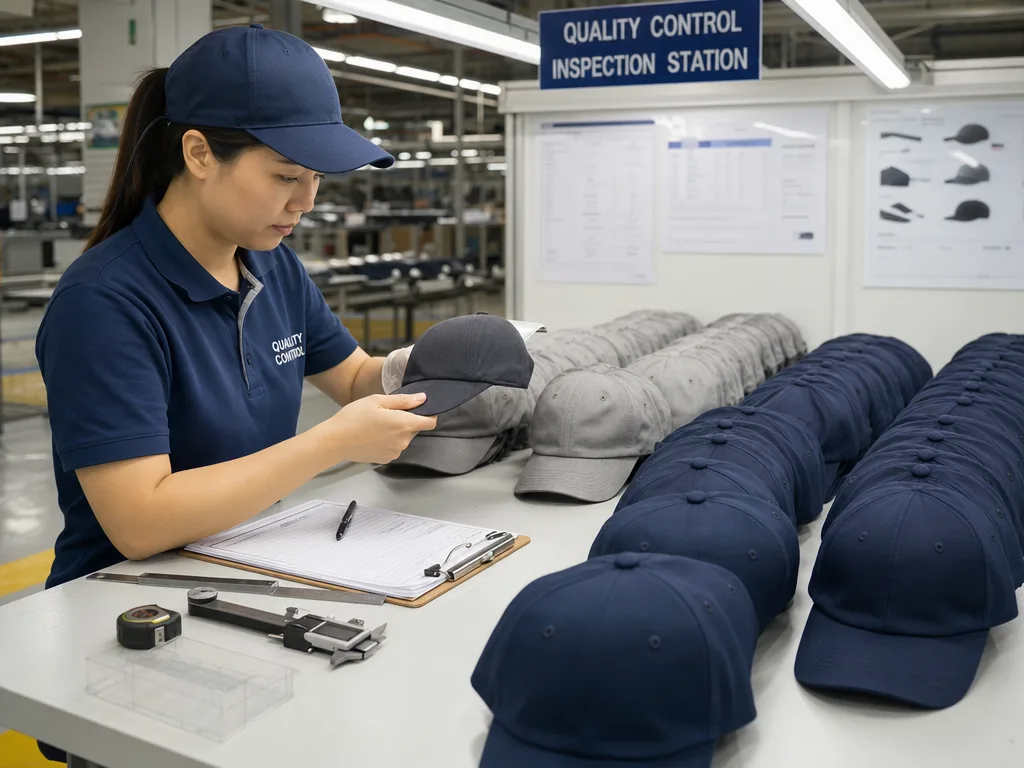
A usable baseball hats for men export shipping checklist starts before cartons are sealed, with a pre-shipment inspection tied to the approved sample, BOM, and packing spec. For most custom cap programs, I would use ANSI/ASQ Z1.4 single sampling at AQL 2.5 for major defects and 4.0 for minor defects, while critical defects stay at zero tolerance: wrong logo, wrong size label, broken needle damage, mold, mixed colorways in one carton, or a missing closure. The tech pack should lock tolerances in writing, not by tribal memory: head circumference +/-0.5 cm, visor width +/-0.3 cm, crown height +/-0.3 cm, logo position +/-2 mm, and front-panel seam offset no more than 2 mm. On structured 6-panel caps, I also check peak symmetry with a template and closure pull strength on snapback posts or metal buckle stitching. In practice, shade drift beyond Delta-E 1.5 to 2.0 versus the approved Pantone TCX reference under D65 lighting is enough to trigger rejection, because buyers notice color inconsistency faster than they notice a half-millimeter seam shift.
Most export loss is not dramatic; it shows up as latent damage after compression, humidity swing, or sloppy carton control. Sweatbands and shell fabrics should have documented crocking, perspiration fastness, and, for cotton twill or brushed chino, wash fastness; for polyester mesh, nylon, or microfiber, ask for lab reports, not a factory assurance. Embroidery needs a close read for thread breaks, loose trims, puckering, backing instability, and density mismatch between panels, especially on Tajima, Barudan, or ZSK runs where the logo can look clean at the machine but distort after steaming or carton compression. Cartons should be 5-ply export grade and marked with PO, style, color, size range, carton number, quantity, gross/net weight, country of origin, and HS code 6505.00 where applicable, with each inner pack label matching the master mark. Under FOB, the buyer carries main-carriage and insurance exposure once the goods pass the ship’s rail or terminal handoff, so sealed-carton photos, loading photos, and cubic-meter confirmation matter. Under DDP, the supplier carries customs and landed-cost risk, so consignee details, declared value, and the commercial invoice need the same level of scrutiny as the caps themselves.
Buyer checklist for the next RFQ
A usable quote starts with a locked spec, not a mood board. For any baseball hats for men export shipping checklist, define the construction down to the parts that change labor minutes and material yield: 5-panel vs. 6-panel, structured front with 1.8-2.0 mm PE board or full soft crown, low/mid/high profile, visor shape and pre-curve, closure type, and head size range such as 58 cm standard or fitted S/M/L. Decoration has to be called out with production references: AI/EPS vector file, logo placement by panel, estimated stitch count, 3D puff foam height in mm, patch type with merrowed or laser-cut edge, woven label size, and any secondary process like screen print, DTF, or sublimation on tape or undervisor. If the program mixes team caps, promo caps, and bucket hats, separate them into individual SKUs with separate BOMs. When buyers lump different constructions into one line, factories either pad the price or miss costs on buckram, closure hardware, and sewing time.
Most quote mistakes start in materials and shipping terms. Specify shell fabric by composition and weight—cotton twill 260 gsm, recycled polyester 150D, nylon taslon 120 gsm—then list visor board, buckram grade, sweatband composition, seam tape, eyelet method, and thread spec such as 40 wt polyester embroidery thread for Tajima or Barudan runs. Tie every color to Pantone C or Pantone TCX and state tolerance if shade matters; on retail orders, Delta-E below 1.5 on self-fabric and below 2.0 on trims is a realistic control point. Include photos of any approved sample from front, side, back, inside, and underside of visor, because a missing undervisor color or closure detail can shift both cost and lead time. Put freight terms into the RFQ on day one: FOB Ningbo, DDP Toronto M5V, or courier to ZIP 90058, plus in-hands date. Cap freight regularly moves landed cost by $0.35-$1.80 per piece based on carton density, mode, and seasonality. Also lock order math and compliance up front: color ratio, carton pack, barcode placement, AQL 2.5, CPSIA or Prop 65 if needed, country-of-origin marking, and audit requirements such as BSCI 2.0 or Sedex SMETA 4-Pillar. At CrownsForge, anything short of that is treated as a budgetary quote, not a production-ready one.
Working with CrownsForge
The biggest failure point in a baseball hats for men export shipping checklist is starting bulk without a locked production standard. The approved sample has to be measurable, not a vague “looks good” sign-off. Tie one signed counter sample to the PO, BOM, carton spec, and inspection file, with crown height, bill curvature, top-button position, eyelet spacing, closure type, and logo placement all recorded in millimeters. Fabric needs the same discipline: 260 gsm brushed cotton twill, 180 gsm interlock polyester, and 300 gsm wool blend do not shrink, hold shape, or pack the same way. For dyed lots, a realistic color target is Delta-E 1.5 to 2.0 against the approved Pantone TCX reference, assuming the mill holds lot consistency and the buyer accepts normal shade banding at seam turns. On structured fronts, embroidery specs must name thread brand, backing weight, underlay, density, pull compensation, and max stitch count by panel shape. A logo that runs clean on a Barudan sample head can still tunnel on a buckram-backed six-panel crown if the digitizing was built for a flat swatch instead of the actual cap block.
Sampling only matters if the factory builds bulk with the same inputs. Pre-production samples should run on the same machine family, cap block, needle setup, and finishing method planned for mass production, whether that is Tajima cap embroidery, ZSK side-logo work, heat-transfer numbering, or woven patch attachment. If the sample used softer buckram, lighter sweatband tape, or a different visor board, the approval is weak because those substitutions change crown hand feel, curve recovery, and carton compression performance. For Canada-bound programs, the sample stage should also lock bilingual carton marks, fiber content labeling, country-of-origin wording, and barcode placement; those details cause more shipping delay than sewing faults. Our standard practice is to separate approval by silhouette when one shipment mixes six-panel baseball caps with bucket hats, because brim topstitch pitch, circumference tolerance, and panel alignment are judged to different specs and should never share one pass/fail standard.
Export dates slip when decoration, QC, and packing are treated as separate departments instead of one critical path. Bulk embroidery should start only after a sew-out confirms registration, thread-break rate, edge definition, and colorfastness at actual production speed, usually 650 to 850 rpm on structured caps, not the optimistic speed used in sampling. Dense front logos often need stitch-count reduction or fill-angle changes; forcing a 26,000- to 28,000-stitch design onto a low-profile front panel is how you get flagging, needle heat, and crown distortion. In-line QC after cutting, sewing, and decoration is the practical minimum, with final inspection typically set at AQL 2.5 major and 4.0 minor unless the buyer writes tighter limits. Packing then has to match route and service level: for ocean freight, outer cartons are often around 60 x 45 x 45 cm, gross weight under 15 kg, with desiccants, vent holes, and nesting rules defined before pilot pack-out. The baseball hats for men export shipping checklist only stays useful when invoice data, packing list, HS code, COO requirements, and audit files such as BSCI 2.0 or Sedex SMETA 4-Pillar are controlled in the same document set.
Frequently Asked Questions
What logo decoration techniques do you offer?
3D puff embroidery, flat embroidery, woven patch, leather patch, PVC patch, screen printing, sublimation, applique and laser etching, all in-house with no subcontracting.
Can I order a sample before bulk production?
Yes. We strongly recommend approving a pre-production sample before mass production. Samples are charged at 35 to 60 USD each plus express shipping, fully refundable against confirmed bulk orders over 500 pieces.
What is the minimum order quantity (MOQ) for custom hats?
Our standard MOQ is 100 pieces per design and color, with sampling available from 1 piece. For complex multi-color logos or premium fabric upgrades, the MOQ can be lowered with a small per-piece surcharge.
How long does production take?
Sampling takes 7 to 12 days. Bulk production runs 20 to 30 days depending on quantity, fabric availability and decoration complexity. Inspection and packing adds another 3 to 5 days before shipment.
What file format should I send for my logo?
Vector files (AI, EPS, PDF) are ideal. High-resolution PNG or JPG at 300 dpi on transparent background works as a fallback. Provide Pantone color references for accurate reproduction.
How does ordering custom fitted hats for men work?
When evaluating custom fitted hats for men, the key considerations are construction quality, decoration capability, MOQ flexibility and lead time. Explain the buyer intent behind baseball hats for men export shipping checklist, when it differs from generic hat sourcing, and what decisions affect cost, lead time and compliance. Describe how CrownsForge manages baseball hats for men export shipping checklist programs with sampling, decoration, QC and export coordination.
What should buyers know about nike bucket hats for men?
When evaluating nike bucket hats for men, the key considerations are construction quality, decoration capability, MOQ flexibility and lead time. Explain the buyer intent behind baseball hats for men export shipping checklist, when it differs from generic hat sourcing, and what decisions affect cost, lead time and compliance. Describe how CrownsForge manages baseball hats for men export shipping checklist programs with sampling, decoration, QC and export coordination.
How does ordering custom embroidered baseball hats work?
When evaluating custom embroidered baseball hats, the key considerations are construction quality, decoration capability, MOQ flexibility and lead time. Explain the buyer intent behind baseball hats for men export shipping checklist, when it differs from generic hat sourcing, and what decisions affect cost, lead time and compliance. Describe how CrownsForge manages baseball hats for men export shipping checklist programs with sampling, decoration, QC and export coordination.
How does ordering custom leather patches for hats work?
When evaluating custom leather patches for hats, the key considerations are construction quality, decoration capability, MOQ flexibility and lead time. Explain the buyer intent behind baseball hats for men export shipping checklist, when it differs from generic hat sourcing, and what decisions affect cost, lead time and compliance. Describe how CrownsForge manages baseball hats for men export shipping checklist programs with sampling, decoration, QC and export coordination.
What is the best shipping method for hats?
It's always better to package the hat in a size-appropriate box and not mash it into a smaller one. In some instances, maybe you don't need a box. Instead of always using a box, you can choose to ship soft and bendable hats in a plastic shipping bag with some protective material.
Looking for a reliable hat manufacturer in China?
CrownsForge has produced custom hats for 800+ brands across 40 countries. From 100-piece launches to 100,000-piece retail programs, we deliver on time and on spec.
Get in touchRelated guides
BSCI vs Sedex vs WRAP vs WCA: Compliance Audit Standards Compared (2026 Update) - 2026 Buyer's Guide
Read article →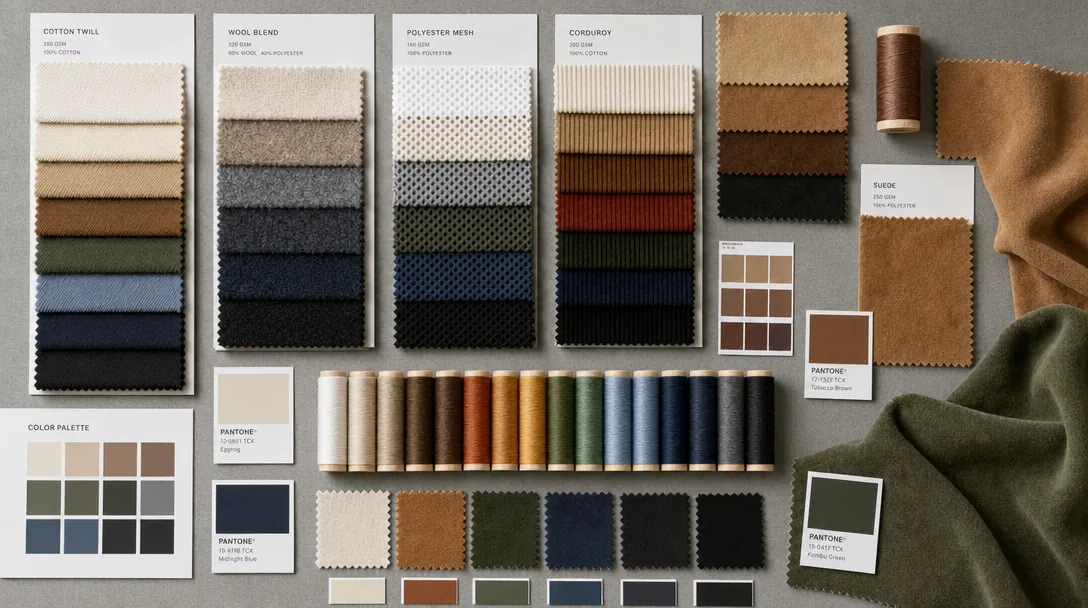
Sustainable Cap Packaging: Options, Costs and Retail-Buyer Demands - 2026 Buyer's Guide
Read article →Bucket Hat Corduroy Fabric And Trim Spec Guide for Custom Hat Buyers
Read article →Sourcing custom hats does not have to be complicated. With the right manufacturing partner, clear specifications and a small upfront investment in sampling, you can launch a retail-quality product in 30 to 45 days.