
Ball Caps for Men: A 2026 Sourcing Playbook for International Buyers - Cost & MOQ Breakdown
Every week, our sales team answers detailed questions about ball caps for men: a 2026 sourcing playbook for international buyers - cost & moq breakdown. We wrote this guide so that wholesalers, streetwear brands, corporate buyers and promotional resellers can compare options with full information, and avoid the traps that show up only after production has started.
Dad Hats for Men
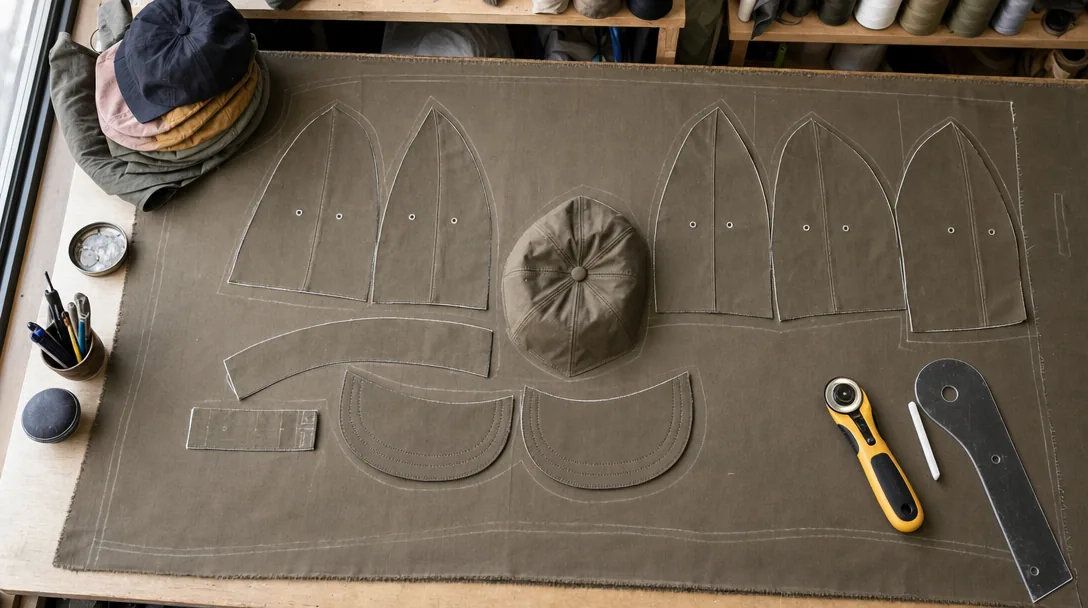
Dad hats look forgiving, but they expose bad workmanship faster than almost any silhouette in ball caps for men. Because the crown is soft and usually unstructured, you cannot hide crooked center-front embroidery, uneven topstitch spacing, drifting eyelets, or a back opening that twists after washing. The standard build is a 6-panel low-profile crown with no buckram or only a light 0.4-0.6 mm front support, a pre-curved PE visor, self-fabric sweatband, and a tuck strap, tri-glide, or antique brass buckle closure. Most commercial programs run in 100% cotton twill or chino twill at 220-280 gsm; brushed cotton canvas at 240-300 gsm gives a drier hand and a cleaner vintage wash, while lighter performance versions use 75D-150D polyester microfiber to cut weight and dry faster. If a buyer wants pricing that survives sampling, the tech pack has to lock down crown height, finished head circumference, visor length and curvature, fabric gsm, Pantone TCX, closure plating, eyelet method, and target wash effect. Enzyme wash, pigment wash, and heavy vintage wash can share one pattern but still produce very different shrinkage, seam torque, and shade variation.
Dad hat costing is where many buyers get caught using structured-cap assumptions on a much less forgiving product. A stock-color washed cotton style with 5,000-8,000 stitches of flat front embroidery usually lands around $2.10-$3.40 FOB China at 300-500 pieces per colorway. Add felt applique, chain stitch, custom seam tape, woven loop labels, metal logo hardware, or printed internal taping, and the real FOB range moves closer to $3.80-$5.20. If you want true Pantone-matched shell colors instead of the nearest stock fabric, expect a practical MOQ of about 1,000 pieces per shade so dye lots, sweatbands, visor binding, and closures can be controlled to a usable Delta-E tolerance under D65 lighting rather than judged by eye on the packing table. QC should also be tougher than buyers expect: check crown symmetry, visor curve consistency, top-button centering, strap alignment, embroidery flagging on soft fronts, and buckle corrosion or rust transfer after wash. AQL 2.5 final inspection is normal, but the better factory move is an in-line inspection before laundry, because once an unstructured dad hat puckers or twists in wash, it is usually scrap.
Ball Caps for Women
Women’s ball caps do not need a separate sewing line, but they do need a different block. The fit issue is structural: a sellable women’s silhouette usually uses a shallower 6-panel crown at roughly 10.5-11.5 cm finished height, compared with the 11.5-12.5 cm crown still common on mainstream ball caps for men. I’d also spec a narrower pre-curve visor, often 7.0-7.3 cm instead of the fuller standard shape, and lighter front-panel support such as 0.35-0.45 mm buckram rather than the stiffer build used on many men’s caps. When buyers just “size down” a men’s pattern, the failures are obvious on fit samples: the crown sits tall, the rear opening floats, and the cap looks oversized above a ponytail or bun. The difference between a style that reorders and one that stalls is usually not branding; it is measurable control over crown depth, visor proportion, sweatband width, opening circumference, and closure placement. Lock the technical spec before sampling, because women’s fit problems are expensive to fix after embroidery programs and trim molds are approved. For fabric, brushed cotton twill usually sits in the 260-320 gsm range, washed chino gives a softer hand at similar weight, and lightweight performance polyester is typically 150-220 gsm with a moisture-wicking mesh or Coolmax-type sweatband. A usable tech pack should call out finished head-circumference range, visor curve, 6-row or 8-row brim stitching, closure type, top button finish, and color standard by Pantone TCX or Pantone Coated, depending on the material and trim. If the collection includes matching women’s styles and ball caps for men, keep bulk shade tolerance around Delta-E 1.5-2.0 and confirm decoration early: flat embroidery on Tajima or ZSK heads is stable on twill, while soft washed fabric may need reduced stitch density to avoid puckering.
Pricing moves quickly once you step beyond stock trims. In Yiwu, a basic custom women’s cap in cotton twill with flat embroidery typically runs about 144-300 pieces per colorway at roughly $2.10-$3.40 FOB, assuming a standard hook-and-loop or metal buckle closure and no custom internal branding. Washed retail versions with enzyme finishing, branded seam tape, custom eyelets, or die-cast logo hardware usually land closer to $3.60-$5.20 FOB. Once you add specialty closures, logo rivets, custom sweatbands, or low-volume lab dips, MOQ often pushes toward 500 pieces because the trim vendors—not the sewing floor—become the bottleneck. Blank programs can start around $1.35-$1.90, but that number is meaningless for buyers who need repeatable fit and branded details. Quality control is straightforward if the inspection points are set correctly. I would run AQL 2.5 and measure crown height, visor length, back opening circumference, brim symmetry, closure pull strength, and embroidery centering from carton to carton, not just on a table sample. Common defects are predictable: dense embroidery on 150-180 gsm polyester can tunnel the front panel, weak fusing causes crown collapse after compression packing, and poor strap construction leads to slippage after wear testing. Sweatband crocking, distorted back arches, and uneven visor curvature are the repeat offenders on softer women’s profiles. At CrownsForge, our standard practice is to compare approved fit samples side by side whenever a supplier claims to offer both women’s shapes and ball caps for men; factories that truly control both silhouettes will show different pattern blocks, not the same shell with a different label.
Country Hats for Men
Country styling sells on profile, hand feel, and wash consistency long before anyone notices the logo, so the tech pack for country-inspired ball caps for men should lock the shell spec first. The three commercial builds are reliable because they fit how this category actually sells: a 5-panel foam trucker with a 2.5-3.0 mm PE visor board and semi-rigid polyester mesh, a 6-panel brushed cotton twill cap at 260-320 gsm, or a washed canvas dad cap at 280-340 gsm with a visibly lower crown than standard mid-profile programs. If the target is a broken-in ranch look, write in enzyme wash, garment wash, or pigment wash by name and approve a physical shade band; “vintage wash” without a standard is where suppliers bury unacceptable lot-to-lot variation. Mesh-back styles need their own callouts too: mesh weight, aperture, and rebound matter, because cheap 100% polyester mesh can collapse under master-carton compression and arrive with permanent panel memory.
Decoration is where average factories get exposed. Wildlife layouts, cattle brands, serif western wordmarks, and rope-front graphics look simple, but on washed twill they punish weak digitizing and poor tension control. Ask what embroidery heads the factory runs—Tajima, Barudan, or ZSK—what underlay they plan to use, and the stitch-count range before sampling. Dense satin columns on soft 0.35 mm washed twill or canvas will tunnel fast if the file is overbuilt, especially on unstructured fronts. A usable spec should also state crown height, visor curve, seam tape color, sweatband composition, closure hardware, Pantone TCX for shell fabric, and Pantone references for thread colors; otherwise the sample drifts into generic promotional territory instead of a saleable country cap. At entry level, stock-body programs with flat embroidery or woven labels usually open around 144-300 pieces per colorway, while custom rope, camo underbrim, printed inside taping, branded buckles, or patch packages push realistic MOQs to 500-1,000 pieces per style-color, with FOB China pricing typically landing at $1.85-$2.90 for foam truckers, $2.10-$3.40 for brushed twill, and $3.20-$4.80 for washed canvas.
Inspection is where margin gets protected, because country caps fail in predictable ways. The repeat issues are uneven visor curvature, front panels sewn off-grain, mesh shade mismatch against the crown, loose top buttons, and embroidery registration drifting on low-structure fronts. For washed ball caps for men, set an approved shade band and a Delta-E tolerance before bulk cutting; if you skip that step, color variation shows up at packing and turns a “heritage wash” into a claim. AQL 2.5 is the minimum sensible outbound standard, with extra checkpoints on head circumference tolerance, visor symmetry, closure cycle performance, patch adhesion, and pressure marks after 24-hour carton stacking. In practice, the factory choice should be driven by shaping consistency, wash control, and embroidery discipline before headline price. A cheap quote looks attractive until rework, delayed ex-factory dates, or retailer chargebacks erase the margin.
Toilet Bolt Caps
Toilet bolt caps have nothing to do with ball caps for men, and that mismatch is exactly the risk: trading companies that juggle unrelated SKUs often present themselves as “full-category” suppliers, then outsource to whichever molder is cheapest that week. The part itself is simple but spec-sensitive. Most programs use a two-piece snap cap and base in homopolymer or copolymer PP for low cost and decent impact resistance; ABS is chosen when buyers want a stiffer wall, cleaner gloss, or vacuum-metallized chrome finish. A serious RFQ should lock resin family, melt flow index range, virgin-versus-regrind ratio, wall thickness, internal diameter, cap height, snap-ring profile, and color target in Pantone or RAL. For white, I would hold Delta-E at 1.0 to 1.5 max, because loose color control is obvious on retail hardware. When factories push high-regrind PP, you usually see brittle locking tabs, stress whitening around the retention ring, and shrink variation that makes one lot install smoothly and the next lot spin loose on the bolt.
Pricing is straightforward if the spec is disciplined. For an existing mold, MOQ usually starts at 3,000 to 5,000 sets per color; a new basic mold in P20 steel with 2 to 4 cavities typically costs $800 to $2,000, while a higher-output hot-runner tool in 718 steel can run higher if the buyer wants longer tool life past 300,000 shots. Standard white PP sets from Zhejiang or Guangdong normally quote around $0.05 to $0.12 per set FOB China at 5,000 to 10,000 sets; ABS or plated decorative versions are more often $0.15 to $0.30. The common defects are also predictable: sink on the dome, flash at the parting line, short shots on the clip edge, lot-to-lot shade drift, and tabs cracking during installation because the section is too thin or the dryer settings overcook the resin. Release criteria should be explicit: caliper checks against approved dimensions, color review under D65 light, live fit tests on the actual closet-bolt assembly, packaging drop checks for retail packs, and final inspection at AQL 2.5 with a defined retention-force window so pass/fail does not become an argument at shipment stage.
Embroidered Caps Wholesale
Embroidery makes or breaks perceived value on ball caps for men, and the real decision is not the mockup but the stitch engineering. On a standard 6-panel baseball cap, front logos are typically run on Tajima, Barudan, or ZSK multi-head machines using 40 wt polyester thread because it holds color better than rayon under sweat, UV, and abrasion. Buyers should ask for the actual digitized file specs: stitch count, fill density, edge run, underlay type, pull compensation, and whether the logo is sewn flat before assembly or on finished cap frames. Flat embroidery usually gives cleaner edges and better small-text legibility; finished-cap embroidery is faster for stock programs but can distort the crown on dense fills. On structured caps, the front panel normally needs PE buckram around 160-220 gsm to support fills above roughly 8,000 stitches. Without that support, tunneling, puckering, and crown collapse show up fast, especially on heavy center-front logos. Text under 4 mm, thin satin columns, and sharp serif corners should always be redigitized for cap embroidery instead of converted straight from vector art.
A workable wholesale spec sheet needs more than “3D embroidery on front.” Lock down crown profile, panel count, visor curve, closure, shell fabric, sweatband, seam tape, eyelet style, thread brand, Pantone references, and measurement tolerances. For everyday programs, 260-320 gsm cotton twill is the standard commercial range; brushed chino reads softer at retail, while 75D-150D polyester microfiber is more common for sports and promo orders. Color control should separate fabric and thread: Pantone TCX for dyed fabric, Pantone Solid Coated as the nearest embroidery-thread target, and an agreed Delta-E tolerance if repeat orders matter. In China, MOQ is commonly 144-300 pcs per colorway when using stock twill and standard trims; once you move to custom-dyed fabric, woven labels, printed seam tape, or metal hardware, 500-1,000 pcs is a more realistic floor.
Inspection is where margin is protected, because embroidery defects are expensive to rework after export and easy to hide in approval photos. Bulk QC should check logo registration, loose threads, birdnesting on the reverse, thread breaks, fill coverage, puckering at the front panels, visor symmetry, crown depth, and whether the embroidery has warped the cap profile. AQL 2.5 is the usual baseline, but embroidery-heavy orders often need tighter visual standards because one bad front logo can downgrade an otherwise sellable carton. Pricing in the current China market is still fairly predictable: a basic embroidered cap in stock cotton twill usually lands around $2.10-$3.60 FOB Ningbo, while higher-build ball caps for men with sandwich visor, enzyme wash, metal buckle, custom inner tape, and an 8,000-12,000 stitch logo more often sit in the $4.20-$6.80 FOB range. The safest pre-production checkpoint is a sew-out on bulk fabric before line launch; it catches most density, thread-tension, and digitizing failures before they become a shipment claim.
Wholesale Embroidered Caps
Embroidery drives cap cost through machine time and failure rate, not just thread consumption. For wholesale embroidered ball caps for men, a usable RFQ separates blank cap cost from decoration cost and locks the construction before pricing: 6-panel structured or unstructured crown, buckram thickness, fabric gsm, visor type, closure, sweatband, seam tape, and every embroidery position with an estimated stitch count. A front logo on a men’s cap usually lands at 5,000-12,000 stitches, a side hit 3,000-6,000, and a back arch 4,000-8,000. On Tajima, Barudan, or ZSK heads, that changes machine minutes, thread-break frequency, and registration stability, especially on curved front panels. If a supplier quotes “logo included” without splitting cap-body and stitch-program cost, you are comparing guesses, not production-ready numbers. For fabric, 260-320 gsm brushed cotton twill is the safe baseline for core retail programs, while 140-180 gsm polyester or poly-spandex performance fabric works better for golf, team, and promo orders where moisture management matters. Front-panel embroidery should be run pre-assembly for cleaner placement, but only if the digitizing is built with the right underlay, pull compensation, and fill density for that exact fabric and backing; otherwise puckering shows up fast on structured crowns. Thread colors should be tied to Pantone references, logo dimensions listed in millimeters, and small text treated conservatively: on curved cap fronts, I do not recommend letters under 4 mm height unless the factory has already sampled the same art on the actual shell fabric, backing, and crown profile.
The real risk in embroidered cap production is process control between digitizing, panel prep, embroidery, and finishing. Buyers should require the production file format, usually DST, approved thread brand, color reference, placement tolerances, and a measurable standard for shade approval. A sensible export benchmark is Delta-E below 1.5 against the approved thread card or lab standard under D65 lighting, with bulk inspection held to AQL 2.5. Pre-production samples need a hard check for push-pull distortion, exposed bobbin, needle cuts, loose trims, visor-center alignment, and crown symmetry before bulk release. At CrownsForge, our standard practice is to approve embroidery on the actual front panel set, not on a flat strike-off alone, because a clean swatch can still fail once the crown is shaped. Pricing in Zhejiang is straightforward when the quote is built correctly. A standard 6-panel cotton twill embroidered cap with a simple 6,000-8,000 stitch front logo typically lands around $2.20-$3.40 FOB China at 300-500 pieces. Add side and back embroidery, heavier brushed twill, a metal buckle, branded seam tape, woven labels, or retail packaging, and the range moves closer to $3.80-$5.80 FOB. Repeat programs often start at 144-300 pieces per colorway, while fully custom developments usually need 500-1,000 pieces to make the trim package efficient. Sampling is commonly $35-$80 per style, often creditable against bulk. For ball caps for men, embroidery is the right call when the brand wants permanence and a premium hand, but only if the factory can repeat the same digitizing and reorder pricing without rebuilding the cost model each season.
Working with CrownsForge for ball caps for men programs
The biggest failure point in a ball caps for men program is not sewing capacity; it is uncontrolled substitutions after sample approval. I have seen approved caps come back in bulk with lighter twill, softer buckram, cheaper hook-and-loop, or a sweatband downgraded from 32 mm cotton to thin polyester because the BOM was never locked line by line. A realistic sampling path is 3-5 working days for artwork and tech-pack review, 7-10 days for a first sewn proto, and 12-15 days when you add Pantone TCX-matched sweatbands, custom metal adjusters, molded rubber badges, or branded seam tape. For a first order, freeze one body before chasing options: a 6-panel brushed cotton twill cap at 260-280 gsm with PE buckram and a standard curved visor, or a performance style in 75D-100D polyester at 140-160 gsm. True cut-and-sew MOQ is usually 144-300 pieces per colorway per style; stock-body programs with decoration only can sometimes start at 48-100 pieces, but buyers should confirm size spec, crown height, visor length, and closure source before treating those numbers as real.
Decoration is where margin disappears fastest if the logo method does not match the fabric. Front embroidery is most stable on Tajima, Barudan, or ZSK cap frames when the stitch count stays around 12,000-15,000 stitches per location; above that, machine speed drops, thread breaks increase, and puckering becomes harder to control, especially on lightweight polyester or unstructured crowns. Foam-front truckers often take heat transfer or screen print better than dense embroidery, while melton wool, corduroy, and brushed twill usually present woven patches or direct appliqué with cleaner edge definition. A straightforward chino-twill order with flat embroidery typically lands around $2.80-$4.60 FOB China at 300-1,000 pieces; melton blends, genuine leather straps, multi-location patches, and printed seam tape can push FOB to $5.50-$8.50. CrownsForge keeps digitizing in-house because outsourced punch files are still a common cause of poor satin coverage, center-front distortion, and approval photos that look acceptable straight on but fail under a 45-degree QC check.
Compliance and workflow discipline decide whether ball caps for men ship cleanly or turn into a month of avoidable rework. Any export supplier should be able to show current sedex-audit-cap-supplier-guide.html">BSCI 2.0 or Sedex SMETA 4-Pillar audit status, needle-control logs, azo-free dye compliance where required, and a written AQL 2.5 final inspection standard with clear critical, major, and minor defect definitions. If the order carries licensed sports marks, private-label packaging, or strict retailer color standards, lock references early to Pantone Solid Coated or Pantone TCX and agree a Delta-E tolerance before bulk dyeing; otherwise the crown fabric, sandwich visor, binding, and embroidery thread can drift enough to trigger rejection. The clean production sequence is artwork sign-off, raw-material approval, pre-production sample, line-start confirmation, mid-line QC, final packed inspection, and carton-mark approval before balance payment. That sequence prevents the factory-floor mistakes buyers actually pay for: wrong eyelet color, substituted buckle finish, mixed inner labels, inaccurate carton CBM, or crown profile changes caused by different buckram stiffness.
Frequently Asked Questions
What file format should I send for my logo?
Vector files (AI, EPS, PDF) are ideal. High-resolution PNG or JPG at 300 dpi on transparent background works as a fallback. Provide Pantone color references for accurate reproduction.
How long does production take?
Sampling takes 7 to 12 days. Bulk production runs 20 to 30 days depending on quantity, fabric availability and decoration complexity. Inspection and packing adds another 3 to 5 days before shipment.
What logo decoration techniques do you offer?
3D puff embroidery, flat embroidery, woven patch, leather patch, PVC patch, screen printing, sublimation, applique and laser etching, all in-house with no subcontracting.
Do you support sustainability certifications?
Yes. We work with GOTS organic cotton, GRS-certified recycled polyester, OEKO-TEX Standard 100 fabrics, and are BSCI and Sedex audited. Certification documentation can be provided per order.
What is the minimum order quantity (MOQ) for custom hats?
Our standard MOQ is 100 pieces per design and color, with sampling available from 1 piece. For complex multi-color logos or premium fabric upgrades, the MOQ can be lowered with a small per-piece surcharge.
What's the MOQ for custom leather patch hats no minimum?
When evaluating custom leather patch hats no minimum, the key considerations are construction quality, decoration capability, MOQ flexibility and lead time. Cover everything buyers ask about dad hats for men: how it's manufactured, what specs to request from a factory, typical MOQ and pricing, common quality issues to inspect for, and how this ties back to the broader ball caps for men sourcing decision. Cover everything buyers ask about country hats for men: how it's manufactured, what specs to request from a factory, typical…
What's the MOQ for custom new era 59fifty fitted hats no minimum?
When evaluating custom new era 59fifty fitted hats no minimum, the key considerations are construction quality, decoration capability, MOQ flexibility and lead time. Cover everything buyers ask about dad hats for men: how it's manufactured, what specs to request from a factory, typical MOQ and pricing, common quality issues to inspect for, and how this ties back to the broader ball caps for men sourcing decision. Cover everything buyers ask about country hats for men: how it's manufactured, what specs to request from a factory, typical…
What should I know about custom bulk trucker hats?
When evaluating custom bulk trucker hats, the key considerations are construction quality, decoration capability, MOQ flexibility and lead time. Cover everything buyers ask about dad hats for men: how it's manufactured, what specs to request from a factory, typical MOQ and pricing, common quality issues to inspect for, and how this ties back to the broader ball caps for men sourcing decision. Cover everything buyers ask about country hats for men: how it's manufactured, what specs to request from a factory, typical…
What's the MOQ for custom embroidered trucker hats no minimum?
When evaluating custom embroidered trucker hats no minimum, the key considerations are construction quality, decoration capability, MOQ flexibility and lead time. Cover everything buyers ask about dad hats for men: how it's manufactured, what specs to request from a factory, typical MOQ and pricing, common quality issues to inspect for, and how this ties back to the broader ball caps for men sourcing decision. Cover everything buyers ask about country hats for men: how it's manufactured, what specs to request from a factory, typical…
What does a 47 on a baseball cap mean?
The '47 or 47 on hats and caps refers to the '47 Brand company. '47 refers to 1947, which is the year that the '47 Brand company was started by Italian immigrant brothers, Henry D'Angelo and Arthur D'Angelo.
What is the difference between a ball cap and a baseball cap?
Technically, baseball hats are structured ball caps designed for team uniforms. They originated with MLB players in the 1800s. Today, they have evolved into the iconic six-panel cap with a stiffer crown and bill. Today, they're used to make a fashion statement and as a functional accessory.
Need a low-MOQ test order?
We help emerging brands launch with as few as 100 pieces. Premium fabric, in-house embroidery, retail-ready packaging.
Start a small orderRelated guides
Switching Hat Manufacturers Mid-Program Without Losing Quality - Cost & MOQ Breakdown
Read article →
Bucket Hat Women: Properties, Costs and How to Spec It Right - Cost & MOQ Breakdown
Read article →
Kids' & Children's Cap Manufacturing: CPSIA Compliance and Sizing
Read article →Sourcing custom hats does not have to be complicated. With the right manufacturing partner, clear specifications and a small upfront investment in sampling, you can launch a retail-quality product in 30 to 45 days.