
5-panel Hat Men: A 2026 B2B Sourcing Guide - Cost & MOQ Breakdown
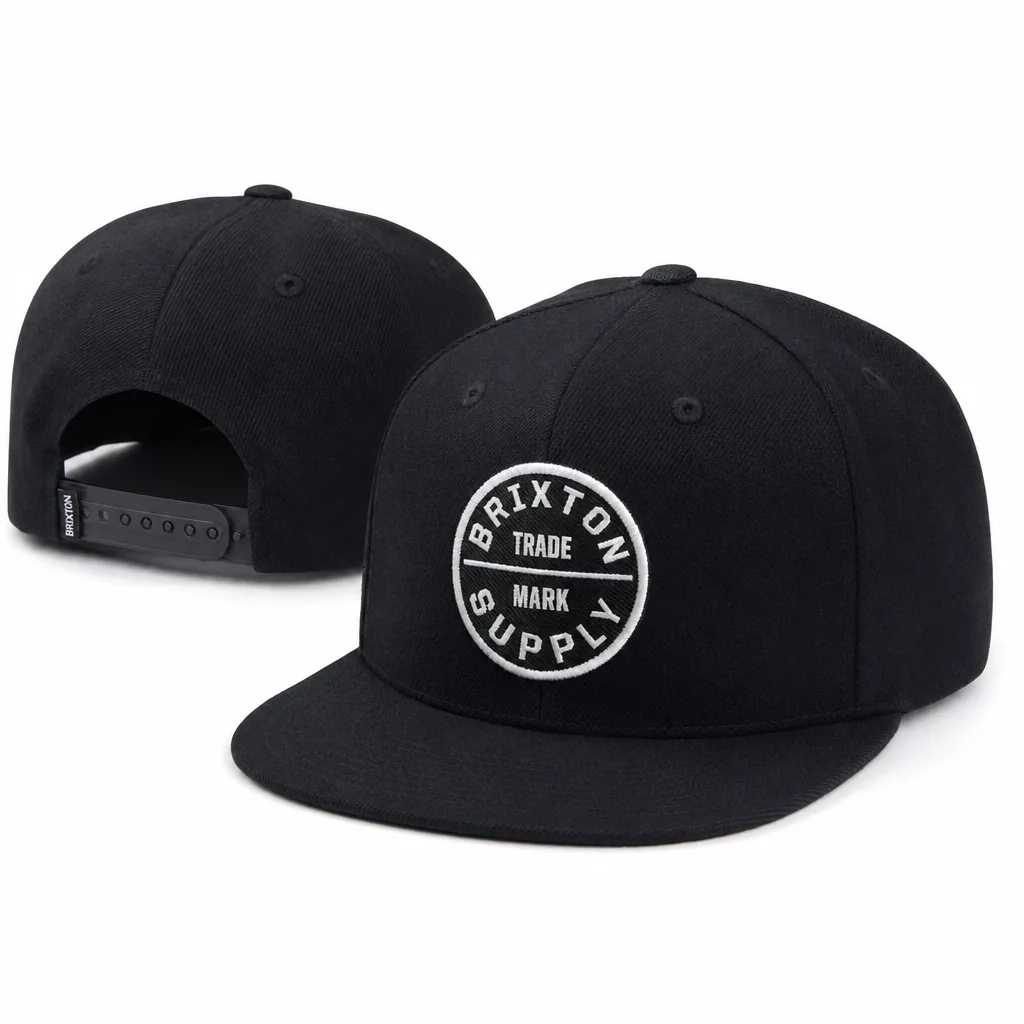
5-panel Hat Men: A 2026 B2B Sourcing Guide - Cost & MOQ Breakdown is one of the most-asked questions we receive from international buyers, and for good reason. With dozens of factories competing for your order and an alphabet soup of technical terms in every supplier quote, even experienced importers can feel lost. This guide consolidates what we have learned producing custom hats for clients in 40+ countries.
6 Panel Hat Custom
A stable 6-panel custom cap program starts with the pattern pack, not the logo art. The center-front seam is the make-or-break point: if crown height, seam allowance, panel curvature, and front support are not frozen before digitizing, the embroidery can read off-center even when the Tajima or Barudan run is within machine tolerance. On a competent line, the sequence is usually 12-24 hours fabric relaxation, CAD marker cutting, front-panel fusing for structured builds, pre-sew embroidery, crown assembly, visor joining, sweatband setting, closure attachment, shaping, trimming, and steam finishing. Buyers should specify fabric by composition, construction, and weight instead of broad names. A shell in 100% cotton twill 260 gsm, recycled polyester plain weave 150D, and nylon taslan 120 gsm will sew, shrink, and hold shape very differently. Lock the visor curve, buckram versus 1.5-2.0 mm EVA front support, stitch density, sweatband material, and closure hardware in the tech pack; if the sheet only says "baseball cap," crown depth and hand feel will drift lot to lot. The RFQ also needs measurable tolerances, otherwise sample review turns into subjective back-and-forth. Call out Pantone TCX for shell, underbill, top button, eyelets, and embroidery thread, and for repeat orders set a Delta-E target around 1.0-1.5 if color consistency matters at retail. Confirm crown depth in centimeters, visor length, embroidery window in millimeters, head-size range, woven-label position, seam-tape print, care label, hangtag, barcode sticker, and carton assortment before the first sample is cut. In Yiwu, a practical MOQ for a standard 6-panel cap is usually 144-300 pieces per colorway with one fabric and one closure; washed treatments, split fabrics, metal trims, or applique plus flat embroidery often push MOQ to 500-1,000 pieces. FOB China pricing at 300 pieces is commonly $2.10-$3.40 for brushed cotton and $4.20-$6.80 for wool blends or technical nylon. Compared with a typical 5-panel hat men program, the tradeoff is straightforward: a 5-panel front gives cleaner logo real estate, while a 6-panel build is usually more forgiving on fit and easier to scale across promo, team, and retail channels.
Inspection is where 6-panel orders either protect margin or create claims. The repeat defects are predictable: embroidery drifting off the center seam, visor twist from uneven pressing, inconsistent topstitch spacing, puckering around eyelets, bulky sweatband joins, and snapback mismatch inside mixed cartons. For trucker or foam-front versions, add recovery checks on mesh, crown collapse after compression packing, and foam rebound after 24 hours in carton. A serious control plan is inline inspection plus final AQL 2.5, with measurement tolerance typically held at +/-0.5 cm on crown height, visor length, and opening. Visual centering matters just as much as tape-measure compliance because a cap can pass spec and still look wrong on shelf. Buyers sourcing both 6-panel and 5-panel hat men styles should judge the 6-panel program less on trend language and more on execution stability. The center seam gives the eye a hard reference, so sewing variation shows faster than on a 5-panel crown. That means factories need tighter control on panel matching, seam-tape placement, and pre-sew hoop alignment, especially on high-density embroidery or logos spanning the seam. If the order is color-critical or headed to licensed retail, ask for a pre-production sample, inline photos from the first 20-30 pieces, and a final packing report by color and closure count. Those checkpoints cost very little compared with a rework on 600 caps that are technically within spec but visually off-center.
6 Panel Hat Wholesale
Six-panel caps remain the wholesale volume standard because they are easier to run consistently than most 5-panel hat men programs, especially above 1,000 pcs per color. The extra center seam on the front splits the branding area, but it also stabilizes crown shape and hides small tension errors that would be obvious on a single wide 5-panel front. A commercial spec usually starts with 100% cotton twill or chino twill at 260-280 gsm, 10x10 or 10x7 yarn count, fused buckram on the two front panels, and a 1.8-2.2 mm PE visor board. Standard construction is six embroidered eyelets, 6 rows on the visor, 4-needle sweatband join, and either a plastic snap, hook-and-loop, or self-fabric tuck strap with brass buckle. On the floor, front logo embroidery normally runs pre-assembly on Tajima or Barudan heads, while back arch embroidery is cleaner after crown sewing to avoid hoop marks and panel distortion.
If you are sourcing both six-panel volume and 5-panel hat men styles, the real decision is not aesthetics; it is tolerance control, branding area, and claim risk. A proper tech pack should lock Pantone TCX, fabric composition, finished weight tolerance at plus or minus 5%, crown height, visor curve radius, seam allowance, stitch-per-inch range, sweatband content, closure spec, and embroidery stitch count before the PP sample. For dyed shell fabric, Delta-E under 1.5 against approved lab dip is realistic; trims like snaps, webbing, and woven labels should be held under 2.0. Cost in Zhejiang for a basic six-panel cotton twill cap at 300-500 pcs per color is typically $2.20-$3.40 FOB Ningbo with 5,000-8,000 stitches of flat embroidery; brushed twill, sandwich visor, metal buckle, 3D puff, applique, or custom seam tape moves it to $3.80-$5.20. MOQ is commonly 144 pcs for stock-color blanks, 300 pcs for full custom, and 500-1,000 pcs when custom-dyed fabric or exclusive trims are involved. Final inspection should run to AQL 2.5 with tight checks on visor centering, crown twist, seam symmetry, raw edge exposure under the sweatband, and mixed-lot shade variation; in our standard practice at CrownsForge, even a 3 mm visor skew is enough to trigger rework on retail-grade orders.
Custom 6 Panel Hat
The front center seam is the non-negotiable difference between a 6-panel cap and a typical 5-panel hat men program. It improves contour on medium and large head sizes, but it also creates decoration risk: any front embroidery above about 55-60 mm tall, or a wide satin-fill logo crossing the seam, will pucker unless the digitizing compensates for push-pull and seam height. Lock the geometry before sampling. Buyers should spec crown height in cm, visor length and pre-curve radius, buckram type, seam tape width, eyelet finish, closure hardware, sweatband composition, and shell weight. For everyday retail, 100% cotton twill at 240-280 gsm is still the safest base; brushed chino around 220 gsm gives a softer hand but abrades faster at the brim edge; recycled polyester in 150D-180D works better for quick-dry or performance use. If mesh enters the build, call out gsm and resin hand: 20-25 gsm polyester mesh bags out quickly, while 35-45 gsm nylon mesh keeps recovery after compression packing.
Most costing errors start with a vague tech pack. A workable package should include Pantone TCX references for shell, thread, and trims; lab-dip tolerance with fabric Delta-E under 1.5; embroidery dimensions or stitch count; visor sandwich details; label map; carton pack-out; and inspection terms such as AQL 2.5. On a competent line, sewing is usually split across Juki single-needle, double-needle, and bartack stations, while logo execution runs on Tajima, Barudan, or ZSK heads after panel prep and fusing. In China, 2026 MOQ is commonly 144-300 pieces per colorway when using stock fabric and standard closures; add custom-dyed shell, printed seam tape, woven inside labels, or underbrim print, and the floor usually jumps to 500 pieces. Real FOB pricing sits around $2.10-$3.40 for a basic brushed-cotton 6-panel, $3.60-$5.20 with applique or dense 3D embroidery, and $4.80-$6.50 for wool blends, 8- wale corduroy, or suede-look microfiber. QC should focus on blocked shape, not tabletop appearance: front seam drift, visor skew over 3 mm, left-right crown imbalance, SPI inconsistency, sweatband twist, and lot shade mismatch are the defects that trigger rework fastest.
7 Panel Hats Wholesale
A 7-panel cap makes sense when you need a taller, billboard-style face for graphics, but it is less forgiving than a standard 5-panel hat men silhouette. The pattern usually combines one oversized front panel, two side panels, two rear panels, and a split visor, so seam alignment is tighter than on a basic 6-panel. If the front seam, visor midpoint, and back closure drift more than 2 mm, the cap reads twisted immediately on-head and should be rejected at final. For structure, most factories use 0.8-1.2 mm buckram on streetwear builds; softer golf or resort fits often drop to 0.5-0.7 mm to avoid a hard forehead break. The safest base fabrics are 108x58 cotton twill at 260-280 gsm, brushed cotton canvas around 300 gsm, or poly-cotton twill when you need better crocking resistance and wash stability. Decoration on a 7-panel needs stricter digitizing because that wide front exposes every mistake. Flat embroidery, woven patches, TPU badges, screen print, and sublimated inserts all work, but wide embroidery will pucker faster than a comparable 5-panel hat men cap if underlay density or hoop tension is off. On Tajima, Barudan, and ZSK heads, 3D puff usually fails first at the upper corners: foam exposure, satin collapse, or uneven coverage. A real tech pack should lock crown height, visor length and curve, front-panel width, eyelet type, sweatband material, closure spec, top button size, and Pantone TCX references for shell, undervisor, and thread; vague specs are why sampling stretches into three rounds instead of one.
Wholesale numbers move quickly once you leave stock materials. For stock cotton twill or canvas, a compliant China factory will typically quote 144-300 pieces per colorway, with FOB pricing around $3.10-$4.80 at 300 pieces for a basic 7-panel. Add applique, rubber patch, rope detail, printed seam tape, metal buckle, or custom interior labeling, and the workable range is usually $5.20-$7.50 FOB. If you specify custom-dyed fabric, proprietary camouflage, or matched mesh for a trucker variation, MOQ often jumps to 500-1,000 pieces because mills will not run short yardage efficiently. If mesh is part of the build, specify 50D versus 75D polyester mesh up front; the rebound, hand feel, and panel memory are materially different, not cosmetic. Inspection is where the margin disappears fastest, so I would hold 7-panel production to AQL 2.5 and measure crown height, head opening, visor width, front-panel symmetry, closure centering, embroidery registration, and sweatband join bulk. Check color under D65 light against the approved standard; Delta-E below 1.5 is realistic on solid twills, while heather or mélange goods usually drift wider. Carton compression testing matters too, because buckram bubbling and visor deformation often show up after long DDP transit or warehouse dwell. As a sourcing rule, a 7-panel is not a replacement for every 5-panel hat men program: it is more trend-led, carries higher sewing risk, and usually costs 8-15% more than a plain 6-panel in the same fabric and trim package.
5 Panel Hat Vintage
A convincing vintage 5-panel starts with pattern and material selection, not a post-production wash meant to fake age. For a proper 5-panel hat men program, lock the crown architecture first: unstructured front panels with no buckram for a true camper handfeel, or a light 1.5-2.0 mm EVA insert if the brand wants a cleaner face after wash. The most dependable shells are 10 oz cotton canvas, washed cotton twill at 220-260 gsm, 8-10 wale corduroy, and nylon taslon at 110-140 gsm for a 1990s outdoor look. Specify visor length, crown height, seam allowance, eyelet type, sweatband composition, and closure construction in the tech pack, because enzyme wash, garment wash, and pigment wash each move the cap differently. Buyers who ignore that usually end up with panel torque, brim twist, or embroidery that drifts off-center after finishing. If body color must match tees, bags, or jackets, submit a Pantone TCX reference with an agreed Delta-E tolerance; under 1.5 is realistic on the shell fabric, while webbing, edge binding, and back straps often relax to 2.0 after washing.
Cost gets predictable only when the wash standard and trims are frozen before sampling. On current FOB China pricing, a washed vintage 5-panel hat men style with flat embroidery on Tajima or Barudan heads usually lands at $2.10-$3.40 for 300-500 pieces per color, assuming stock fabric, woven main label, and standard plastic snap or nylon web closure. Add chain stitch, appliqué, leather strapback, contrast seam taping, custom metal hardware, or heavy pigment wash, and the workable range moves to $3.80-$5.20. Custom-dyed fabric is where smaller buyers get caught: most mills want 500-1,000 meters per color, so stock greige programs or existing shade cards are the practical route below roughly 1,200 caps. Inspection should focus on wash-sensitive defects, not generic loose-thread checks. AQL 2.5 is the right baseline, with circumference tolerance at +/-0.5 cm, brim symmetry checked from center front to each peak edge, and shade reviewed under D65 light against the approved washed PPS. The failures that actually generate claims are visor twist, left-right panel imbalance, seam puckering at the front join, embroidery distortion on soft fabric, tape drift inside the crown, and color break between body, brim, and closure.
5 Panel Trucker Hat
A 5-panel trucker works only when the front panel and mesh are engineered as separate components, not treated like generic cap material. The structure is straightforward: one uninterrupted front crown panel, two side panels, two rear mesh panels, and a flat or 8-10 mm pre-curved visor. That seam-free face is exactly why the 5-panel hat men segment performs so well for bold branding. You get a cleaner embroidery field than a 6-panel cap, with no center seam fighting 3D puff, molded TPU or silicone badges, or woven patches in the 50-70 mm range. For a retail-grade build, I would lock the front fabric first: 210-260 gsm cotton twill for a softer streetwear hand, 240-300 gsm 8x8 canvas for a firmer face, or 3-5 mm foam-backed polyester for the classic high-profile trucker shape. Rear mesh should usually sit around 80-120 gsm polyester; once you go lighter, seam strength and recovery drop fast. A real tech pack needs crown height in centimeters, visor length and width, seam tape color, eyelet placement on non-mesh fronts, closure spec, and Pantone TCX references for every visible fabric, thread, and trim.
Production problems usually start at decoration, not sewing. A trucker front is die-cut, laminated with buckram or foam, paired with a PE or HDPE visor insert, then sewn, sweatbanded, buttoned, closed, trimmed, and heat-shaped. On Tajima, Barudan, or ZSK heads, foam fronts need lower stitch density and a controlled underlay; if the digitizing is wrong, the panel tunnels, the logo sinks, and puckering shows up after capping. My baseline spec is a 25-30 mm sweatband, snapback resin that survives carton compression, confirmed mesh hole count from the sealed sample, and embroidery placement tolerance within ±2 mm from center front. In China, workable MOQ is usually 144-300 pcs per colorway for a basic build, but once you add woven labels, contrast seam tape, inside taping print, or multiple patch applications, the practical MOQ usually moves to 300-500 pcs. Current FOB pricing for a standard trucker is about $2.20-$3.60, while patch-heavy or higher-spec versions with branded tape and tighter QC typically land around $3.80-$5.50 FOB.
Most trucker claims come from weak inspection discipline, not difficult assembly. The repeat defects are predictable: front panel height mismatch, bill warping, mesh tearing at seam joins, loose snap posts, off-center patches, and embroidery drift of 2-3 mm that looks terrible on a centered 5-panel face. For branded programs, I would inspect to AQL 2.5, verify finished head circumference against the approved spec, check left-right bill symmetry, and hold color tolerance to Delta-E 1.5-2.0 against approved lab dips or strike-offs. Inline QC at visor forming, panel sewing, and finishing catches the expensive failures earlier; if the factory waits until packed goods, reject rates climb fast. From a sourcing standpoint, the trucker remains one of the strongest value options in 5-panel hat men development because raw material cost is low, the decoration window is large, and the fit is commercially stable across promo, streetwear, and team merchandise. What buyers should not do is merge the trucker fit block with a 6-panel or 7-panel file; crown angle, forehead contact, and logo geometry are different enough to create avoidable resampling and approval delays.
Working with CrownsForge for 5-panel hat men programs
Sampling is where most 5-panel hat men programs either stay on schedule or start bleeding weeks. In Yiwu, a competent factory should turn digital review—artwork, panel split, visor shape, seam-tape layout, and BOM check—in 2 to 4 working days, then deliver a first physical sample in 7 to 10 days when the build uses stocked 210-260 gsm cotton twill, nylon taslon, standard buckram, PE visor board, and a PP snap closure. Once you move into custom-dyed 14-wale corduroy, Pantone TCX matched webbing, molded TPU logos, sublimated seam tape, or low-MOQ woven patches, the real constraint becomes trim development, not sewing; add 5 to 12 days for lab dips, strike-offs, and mold approval. MOQ follows the same logic. A basic cut-and-sew 5-panel hat men order may be quoted at 144-300 pcs per colorway, but the practical floor is usually set by dye-lot minimums, patch supplier MOQs, or closure sourcing rather than line capacity.
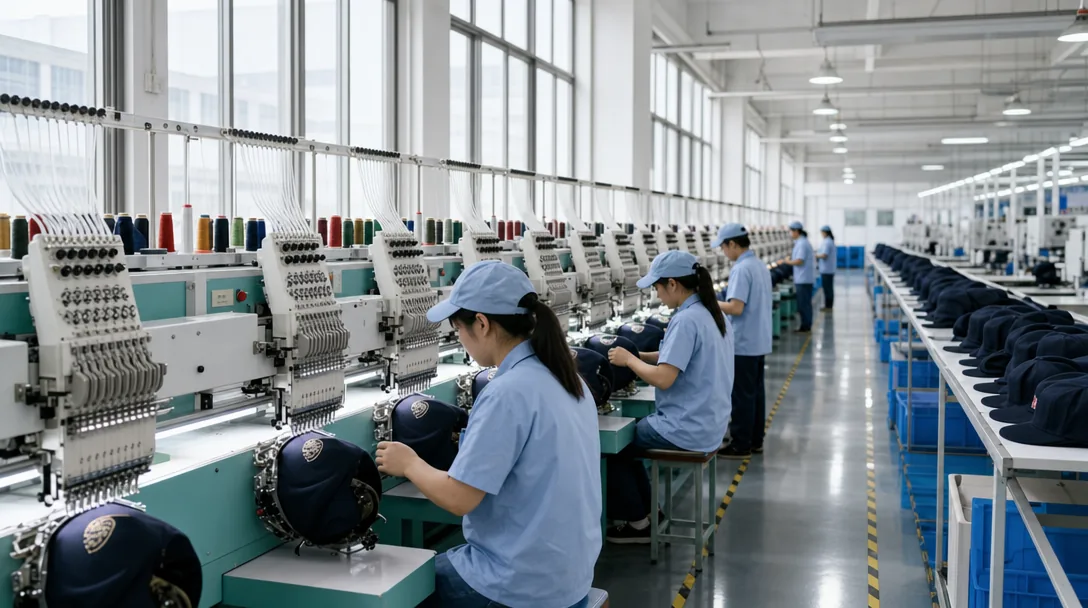
Decoration is the fastest way to ruin a good silhouette. On Tajima, Barudan, or ZSK heads, front embroidery on a 5-panel hat men style usually lands in the 8,000-18,000 stitch range; above that, lightweight nylon and unstructured cotton start tunneling unless the digitizing, underlay, backing weight, and needle spec are right. We normally switch approach before forcing density: satin borders become woven patches, heavy fills become appliqué, and fine outlines may need a 65/9 needle with softer backing to avoid crown distortion. Buyers should approve decoration from the same production method intended for bulk, not from a hand-tuned sample that can’t be repeated at line speed. In 2026, FOB Yiwu pricing is still spec-driven: roughly $2.10-$3.40 for a basic brushed cotton build, $3.20-$5.80 for technical fabrics or multi-decoration programs, and higher once you add printed inside taping, custom polybags, barcode labels, or retail inserts. The safest workflow is to freeze BOM, Pantone references, logo size, packing details, and AQL 2.5 before bulk cutting, then inspect inline and final against the sealed sample.
The cheapest quote on 5-panel hat men is usually the one that creates chargebacks later. Color control needs to be defined before fabric booking: specify whether approval is against Pantone TCX or coated references, and set a commercial Delta-E tolerance that both mill and buyer accept. Without that, the standard drifts from lab dip to warehouse lighting, and every shade dispute turns subjective. A factory handling serious programs should be able to show current sedex-audit-cap-supplier-guide.html">BSCI 2.0 or Sedex SMETA 4-Pillar status, a documented needle policy, trim incoming inspection records, and metal detection protocol when the customer requires it. For e-commerce or licensed retail, carton drop testing and barcode verification are not extras; they are basic risk control. CrownsForge generally runs the clean sequence that actually scales: tech-pack review, quote confirmation, pre-production sample, raw-material booking, line trial, inline inspection, final inspection at AQL 2.5, then shipment under FOB, CIF, or DDP. That process works whether the buyer is testing 300 pcs or rolling a wider headwear program across multiple colorways and fabrications.
Frequently Asked Questions
Can I order a sample before bulk production?
Yes. We strongly recommend approving a pre-production sample before mass production. Samples are charged at 35 to 60 USD each plus express shipping, fully refundable against confirmed bulk orders over 500 pieces.
Do you support sustainability certifications?
Yes. We work with GOTS organic cotton, GRS-certified recycled polyester, OEKO-TEX Standard 100 fabrics, and are BSCI and Sedex audited. Certification documentation can be provided per order.
How long does production take?
Sampling takes 7 to 12 days. Bulk production runs 20 to 30 days depending on quantity, fabric availability and decoration complexity. Inspection and packing adds another 3 to 5 days before shipment.
What file format should I send for my logo?
Vector files (AI, EPS, PDF) are ideal. High-resolution PNG or JPG at 300 dpi on transparent background works as a fallback. Provide Pantone color references for accurate reproduction.
Which shipping methods do you support?
We support FOB, CIF and DDP shipping. Air express for samples and small orders, sea LCL for 100 to 500 pieces, sea FCL for 5,000+ pieces. Door-to-door DDP available for US, EU, UK, Canada and Australia.
How does ordering custom hat trucker work?
When evaluating custom hat trucker, the key considerations are construction quality, decoration capability, MOQ flexibility and lead time. Cover everything buyers ask about 6 panel hat custom: how it's manufactured, what specs to request from a factory, typical MOQ and pricing, common quality issues to inspect for, and how this ties back to the broader 5-panel hat men sourcing decision. Cover everything buyers ask about custom 6 panel hat: how it's manufactured, what specs to request from a factory, typical…
What should I know about wholesale trucker hats?
When evaluating wholesale trucker hats, the key considerations are construction quality, decoration capability, MOQ flexibility and lead time. Cover everything buyers ask about 7 panel hats wholesale: how it's manufactured, what specs to request from a factory, typical MOQ and pricing, common quality issues to inspect for, and how this ties back to the broader 5-panel hat men sourcing decision. Cover everything buyers ask about 6 panel hat wholesale: how it's manufactured, what specs to request from a factory,…
How does ordering custom hats for men work?
When evaluating custom hats for men, the key considerations are construction quality, decoration capability, MOQ flexibility and lead time. Cover everything buyers ask about 6 panel hat custom: how it's manufactured, what specs to request from a factory, typical MOQ and pricing, common quality issues to inspect for, and how this ties back to the broader 5-panel hat men sourcing decision. Cover everything buyers ask about custom 6 panel hat: how it's manufactured, what specs to request from a factory, typical…
How does ordering custom embroidered trucker hats work?
When evaluating custom embroidered trucker hats, the key considerations are construction quality, decoration capability, MOQ flexibility and lead time. Cover everything buyers ask about 6 panel hat custom: how it's manufactured, what specs to request from a factory, typical MOQ and pricing, common quality issues to inspect for, and how this ties back to the broader 5-panel hat men sourcing decision. Cover everything buyers ask about custom 6 panel hat: how it's manufactured, what specs to request from a factory, typical…
Ready to start your custom hat project?
Send us your tech-pack, sketch or even just an inspiration photo. We will respond with a detailed quotation and digital mock-up within 24 hours.
Request a free quoteRelated guides
Bulk Trucker Hats Reorder Planning Guide for Custom Hat Buyers
Read article →Men's Bucket Hat: A Vertical-Specific Sourcing Guide - Cost & MOQ Breakdown
Read article →Baseball Hats For Men Export Shipping Checklist for Custom Hat Buyers
Read article →We hope this guide demystifies 5-panel hat men: a 2026 b2b sourcing guide - cost & moq breakdown and helps you move forward with confidence. If you have questions specific to your project, our English-speaking sales engineers are one message away.