
Wool Blend Caps: Manufacturing, Sourcing and Buyer Specifications - Cost & MOQ Breakdown
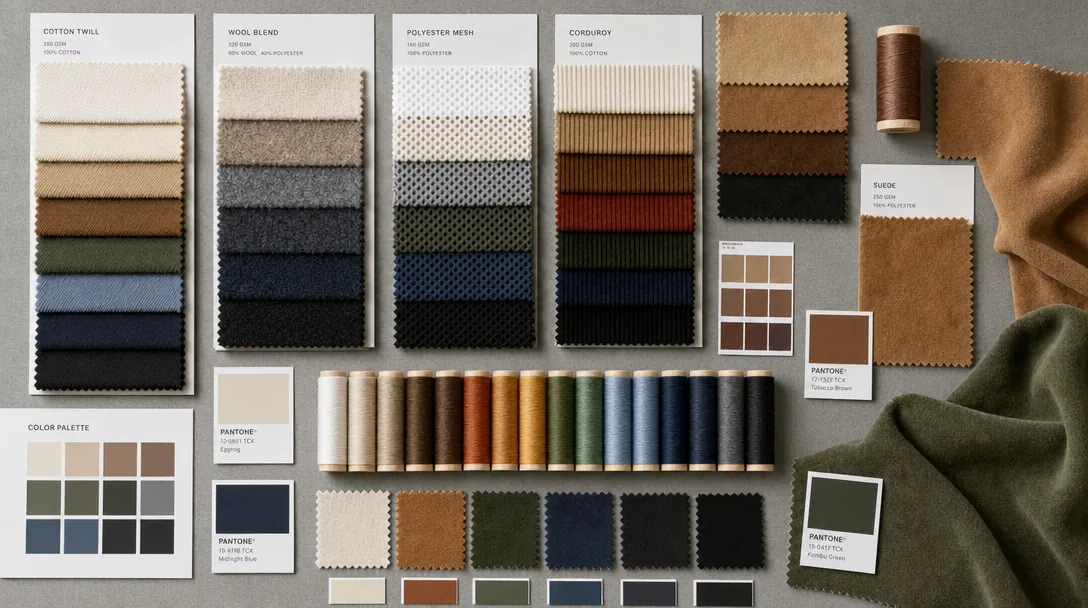
Every week, our sales team answers detailed questions about wool blend caps: manufacturing, sourcing and buyer specifications - cost & moq breakdown. We wrote this guide so that wholesalers, streetwear brands, corporate buyers and promotional resellers can compare options with full information, and avoid the traps that show up only after production has started.
The three dominant wool-blend cap fabrics
The commercial default is 80/20 acrylic-wool melton, and most buyers asking for a custom wool cap mean this fabric whether they specify the ratio or not. For structured 6-panel snapbacks and baseball caps, mills in China usually offer it at 320 to 380 gsm with a brushed or lightly sheared face, enough body to support a buckram-backed crown and PE visor board without the shrink instability of 100% wool. The acrylic content is doing real work: on dark shades like black, navy, and heather charcoal, decent mills can usually hold lab dips within Delta-E 1.0 to 1.5 against a Pantone TCX target, while full wool commonly shows wider lot-to-lot drift. On the production floor that means cleaner runability on Tajima and Barudan embroidery heads, less panel torque during hooping, and more consistent steam blocking after top button and closure assembly. FOB pricing for a standard embroidered snapback in this cloth is typically $3.20 to $4.60 at 300 to 500 pieces, with cost moving on stitch count, visor sandwich construction, closure hardware, and whether the underbrim is self fabric, wool felt, or green satin.
100% wool melton is the premium option, but it only pencils out when the retail price can absorb both the fabric cost and the extra process control. A cap-grade melton usually sits around 360 to 450 gsm, heavily fulled, dense on the surface, and noticeably deeper in black, camel, forest, and burgundy than acrylic blends. It also gives manufacturers more ways to lose money if they are sloppy. Fusing can fail if the press temperature is too aggressive, crown panels can move 1.5% to 2.0% after steaming, and fitted sizes will drift fast if shrinkage is not tested before bulk cutting. Any competent wool blend cap manufacturer should check relaxation shrinkage, skew, crocking, and needle cutting risk on bulk fabric before approving markers, then hold in-line inspection to at least AQL 2.5 during sewing and finishing. FOB cost for an embroidered retail cap in full wool usually lands around $4.80 to $7.50 at 200 to 300 pieces, which is why you see it more in fashion capsules, licensed team product, and higher-margin winter assortments than in promo programs.
The practical middle ground for cold-weather programs is 70/30 wool-polyester, especially for unstructured 5-panels, low-profile baseball caps, and earflap silhouettes where drape matters more than crown rigidity. Most workable constructions fall in the 280 to 340 gsm range with a brushed, felted, or melange face, and the polyester improves abrasion resistance, seam stability, and carton recovery after 30 to 45 days in compression-packed export transit. It is also easier to buy in smaller color runs: many mills will support 300 to 500 meter dye lots on this blend, while custom full-wool developments often start closer to 800 meters per shade. The weak point is inconsistency at the low end of the market. Cheap 70/30 cloth tends to fail first on pilling, dry crocking, and surface hairiness, so buyers should ask for Martindale abrasion data, pilling grades, and rubbing fastness results before approval, then confirm sweatband compatibility if they are using moisture-wicking polyester or brushed cotton twill. In production, this blend generally handles seam taping, laser-cut eyelets, and reflective trims with fewer surprises than pure wool.
Why 80/20 acrylic-wool dominates baseball cap retail
80/20 acrylic-wool owns baseball cap retail because it delivers the visual cues of traditional melton without the cost volatility and processing risk of 100% wool. In current mill buying, a 400-430 gsm melton at 80/20 usually lands 15% to 25% below comparable all-wool, with the gap widening when the wool side is finer micron or the dye lot is small. On a 2,000-piece six-panel snapback order, that typically trims FOB by about $0.35 to $0.75 per cap before embroidery, enough to protect a retail ladder at $24.99-$34.99. Buyers still get the dense, matte surface consumers associate with MLB-style caps, but the acrylic content reduces shrinkage after steaming, lowers moth sensitivity in warehousing, and cuts the reject rates that show up when wool-rich shells distort during blocking. Any experienced wool blend cap manufacturer defaults to 80/20 for this reason: customers read it as premium, while sourcing teams keep margin intact.
The factory-floor advantage is more important than most buyers realize. Pure wool is inconsistent in steam response because moisture regain shifts by lot, and that shows up fast in production: crown panels torque, visor seam lines ripple, and matching on six-panel assembly drifts outside tolerance. At 80% acrylic, dimensional stability is better and replenishment color control is easier; decent mills can usually hold Pantone TCX repeats within Delta-E 1.5-2.0, which matters when reorder stock has to sit next to prior deliveries at retail. The blend also bonds more predictably to front-panel buckram, so structured crowns hold shape with fewer delamination issues after pressing and packing.
Embroidery performance is where 80/20 became the commercial standard and stayed there. On Tajima, Barudan, and ZSK heads, a firm acrylic-wool melton face runs flat and 3D puff embroidery more cleanly than softer wool-rich shells, with less fiber bloom around satin columns and fewer thread breaks at 700-850 stitches per minute. Small lettering holds sharper edges, raised fills stay more uniform, and the laminated front panels keep the high-crown profile buyers expect in licensed sports and streetwear programs. That translates directly into fewer deformation defects at final inspection and more stable pass rates under AQL 2.5. For reorder-heavy retail business, 80/20 is not a fashion preference; it is the safest production spec that still looks premium on shelf.
Melton wool: premium retail and heritage brands
Melton wool is where buyers stop comparing caps like commodity promo product and start checking face density, crown recovery, and color depth under 4000K to 5000K retail lighting. For a cap to read premium on shelf, the shell usually needs true melton in the 380 to 500 gsm range, tightly woven and properly milled, not a loose 20/80 or 30/70 wool-synthetic blend brushed to fake the look. On a 6-panel baseball cap, unstructured strapback, or vintage-style snapback, that extra body gives you a cleaner front profile, crisper visor seam, and better panel memory after packing. Buyers using melton for heritage programs should also ask for fiber content by testable spec, because many “wool” programs in the market are really acrylic-heavy blends with a softer price and a flatter visual result. The cost jump is real, but it is usually justified when the retail target is above mid-tier. In practical factory costing, 100% wool melton commonly adds $1.40 to $2.20 per cap over a basic wool/acrylic body, and custom-dyed melton can add another $0.35 to $0.80 depending on shade depth, MOQ, and lab-dip approval rounds. If the buyer wants Pantone TCX matching, a serious wool blend cap manufacturer should quote bulk tolerance honestly: Delta-E 1.0 to 1.5 is achievable on stable darks and heathers, while bright fashion shades and lot-to-lot repeats often land closer to Delta-E 1.5 to 2.0. That difference matters on adjacent trims like wool button wraps, self-fabric straps, and undervisor matching, where shade drift shows immediately.
Melton is far less forgiving than brushed twill, and most production mistakes show up before the cap even reaches final pressing. Needle marks can stay visible, panel shading is obvious on dense dark colors, and cheap buckram will make an otherwise premium build feel hollow. Good factories test shrinkage, skew, and dry/wet crocking before cutting, then relax the rolls for at least 12 to 24 hours and bundle crown panels by dye lot. For premium retail orders, shade control should be held to a commercial 4-point gray scale standard or better, with inline inspection against approved swatches under D65 light rather than warehouse fluorescents. CrownsForge’s standard practice on melton programs is to reject mixed-lot paneling even when the variance still passes a casual promo tolerance. Embroidery setup also needs to be dialed back. On Tajima or Barudan machines, melton generally runs cleaner with lighter underlay, reduced top stitch density around 0.35 to 0.40 mm, and conservative pull compensation so satin columns do not cut scars into the milled face. That is why better executions lean toward simplified direct embroidery, wool felt applique, or chain stitch, then finish the interior with cotton twill seam tape and a sweatband in cotton twill or microfiber instead of basic polyester tricot. MOQ is usually 144 to 300 pieces per colorway when using stock melton; once you require custom-milled shades, cap-to-jacket fabric matching, or fully custom trims, mills often push the fabric minimum to 80 to 120 meters, which moves the cap MOQ to roughly 500 to 1,000 pieces and adds 3 to 5 weeks before bulk sewing starts.
Pilling: which blend resists best?
Pilling resistance is set less by the headline blend ratio than by fiber length, yarn hairiness, and finishing. In cap production, a 60/40 or 50/50 acrylic-wool melton usually outperforms untreated 100% wool on the shelf because acrylic adds tensile strength and a cleaner surface. On a Martindale or ICI pilling test, a properly sheared 60/40 melton in the 380-450 gsm range can typically hold grade 3.5-4.0 after 7,000-10,000 rubs; many plain-finished 100% wool cap cloths fall to grade 2.5-3.0 in the same window. The failure points are predictable: front panel edge, button seam ring, sweatband line, visor break, and the area above a plastic snap or metal buckle where repeated abrasion lifts loose ends. Any serious wool blend cap manufacturer should quote more than “80 wool/20 acrylic.” Ask for gsm, yarn count, weave density, singeing, shearing, brushing, and whether the mill has an anti-pilling finish, because those details can move the result by a full grade.
For structured streetwear and licensed team caps, 80/20 wool-acrylic melton is usually the best balance of handfeel and durability. It keeps the fuller face buyers expect from wool, but runs more stable through blocking, fusing, and embroidery than untreated 100% wool. On Tajima, Barudan, or ZSK heads, that matters: dense fills and satin borders on a hairy face create fiber lift and a visible halo around small lettering, especially on black, navy, and dark heather shades. Anti-pilling or low-friction finishing from the mill typically adds about $0.12-$0.28 per cap at 3,000-5,000 pieces, which is cheap compared with retail returns. Do not approve bulk from handfeel and lab dips alone. Cut panels from the actual lot, build pre-production caps, then run abrasion or 3-5 controlled wash cycles and grade against ISO 12945 reference photos under a fixed light box. For retail programs, Delta-E under 1.5 after testing is realistic, but texture change and crown-face fuzz usually fail before color does; that is where AQL 2.5 claims start.
Dye consistency in wool blends
The failure point in wool blends is rarely the lab dip; it is shade separation after bulk dyeing, brushing, steaming, and fusing. Wool takes acid dye faster than acrylic or polyester, so an 80/20 wool-acrylic melton can show the wool-rich face 0.5 to 1.0 shade darker once the nap is raised. On caps, that mismatch shows up first at the top button, underbrim binding, seam-wrapped eyelet areas, and neighboring crown panels cut against different grain directions, because pile reflection changes the visual read under light. Any wool blend cap manufacturer worth qualifying should check color two ways: visually against an approved Pantone TCX standard under D65 and TL84, then instrumentally with a spectrophotometer. In practice, a lab dip target of Delta-E 1.0 to 1.5 is achievable; bulk production should be written at Delta-E 2.0 maximum, not fantasy claims about perfect uniformity on brushed goods.
Cross-dyeing is usually the right control, but buyers need to lock it at mill stage because sewing cannot correct a bad strike rate. On 360 to 420 gsm brushed melton or wool-acrylic shell fabric used for snapbacks and winter baseball caps, a controlled cross-dye program typically adds $0.10 to $0.20 per cap, with charcoal, navy, burgundy, and forest green trending higher because dark shades expose undertone drift faster under store lighting. That premium is justified for licensed programs, repeat seasonal styles, and any reorder where new stock will sit beside old inventory. The purchase specification should state blend ratio, gsm tolerance, finish, approved Pantone reference, and lot tolerance in one line item: for example, 80/20 wool-acrylic melton, 380 gsm +/-5%, brushed finish, Delta-E max 2.0 to sealed standard. Our standard practice is also to enforce dye-lot segregation and panel-bundle cutting, because once a darker lot is sewn into the front crown, no steaming, pressing, or AQL 2.5 final inspection will make the mismatch disappear.
Sourcing certified wool: RWS, Mulesing-free
For EU and UK retail programs, RWS and mulesing-free are paperwork controls, not branding language. The document that matters is the RWS transaction certificate for the exact shipment lot: it must reconcile to the purchase order, invoice, fiber composition, net weight, and the specific yarn lot or fabric roll numbers booked into production. A mill’s scope certificate only proves it is licensed to process certified wool; it does not validate the goods on your cutting table. Where buyers get burned is accepting a recycled PDF from a prior season or a certificate that covers fabric broadly but not the actual lot used for the caps. Any disciplined wool blend cap manufacturer should lock certificate reconciliation before panel fusing, cutting, or embroidery release, because once certified and non-certified rolls are mixed in WIP, chain-of-custody is already broken and cannot be repaired with paperwork later. If the retailer spec, care label, or hangtag says “RWS wool,” expect pre-shipment compliance to ask for a full paper trail, including transaction certificate references against finished-goods quantity. On the factory floor, that means segregated roll storage, lot-level issue records, and trim control so certified shell fabric does not get blended into non-certified orders. Our standard practice is to stop production if the certified weight on the paperwork cannot cover the booked cap quantity within normal marker loss and fabric utilization. That is a much cheaper pause than a failed compliance review after goods are packed, especially on FOB programs shipping into the UK or Germany where document scrutiny is tighter.
Mulesing-free declarations are common, but a one-page supplier statement is weak evidence unless it sits behind a traceable farm-to-spinner program. In practice, RWS-certified Australian and New Zealand wool usually gives cleaner documentation, more stable 19.5 to 23 micron inputs, and fewer substitution risks than mixed-origin spot buys. That matters on melton or melange cap shells in the 380 to 450 gsm range, where fiber inconsistency shows up fast in shade variation, pilling, and crown distortion after pressing. Most commercial cap fabrics land in the 60/40 to 80/20 wool/polyester or wool/acrylic range because the synthetic portion improves abrasion resistance, reduces shrinkage, and gives more stable embroidery on Tajima or Barudan heads, especially around dense satin borders and 3D foam logos. The cost premium for documented RWS wool is real but usually manageable: on a 500-piece structured 6-panel order, certified shell fabric typically adds about $0.18 to $0.45 per cap against a conventional wool blend, assuming the certification stops at shell fabric and does not extend to lining, tape, or branded trims. MOQ is usually driven by fabric availability, not cap sewing capacity. Stock certified melton can often support 300 to 500 pieces per color, but custom-dyed shades typically push mills to 800 to 1,200 meters, with lab dips approved under D65 and a Delta-E target under 1.5. Dark heathers, charcoal, and navy are the trouble colors; they drift more in wool blends than equivalent cotton twill, so lab approval discipline matters.
Frequently Asked Questions
What file format should I send for my logo?
Vector files (AI, EPS, PDF) are ideal. High-resolution PNG or JPG at 300 dpi on transparent background works as a fallback. Provide Pantone color references for accurate reproduction.
How long does production take?
Sampling takes 7 to 12 days. Bulk production runs 20 to 30 days depending on quantity, fabric availability and decoration complexity. Inspection and packing adds another 3 to 5 days before shipment.
What logo decoration techniques do you offer?
3D puff embroidery, flat embroidery, woven patch, leather patch, PVC patch, screen printing, sublimation, applique and laser etching, all in-house with no subcontracting.
Do you support sustainability certifications?
Yes. We work with GOTS organic cotton, GRS-certified recycled polyester, OEKO-TEX Standard 100 fabrics, and are BSCI and Sedex audited. Certification documentation can be provided per order.
What is the minimum order quantity (MOQ) for custom hats?
Our standard MOQ is 100 pieces per design and color, with sampling available from 1 piece. For complex multi-color logos or premium fabric upgrades, the MOQ can be lowered with a small per-piece surcharge.
What's the MOQ for custom embroidered baseball caps no minimum?
When evaluating custom embroidered baseball caps no minimum, the key considerations are construction quality, decoration capability, MOQ flexibility and lead time. 80/20 acrylic-wool (sports/streetwear standard), 100% wool melton (premium retail), 70/30 wool-polyester (cold-climate athletic). Cheaper than pure wool, more washable, less pilling, takes embroidery cleanly. The MLB-style cap standard for decades.
How does ordering custom embroidered snapback hat work?
When evaluating custom embroidered snapback hat, the key considerations are construction quality, decoration capability, MOQ flexibility and lead time. 80/20 acrylic-wool (sports/streetwear standard), 100% wool melton (premium retail), 70/30 wool-polyester (cold-climate athletic). Cheaper than pure wool, more washable, less pilling, takes embroidery cleanly. The MLB-style cap standard for decades.
What should I know about wholesale baseball caps made in usa?
When evaluating wholesale baseball caps made in usa, the key considerations are construction quality, decoration capability, MOQ flexibility and lead time. 80/20 acrylic-wool (sports/streetwear standard), 100% wool melton (premium retail), 70/30 wool-polyester (cold-climate athletic). Cheaper than pure wool, more washable, less pilling, takes embroidery cleanly. The MLB-style cap standard for decades.
How does ordering custom flat bill hat embroidery work?
When evaluating custom flat bill hat embroidery, the key considerations are construction quality, decoration capability, MOQ flexibility and lead time. Cheaper than pure wool, more washable, less pilling, takes embroidery cleanly. The MLB-style cap standard for decades. 80/20 acrylic-wool (sports/streetwear standard), 100% wool melton (premium retail), 70/30 wool-polyester (cold-climate athletic).
Need a low-MOQ test order?
We help emerging brands launch with as few as 100 pieces. Premium fabric, in-house embroidery, retail-ready packaging.
Start a small orderRelated guides
Switching Hat Manufacturers Mid-Program Without Losing Quality - Cost & MOQ Breakdown
Read article →Bucket Hat Women: Properties, Costs and How to Spec It Right - Cost & MOQ Breakdown
Read article →
Kids' & Children's Cap Manufacturing: CPSIA Compliance and Sizing
Read article →Sourcing custom hats does not have to be complicated. With the right manufacturing partner, clear specifications and a small upfront investment in sampling, you can launch a retail-quality product in 30 to 45 days.