
Winter Beanie & Knit Cap Manufacturing: The Complete Wholesale Guide (2026 Update)
Every week, our sales team answers detailed questions about winter beanie & knit cap manufacturing: the complete wholesale guide (2026 update). We wrote this guide so that wholesalers, streetwear brands, corporate buyers and promotional resellers can compare options with full information, and avoid the traps that show up only after production has started.
Knit cap construction basics
Gauge decides the whole production lane: handfeel, stitch clarity, and how much risk you carry in bulk. A 7-gauge beanie is usually knitted in heavier counts such as 2/3.5Nm to 2/7Nm acrylic, acrylic-wool, or recycled polyester blends, giving more loft, stronger cover, and better tolerance when yarn-lot shrinkage or dye variation is not perfectly stable. A 12-gauge setup, typically using finer yarns in the 2/26Nm to 2/48Nm range, delivers a cleaner retail face and sharper jacquard text, but it also exposes barré, needle-line defects, and tension drift much faster. On the factory floor, 12gg looks great on a tech pack and punishes you later if yarn evenness and machine settings are loose. If the design calls for fine stripes, small lettering, or cleaner Pantone-matched jacquard blocks, 12gg is the right choice; if the target is a chunky winter rib with dependable stretch recovery and fewer QC headaches, 7gg is usually the safer specification for a custom beanie manufacturer.
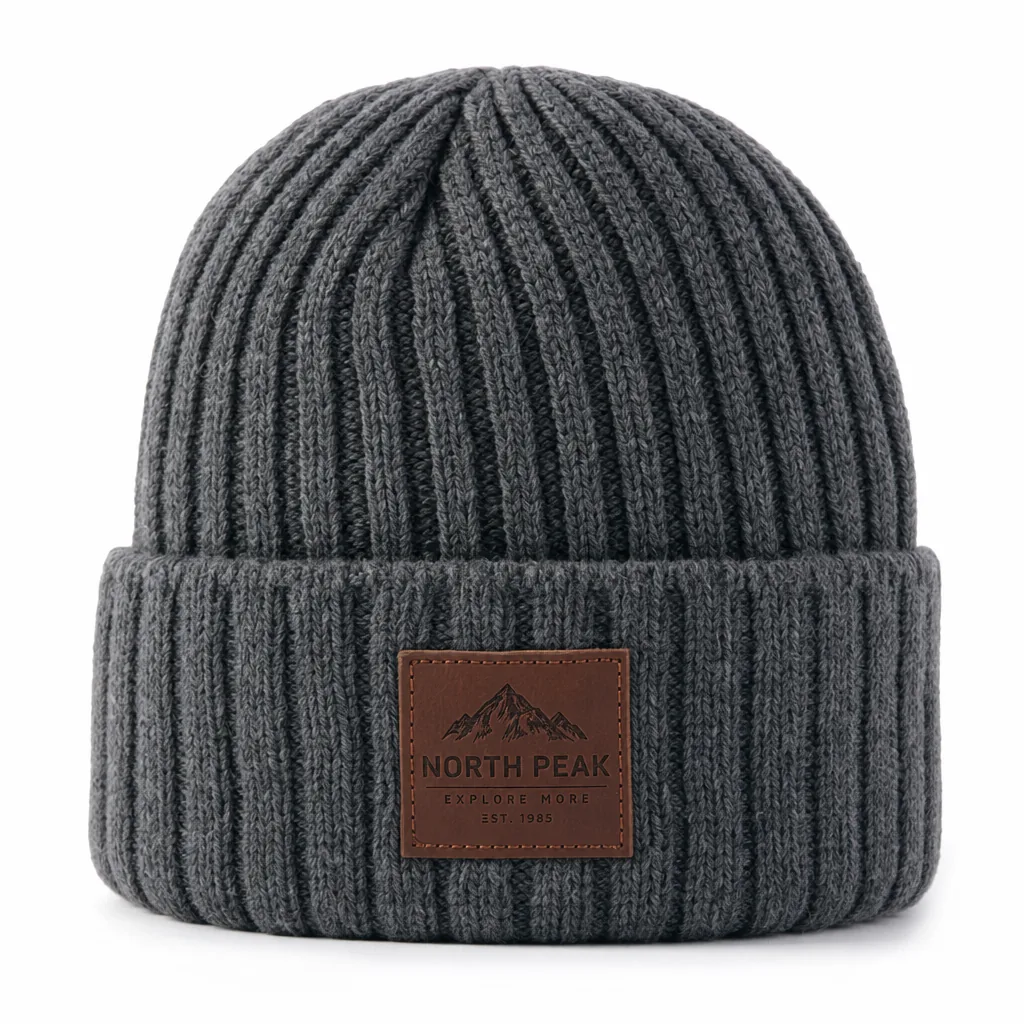
Cuff depth and knit structure control both fit and logo execution, and this is where weak specs create expensive inconsistency. A standard fold cuff usually finishes at 6 to 8 cm, enough space for a 50 to 60 mm woven patch or direct embroidery around 4,000 to 6,000 stitches without creating a stiff pressure band on the forehead. A deeper cuff at 9 to 11 cm gives stronger visual weight and better front branding presence, but once body height drifts more than 1.0 to 1.5 cm before folding, the silhouette is visibly off. Structure matters just as much: 1x1 rib gives the best stretch-recovery balance, 2x2 rib reads heavier and more casual, and flat knit is cleaner for all-over graphics but usually needs double-layer construction or a higher-denier yarn to avoid a thin handfeel. In bulk production, single-layer 12gg acrylic often lands around 75 to 90 grams, while double-layer cuffed styles commonly reach 110 to 140 grams, adding warmth, opacity, and better embroidery stability but also roughly $0.18 to $0.45 per piece in yarn and freight-sensitive weight. Lock finished weight to within +/-5%, and seal body height and cuff depth before bulk; those are the measurements buyers dispute most after shipment.
Yarn options
Yarn choice drives returns faster than decoration, so buyers should define the price tier before asking a custom beanie manufacturer for swatches: promo, retail core, or premium. For school spirit, giveaways, and value wholesale, 100% acrylic remains the safest platform because it runs cleanly on 7GG, 9GG, and 12GG machines, delivers stable shade consistency, and can usually hit Pantone TCX targets within a practical lab-dip tolerance of Delta-E 1.5-2.0 on solid colors. At 1,000-3,000 pieces, a standard acrylic cuff beanie typically lands around $1.10-$2.20 FOB China; anti-pilling yarn, jacquard artwork, fleece lining, or a tighter 12-gauge construction will push that higher. The real quality breakpoint is not the word acrylic but the yarn spec: 28/2 or 32/2 anti-pilling acrylic holds a cleaner surface after Martindale abrasion and repeated wear, while low-grade open-end yarn fuzzes early, loses crown shape, and looks flat after a few wash cycles. Acrylic is cost-efficient and production-friendly, but it does not deliver a true premium handfeel.
Most retail programs sit in blends because pure wool creates more trouble in both manufacturing and consumer care. Commercially, 50/50 wool-acrylic, 30/70 wool-nylon, and acrylic-polyester-neop blends are common because they balance warmth, elasticity, and cost while reducing yarn breakage, steam-setting distortion, and post-finish size variance. Surface character matters as much as fiber ratio: lofty wool blends can swallow embroidery detail, so lettering under 5 mm height often closes up unless the factory tightens gauge, lowers pile, and adjusts satin column width during digitizing on Tajima or Barudan heads. That is why approval should come from stitched samples on real knitted panels, not flat artwork or a paper strike-off. For premium programs, merino in the 19.5-21.5 micron range gives noticeably better next-to-skin comfort than standard wool, but it also raises raw-material cost and demands stricter shade control lot to lot. Cashmere blends are even less forgiving at scale: above roughly 5%-10%, pilling risk, lot variation, and yarn-price volatility start to outweigh the marketing value for most bulk beanie programs.
Decoration techniques for beanies
Flat embroidery is still the volume choice on beanies, but knit geometry—not artwork—usually decides what is actually manufacturable. On a 2x2 acrylic rib cuff, a 5,000-8,000 stitch logo will normally sew cleanly on Tajima or Barudan heads at about 650-800 rpm; push beyond that on soft 7-gauge knits or hairy recycled yarn blends and you start seeing tunneling, flagging, and lost edge definition. The right fix is in digitizing, not brute-force machine speed: lighter underlay, conservative pull compensation, satin columns above roughly 1.2 mm, and a tear-away or water-soluble backing to keep the logo sitting on the rib crest instead of collapsing into the valleys. Any custom beanie manufacturer promising crisp text below 4 mm on chunky knit is overselling unless the design is heavily simplified before sampling. For commercial programs, embroidery usually lands around $0.22-$0.55 per unit at 1,000 pieces, with metallic thread, 3D foam, applique, or a new punch file adding both cost and reject risk. Woven labels and patches solve the detail problem embroidery cannot. Damask woven labels hold fine serif copy, size marks, and 4-color brand elements far better than direct stitching on coarse ribs, and applied cost is commonly $0.13-$0.28 per piece depending on fold type and whether you sew two or four sides. Patch programs need more than a pretty sales sample: PU works for promotional caps, while genuine cowhide or suede reads better in fashion retail, but both should pass peel adhesion, crocking, and cold-flex checks before approval. On dark materials, I also watch edge paint and topcoat shift after 24 hours at low temperature, because that is where attractive lab-dips start turning into claims.
If the graphic should be part of the hat rather than an attachment, jacquard knit is usually the cleaner engineering choice. The logo is knitted into the structure itself, so you eliminate needle penetration distortion and get better long-term durability for teamwear, ski programs, and licensed product that will be washed hard. The tradeoff is development time and design discipline. Artwork has to be redrawn to machine gauge, small type often needs to be blocked up, and color count is limited by yarn feeder configuration and the knitting machine setup. A stripe-and-logo jacquard on a 12-gauge machine can look sharp, but every revision means a new knit program and another development round, so sampling moves slower than embroidery or label application. Sublimation is the outlier technique, and buyers should treat it as a panel-print solution rather than a true knit decoration method. In practice, it is usually printed on white polyester interlock or microfiber cuff panels that are later sewn onto the beanie body. It handles gradients, photographic fills, and sponsor-heavy layouts well, especially for event merchandise, but the hand feel is flatter and less premium than a full-fashioned or jacquard-knit beanie. That is why sublimation works better for promotional price points than core winter retail. If the target is a higher-end sell-through, I would usually choose engineered jacquard, a woven label, or a well-digitized embroidery file before I start attaching printed polyester to a cold-weather knit hat.
Lining options
Lining changes field performance faster than changing the shell yarn from acrylic to wool-blend. A single-layer 7-gauge acrylic beanie may pass a tech pack, but once you add a 160-220 gsm brushed microfleece liner, the product moves up a real warmth tier: better dead-air retention, less wind penetration, and a softer hand against the forehead and ears. It also hides the reverse of jacquard, intarsia, and high-stitch-count embroidery, which matters on ski resort, workwear, and outdoor promotion orders where customers immediately notice scratchy floats or backing edges. The tradeoff is fit engineering. Fleece lining typically adds 25-40 g per piece, pushes carton weight up around 8-12% on a 144-piece case, and can shrink finished head circumference by 0.5-1.5 cm if the shell was not graded for the extra layer. Any capable custom beanie manufacturer should recheck post-steam measurements, stretch recovery, and crown symmetry after liner attachment; too much joining tension at the crown will create torque, oval distortion, and uneven rebound after wear.
Satin lining solves a different problem entirely. It is not insulation; it is a low-friction interior specified for customers with curls, braids, locs, or chemically treated hair, and for retail programs selling “hair protection” as a feature. Most volume orders use 75D-100D polyester satin, while better private-label programs move to charmeuse-type constructions with a smoother face and better seam stability. Satin is harder to sew cleanly than fleece: seam grin-through, crown puckering, and needle heat marks show up fast, especially when pairing a dark shell with a light lining or when the closing thread tension is too aggressive. A disciplined custom beanie manufacturer should check seam slippage, colorfastness to rubbing, and crown puckering under AQL 2.5 instead of approving only the lab dip and bulk shade. In practical FOB China terms, microfleece lining usually adds about $0.35-0.70 per piece, while satin adds roughly $0.45-0.90 depending on denier, shade matching, and whether the liner is fully bagged or simply tacked in. On programs under $4.50 FOB, fleece usually delivers better cost-to-function value; satin earns its margin when the retail story is cleaner finishing and reduced hair friction, not extra warmth.
Pricing and MOQ
MOQ on knit caps is driven by yarn commitment and setup waste, not machine speed. For a plain cuff beanie in 1x1 rib at 70-90 gsm finished weight, using stock 28/2 acrylic on a 7-gauge or 9-gauge flat knitting program, a realistic target is 200 pcs per colorway, not 200 pcs mixed across six shades. At that level, FOB China pricing usually lands at $2.10-$2.80 with a standard center-fold woven label and export packing. Add cuff embroidery on a Tajima or Barudan head and the range moves to roughly $2.70-$3.60; once the logo passes 8,000-10,000 stitches, thread trims, backing consumption, and machine minutes start to matter. Melange yarn, jacquard knitting, polar fleece lining, or a pom typically adds $0.25-$0.90 per piece depending on gauge, yarn count, and finishing complexity. Small runs get expensive because development costs do not scale down neatly. A buyer looking for a custom beanie manufacturer often focuses on unit price and ignores the pre-production line items: Pantone TCX yarn matching, knit-down sampling, revised strike-offs, and shade approvals. If the factory can pull from stock shades, development may stay around $80-$150 per style; if the spinner has to dye or spin a custom lot, the surcharge rises fast and the MOQ usually follows. In practice, MOQ should be quoted by color, yarn composition, and construction because 300 pcs of solid acrylic rib and 300 pcs of jacquard melange with fleece lining do not consume the floor in the same way.
The real price break usually starts at 500 pcs, when yarn utilization, knitting allocation, and finishing loss begin to normalize. A basic acrylic or acrylic-poly beanie at that volume is commonly $1.65-$2.30 FOB, while an embroidered cuff version is more honestly $2.15-$3.00, assuming standard polybags, master cartons under 15 kg, and no special retail packaging. At 1,000 pcs, those same builds often settle at $1.35-$1.95 plain and $1.85-$2.55 embroidered. Extras are rarely dramatic on their own but add up quickly: woven clamp tags, merrow-edge patches, recycled polyester yarn, or RPET care labels usually add $0.12-$0.45 per unit, and each extra handling step increases inspection exposure. At 5,000 pcs, a plain cuffed beanie can realistically quote at $1.05-$1.55, with embroidered versions at $1.45-$2.10, but only when the order is concentrated into a workable number of colorways. This is where an experienced custom beanie manufacturer separates total volume from usable volume: 5,000 pcs across 10 colorways behaves like a fragmented order, while 5,000 pcs across 2-3 colors gives cleaner line balancing, lower remnant yarn loss, and more stable shade control. Our standard practice is to quote MOQ by color and construction first, then total units second, because that is what actually affects efficiency, defect risk, and final inspection performance against AQL 2.5 and acceptable Delta-E tolerance.
Seasonal planning
For Q4 delivery, September is already salvage mode; serious winter programs should be locked by May through July. A beanie has a shorter assembly route than a structured cap, but the critical path starts earlier because yarn booking, lab dips, knit-program setup, decoration sampling, and packing approvals all stack on the front end. If your custom beanie manufacturer is matching a Pantone TCX shade instead of pulling a stock color, allow 7 to 10 days just for yarn sourcing on common counts like 28/2 acrylic, 21Nm wool-touch acrylic, or 50/50 recycled polyester-acrylic. Add another 5 to 7 days for embroidery strike-offs on folded cuffs, where stitch density, underlay, and pull compensation have to be tuned to avoid tunneling on 1x1 and 2x2 ribs. Once you slip past July, you are no longer only late on materials; you are competing for the same flat-knit capacity, Tajima and Barudan embroidery heads, woven-label production, and vessel space as every holiday program in the market. At that point, a two-day approval delay can easily turn into a missed ex-factory date. The real risk is not one big failure but several small ones landing on the same week. A custom shade that comes in half a tone warm, a cuff logo that shifts 3 mm off-center after folding, or a barcode file that arrives after carton print approval can each burn days you do not have. Our standard practice is to freeze artwork, BOM, care-label language, carton marks, and barcode data by August for October or November shipment, especially when the order carries multiple colorways, mixed size ratios, or retailer-specific packing rules. Every added SKU creates another chance for carton-ratio errors, label mismatches, and count discrepancies at final inspection.
Chinese New Year causes fewer missed winter shipments than late-season congestion, but buyers still underestimate how early the disruption starts. By late December, many yarn mills stop taking small top-up orders, carton and polybag suppliers stretch from a normal 7 days to 15 to 20 days, and outsourced steps like pom-pom attachment, woven-label folding, or metal badge fixing become unreliable. A January shipment often fails for a boring reason: knitting is complete, embroidery is finished, but one missing trim blocks packing. That is why top-up POs placed after mid-December are far riskier than they look on paper, especially for styles with recycled yarn declarations, multilingual care labels, or retailer compliance packaging. Early booking protects margin as much as timing. In June, stock-service yarn pricing is usually stable; by September, the same 28/2 acrylic or recycled blend can carry a 6 to 12 percent surcharge once capacity tightens. Decoration follows the same pattern: an 8,000 to 12,000-stitch cuff logo runs cleaner on ZSK or Barudan heads before peak load, while rushed orders are more likely to show loose trims, uneven cuff height, off-center placement, or puckering after fold-over. If the program is retail-bound, leave time for in-line QC and final inspection at AQL 2.5, with color tolerance agreed in advance—typically Delta-E under 1.5 to 2.0 under D65 lighting for body yarn and cuff match. The buyers who hit Q4 consistently do not gamble on one late PO; they book forecast volume early, then leave a narrower repeat window for proven sellers once sell-through data starts coming back.
Frequently Asked Questions
How long does production take?
Sampling takes 7 to 12 days. Bulk production runs 20 to 30 days depending on quantity, fabric availability and decoration complexity. Inspection and packing adds another 3 to 5 days before shipment.
What file format should I send for my logo?
Vector files (AI, EPS, PDF) are ideal. High-resolution PNG or JPG at 300 dpi on transparent background works as a fallback. Provide Pantone color references for accurate reproduction.
Can I order a sample before bulk production?
Yes. We strongly recommend approving a pre-production sample before mass production. Samples are charged at 35 to 60 USD each plus express shipping, fully refundable against confirmed bulk orders over 500 pieces.
What is the minimum order quantity (MOQ) for custom hats?
Our standard MOQ is 100 pieces per design and color, with sampling available from 1 piece. For complex multi-color logos or premium fabric upgrades, the MOQ can be lowered with a small per-piece surcharge.
What logo decoration techniques do you offer?
3D puff embroidery, flat embroidery, woven patch, leather patch, PVC patch, screen printing, sublimation, applique and laser etching, all in-house with no subcontracting.
What's the MOQ for custom embroidered baseball caps no minimum?
When evaluating custom embroidered baseball caps no minimum, the key considerations are construction quality, decoration capability, MOQ flexibility and lead time. Knitting gauge (7gg, 12gg fine knit), cuff options, ribbed vs flat knit, double-layer thickness. Acrylic (budget), wool blend (retail), merino wool (premium), cashmere blend (luxury).
How does ordering custom embroidered ball cap work?
When evaluating custom embroidered ball cap, the key considerations are construction quality, decoration capability, MOQ flexibility and lead time. Knitting gauge (7gg, 12gg fine knit), cuff options, ribbed vs flat knit, double-layer thickness. Acrylic (budget), wool blend (retail), merino wool (premium), cashmere blend (luxury).
What's the MOQ for custom embroidered hats no minimum no setup fee?
When evaluating custom embroidered hats no minimum no setup fee, the key considerations are construction quality, decoration capability, MOQ flexibility and lead time. Knitting gauge (7gg, 12gg fine knit), cuff options, ribbed vs flat knit, double-layer thickness. Acrylic (budget), wool blend (retail), merino wool (premium), cashmere blend (luxury).
How does ordering etsy custom embroidered hat work?
When evaluating etsy custom embroidered hat, the key considerations are construction quality, decoration capability, MOQ flexibility and lead time. Knitting gauge (7gg, 12gg fine knit), cuff options, ribbed vs flat knit, double-layer thickness. Acrylic (budget), wool blend (retail), merino wool (premium), cashmere blend (luxury).
Looking for a reliable hat manufacturer in China?
CrownsForge has produced custom hats for 800+ brands across 40 countries. From 100-piece launches to 100,000-piece retail programs, we deliver on time and on spec.
Get in touchRelated guides
10 Questions to Ask a Cap Manufacturer on Your First Call - Supplier Checklist
Read article →
Hat With Patch Decoration QC Checklist for Custom Hat Buyers
Read article →
Switching Hat Manufacturers Mid-Program Without Losing Quality - Supplier Checklist
Read article →We hope this guide demystifies winter beanie & knit cap manufacturing: the complete wholesale guide (2026 update) and helps you move forward with confidence. If you have questions specific to your project, our English-speaking sales engineers are one message away.