
10 Questions to Ask a Cap Manufacturer on Your First Call - Supplier Checklist
Every week, our sales team answers detailed questions about 10 questions to ask a cap manufacturer on your first call - supplier checklist. We wrote this guide so that wholesalers, streetwear brands, corporate buyers and promotional resellers can compare options with full information, and avoid the traps that show up only after production has started.
Question 1: What's the actual lead time from artwork approval to shipment?
A credible lead time starts with gates, not a vague promise. On a first call, I expect a cap factory to break the schedule into 7-10 calendar days for a pre-production sample after artwork approval, 25-30 days for bulk after PPS sign-off and deposit, and another 3-5 days for trimming, carton packing, final inspection, and export booking. For a normal 3,000-10,000 piece custom order, that usually means 35-45 days ex-factory or FOB China if the shell fabric is in stock, the closure is standard, and the logo file is ready for digitizing without rework. If a supplier says “around a month” but cannot separate sampling, cutting, embroidery, sewing, finishing, and booking, they are not planning production; they are buying time. Among the best questions for hat manufacturer calls, this one exposes very quickly whether you are talking to a scheduler who knows the floor or a salesperson working from a generic quote sheet. Construction changes the clock more than buyers expect. A basic 6-panel brushed cotton twill baseball cap with flat embroidery on Tajima or Barudan heads is routine; a 5-panel recycled nylon camp cap with laser-cut vents, seam tape, molded TPU patch, and custom webbing is a different path entirely. Stock fabric can save 5-7 days, while custom-dyed fabric usually adds 10-14 days for lab dips and bulk shade approval, ideally within Delta-E 1.0-1.5 against the buyer’s Pantone TCX or sealed standard. Imported buckles, hook-and-loop tape, woven labels, or custom metal trims can add another week if purchasing is not locked early. A capable factory should tell you the real constraint by name: embroidery head capacity, cutting-table loading, wash schedule, finishing bottlenecks, or vessel cutoff.
The strongest answer includes capacity, bottlenecks, and risk controls, not just a ship date. Ask when trims are ordered, when the BOM is frozen after PPS approval, how many sewing lines are assigned, and whether inspection is inline plus final at AQL 2.5 or just a last-carton check. A factory that actually runs caps should be able to tell you that 5,000 structured baseball caps may run across two lines at roughly 1,200-1,500 pieces per day once embroidered panels are ready, and that sweatbands, eyelets, buckram forming, and back-closure assembly often slow output more than sewing itself. If they cannot identify the choke point, they probably do not control their own production schedule. You also need to hear what can slip after the caps are technically finished. Chinese New Year, Golden Week, month-end vessel cutoff, and port congestion can add 5-10 days even when cartons are sealed and passed inspection. If the program requires CPSIA-related testing, needle logs, carton drop tests, or metal detection for children’s product channels, that time has to be included up front. CrownsForge quotes sample lead time, bulk lead time, and FOB readiness separately because each stage has a different owner and a different failure mode. That is exactly why this belongs high on any list of questions for hat manufacturer calls: a promise of “two weeks total” is plausible for blank stock caps with simple decoration, not for a true custom production run.
Question 2: Which embroidery machines do you run?
One of the most revealing questions for hat manufacturer qualification is the simplest one: ask for the exact embroidery lineup by brand, machine type, and active head count. A factory that actually controls its own cap production should answer in concrete terms, such as Tajima TFMX-IIC 12-head cap machines, Barudan 15-head units for bulk, and 1-head or 2-head sample machines for strike-offs, approvals, and remake work. If the answer is “we have many machines,” assume there is outsourced capacity somewhere in the chain. On cap programs, that usually means unstable scheduling, inconsistent thread tension between lots, and weaker control over color matching. Single-head machines absolutely have a place for pre-production samples and urgent repairs, but they are not a serious backbone for 5,000 to 20,000-piece orders. The mix of machines matters more than the raw number. Dedicated cap frames, wide-angle cap drivers, and separate flat-bed stations let a shop run front crown logos, side hits, rear arches, and beanies without constant re-hooping, which is where registration drift starts on structured 6-panel caps with heavy buckram. A competent team should also talk about digitizing for its own machine settings rather than blindly accepting a generic DST file. On standard cap logos, clean production usually sits around 8,000 to 18,000 stitches; backing choice might be 70 gsm tear-away for lighter logos or cut-away for denser fills; and small satin text below roughly 3 mm height is where readability and edge definition start to fail. Those are factory-floor answers, not trading-company answers.
Head count drives output, consistency, and remake risk. One well-maintained Barudan 15-head running matched tension, needle condition, and color sequence across all heads will usually produce more stable bulk quality than a patchwork of old single-head machines. For standard flat embroidery on caps, normal production speed is about 900 to 1,100 stitches per minute; push much beyond that and you start seeing thread breaks, flagging, poor edge sharpness, and higher rejection rates. On 3D puff embroidery, most serious operators drop closer to 650 to 850 SPM, especially with 2 mm to 3 mm EVA foam and high-density satin borders, otherwise foam exposure and collapsed edges show up quickly. These are not small technical preferences; they directly affect shipment reliability. Ask how the machines are maintained and how much embroidery stays in-house during peak season. A serious factory should be able to state service intervals, needle-change practice by run hours, and the percentage of capacity reserved for sampling versus bulk. As a practical benchmark, four modern 15-head cap machines can support several thousand caps per week depending on stitch count, appliqué steps, and color changes. Our standard practice is to judge embroidery capability the same way buyers should: by active machine count, maintenance discipline, digitizing control, and whether bulk output can stay inside approved appearance standards and AQL 2.5 limits. If they can answer those points cleanly, you are probably talking to a manufacturer rather than a broker.
Question 3: Can I do a video factory tour right now?
If a supplier cannot show you the factory live within 24 to 48 hours, treat that as a real risk signal. On a first call, a polished PDF or 90-second promo video proves almost nothing; what matters is one continuous smartphone walk from the gate through cutting, sewing, embroidery, QC, and packing with no jump cuts. Ask the operator to stop on fabric rolls with lot stickers, WIP bundles with style cards, needle-control logs, and export cartons marked with PO numbers and consignee data. Those are the details that expose whether the supplier is running production or borrowing someone else’s floor for sales. Among practical questions for hat manufacturer screening, this is one of the fastest ways to separate a factory from a trader. Ignore the building facade and watch the workflow. On the embroidery line, you should see Tajima, Barudan, or ZSK cap heads loaded with cap frames, 40 wt polyester thread, backing rolls, and active orders at the machines. In QC, ask how they verify logo placement, crown height, visor symmetry, and color against Pantone TCX or coated references, and whether final inspection follows AQL 2.5. A real team should be able to quote working tolerances without hesitating: logo position within 2 to 3 mm, visor pairing checked left to right, and shade variance controlled to an agreed Delta-E standard. If they can also pull up incoming fabric inspection sheets and inline defect tags during the call, you are looking at a supplier with actual floor control, not just order-taking capability.
Repeated delays, claims that the workshop is “confidential,” or weak-signal excuses for a week usually point to one of three problems: they are a trading company, they subcontract heavily, or the factory condition will not survive a live walkthrough. There are legitimate restrictions; licensed sports graphics may be covered, and some factories need a day to clear customer samples or reroute the camera away from cutting tables, eyelet punching, or steam-forming stations. But if live access keeps slipping, assume it will also show up later in lead-time control, rework handling, and claims response. Use the tour to test operating knowledge, not just visibility. Ask for monthly output in pieces, sample lead time for flat embroidery versus 3D puff embroidery, MOQ by fabric color, standard shell fabric weight in gsm, and whether the site holds sedex-audit-cap-supplier-guide.html">BSCI 2.0 or Sedex SMETA 4-Pillar audit reports. A factory that actually cuts and sews caps will answer with ranges, not vague promises: 50,000 to 120,000 caps per month, 7 to 10 days for samples, 25 to 35 days for bulk after approval, and common shell fabrics like 260 to 320 gsm brushed cotton twill or 600D polyester. That is why live video sits near the top of serious questions for hat manufacturer qualification on the first call.
Question 4: Which compliance audits do you currently hold and when do they expire?
Start with three facts and do not let the supplier speak in generalities: audit standard, audit firm, and expiry month. A credible first-call answer sounds like, "amfori BSCI 2.0, audited by Intertek, grade C, valid through October 2026," or "Sedex SMETA 4-Pillar, audited by SGS, completed December 2025." Then ask for the audit ID, report reference, and exact legal entity name so your sourcing team can verify the record in amfori or Sedex rather than relying on a cropped PDF. If the answer is "we passed last year" or "renewal is in progress," treat that as commercial risk, not admin delay. Many retailers, licensed sports programs, and promotional distributors will not release a PO against an expired social compliance file, even if pricing, samples, and lab dips are already approved. Among the most revealing questions for hat manufacturer calls, this one shows whether the factory controls compliance with the same discipline it should apply to AQL 2.5 inspection, Pantone approval, and ship-date planning.
The certificate title alone is not enough; scope is where weak suppliers usually hide. Confirm the audit covers the exact production site making your caps, including cutting, sewing, embroidery, finishing, packing, and any dormitory or canteen tied to that address. I have seen suppliers present a valid Sedex profile for a sales office while the workshop running Tajima or Barudan embroidery heads had no working-hours records, no needle control log, and no documented chemical storage procedure. Match the English and Chinese company names, full site address, worker headcount, audit scope, and subcontracting status. If brim stitching, garment washing, screen printing, or metal trim attachment is outsourced, ask whether those subcontractors also hold current BSCI 2.0 or SMETA 4-Pillar coverage. This matters even more for kids' caps, licensed product, and accounts that require BSCI, Sedex, CPSIA, or Proposition 65 paperwork before bulk approval. Audit timing matters too: if the file expires during your sample-to-bulk cycle, a renewal and CAP closure can easily delay FOB loading by 2 to 6 weeks, depending on auditor capacity and finding severity. The right question is simple: what is active today, for which site, and until when?
Question 5: What's your MOQ and how does it scale?
MOQ only means something if the factory breaks it down by style, color, and decoration. On a first call, ask for the minimum by SKU, then ask what changes if you add a second colorway or switch from flat embroidery to 3D puff. A factory that actually costs from BOM and labor minutes will give you hard tiers: 100 pcs per color per logo for a stock 6-panel brushed cotton twill cap, 144 pcs for a rope cap or 5-panel camper with more sewing operations, and 200 to 300 pcs for washed, enzyme-washed, or garment-dyed programs where shade variation and wash loss increase waste. If they say they can do 48 or 50 pcs, the missing piece is usually price: FOB often rises 25% to 45% because digitizing, pattern setup, marker planning, machine balancing, and in-line QC are spread across too few units. On a Tajima or Barudan line, a 3D puff logo also adds foam testing, stitch-density adjustment, and more setup minutes than a standard flat front mark.
One of the most useful questions for hat manufacturer screening is where the price breaks sit and what operational change drives each break. Ask for quotes at 100, 300, 500, 1,000, and 5,000 pcs and make them explain the delta. A real answer references fabric utilization, trim MOQs, carton fill, and defect allowance under AQL 2.5, not vague phrases like “MOQ is flexible.” As a realistic benchmark, a basic 6-panel cap in 260 gsm brushed cotton twill with standard flat embroidery may land around $4.80 to $7.20 FOB at 100 pcs, then drop once setup cost is diluted above 1,000 pcs. Material choice can move the floor fast: stock chino, cotton twill, and poly mesh often work at 100 pcs, but custom-dyed Pantone TCX fabric, 8-wale corduroy, nylon taslon, or recycled polyester usually pushes the true MOQ to 300 to 500 pcs per color. Trims can set the limit before the shell does; custom metal buckles, molded PVC patches, printed seam tape, and retail mailers regularly carry their own vendor minimums, so our standard practice is to separate factory MOQ from trim-supplier MOQ line by line.
Question 6: What's your sample fee policy?
A sample fee only makes sense when it tracks real setup cost, not a token number used to get you on the hook. For custom caps, a realistic range is $35 to $90 per piece before courier. A standard 6-panel brushed cotton twill cap with flat embroidery usually sits at $35 to $50. A technical 5-panel in 120 gsm nylon Taslon with laser-cut perforation, welded taping, molded silicone patch, custom woven loop label, printed seam tape, and individual polybag can land at $70 to $90. That fee should cover pattern adjustment, fabric and trim allocation, embroidery digitizing, logo placement testing, machine time on Tajima or Barudan heads, pressing, finishing, and internal QC to an AQL 2.5 standard. When building your questions for hat manufacturer list, ask exactly when that fee is credited back. In most factories, the sample charge is refundable at 300 to 500 pieces per style/color; for multi-decoration programs or licensed headwear with tighter compliance controls, the threshold is often 1,000 pieces.
The useful answer is never “sample fee depends” and nothing else; it should spell out what is included. Ask whether the charge covers one development sample only or one initial sample plus one revision, whether embroidery tape-outs or strike-offs are billed separately, and whether DHL, FedEx, or UPS freight is charged at actual cost, typically $28 to $45 to the U.S. for a single cap pack. A disciplined factory should also define the approval standard in writing: Pantone TCX or Pantone C reference, dyed fabric tolerance of Delta-E under 1.5 to 2.0, embroidery stitch count, logo placement tolerance of plus or minus 2 mm, and measurement tolerance on crown height, visor width, and head circumference of about plus or minus 0.5 cm. “Free sample” on a first call is usually a bad sign; it often means stock fabric, substituted trims, or a rushed make that does not reflect bulk production. The clean policy is to state the fee up front, write the refund condition into the PI, and separate development samples from PPS so buyers can compare suppliers on equal terms.
Question 7: What payment terms do you offer?
The cleanest answer on a first call hat factory discussion is still the industry-standard split: 30% deposit to start bulk materials and line booking, 70% balance against the B/L copy after shipment. That tells you the supplier has enough working capital to buy fabric, buckram, sweatband tape, and trims without using your cash to finance the whole run. For most custom cap programs in China, especially FOB Ningbo or Shanghai, this is a normal risk balance for both sides. If a custom hat manufacturer pushes for 50% to 70% upfront, ask why. There are legitimate cases—imported Japanese twill, specialty merino blends, or unusually expensive molded metal trims—but they should be able to break that surcharge down by material cost, MOQ, and lead time rather than giving a vague answer.
A better supplier will also give you a path to improved terms after performance is proven. A practical benchmark is Trade Assurance for early orders, then Net-15 or even Net-30 after three successful shipments with no major claims, chargebacks, or late balance payments. In real cap supplier qualification work, I also want to hear whether they accept T/T, Alibaba Trade Assurance, and in some cases L/C at sight for larger programs above about US$20,000. If they mention that bulk production only starts after deposit, PPS approval, and final artwork sign-off, that is a good sign—they are controlling process, not improvising. These are the kinds of questions for hat manufacturer teams that quickly show whether finance discipline matches production discipline.
The red flag is simple: 100% upfront for standard orders is rarely justified and should trigger deeper vetting cap supplier questions. A factory asking full prepayment before cutting fabric is usually signaling cash-flow stress, weak banking access, or a trading-company setup with no credit from its own upstream vendors. I would also probe refund terms for failed pre-production samples, remake responsibility if Pantone TCX color is outside agreed tolerance, and whether shipment can be held if AQL 2.5 inspection fails. When you interview hat manufacturer candidates, payment terms should connect to accountability terms. At CrownsForge, our standard practice is to tie commercial milestones to production milestones so both sides know exactly what has been approved, what has shipped, and what balance is actually due.
Question 8: Who is my project manager and how do I reach them?
Your day-to-day contact matters more than the factory org chart. On the first call, ask for the project manager’s full name, direct email, WhatsApp, and working hours in China Standard Time—not a generic sales inbox that goes quiet once the PO lands. A capable cap factory should be able to tell you, immediately, who owns the tech pack, who confirms Pantone TCX or Pantone C against available fabric lots, who sends embroidery strike-offs from Tajima or Barudan runs, and who updates the critical path if sampling slips 24 to 48 hours. For overseas buyers, a practical response window is 4 to 12 business hours on weekdays; during sampling, anything slower than 24 hours is a risk because approvals on visor piping, snapback hardware, woven labels, or carton marks can push ex-factory by three to five days. Of all the questions for hat manufacturer qualification, this one shows whether communication is run by operations or diluted through layers of sales forwarding.
The real failure starts when the person replying to you cannot reach the floor. I have seen a visor sandwich change from Pantone 19-4052 TCX to black missed three times because the request never made it cleanly from merchandising to sewing, and the embroidery room kept running the old callout. Ask whether your project manager can speak directly with merchandising, cutting, digitizing, embroidery, sewing, and inline QC, and whether they can pull live status from WIP tracking instead of saying “checking internally” for 48 hours. If they cannot, expect preventable mistakes in logo size, stitch count, fabric substitution, care-label placement, PPS timing, and even carton labeling. A reliable supplier should also spell out escalation clearly: project manager first, backup merchandiser second, production manager third if the reply stalls. Our standard practice is one primary contact and one backup, with email used for BOM, labeling, and packing specs, and WhatsApp reserved for urgent approvals that affect sampling or vessel cut-off.
Question 9: What's your defect tolerance / AQL policy?
If a factory will not state an AQL number in writing on the first call, treat that as a procurement risk, not a minor communication gap. For custom caps, the baseline I expect is AQL 2.5 for major defects, with clear defect definitions agreed before bulk: off-center front embroidery, broken topstitching, visor distortion, wrong closure, fabric contamination, panel mismatch, and incorrect care labels. On a real first call hat factory discussion, ask how they classify critical, major, and minor defects, and whether they inspect against the approved sealed sample or just a general spec sheet. A custom hat manufacturer that answers vaguely with "we check everything carefully" usually has no disciplined release standard, which means quality becomes an argument after the goods are already on the water.
A good system is more than the AQL table itself; it needs a repeatable inspection method. The strongest suppliers will tell you they run a 32-point checklist covering shell fabric, sweatband attachment, crown symmetry, seam allowance consistency, embroidery thread trims, carton markings, barcode accuracy, and assortment ratio. They should also issue a photographic QC report for every shipment, ideally including inline inspection, finished-goods inspection, measurement points, packing view, and close-up defect examples. At CrownsForge, our standard practice is to reference the approved sample, Pantone TCX callout, measurement tolerance, and logo placement spec together, because a cap can pass dimensions but still fail visually if the front logo shifts 3 mm or the color shade drifts beyond an acceptable Delta-E.
One of the best vetting cap supplier questions is whether third-party inspection is welcome before balance payment. The right answer is simple: SGS, Bureau Veritas, Intertek, or QIMA can inspect at no surcharge, provided scheduling is reasonable and the order is packed to inspection readiness. If a supplier resists outside inspection, tries to substitute its own internal pass/fail judgment, or refuses to commit to AQL 2.5, that is a major cap supplier qualification red flag. When you interview hat manufacturer candidates, also ask who pays rework and re-inspection if the lot fails. Serious factories already know the answer, because they have had to re-screen embroidery defects, reblock bent brims, or repack mixed-size assortments before release.
Question 10: Can you give me 3 reference customers I can contact?
If a cap factory cannot produce three relevant, contactable references, treat that as a risk signal, not admin delay. A real supplier may need 24-48 hours to secure written permission before sharing a buyer’s email or WhatsApp; that is standard for private-label streetwear, licensed sports, and promotional accounts. What matters is match. If your program is 2,000-5,000 pieces in brushed cotton twill at $3.20-$5.80 FOB, references from a factory that mainly runs 50,000-piece promo visors at sub-$1.50 tell you almost nothing. Ask for customers with similar MOQ, construction, target market, and shipping terms, whether FOB Ningbo, FOB Shanghai, or DDP to a U.S. 3PL. Among the most useful questions for hat manufacturer screening, this one shows fast whether the factory has repeat export business, stable account management, and enough process discipline to support reorders instead of just making showroom samples. Do not settle for name-dropping. Ask what those reference customers actually buy and how often they reorder: 6-panel snapbacks in 108x58 cotton twill, unstructured dad caps in 14-wale corduroy, truckers with 260 gsm chino twill fronts and 20x20 PE mesh, or running caps in 75D microfiber with laser-cut side panels. Push into decoration and controls: 3D puff embroidery on Tajima or Barudan heads, woven patch application, silicone heat transfer, visor stitching density, and whether bulk fabric stays within an agreed Delta-E against approved Pantone TCX standards. A strong reference should also confirm operational details buyers care about on second and third orders: on-time ex-factory performance, claim handling, carton accuracy, and final release at AQL 2.5.
If a supplier says all references are confidential, accept that only as a temporary position. Before deposit, they should be able to provide at least one live contact or credible substitute proof: redacted purchase orders, recent bill of lading data, shipment history by season, or current social compliance reports such as BSCI 2.0 and Sedex SMETA 4-Pillar. At CrownsForge, our standard practice is to align references by product category and order size first, because a buyer placing 1,200 fashion caps needs different proof than a distributor buying 20,000 event truckers. That distinction matters more than the total number of customers on a supplier’s list. The best reference checks go beyond “yes, they delivered.” Ask whether lab dips were approved quickly, whether embroidery sew-outs matched bulk, whether replacement rates stayed under 1 percent, and whether the factory handled peak-season lead times without slipping from 35 days to 60. Ask if invoices matched the quoted trim spec, whether master cartons passed drop-test expectations, and whether export documents were clean enough to avoid customs delays. If the answers stay vague, overly polished, or inconsistent with the product you are sourcing, move on. A dependable factory should be able to prove repeatability in production, not just competence in sales calls.
Frequently Asked Questions
How long does production take?
Sampling takes 7 to 12 days. Bulk production runs 20 to 30 days depending on quantity, fabric availability and decoration complexity. Inspection and packing adds another 3 to 5 days before shipment.
What file format should I send for my logo?
Vector files (AI, EPS, PDF) are ideal. High-resolution PNG or JPG at 300 dpi on transparent background works as a fallback. Provide Pantone color references for accurate reproduction.
Can I order a sample before bulk production?
Yes. We strongly recommend approving a pre-production sample before mass production. Samples are charged at 35 to 60 USD each plus express shipping, fully refundable against confirmed bulk orders over 500 pieces.
What is the minimum order quantity (MOQ) for custom hats?
Our standard MOQ is 100 pieces per design and color, with sampling available from 1 piece. For complex multi-color logos or premium fabric upgrades, the MOQ can be lowered with a small per-piece surcharge.
What logo decoration techniques do you offer?
3D puff embroidery, flat embroidery, woven patch, leather patch, PVC patch, screen printing, sublimation, applique and laser etching, all in-house with no subcontracting.
What should buyers know about cotton twill army cap kangol?
When evaluating cotton twill army cap kangol, the key considerations are construction quality, decoration capability, MOQ flexibility and lead time. Good answer: '7-10 days sampling, 22-28 days bulk, 3-5 days inspection and packing. Total order-to-FOB 35-45 days.' Vague answer ('around a month'), or impossibly short ('2 weeks total'), means the factory either doesn't track it or is lying to win the order. Good answer names brands: Tajima, SWF, ZSK, Barudan. Number of heads (15-head machines = high-volume; single-head =…
How does ordering best custom baseball cap work?
When evaluating best custom baseball cap, the key considerations are construction quality, decoration capability, MOQ flexibility and lead time. Good answer: '7-10 days sampling, 22-28 days bulk, 3-5 days inspection and packing. Total order-to-FOB 35-45 days.' Vague answer ('around a month'), or impossibly short ('2 weeks total'), means the factory either doesn't track it or is lying to win the order. Good answer names brands: Tajima, SWF, ZSK, Barudan. Number of heads (15-head machines = high-volume; single-head =…
What should buyers know about kangol bucket hat?
When evaluating kangol bucket hat, the key considerations are construction quality, decoration capability, MOQ flexibility and lead time. Good answer: '7-10 days sampling, 22-28 days bulk, 3-5 days inspection and packing. Total order-to-FOB 35-45 days.' Vague answer ('around a month'), or impossibly short ('2 weeks total'), means the factory either doesn't track it or is lying to win the order. Good answer names brands: Tajima, SWF, ZSK, Barudan. Number of heads (15-head machines = high-volume; single-head =…
How does ordering beanie hat custom work?
When evaluating beanie hat custom, the key considerations are construction quality, decoration capability, MOQ flexibility and lead time. Good answer: '7-10 days sampling, 22-28 days bulk, 3-5 days inspection and packing. Total order-to-FOB 35-45 days.' Vague answer ('around a month'), or impossibly short ('2 weeks total'), means the factory either doesn't track it or is lying to win the order. Good answer names brands: Tajima, SWF, ZSK, Barudan. Number of heads (15-head machines = high-volume; single-head =…
Looking for a reliable hat manufacturer in China?
CrownsForge has produced custom hats for 800+ brands across 40 countries. From 100-piece launches to 100,000-piece retail programs, we deliver on time and on spec.
Get in touchRelated guides
Baseball Hats For Men Export Shipping Checklist for Custom Hat Buyers
Read article →
Wholesale Hats Suppliers: Properties, Costs and How to Spec It Right
Read article →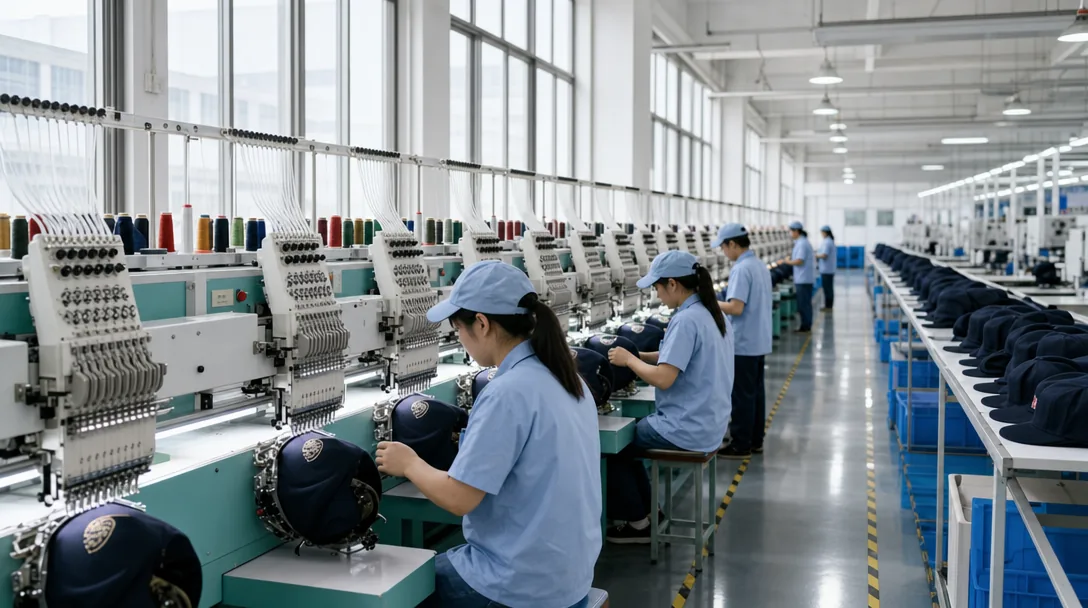
Country Hats For Men Sample Approval Process for Custom Hat Buyers
Read article →We hope this guide demystifies 10 questions to ask a cap manufacturer on your first call - supplier checklist and helps you move forward with confidence. If you have questions specific to your project, our English-speaking sales engineers are one message away.