
Wholesale Hats Suppliers: Properties, Costs and How to Spec It Right
Every week, our sales team answers detailed questions about wholesale hats suppliers: properties, costs and how to spec it right. We wrote this guide so that wholesalers, streetwear brands, corporate buyers and promotional resellers can compare options with full information, and avoid the traps that show up only after production has started.
Corduroy Hat Wholesale
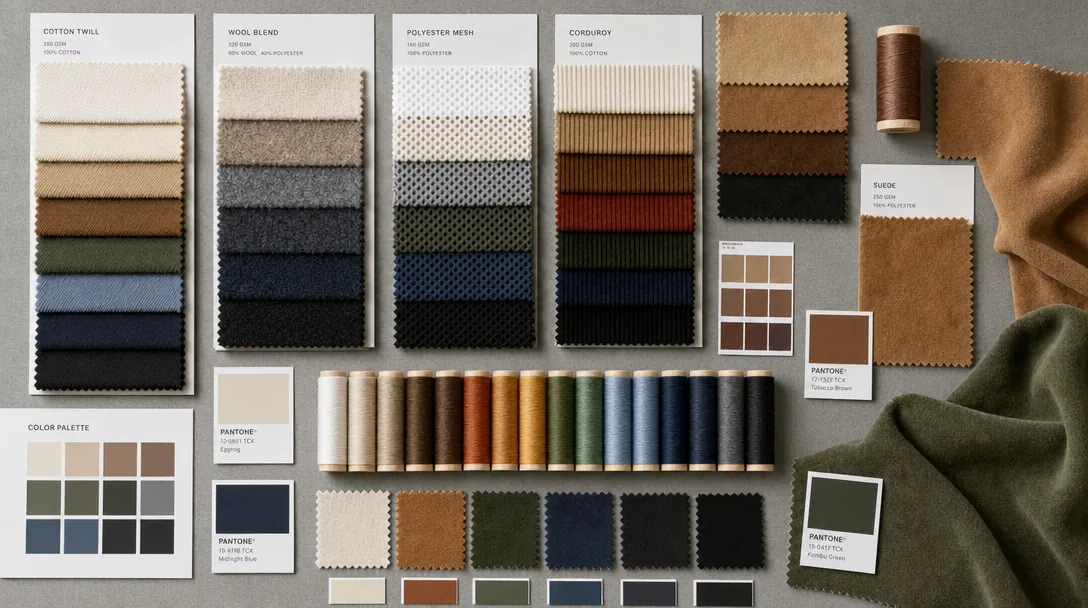
Corduroy hat wholesale is mostly about choosing the right wale count, crown structure, and color control before you ever talk price. A good corduroy cap usually uses 8-wale or 11-wale cotton corduroy at 240–320 gsm, paired with buckram or foam front panels if you want shape retention. Ask the factory for the exact face fabric composition, backing, and sweatband material; cheap lots often switch to polyester-cotton blends that pill fast and crush around the brim. For embroidery, the dense ridges distort stitch tension, so digitizing needs to be tested on a strike-off, not approved from a flat mockup. If you’re comparing wholesale hats suppliers, ask whether they have in-house embroidery heads like Tajima or Barudan and whether they can hold Delta-E under 2.0 on dyed panels, because corduroy absorbs color unevenly and small batch variation shows immediately.
For specs, don’t send “make it like the sample.” Send a tech pack with crown height, panel count, brim curve, taping width, closure type, and trim tolerances. A typical corduroy cap order for export starts around 300–500 pcs per colorway, with sample charges around USD 40–80 and unit pricing roughly USD 4.20–7.80 FOB depending on crown type, embroidery, and closure. Custom corduroy hats Australia buyers often get hit with higher freight and smaller MOQs because air shipment kills margin, while wholesale hat manufacturers usa may quote faster but usually at a much higher landed cost for the same build. If you need a black beanie hat alongside the corduroy program, keep the specs separate; beanies are usually knit-item pricing, not cut-and-sew, so bundling them only works if the supplier truly runs both lines.
The quality issues I inspect first are seam puckering, crushed pile, off-grain panels, and shade banding across the front two panels and brim. Corduroy hides defects until you steam the cap, so check under strong side light, then measure crown symmetry and brim stitch density against the approved sample. For production control, I’d request AQL 2.5 on general inspection, with special attention to fiber snagging, loose threads, and closure pull test. If the factory cannot provide test reports for colorfastness, shrinkage, and sweatband abrasion, that is a red flag, especially when you are comparing wholesale hats suppliers across China, Vietnam, and the US. In practice, the best sourcing decision is the one that balances fabric consistency, embroidery capability, and honest lead times, not just the lowest FOB line item; on corduroy, a cheaper supplier usually costs more once rework, claims, and unsellable shades are counted.
Wholesale Hat Manufacturers Usa
If you are comparing wholesale hat manufacturers usa against offshore factories, the first thing to understand is that the country label does not guarantee the construction method. A decent cap factory will still build the hat the same way: fabric cut by knife or laser, crown panels stitched on 301 lockstitch machines, visor board inserted, sweatband attached, then embroidery or patch application done on Tajima, Barudan, or ZSK heads. What matters is the spec sheet. Ask for crown height in centimeters, panel count, brim curve, closure type, sweatband material, stitch density, and Pantone TCX targets for dyed fabric. For a corduroy cap, I want the wale count, fabric weight in gsm, and shrinkage after wash. For a black beanie hat, I want yarn composition, gauge, cuff depth, and pilling grade, because knitwear problems are not visible on a glossy sample sheet. Buyers searching wholesale hats suppliers usually lose money because they compare sample photos instead of construction details.
Typical MOQs for branded headwear are 300 to 500 pieces per color for basic styles, but true custom runs often start at 1,000 pieces if you need woven labels, custom taping, or special dye lots. In the USA, labor and overhead push factory pricing higher; a plain dad cap can land around $5.50 to $9.50 ex-works, while a more complex corduroy hat wholesale program with embroidery, enzyme wash, and custom packing can sit in the $7.50 to $13 range before freight. If you are sourcing for custom corduroy hats australia, remember that DDP landed cost can jump fast once you add domestic VAT/GST, port charges, and last-mile freight. Serious buyers should request AQL 2.5 inspection on appearance and AQL 4.0 on workmanship-critical components like seam slippage, button attachment, and eyelet alignment. CrownsForge’s standard practice is to approve pre-production samples against a written tech pack, not verbal notes, because most quality disputes start with vague approvals and end with a rejected container.
The common defects are boring but expensive: off-center embroidery, uneven visor stitching, crooked side seams, color drift above Delta-E 2.0, weak hook-and-loop closure, oil stains from the sewing line, and misshaped crowns from poor packing. For corduroy and brushed fabrics, check nap direction, panel matching, and whether the fabric crushes under carton stacking; a soft corduroy cap can look premium in hand and arrive flattened if the carton spec is wrong. For knit items like a black beanie hat, inspect yarn tension, seam bulk at the crown join, and whether the rib recovers after stretch. The broader sourcing decision with wholesale hats suppliers is simple: choose manufacturers that can document fabric lot control, inline QC, and carton drop testing, not just send good photos. The cheapest quote usually hides higher reject rates, inconsistent dye lots, and rework fees that erase any savings on the first container.
Custom Corduroy Hats Australia
Custom corduroy hats Australia orders are usually made the same way as any structured 5-panel or 6-panel cap, but the fabric changes the failure points. The base cloth is typically 8-wale or 11-wale cotton corduroy, around 260-320 gsm, then cut with the nap direction controlled so the panels match under front-light. If you are asking wholesale hats suppliers for a corduroy cap, do not stop at “corduroy” in the spec sheet. Request wale count, fabric weight, fiber content, shrinkage after wash, crown structure, visor insert type, and whether the front panel has buckram or foam. For embroidery, ask for digitized stitch density and pull compensation; corduroy eats detail faster than twill, so a logo that looks clean on a black beanie hat or flat cotton twill can still distort on pile fabric.
Typical MOQ for this category is 300-500 pieces per color per logo for standard factory runs, with 100-150 piece surcharge runs if the factory is trying to fill an open production slot. At FOB China, a basic corduroy cap with woven label, one-color embroidery, and polybag packing often lands around USD 3.20-5.80 depending on fabric grade, closure, and crown construction; add another USD 0.40-1.20 for patch work, sandwich brim, or custom taping. Buyers comparing wholesale hat manufacturers usa to offshore suppliers should cost the full landed number, not just unit price: domestic pricing can look higher until you factor freight, tariffs, and lower minimums. For custom corduroy hats australia, DDP air or sea can make sense if the order is smaller and the retailer needs predictable landed cost in AUD.
The quality checks that matter are the ones that catch corduroy-specific mistakes before shipment. Inspect for nap direction mismatch, panel shade variance under daylight, skipped stitches on thick seams, crown collapse after steam, and brim edge waviness where the fabric is too soft for the board. On sample approval, I want a physical reference measured against Pantone TCX for thread and trim, plus a Delta-E target under 2.0 for any matching fabric components; for black styles, confirm there is no brown cast under warm light. If you are sourcing through wholesale hats suppliers, ask for AQL 2.5 inspection with photo evidence of defects, and confirm carton drop-test and moisture control because corduroy marks easily in humid transit. The factory that can handle a clean corduroy cap usually understands the discipline needed for other seasonal items too, including fleece pieces and a black beanie hat, but the spec sheet still needs to be exact or you will pay for it in rework.
Cotton Hats for Men
Cotton hats for men are usually built from 100% cotton twill, brushed cotton, or heavier canvas depending on the target hand-feel and margin. If you want a clean retail result, ask for fabric weight in gsm, yarn count if available, and shrinkage after wash; a 260 to 320 gsm cotton twill is the sweet spot for a structured dad cap or six-panel. For production, the factory should confirm crown buckram type, sweatband material, eyelet finish, seam allowance, and whether the visor is single- or double-layer with PE insert. On embroidery jobs, digitizing density matters as much as the fabric: too much stitch load on light cotton will pucker at the front panels, especially around a curved brim and center seam. Buyers comparing wholesale hats suppliers should not just ask for a sample photo; they should request a pre-production sample with the exact Pantone TCX color, stitch count, and wash test result before approving bulk.
Typical MOQ for a cotton men’s hat is 300 to 500 pieces per colorway if you want reasonable pricing, though some factories will stretch to 100 pieces at a higher unit cost. In a normal FOB China quote, a plain cotton five-panel can land around $2.20 to $3.80, while a custom embroidered six-panel with woven label, inside taping, and back closure usually runs $3.20 to $6.50 depending on fabric and trim. If you are comparing against wholesale hat manufacturers usa, the sticker price is often 2 to 4 times higher, but local lead time and domestic freight can offset part of that on urgent orders. For niche programs like corduroy hat wholesale, expect a premium of about $0.60 to $1.50 over cotton twill because corduroy needs better cutting control and the nap must be kept directionally consistent; that same logic applies if you are sourcing custom corduroy hats australia, where freight and compliance can push landed cost higher.
The quality failures I check first are panel symmetry, crown height tolerance, visor curvature, and color drift between lab dip and bulk production. Cotton looks easy until you inspect it under a light box: one roll can vary by Delta-E 1.5 to 2.0 against the approved sample, which is enough to trigger a customer complaint on a black beanie hat or a deep navy cap. Sewing issues are usually more expensive than fabric issues, so inspect topstitch spacing, thread tension, sweatband alignment, and whether the back closure sits centered after packing compression. For wholesale hats suppliers, I would insist on AQL 2.5 for major defects, 4.0 for minor defects, and a one-piece retained sample from each color run. If the supplier cannot explain fabric composition, shrinkage, or trimming tolerance in plain numbers, they are not ready for serious bulk buying, and the pricing you get will not survive the first QC pass anyway.
Acrylic Beanie Hats
Acrylic beanie hats are usually made from 100% acrylic yarn in 7-gauge to 12-gauge knitting, with 1x1 rib or double-layer construction depending on whether the buyer wants a soft slouch or a tighter cuffed fit. On the machine floor, the real variables are yarn count, stitch density, and shrink control after steam setting; if those are off, the hat will twist, pill, or lose shape fast. For a basic black beanie hat, I’d ask the factory to confirm yarn composition, weight in grams per piece, folded height, cuff height, and whether the yarn is OEKO-TEX certified if the buyer needs retail compliance. Typical FOB pricing from wholesale hats suppliers is about $0.85 to $1.80 for plain stock beanies at 500 to 1,000 pcs, while custom jacquard or pom styles move higher because knitting time and finishing labor increase.
When you spec acrylic beanies, don’t stop at color and size. Request a POM sheet with circumference, body length, cuff width, and tolerance limits of ±0.5 cm on key dimensions, then define pilling target, colorfastness to rubbing, and wash behavior. For decoration, embroidery on acrylic knit needs backing control and low stitch density; otherwise the knit distorts around logos. If you’re comparing a corduroy cap or corduroy hat wholesale program to a beanie program, remember the risk profile is different: knit hats fail on stretch and yarn quality, while woven caps fail on panel symmetry, seam slippage, and fabric shade matching. Buyers sourcing from wholesale hat manufacturers usa or from Asia should still ask for the same discipline on measurements, lab dips, and pre-production samples, because “made locally” does not automatically mean better QC.
The usual factory MOQ for acrylic beanies is 200 to 300 pcs per color for stock yarn, but once you ask for custom Pantone-matched yarn, woven labels, or a branded cuff patch, 500 pcs per color is more realistic. If you need multiple sizes or two-color jacquard, expect setup charges for knitting programs and sampling, especially on smaller runs. Common defects to inspect include uneven rib tension, loose threads at the crown closure, yarn knot marks, wrong fold symmetry, and shade variation between production lots; for inspection, AQL 2.5 is standard for general apparel buyers, but I’d tighten visual checks if the order is for school programs, sports merch, or a licensed line. That same sourcing logic applies whether you’re buying a plain beanie or ordering custom corduroy hats australia through a broker: the supplier should show you raw material traceability, production lead time, and a realistic QC plan before you commit to a PO.
Corduroy Hats Australia
Corduroy hats for the Australian market are usually built on a cotton or cotton-poly brushed wale fabric, most often 11-wale or 16-wale corduroy at about 260–320 gsm, then cut and sewn like a standard 6-panel cap. The important spec is the wale count and nap direction, because a cheap corduroy cap can look right in photos and still shade inconsistently across panels once it gets pressed in production. For custom corduroy hats australia, I’d ask for fabric composition, gsm, shrinkage after wash, crown height, brim curve, and whether the underbrim is self-fabric or black twill. If the bill needs structure, specify buckram grade and stitch density; if it’s a softer streetwear build, request unstructured front panels and a washed finish. On embroidery, send Pantone TCX, thread density, and DST or EMB files, and if the logo sits on the crown, confirm the seam crossing tolerance so the needle doesn’t distort the pile.
Typical MOQ for corduroy hat wholesale runs 300–500 pieces per colorway when the factory is using stock fabric, but 800–1,000 pieces is more realistic if you need a custom-dyed corduroy cap or a special wash. In China, FOB pricing for a basic 6-panel corduroy cap usually lands around USD 2.80–4.80 at 500 pieces, with embroidery adding USD 0.35–1.20 depending on stitch count; a woven label, printed sweatband, and custom back closure can push it into the USD 5.50–7.50 range. Buyers comparing wholesale hat manufacturers usa will usually see higher labor costs, often 30–60% above Asia, but faster sample turnaround and easier small-batch reorders. If you are sourcing through wholesale hats suppliers, ask for all-in pricing that separates fabric, embellishment, packaging, and inland freight; otherwise you will not know what is actually driving cost.
The failures I see most often are pile crushing, seam puckering on the front panels, off-tone panels from poor shade control, and crown distortion after steaming. For inspections, check cord alignment across the center seam, embroidery registration, sweatband stitching, brim symmetry, and color consistency under D65 light; for bulk, I’d hold to AQL 2.5 for major defects and make the factory pull at least one pre-production sample plus a top-of-production reference. If the product is meant to sit beside a black beanie hat in a winter program, pay attention to hand feel and color depth, because corduroy that looks rich in the lab can read dusty in retail lighting. The sourcing decision is simple: the best wholesale hats suppliers are the ones that can prove fabric control, packing discipline, and stable repeat production, not the ones with the lowest first quote.
Working with CrownsForge for wholesale hats suppliers programs
The fastest way to lose money with wholesale hats suppliers is to skip a proper sample path. Our standard practice is 5 to 7 business days for a first proto on a simple 5-panel or dad cap, then 7 to 10 days for decorated revisions if the logo needs stitch-density adjustment or a new applique placement. For a corduroy cap or corduroy hat wholesale program, expect one extra round if the wale direction, visor board, or wash shrinkage changes the fit by more than 3 mm. We can work with lower MOQs than many wholesale hat manufacturers USA operations, but the real tradeoff is price: a 100-piece run will usually carry a 15 to 30 percent unit premium versus 500 pieces, especially on custom trims, woven labels, and specialty fabrics. First-time buyers usually need that flexibility more than they need a rock-bottom quote.
Decoration is where bad sourcing gets exposed. CrownsForge runs in-house embroidery on Tajima and Barudan heads, plus heat transfer, patch sewing, and private-label finishing, so we can control stitch count, underlay, and thread tension instead of outsourcing the risk. For a standard 3-inch front logo, 8,000 to 10,000 stitches is normal; once you push past 12,000, your price and puckering risk both rise fast. For a black beanie hat, we typically keep the knit density tight enough to hold a clean 2-color logo without distorting the crown, while for custom corduroy hats Australia shipments we pay close attention to colorfastness and trim corrosion because long ocean transit will punish weak components. That in-house control matters more than people think when comparing wholesale hats suppliers across factories.
Compliance and order control are what keep a small problem from becoming a chargeback. We build each program around fabric spec, Pantone TCX targets, and an agreed Delta-E tolerance, usually under 2.0 for critical brand colors, then inspect to AQL 2.5 for major defects and 4.0 for minor ones unless the buyer requests a tighter lot check. Our order workflow is simple: tech pack review, sample approval, pre-production confirmation, inline inspection, then final packing with carton marks and barcode labels matched to the PO. For brands selling into Europe or working with retail chains, sedex-audit-cap-supplier-guide.html">BSCI 2.0 and Sedex SMETA 4-Pillar documentation can be folded into the file set early, which cuts back-and-forth later. That is the part most wholesale hats suppliers miss: good hats are easy; controlled delivery, clean records, and repeatable specs are what protect margin.
Frequently Asked Questions
How long does production take?
Sampling takes 7 to 12 days. Bulk production runs 20 to 30 days depending on quantity, fabric availability and decoration complexity. Inspection and packing adds another 3 to 5 days before shipment.
Do you support sustainability certifications?
Yes. We work with GOTS organic cotton, GRS-certified recycled polyester, OEKO-TEX Standard 100 fabrics, and are BSCI and Sedex audited. Certification documentation can be provided per order.
What is the minimum order quantity (MOQ) for custom hats?
Our standard MOQ is 100 pieces per design and color, with sampling available from 1 piece. For complex multi-color logos or premium fabric upgrades, the MOQ can be lowered with a small per-piece surcharge.
What logo decoration techniques do you offer?
3D puff embroidery, flat embroidery, woven patch, leather patch, PVC patch, screen printing, sublimation, applique and laser etching, all in-house with no subcontracting.
Can I order a sample before bulk production?
Yes. We strongly recommend approving a pre-production sample before mass production. Samples are charged at 35 to 60 USD each plus express shipping, fully refundable against confirmed bulk orders over 500 pieces.
How do I find a reliable custom hat manufacturers usa?
When evaluating custom hat manufacturers usa, the key considerations are construction quality, decoration capability, MOQ flexibility and lead time. Cover everything buyers ask about wholesale hat manufacturers usa: how it's manufactured, what specs to request from a factory, typical MOQ and pricing, common quality issues to inspect for, and how this ties back to the broader wholesale hats suppliers sourcing decision. Cover everything buyers ask about corduroy hat wholesale: how it's manufactured, what specs to request…
How does ordering beanie hats custom work?
When evaluating beanie hats custom, the key considerations are construction quality, decoration capability, MOQ flexibility and lead time. Cover everything buyers ask about custom corduroy hats australia: how it's manufactured, what specs to request from a factory, typical MOQ and pricing, common quality issues to inspect for, and how this ties back to the broader wholesale hats suppliers sourcing decision. Cover everything buyers ask about acrylic beanie hats: how it's manufactured, what specs to request from…
How do I find a reliable baseball cap manufacturers usa?
When evaluating baseball cap manufacturers usa, the key considerations are construction quality, decoration capability, MOQ flexibility and lead time. Cover everything buyers ask about wholesale hat manufacturers usa: how it's manufactured, what specs to request from a factory, typical MOQ and pricing, common quality issues to inspect for, and how this ties back to the broader wholesale hats suppliers sourcing decision. Cover everything buyers ask about corduroy hat wholesale: how it's manufactured, what specs to request…
How does ordering custom hats made in usa work?
When evaluating custom hats made in usa, the key considerations are construction quality, decoration capability, MOQ flexibility and lead time. Cover everything buyers ask about wholesale hat manufacturers usa: how it's manufactured, what specs to request from a factory, typical MOQ and pricing, common quality issues to inspect for, and how this ties back to the broader wholesale hats suppliers sourcing decision. Cover everything buyers ask about custom corduroy hats australia: how it's manufactured, what specs to…
Ready to start your custom hat project?
Send us your tech-pack, sketch or even just an inspiration photo. We will respond with a detailed quotation and digital mock-up within 24 hours.
Request a free quoteRelated guides
Shipping Custom Hats from China: FOB, EXW, DDP & Incoterms Decoded
Read article →
Wholesale Trucker Hats with Custom Logo: A Complete Bulk Sourcing Playbook
Read article →
Launching a Hat Brand: Marketing Playbook for the First 12 Months
Read article →Sourcing custom hats does not have to be complicated. With the right manufacturing partner, clear specifications and a small upfront investment in sampling, you can launch a retail-quality product in 30 to 45 days.