
Launching a Hat Brand: Marketing Playbook for the First 12 Months
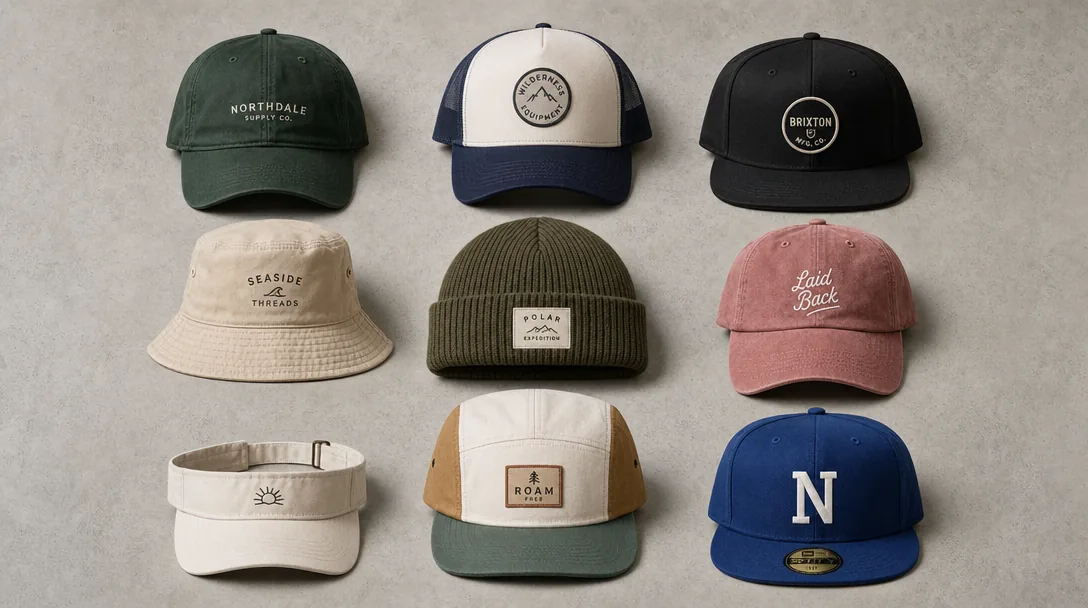
Every week, our sales team answers detailed questions about launching a hat brand: marketing playbook for the first 12 months. We wrote this guide so that wholesalers, streetwear brands, corporate buyers and promotional resellers can compare options with full information, and avoid the traps that show up only after production has started.
The first 90 days: brand identity + photo assets
The first 90 days are not about “building a vibe”; they are about locking four things that prevent chaos later: a usable logo system, a consistent voice, three core colors, and a photo library big enough to support a site, an Instagram grid, and a wholesale line sheet. For hat brand marketing, the logo has to work at embroidery scale first, not just on a mood board. I want a primary mark, a one-color version, and a small-size version that still reads on a 54 mm front panel or a woven label. Pick three core colors and pin them to actual references: Pantone TCX for fabric direction, plus CMYK/RGB values for web so your cap branding for startup does not drift between sample tags, website banners, and seller deck files. The hardest mistake I see is founders approving five colors, three fonts, and “we’ll refine later.” Later becomes expensive once packaging, hangtags, and digital ads are already in motion.
Without at least 30 usable images, you do not really have a launch asset set; you have a sample, not a brand. Thirty is the minimum because you need room for product-only shots, on-head lifestyle shots, detail macros of stitching and closure hardware, flat lays, color variations, and a few images that are intentionally left clean for wholesale buyers who want to drop them into their own catalogs. For launching a hat brand, plan 2 to 3 full shooting days from the first sample order, because hat product photography gets slowed down by fit adjustments, sweatband steaming, and correcting panel shape under different light. We usually tell founders to budget for one white seamless day, one outdoor or streetwear day, and one detail day; that mix gives enough material for custom hat marketing, email banners, and paid social without recycling the same angle. If you only shoot one hat from one angle, your conversion rate will tell you the truth fast.
Good cap brand seo starts with the photos, not the blog post. Each image should have a file name that matches the product system, alt text that includes the hat type and key material, and enough visual consistency that Google Images and marketplace buyers can recognize the brand at a glance. Keep the first asset pack simple: front, side, back, inside taping, sweatband, closure, close-up of embroidery or patch, and one full lifestyle scene per colorway. If you are sampling in batches, tag every photo against the exact spec sheet so the same style number is used across your website, lookbook, and wholesale outreach. The brands that move fastest in month one are usually the ones that treat image production like inventory control, not content theater.
Product photography: spec, lighting, and turnaround
For hat brand marketing, product photography is not optional polish; it is the sales asset that makes a new SKU believable before anyone has touched it. The minimum set I’d insist on is three angles with different jobs: a flat-lay on white background in 1:1 for marketplace listings and Shopify thumbnails, a lifestyle image in 4:5 for Instagram, Meta ads, and PDP modules, and a tight detail shot in 16:9 so buyers can inspect stitch density, patch edge clean-up, seam tape, and brim curvature. When launching a hat brand, that mix does more for conversion than another round of logo variants because it answers the questions buyers actually have: scale, texture, fit, and finish. For cap branding for startup founders, the fastest mistake is using one “pretty” image everywhere; the algorithm and the customer both punish that.
Our standard practice is to photograph against controlled, neutral lighting so the color reads close to production, not under warm showroom bulbs that push black toward brown or make navy look washed out. For custom hat marketing, I prefer a softbox setup with a color checker and a calibrated white balance, then a quick pass in post to keep Pantone TCX references honest; if the sample is off by Delta-E 2 or 3, the photo should not hide it. We can shoot all three formats at our facility with your sample order for a small per-shot fee, and that is usually faster than shipping hats back and forth to an outside studio. For teams working on cap brand seo, consistent file naming, alt text, and aspect ratios matter as much as the image itself because Google Shopping and organic product pages both reward clean, structured asset sets.
Turnaround depends on how fast the sample is approved and whether you want retouching beyond basic dust removal and lint cleanup. A straightforward set of flat-lay, lifestyle, and detail shots usually moves in 2 to 4 working days after the sample lands, while a more involved lifestyle shoot with talent booking, prop styling, or location work can stretch to a week. If the hat has complicated details — 3D puff embroidery, woven labels, suede patches, or a rope insert — I’d budget an extra day for close-up retouching so the stitch shadow and edge finish are visible instead of smeared. For hat product photography tied to early custom hat marketing, speed matters, but so does consistency; if you launch with mismatched shadows, clipped brims, and 20% different crop margins, you create avoidable work for every future campaign update.
The practical way to handle launching a hat brand is to treat photography like part of the sampling workflow, not a separate creative project that happens later. Get one approved production sample, then shoot the full content set before you place the first bulk order, because that gives you clean images for the product page, paid social, and distributor outreach while you are still fixing fit or embroidery density. It also helps cap branding for startup teams who need to test a few colorways without blowing the budget; one solid shoot can support multiple SKUs if the base silhouette is the same and only the panel color or front decoration changes. In my experience, that is the most efficient place to spend money early, because better images improve click-through rate, reduce pre-sale questions, and make cap brand seo work harder from day one.
Instagram + TikTok: organic growth in headwear
For hat brand marketing on Instagram, the feed usually wins before the reel does. The highest-performing content clusters are still outfit-style flat-lays, clean product-on-model shots, and customer-wearing proof that makes the cap look already adopted, not newly invented. If you are launching a hat brand, do not treat a cap as a standalone object; style it with denim, outerwear, teamwear, or streetwear basics so the brim shape, crown height, and embroidery scale are visible in context. Good hat product photography here means hard light control, a consistent background, and enough close-up detail to show stitch density, thread sheen, and panel structure. A 6-panel structured cap with a 3D puff logo should look materially different from a washed dad cap, or the buyer cannot tell why your price is higher.
The content that usually earns saves and shares is behind-the-scenes manufacturing, but only if it looks real. People respond to embroidery heads running, visor stitching, panel cutting, sweatband insertion, and packing lines because that proves the cap is not just a mockup. For cap branding for startup founders, that factory footage also does a second job: it quietly reduces buyer anxiety about MOQ, lead time, and consistency. One strong sequence is a 10 to 15 second “cap drop” announcement video that moves from blank panels to finished cap to on-head fit, with a clean caption naming fabric, closure type, and colorway. That format works better than polished talking-head ads because headwear is tactile; buyers want to see shape, depth, and finish, not hear generic brand language.
TikTok is less forgiving and more useful for momentum. Quick assembly edits, unboxing clips, heat-press or embroidery reveals, and before/after transformations are the format that usually gets picked up, especially when the edit shows a satisfying physical change in under 12 seconds. For cap brand SEO, the caption and on-screen text should repeat plain-language terms like snapback, dad cap, 5-panel, corduroy, or trucker cap instead of invented brand slogans. That helps both platform search and off-platform search traffic when people look for custom hat marketing examples. The brands that grow fastest post like operators, not lifestyle editors: show quantity, show process, show fit, and keep the visual grammar consistent enough that a buyer can recognize the hat shape in one frame.
Wholesale outreach: who to email and what to send
Independent retailers are the fastest way to get early volume for a new cap line, but they do not want a long brand story in the first email. For hat brand marketing, the winning package is simple: a clean linesheet PDF, three lifestyle photos, and a per-piece wholesale price list with clear margins. I’ve seen skate shops, surf stores, boutique buyers, and festival vendors delete anything that looks like a deck or a vague “let’s collaborate” note. If you are launching a hat brand, send one SKU per style, list the crown shape, fabric, closure, decoration method, and MOQ right on the sheet. Include wholesale pricing, suggested retail, lead time, and carton packout so the buyer can decide fast.
Cold-email performance is modest, so volume and clarity matter more than clever wording. A realistic benchmark is about 20% open rate and roughly 5% reply rate, which means your cap branding for startup outreach needs a lot of clean targeting, not more adjectives. Build your list by store type, not by geography alone: skate accounts want bolder graphics and flatter brims, surf shops care about washability and pigment-dyed cotton, festival vendors want fast turnaround and low risk. In custom hat marketing, a buyer is asking one question: can I sell this at 2.2x to 2.8x markup without support issues? If your wholesale price and perceived retail price do not make sense together, the email is dead on arrival.
The photos matter more than most founders think. Use hat product photography that shows the front, side, and back closure clearly, plus one worn image in context so the buyer can imagine the shelf appeal. Do not send studio cutouts only; retailers want to see how the hat sits on a real head, especially for trucker caps, unstructured dad caps, and five-panel styles. For cap brand seo later, reuse those same images on your product pages with filenames and alt text that include the style and colorway, but for outreach keep the PDF lightweight and under 10 MB. Our standard practice is to make the outreach asset look like a buying tool, not a brand manifesto: concise, factual, and easy to forward to a store owner who has 30 seconds between customers.
Paid ads vs organic: what works for a $50K launch budget?
If you have a $50,000 first-year budget, I would not let Meta eat more than 25% to 30% of it unless your creative pipeline is unusually strong. For a $30 to $40 cap, cold-traffic conversion math gets ugly fast: CPMs of $8 to $18 are normal, click-through rates often sit around 0.8% to 1.5%, and a new brand can easily see $35 to $70 customer acquisition cost before any repeat purchase data exists. Meta is still useful for launching a hat brand because it builds top-of-funnel awareness and gives you fast feedback on which colors, crown profiles, and logo treatments stop the scroll. But treat it as a testing and retargeting channel first, not your primary sales engine. In practical hat brand marketing, I would spend $8,000 to $12,000 on Meta over 12 months, with at least one-third reserved for retargeting product viewers, cart abandoners, and 30-day engaged visitors rather than broad interest stacks. Creative quality matters more than audience hacks. Flat lay shots rarely carry paid social for caps; short try-on clips, side-profile brim curvature, sweatband close-ups, and stitched logo macro shots usually outperform because buyers want to see shape retention and embroidery density before paying premium pricing. Good hat product photography is not cosmetic here; it directly affects thumb-stop rate and lowers wasted spend. We usually see cleaner results when founders shoot each SKU in 5 to 7 angles and separate lifestyle assets from PDP assets, then test hooks by silhouette: dad cap, A-frame snapback, unstructured 5-panel, and trucker all attract different buyers. If your brand has only three weak creatives, Meta will punish you faster than Search ever will.
Google Search is where a startup can win earlier because intent is doing the heavy lifting. Long-tail terms like "streetwear cap brand," "premium snapback hats," or even B2B-facing phrases such as "custom snapback wholesale" tend to produce lower traffic volume but much better buying behavior than broad social cold audiences. I have seen small apparel launches get non-brand CPCs in the $0.90 to $2.80 range on specific queries, then convert at 2.5% to 5% when landing pages are SKU-specific and load in under 2.5 seconds. For custom hat marketing, that is simply healthier math than paying for millions of low-intent impressions. A sensible split is $10,000 to $15,000 into Google across Search and a tightly controlled Performance Max test, while excluding junk queries and pushing budget into exact and phrase match terms that reflect real purchase intent. Search also forces operational discipline. Your product titles, collection pages, and ad groups need to mirror how customers actually shop: fabric, fit, closure, and use case. "100% cotton twill dad hat," "6-panel wool blend snapback," and "rope golf cap" are not interchangeable keywords, and your landing pages should prove the differences with close-up material shots, crown height specs, and stitching details. That is where cap brand SEO compounds with paid search rather than competing against it. Build pages around long-tail demand, write clean meta titles, compress images, and structure internal links from blog content into collection pages. At CrownsForge, our standard practice when advising startup buyers is to treat paid Search as immediate demand capture and SEO as the margin-protection layer that lowers blended CAC over months 6 to 12.
Organic is slower, but it is the only part of the mix that keeps paying after the ad budget pauses. If you are serious about cap branding for startup growth, I would allocate at least $12,000 to $18,000 of that $50,000 toward content, email/SMS capture, creator seeding, and cap brand SEO rather than pouring everything into ad dashboards. A founder-led content cadence can outperform polished campaigns if it shows real product truth: brim shaping, embroidery before-and-after digitizing cleanup, Pantone TCX color matching, fabric gsm comparisons, and wear tests after 20 to 30 uses. Those details build credibility, especially when buyers are choosing between your $38 cap and a cheaper generic option. Organic social should not be measured only by follower count; measure save rate, email sign-up rate, returning visitor rate, and assisted conversion paths in GA4. The best first-year structure is not paid versus organic; it is paid feeding organic proof and organic lowering paid inefficiency. I would roughly model a $50,000 launch as 25% Meta, 25% to 30% Google, 30% to 35% content and SEO, and the remaining 15% to 20% for retention tools, sampling, and creator product drops. That mix gives you enough data to learn without burning cash on vanity reach. In month 1, paid channels tell you which SKU deserves attention. By month 4, email flows, UGC, and ranking collection pages should start reducing dependence on cold traffic. By month 9, if hat brand marketing is working properly, branded search volume, repeat purchase rate, and direct traffic should be climbing together. If they are not, the problem is usually weak product-market fit or weak creative, not insufficient ad spend.
The first wholesale account: what to expect
The first wholesale account usually starts with terms, not enthusiasm. Expect the buyer to push for Net-30 once the line sheet is approved, and if you are a new vendor, expect resistance unless your margins and fill rate look clean. For a startup, 50% upfront for sample development or the lookbook run is normal because you are paying for embroidery program setup, woven labels, packing materials, and photography before any PO lands. In hat brand marketing, this is the part people underestimate: the buyer is not paying for your brand story, they are paying for confidence that the order will ship complete, on time, and without color drift beyond a Delta-E of 2.0 to 3.0 on approved Pantone TCX references. If you cannot state lead times, carton specs, and MOQ clearly, the account will stall fast.
Free freight on the first order is common because the retailer is testing you, not because shipping is free. Treat it as a customer acquisition cost and build it into the margin on the first PO, especially if you are doing FOB from Ningbo or DDP into the US. The smarter move is to use the first shipment to prove execution: barcode labels, master cartons, carton drops, and no mix-ups between colorways or size runs. For launching a hat brand, the first wholesale account is also where cap branding for startup teams gets judged in a very practical way — hangtags, backstrap spec, sweatband hand feel, and whether your hat product photography matches the actual article. If the photos hide fit or crown shape, the buyer will notice the mismatch the moment the cartons are opened.
Do not confuse one wholesale win with a finished sales engine. Repeat purchase rate at about 35% means 65% of first accounts do not reorder, so your first account is really a funnel test, not proof of product-market fit. Keep building outbound, sampling, and cap brand seo at the same time, because wholesale buyers often search the category months later and compare vendors by keywords, image quality, and trade-show visibility before they ever reply to an email. The brands that survive usually track reorder data by style, not by customer hype: which 6-panel dad cap, which washed cotton trucker, which embroidered logo depth sells through in 60 to 90 days. That feedback should feed the next sample round, because custom hat marketing only works when product, photos, and search visibility all reinforce the same core offer instead of drifting into three separate messages.
Frequently Asked Questions
Do you support sustainability certifications?
Yes. We work with GOTS organic cotton, GRS-certified recycled polyester, OEKO-TEX Standard 100 fabrics, and are BSCI and Sedex audited. Certification documentation can be provided per order.
What is the minimum order quantity (MOQ) for custom hats?
Our standard MOQ is 100 pieces per design and color, with sampling available from 1 piece. For complex multi-color logos or premium fabric upgrades, the MOQ can be lowered with a small per-piece surcharge.
What file format should I send for my logo?
Vector files (AI, EPS, PDF) are ideal. High-resolution PNG or JPG at 300 dpi on transparent background works as a fallback. Provide Pantone color references for accurate reproduction.
Which shipping methods do you support?
We support FOB, CIF and DDP shipping. Air express for samples and small orders, sea LCL for 100 to 500 pieces, sea FCL for 5,000+ pieces. Door-to-door DDP available for US, EU, UK, Canada and Australia.
How long does production take?
Sampling takes 7 to 12 days. Bulk production runs 20 to 30 days depending on quantity, fabric availability and decoration complexity. Inspection and packing adds another 3 to 5 days before shipment.
How does ordering baseball cap embroidered custom work?
When evaluating baseball cap embroidered custom, the key considerations are construction quality, decoration capability, MOQ flexibility and lead time. Meta ads work for cold-traffic awareness but underperform for direct conversion on a $30-40 cap. Google Search ads on long-tail keywords ('custom snapback wholesale', 'streetwear cap brand') convert better. Hat content on Instagram clusters around: outfit-style flat-lays, behind-the-scenes manufacturing, customer wearing, and 'cap drop' announcement videos. TikTok favors…
How does ordering custom embroidered trucker hat work?
When evaluating custom embroidered trucker hat, the key considerations are construction quality, decoration capability, MOQ flexibility and lead time. Hat content on Instagram clusters around: outfit-style flat-lays, behind-the-scenes manufacturing, customer wearing, and 'cap drop' announcement videos. TikTok favors quick assembly / unboxing edits. Meta ads work for cold-traffic awareness but underperform for direct conversion on a $30-40 cap. Google Search ads on long-tail keywords ('custom snapback wholesale',…
What's the MOQ for custom embroidered baseball caps no minimum?
When evaluating custom embroidered baseball caps no minimum, the key considerations are construction quality, decoration capability, MOQ flexibility and lead time. Meta ads work for cold-traffic awareness but underperform for direct conversion on a $30-40 cap. Google Search ads on long-tail keywords ('custom snapback wholesale', 'streetwear cap brand') convert better. Logo, brand voice, three core colors, and 30 photos. Without 30 photos you cannot launch a website, populate Instagram, or seed wholesale buyers. Plan 2-3 days of…
How does ordering custom flat brim hat work?
When evaluating custom flat brim hat, the key considerations are construction quality, decoration capability, MOQ flexibility and lead time. Hat content on Instagram clusters around: outfit-style flat-lays, behind-the-scenes manufacturing, customer wearing, and 'cap drop' announcement videos. TikTok favors quick assembly / unboxing edits. Flat-lay (white background, 1:1 aspect), lifestyle (model wearing, 4:5 aspect), detail shot (logo close-up, 16:9 hero). We can do all three at our facility with your sample…
Looking for a reliable hat manufacturer in China?
CrownsForge has produced custom hats for 800+ brands across 40 countries. From 100-piece launches to 100,000-piece retail programs, we deliver on time and on spec.
Get in touchRelated guides

How to Vet a China Hat Manufacturer Before You Wire the Deposit
Read article →
Custom Hats for Corporate, Business and Branded Merchandise Programs
Read article →
Mesh Caps Wholesale: Trucker Cap Manufacturing Specifications and Pricing
Read article →If you are ready to take the next step on launching a hat brand: marketing playbook for the first 12 months, our team can put a tailored quotation and digital mock-up in your inbox within 24 hours. Send the inquiry form on our contact page or message us directly on WhatsApp.