
Building a Repeat-Order Workflow with Your Hat Factory (2026 Update)
Every week, our sales team answers detailed questions about building a repeat-order workflow with your hat factory (2026 update). We wrote this guide so that wholesalers, streetwear brands, corporate buyers and promotional resellers can compare options with full information, and avoid the traps that show up only after production has started.
Why repeat orders are cheaper than first orders
First orders are expensive because the factory is building controlled production data, not simply sewing caps. For the Vincent Xi editorial byline, treat 2026 China cap quote checks as the evidence base, not old price memory: embroidery digitizing is commonly USD 30-80 per logo file, screen-print plate making USD 30-60 per color plate, Pantone TCX lab matching USD 40-100 per color target, and physical pre-production samples USD 40-80 per colorway; these are example assumptions to verify on the supplier’s proforma invoice. Source contexts are 2025-2026 China cap quotation templates for low-to-mid volume custom programs and CrownsForge buyer-education cost reviews covering digitizing, decoration setup, lab dips, and PPS approval flow. The method is simple: separate non-recurring engineering charges from repeatable unit costs, then record every controlled variable under one style code, including artwork, placement, shell fabric, closure, trim, carton mark, barcode, and packing ratio. A capable repeat order hat factory should show that split before the buyer signs the reorder PO.
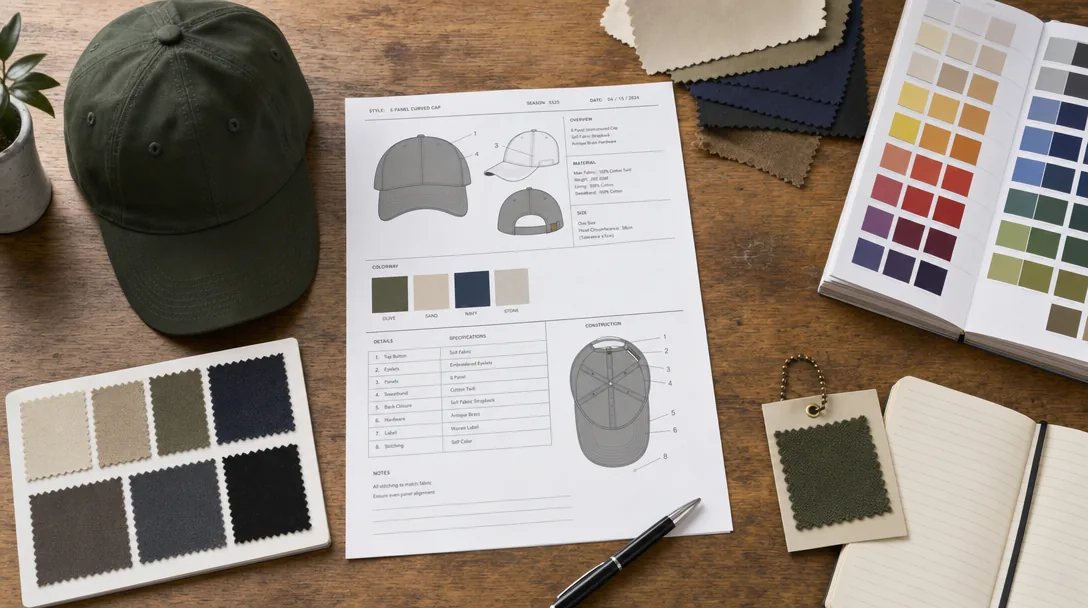
Reorder savings are legitimate only when the approved specification is unchanged and retrievable. Once a Tajima, Barudan, or ZSK sew-out is approved, the supplier should retain the DST file, Madeira or Gunold thread codes, stitch density, backing type, logo placement measurement, and approved sew-out photo under the same style code. The same logic applies to woven patch molds, silicone patch tooling, heat-transfer films, screen-print plates, carton artwork, and barcode labels. For a 500-piece reorder placed in 2026, removing one USD 60 digitizing charge, two USD 45 print plates, and two USD 60 colorway samples cuts USD 270 from setup before courier charges or the 5-10 calendar days often lost to another PPS round; this is an example calculation to confirm against current tooling status. A useful article visual would show an unbranded QC table with an approved cap sample, thread card, Pantone TCX chip, DST file printout, calipers, carton label proof, and AQL checklist, with no logos or people.
The main limitation is version control, not factory willingness. Buyers should verify that fabric still comes from the same mill at the same gsm, that the approved lab dip is still inside the buyer’s Delta-E tolerance, and that the factory has not changed buckram, sweatband, eyelet, closure, visor board, polybag, or carton supplier since the last purchase order. AQL 2.5 can structure final inspection sampling, but AQL does not prove repeat-order conformity unless the checklist references the approved sample, BOM, thread card, carton specification, and defect limits for loose threads, embroidery puckering, panel stains, asymmetric crowns, and crooked visors. Also separate setup savings from market movement: a cleaner reorder quote can still rise if 2026 cotton twill, recycled polyester, local wage, carton, or DDP freight costs moved after the previous shipment. Before treating the reorder as cheaper, confirm retained tooling, current material availability, and whether any mold, plate, or heat-transfer film has expired or worn out.
Locking in pricing for 12 months
Lock a 12-month FOB price only after the second or third repeat PO, when the supplier has real efficiency data instead of a sampling-room estimate. A repeat order hat factory should price against a named SKU and scope: 6-panel structured cap, 280 gsm cotton twill, 58 cm block, curved visor, antique-brass metal buckle, 10,000-stitch front embroidery, one polybag per unit, 50 units per export carton, FOB Ningbo under Incoterms 2020, quoted in USD. Build the baseline from the last 2-3 purchase orders, the approved PPS, BOM, marker or fabric-consumption sheet, embroidery run sheet, sewing output, rejection rate, carton cube, and final packing list. In 2026, a practical price lock is rarely a perfectly frozen number. Use a 12-month cap such as FOB unit price held within +/-2% to 3% if quarterly volume stays within +/-10%, the BOM is unchanged, and shipment releases arrive on time.
Tie price protection to a call-off calendar and booked inputs. A usable forecast might be 5,000 caps in Q1, 8,000 in Q2, 6,000 in Q3, and 10,000 in Q4 2026, with purchase releases issued 45-60 calendar days before the ETD. The clause should name the approved Pantone TCX shades or lab dips, confirmed DST embroidery file, thread brand and color codes, trim samples, pre-production sample, carton count, and fabric booking terms. If the fabric requires a custom dye lot, state the mill MOQ, such as 1,000 kg of yarn or 3,000 meters of fabric, and assign ownership of leftover greige or dyed goods if the buyer cancels, delays, or cuts the forecast. Classify costs clearly: labor, standard sewing thread, and factory overhead may be fixed; fabric and cartons may be capped; currency, duty, or buyer-requested air freight should be pass-through. Keep compliance separate from pricing: AQL 2.5 is an inspection sampling level, while sedex-audit-cap-supplier-guide.html">BSCI 2.0 or Sedex SMETA 4-Pillar only matters if current audit documents are supplied.
Define every event that breaks the lock before signing. If the logo increases from 10,000 to 14,000 stitches, the extra 4,000 stitches per cap should be repriced using the agreed decoration rate; at USD 0.18 per 1,000 stitches, that change adds USD 0.72 per cap before any thread or setup adjustment. Reprice the order if 280 gsm twill becomes 320 gsm twill, the standard buckle becomes a custom engraved mold, woven labels are added, carton quantity drops from 50 to 24 units, or bulk export packing changes to individual retail boxes. Set pass-through thresholds in numbers: cotton or polyester yarn movement above 5%, metal trim above 3%, carton board above 5%, or RMB/USD moving outside a stated range such as 7.05-7.35. Require evidence from supplier invoices, customs data, or an agreed index on the review date, and state overrun or underrun tolerance, MOQ exposure, and when a revised PPS is required.
Fabric reservation and dye-lot consistency
Fabric reservation is the control point that makes a repeat order hat factory predictable instead of lucky. Example calculation to verify in the 2026 supplier quote: a 10,000-piece, 6-panel cap program using 0.23 linear yard per cap of 58-inch cotton twill needs 2,300 linear yards before waste; with an 8% cutting, shrinkage, panel-matching, and shade allowance, the reservation becomes 2,484 linear yards for one colorway. The reservation line should say exactly what is being held: greige fabric, finished dyed fabric, or only a mill production slot. It should also list fabric weight in gsm, yarn construction such as 16 x 12 cotton twill or 21-wale corduroy, Pantone TCX target, dye-lot number, usable yardage after inspection, storage term, expiry date, and any warehouse charge per month. Source context: Vincent Xi, Editorial Author, https://crownsforge.com/authors/vincent-xi/, plus supplier-side production records used for cap costing, fabric booking, and repeat-order control.
Dye-lot consistency needs a measurable tolerance, because Pantone references alone do not keep two production runs visually aligned. As an example buyer-factory tolerance to confirm before deposit, specify Delta-E 1.0 or lower against the approved bulk standard, measured in Delta-E units on the same fabric face with a calibrated spectrophotometer under D65 viewing. A Q2 2026 navy cap and a Q4 2026 navy cap may both reference Pantone 19-4024 TCX, but different dye vats, resin-finishing recipes, or tenter-frame tension settings can still create a visible mismatch. AQL 2.5 under ANSI/ASQ Z1.4 or ISO 2859-1 can define final inspection sampling, but it does not prove shade continuity across separate dye lots. Methodology: these figures come from cap consumption math, dye-house lot control, retained-sample comparison, and cut-panel review used in custom hat production files. Limitations to verify: storage fees, unused-yardage refundability, shade guarantee period, shrinkage re-test cost, crocking grade, and wash colorfastness.
The reservation clause also needs a design-change trigger, because the same color does not make two fabrics interchangeable. If a 2026 program shifts from a structured 5-panel cap to an unstructured dad cap, consumption, fusing, panel blocking, shrinkage, and embroidery pull can change enough to invalidate the original yardage forecast. As example material references to verify by fabric spec sheet and test sew-out, 260 gsm cotton twill and 320 gsm corduroy can behave very differently under Tajima, Barudan, or ZSK embroidery heads when flat embroidery exceeds an assumed 8,000 stitches on a front panel. CrownsForge practice is to retain a cutting from the approved bulk lot and compare it before each repeat PO release, but that is a company control step, not a third-party certification. Visual brief/imagePrompt: factory QC bench with navy cotton twill rolls, dye-lot tags, Pantone TCX swatches, calibrated spectrophotometer, retained cap panels, metal cutting ruler, and sample 6-panel caps under neutral inspection lighting; no text, logos, watermarks, staged identities, or impossible machinery.
Sample-on-file matching for every repeat
A repeat order hat factory should release the reorder from the retained, buyer-approved PPS, not from a PDF, phone photo, or sales note. The physical PPS is the control for crown height, panel shape, visor curve, sweatband hand, fabric shade, thread color, embroidery placement, and logo density. Before bulk cutting, the factory should pull the stored PPS, the dated tech pack, the mill lot record, and the thread-card reference, then compare first repeat pieces in a D65 light booth against the correct standard: Pantone TCX for textile shade and the actual embroidery yarn code for thread. As an example tolerance to verify in the supplier quote, many 2026 reorder files use Delta E00 1.0-1.5 under CIEDE2000 for one solid-dyed fabric lot measured by spectrophotometer; that is not a universal rule. Heather, washed, pigment-dyed, and enzyme-finished caps need wider signed tolerances because variation is built into the process. Methodology should be simple and documented: physical sample first, instrument reading second, buyer-approved paperwork third.
The repeat check must cover dimensions, materials, and decoration, because a cap can match color and still fail as the same SKU. Measure crown height, visor length and width, button position, seam allowance, sweatband width, and stitches per inch against the PPS and repeat lot sheet. If the approved sample used 280 gsm cotton twill, record that as an example fabric specification to verify by mill certificate, weave, finish, and dye-lot reference; a 240 gsm substitute is not equivalent just because it looks acceptable under warehouse light. For embroidery, compare the sew-out to the approved DST file, thread code, backing type, needle size, stitch count, density, underlay, and machine-tension record. A move between Tajima, Barudan, or ZSK heads can be controlled, but backing and tension changes often alter edge sharpness and logo height. ANSI/ASQ Z1.4 or ISO 2859-1 with AQL 2.5, where specified by the buyer for that order, defines the sampling plan only; it does not define acceptable shade, shape, hand-feel, or logo appearance. Limitations to verify before production include sample fading, missing file versions, changed mill lots, and replacement rules for soiled PPS units.
Replenishment cycle: how often to reorder
Set the reorder trigger from live sell-through, not last year’s habit. For unchanged core SKUs in the 2026 selling season, a practical trigger is 60% to 70% unit sell-through by SKU, colorway, size range if used, and closure type; this is an example operating rule to verify against the buyer’s POS or wholesale replenishment data. A repeat order hat factory should already have the approved tech pack, DST embroidery file, thread chart, visor curve, carton marks, and AQL 2.5 inspection checklist, so the reorder calendar is mainly constrained by fabric booking, trim availability, embroidery-head time, and shipping mode. As an example calculation to verify in the supplier quote, unchanged 280 gsm cotton twill dad caps, wool-blend snapbacks, or nylon 5-panels often need 45 to 60 calendar days from PO confirmation to ex-factory completion, which usually supports a 3- to 4-month replenishment cadence for stable sellers. Do not combine all colors into one signal: black and navy may merit automatic replenishment, while Pantone 18-1664 TCX red, enzyme-washed panels, seasonal rope, or custom metal buckles need separate demand proof before another cut.
Seasonal programs need a backward calendar before inventory looks low. For a spring floor set, licensed holiday drop, team store reset, or national distributor program, use 6 to 9 months before the required in-warehouse date as a planning assumption to verify in the current 2026 supplier quote. Tajima, Barudan, and ZSK machines can repeat a 7,000-stitch front logo quickly once the tape is approved, but custom-dyed cotton, recycled polyester twill, woven labels, washed panels, and molded trims still depend on outside-vendor queues. Source contexts for this guidance are factory production planning files and buyer-side retail replenishment calendars; the named editorial author is Vincent Xi, Editorial Author, using the approved CrownsForge author profile. Methodology: compare the first-run production file with current capacity confirmation, then rebuild the ship date backward through material booking, lab-dip or strike-off approval, bulk cutting, sewing, embroidery, finishing, AQL inspection, and freight. Limitation: BSCI 2.0 or Sedex SMETA 4-Pillar documents support compliance review, but they do not prove open capacity, Delta-E color control, or finished-goods quality.
For promotional and event programs, the reorder date should tie to a named commercial trigger: confirmed conference attendance, distributor sell-in, stadium retail launch, or capsule release date. As an example calculation to verify in the supplier quote, 5,000 caps for a July 2026 delivery with the PO released 75 calendar days before the in-hand date might reserve 10 calendar days for strike-off approval, 35 to 45 calendar days for cutting, sewing, embroidery, finishing, and inline QC, then the remaining time for final AQL 2.5 inspection, carton marking, booking, and freight under the agreed Incoterms. Before locking the repeat PO, verify the current audit document, fabric stock by gsm or denier, Pantone TCX reference, Delta-E tolerance, embroidery file version, thread lot, trim availability, and written repeat-capacity reservation. Visual brief: factory planning desk with finished dad caps in neutral cotton twill, Pantone TCX chips, embroidery thread cones, cap tech pack, carton label layout, PO calendar, and AQL inspection sheet; no readable logos, people, watermarks, or impossible machinery.
Annual contract vs. spot-buy economics
Annual contracts usually beat spot buys only when the buyer commits to dated call-offs, not a vague annual quantity. Use an apples-to-apples quote: a 6-panel structured cap in 21s cotton twill, fused front panels, a 6,000-stitch flat embroidery, woven side label, self-fabric back strap, and zinc-alloy buckle may price at USD 4.80 per piece FOB Ningbo for a one-time 500-piece order. The same spec under a blanket PO with four quarterly 500-piece releases commonly lands around USD 4.25-4.45 per piece, a 7-12% reduction before freight and duty. The saving is not magic volume discounting. A repeat order hat factory can reuse the approved pre-production sample, embroidery digitizing, stitch count, thread color map, carton size, packing ratio, label artwork, and inspection checklist instead of rebuilding the job from zero. To make the discount enforceable, tie each lot to a release window: PO confirmation by day 1, materials booked by day 7, production start by day 30, and ex-factory by day 45-60.
The larger economic gain is reduced schedule risk. In peak season, an October spot reorder for Q4 delivery can slip 10-20 calendar days because embroidery heads, 280-320 gsm washed canvas or twill, matte black zinc-alloy buckles, 50D polyester woven labels, export cartons, or LCL consolidation space are already allocated. A planned program lets the supplier pre-book fabric, Pantone TCX-matched thread, trim, and carton inventory before September-November capacity tightens. Put the commercial rules in writing: whether the lower unit price applies from the first shipment or after a pilot lot; whether raw-material movement above a stated threshold, such as 5%, can reopen pricing; who owns the embroidery files and setup; who pays for unused fabric or trim MOQ; and whether capacity reservation carries a non-refundable fee. Keep quality language exact: Delta E <= 1.5 for approved lab dips, AQL 2.5 for final random inspection, and current amfori BSCI or Sedex SMETA 4-Pillar documents only for the actual production site. Recheck FOB savings against any DDP quote.
When to add a second supplier (dual-sourcing)
Dual-source only when repeat volume can keep both factories qualified on the same tech pack, BOM, approved cap body, trims, stitch files, carton marks, packing method, and defect library. For a repeat order hat factory program, 5,000 finished caps per year is a useful 2026 example trigger to verify against live quotations, not a universal rule. Below that level, duplicate onboarding often costs more than the risk reduction: counter samples, Tajima or Barudan embroidery digitizing checks, seam-tape setup, lab dips, Pantone TCX or thread-card matching, hangtag approval, carton-mark approval, and PP samples commonly add USD 250-600 per supplier as a pre-bulk assumption to confirm in the supplier quote, excluding courier and third-party lab testing. A workable split usually leaves 60-70% of volume with the primary factory and 30-40% with the backup, provided each PO still clears the factory's 2026 MOQ, commonly 1,000-1,500 pieces per style/colorway or 3,000+ pieces when custom fabric, buckle, sweatband, and thread are shared. The methodology should use two source contexts: current supplier quotation sheets and previous pre-shipment inspection reports, with Vincent Xi's CrownsForge author profile as the attribution source for the cap-production perspective.
A backup supplier is not real capacity until it has passed a full-size PP sample approval and shipped one controlled replenishment run under the same QC plan as the primary. Put measurable tolerances in the PO: crown height +/-3 mm per size/spec point, embroidery placement +/-2 mm from approved artwork coordinates, logo size +/-1 mm against the stitch file, sweatband width +/-2 mm, and fabric shade inside the approved lab dip or a stated buyer limit such as Delta-E <=1.0, labeled as an assumption to verify with the fabric mill's 2026 spectrophotometer method. Use ANSI/ASQ Z1.4 single-sampling inspection for the dated lot and carton count, commonly AQL 2.5 for major defects and AQL 4.0 for minor defects; that standard manages sampling risk, not perfection. Before shifting live volume, verify country of origin, Section 301 or other tariff exposure, current BSCI 2.0 or Sedex SMETA 4-Pillar document status, needle-control records, metal-detection logs, embroidery-head capacity, fabric mill origin, FOB versus DDP landed cost, and lead time. The limitation is practical: dual-sourcing only works when both suppliers can repeat the same cap without customer-visible drift.
Frequently Asked Questions
How long does production take?
Sampling takes 7 to 12 days. Bulk production runs 20 to 30 days depending on quantity, fabric availability and decoration complexity. Inspection and packing adds another 3 to 5 days before shipment.
Do you support sustainability certifications?
Yes. We work with GOTS organic cotton, GRS-certified recycled polyester, OEKO-TEX Standard 100 fabrics, and are BSCI and Sedex audited. Certification documentation can be provided per order.
What file format should I send for my logo?
Vector files (AI, EPS, PDF) are ideal. High-resolution PNG or JPG at 300 dpi on transparent background works as a fallback. Provide Pantone color references for accurate reproduction.
What is the minimum order quantity (MOQ) for custom hats?
Our standard MOQ is 100 pieces per design and color, with sampling available from 1 piece. For complex multi-color logos or premium fabric upgrades, the MOQ can be lowered with a small per-piece surcharge.
Can I order a sample before bulk production?
Yes. We strongly recommend approving a pre-production sample before mass production. Samples are charged at 35 to 60 USD each plus express shipping, fully refundable against confirmed bulk orders over 500 pieces.
How does ordering custom embroidered hats near me work?
When evaluating custom embroidered hats near me, the key considerations are construction quality, decoration capability, MOQ flexibility and lead time. First order absorbs digitizing setup ($30-$80), screen-print plate ($30-$60 per color), fabric color matching ($40-$100 per Pantone), sample fees ($40-$80 per colorway), and PPS approval cycle. Repeat orders amortize none of this — factory has all the files, tooling and samples on hand. Smart buyers sign 12-month pricing agreements with their factory at the second or third…
How does ordering custom bucket hat embroidered work?
When evaluating custom bucket hat embroidered, the key considerations are construction quality, decoration capability, MOQ flexibility and lead time. First order absorbs digitizing setup ($30-$80), screen-print plate ($30-$60 per color), fabric color matching ($40-$100 per Pantone), sample fees ($40-$80 per colorway), and PPS approval cycle. Repeat orders amortize none of this — factory has all the files, tooling and samples on hand. Smart buyers sign 12-month pricing agreements with their factory at the second or third…
What's the MOQ for custom embroidered hats no minimum no setup fee?
When evaluating custom embroidered hats no minimum no setup fee, the key considerations are construction quality, decoration capability, MOQ flexibility and lead time. First order absorbs digitizing setup ($30-$80), screen-print plate ($30-$60 per color), fabric color matching ($40-$100 per Pantone), sample fees ($40-$80 per colorway), and PPS approval cycle. Repeat orders amortize none of this — factory has all the files, tooling and samples on hand. Smart buyers sign 12-month pricing agreements with their factory at the second or third…
How do I find a reliable hat manufacturer los angeles?
When evaluating hat manufacturer los angeles, the key considerations are construction quality, decoration capability, MOQ flexibility and lead time. First order absorbs digitizing setup ($30-$80), screen-print plate ($30-$60 per color), fabric color matching ($40-$100 per Pantone), sample fees ($40-$80 per colorway), and PPS approval cycle. Repeat orders amortize none of this — factory has all the files, tooling and samples on hand. Smart buyers sign 12-month pricing agreements with their factory at the second or third…
Looking for a reliable hat manufacturer in China?
CrownsForge has produced custom hats for 800+ brands across 40 countries. From 100-piece launches to 100,000-piece retail programs, we deliver on time and on spec.
Get in touchRelated guides
Custom Leather Patch Hat Low Minimum: A 2026 B2B Sourcing Guide
Read article →
Mens Beanies: Properties, Costs and How to Spec It Right
Read article →
Bulk Trucker Hats Export Shipping Checklist for Custom Hat Buyers - Cost & MOQ Breakdown - Supplier Checklist
Read article →We hope this guide demystifies building a repeat-order workflow with your hat factory (2026 update) and helps you move forward with confidence. If you have questions specific to your project, our English-speaking sales engineers are one message away.