
Embroidery Thread Libraries: Madeira, Isacord and What Your Cap Factory Uses - Supplier Checklist
Embroidery Thread Libraries: Madeira, Isacord and What Your Cap Factory Uses - Supplier Checklist is one of the most-asked questions we receive from international buyers, and for good reason. With dozens of factories competing for your order and an alphabet soup of technical terms in every supplier quote, even experienced importers can feel lost. This guide consolidates what we have learned producing custom hats for clients in 40+ countries.
Three thread libraries that dominate cap embroidery
Madeira Classic No. 40, Isacord 40, and Robison-Anton Super Brite 40 are the thread libraries that matter in cap production, but they solve different factory problems. Madeira is the premium option when the front panel has no room for error: 3D puff borders, 2.5 to 3.0 mm satin lettering, fine tatami fills, and tonal shading on structured 6-panel caps. On Tajima or Barudan machines running 800 to 900 rpm, Madeira typically gives the cleanest luster and the most stable tension behavior, especially on dense logos stitched over buckram-backed crown panels. For an embroidery thread color hat program where charcoal, stone, navy, and black need visible separation under D65 light, Madeira is usually the easiest library to approve because lot-to-lot variance is tighter and off-shade cones show up less often. In China, the landed cost is commonly 10 to 15 percent higher than standard mid-tier 120D/2 polyester, but that premium is small compared with the cost of rework, panel rejection, and delayed vessel loading on a retail order.
Isacord 40 from Amann is the practical standard for volume programs because it balances durability, color depth, and availability better than most alternatives. Its trilobal polyester construction holds up well in sweat, UV exposure, and repeated home laundering, which is why it shows up so often on sports, uniform, and promotional caps. A competent factory can usually match most Pantone TCX or coated references to a commercially acceptable tolerance without a custom dye lot, but buyers should ask what that tolerance actually means in-house; if the supplier cannot define an approval standard such as Delta-E under 1.5 to 2.0 against the sealed sample, the shade control is probably loose. Robison-Anton still appears in export factories handling older U.S. brand tech packs, NCAA-style programs, and licensed merchandise where legacy thread codes are written into the BOM. The real checklist question is not which brand name the factory quotes, but whether they physically stock the colors, use current shade cards, verify against actual cones before bulk, and lock the approved thread code into the PO and pre-production sample.
The Pantone-to-thread translation problem
Pantone approval is only a visual target; it is not a thread SKU. Buyers approve a continuous color reference such as Pantone TCX, but a cap factory is choosing from a finite cone library, usually 800 to 1,200 running shades in Madeira Classic 40, Isacord 40, or Gunold, plus a much smaller bank of metallic, frosted, and neon yarns. That gap is where most embroidery thread color hat disputes start. A Pantone like 19-4052 TCX or 18-1763 TCX rarely has a one-to-one conversion, so the factory has to nominate the nearest cone code and judge it on the actual shell fabric, not on a PDF mockup. Serious suppliers compare against a physical shade card and then sew the cone on the cap fabric under D65 and TL84 light, because navy on white paper is not navy on black cotton twill. On the floor, acceptable tolerance is usually set by perception, but Delta-E still gives you a usable control point. For stock thread, a realistic target is often Delta-E 2.0 to 3.0 against the approved reference; below that, availability becomes the bottleneck unless you are willing to custom-dye thread at quantities most hat programs cannot justify. Stitch structure also shifts color. Small satin text under 4 mm height, dense fills at 0.38 to 0.42 mm spacing, and heavy underlay all make the same cone read darker than the Pantone chip because sheen, shadow, and stitch angle compress the visual tone. That is why a clean approval process names the thread brand, cone code, stitch type, and fabric color together, not Pantone alone.
The common buyer mistake is treating thread like screen ink. Rayon and trilobal polyester have different luster and light return, so the same nominal shade can look materially different once it is stitched. A fill at 45 degrees on brushed cotton twill will usually read darker than the same thread laid as a satin column, and base fabric matters even more on washed chino, pigment-dyed canvas, and 600D polyester where undertone bleeds into the eye. On khaki, olive, and stone shells, reds and oranges go muddy first if coverage drops or the underlay peeks through. We routinely see a 0.5 to 1.0 Delta-E visual shift just from changing ground fabric from white backing test cloth to a dark cap panel. The supplier checklist should therefore test process discipline, not whether someone owns a Pantone book. Ask which thread libraries they actually stock, whether they segregate dye lots for repeat POs, how often they replace physical shade cards, and whether they will send both a photo and a physical strike-off before bulk. On Tajima, Barudan, and ZSK heads, thread appearance can change if the operator pushes speed from 700 to 950 stitches per minute, loosens upper tension, or alters pull compensation to stop puckering. Our standard practice is to freeze the approved cone code, shell fabric code, backing spec, and sew-out reference on the production order, then verify inline and final goods under standardized lighting to AQL 2.5. For licensed programs, that record is worth more than any verbal assurance that the thread was close enough.
What 'closest match' really means visually
On a cap, “closest match” is a visual tolerance call, not a Pantone code copied into a PO and expected to translate perfectly into thread. Most cap factories run 40 wt / 120 denier trilobal polyester for embroidery, and that triangular filament reflects light far more aggressively than brushed cotton twill, acrylic-wool melton, or recycled polyester canvas. The same Pantone-based red can look noticeably cleaner and brighter once it is stitched as a satin column across a curved crown, especially on structured fronts with buckram pushing the logo toward the light. In practice, a factory may hold flat embroidery around Delta-E 2.5 to 3.0 against an approved reference, but whether that passes depends on what you approved in the first place: Pantone C, Pantone TCX, a physical thread card, or a sewn sample. Those standards are not interchangeable, and digital mockups are the weakest of the lot because monitor calibration and RGB conversion distort hue, value, and saturation before production even starts. For an embroidery thread color hat program, the only reliable approval path is physical thread card first, stitched strike-off second. Madeira Classic No. 40 and Isacord 40 are both industry-standard libraries, but they do not offer perfect one-to-one conversions across every navy, kelly, burgundy, or warm gray, and neither will visually match fabric with a different surface finish. A competent supplier should review sewn samples under D65 lighting and then recheck under warm retail lighting around 3000K to catch metamerism before bulk sewing. If the logo is color-sensitive, approval should be on the actual shell fabric with the planned stitch density, backing, and machine setup—whether Tajima, Barudan, or ZSK—because those variables change how much sheen the eye reads. Screen proofs are for size and placement; color approval belongs to the sewn sample, full stop.
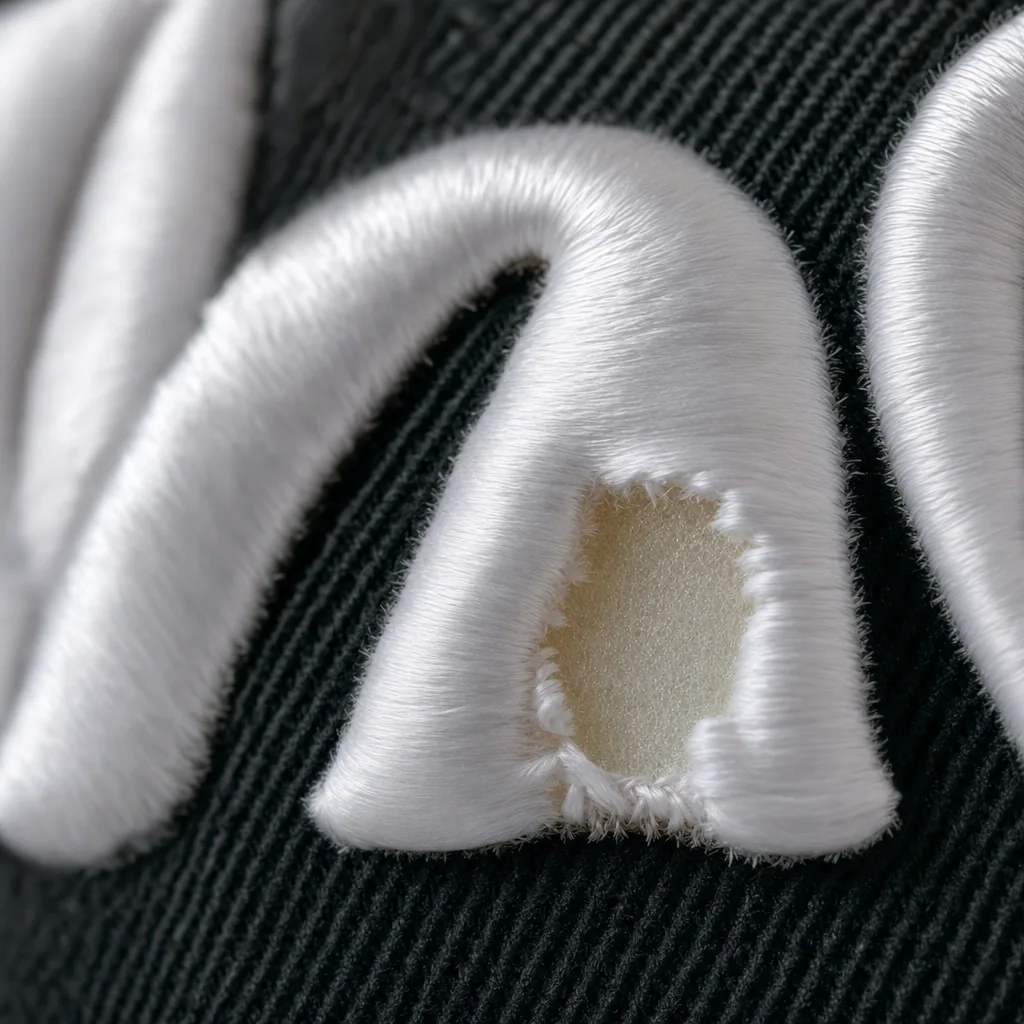
3D puff makes thread mismatch look worse, faster. Raised embroidery exposes more reflective surface, so a shade that looks acceptable on flat tatami fill can be rejected immediately once it sits on 2 mm or 3 mm EVA foam with a wide satin border. I have seen black, royal, and athletic red fail brand review at Delta-E 2.0 to 2.5 on puff fronts, even though the same variance would usually pass on standard flat embroidery at retail viewing distance. Technique matters just as much as color library: chain stitch, appliqué edge satin, and flat fill should never share one blanket approval because each construction changes thread angle, coverage, and perceived depth. If a brand color is sensitive, every decoration method needs its own sewn reference, not a recycled sign-off from another style. The workable rule is simple: approve sewn thread, not catalog numbers. A proper pre-production sample should use the actual cap fabric, target backing, final stitch density, and the same machine family intended for bulk production. For repeat orders, keep the thread supplier, cone code, approved sample, and QC record together, because dye-lot consistency in thread mills is not as tight as buyers assume. Our standard practice is to write color tolerance directly into the supplier checklist: flat embroidery reviewed within about Delta-E 3.0, 3D puff reviewed tighter at around Delta-E 2.0, and no release to production until the embroidery thread color hat sample is signed against the approved physical reference. That is the difference between a clean repeat on 500 caps and a preventable dispute on 50,000.
Specifying thread library on your tech-pack
Put the thread library on page one of the tech pack, next to the logo callout and size, not buried in Illustrator comments. “Red logo” is not a specification; it is how you end up with two different reds on the same PO when one line is run in-house and the overflow goes to a subcontractor. For an embroidery thread color hat program, the minimum line item should read like this: supplier, thread family, size, construction, shade code, and visual reference — for example, “Madeira Polyneon No. 40, 120D/2 trilobal polyester, color 1843, nearest Pantone 18-1664 TCX.” On caps, 120D/2 polyester is still the safest default for front logo work because it holds tensile strength and colorfastness better than rayon when the stitching crosses buckram, center seams, and high-sweat zones. If you leave out the library name, the operator will match from whatever cone stock is on the rack under 5000K factory lighting, and that shortcut is usually where approval problems start.
Pantone alone does not control embroidery thread because Pantone is a color target, not a spool standard. The thread code must come first, then the nearest Pantone TCX reference, then the approval method: “approve against physical thread card under D65 light box” is more reliable than a loose visual check at the sewing floor. If your QA team uses instrumentation, specify a tolerance such as Delta-E 2.0 max to the approved stitched swatch, but on embroidery I still trust strike-offs more than spectro data because trilobal filament sheen can distort readings depending on stitch angle and crown curvature. Separate the family when it matters: Madeira Polyneon and Madeira Classic do not read the same, and Isacord 40 wt shades can shift against the same Pantone when gloss and dye lot change. The cleanest format is a table listing logo position, stitch type, thread library, shade number, Pantone TCX, and substitution rule — ideally “no substitutions without written approval.” That is the level of control that keeps Tajima, Barudan, and ZSK runs consistent from sample room to bulk production.
Why metallic, fluorescent and pastel threads cost more
The premium on metallic, fluorescent, and pastel thread starts upstream, not on the embroidery head. A stock 40 wt trilobal polyester like Madeira Polyneon or Isacord is usually sourced around $2.20 to $3.00 per 5,000 m cone in normal factory volume, while fluorescent shades often run 30% to 50% higher and metallics can exceed $4.50 per cone after MOQ surcharges and inbound freight. Fluorescents cost more because the dye package is less stable under heat and UV, so mills scrap more during dyeing and winding to keep shade consistency usable. Pastels look simple but are often harder to control than dark colors: if the target is a soft Pantone TCX tone, a small shift in undertone can make the sewn result read gray, chalky, or dirty, especially when the embroidery thread color hat sample is stitched on black cotton twill, washed chino, or brushed suede. That is why pale pink, mint, and sand shades frequently need extra lab dips and one more strike-off before bulk approval.
Metallic thread is where the factory-side cost jumps fastest because it cuts output and raises breakage. Its construction—a polyester or nylon core wrapped with metallized film—creates more friction through the needle eye, tension path, and rotary hook, so Tajima, Barudan, and ZSK heads that comfortably run standard polyester at 850 to 900 stitches per minute are often pulled back to 600 to 700 spm, and lower again on dense satin fills or 3 mm lettering. Operators may switch from a DBxK5 #11 to a larger needle, loosen top tension, and still lose time to fraying, trims, and restarts. On a 500-piece cap order, that slower cycle can add roughly $0.12 to $0.35 per hat before rework is counted. Fluorescent and pastel shades create a different cost: approval risk. These colors shift noticeably under D65 daylight, 4000K LED retail lighting, and factory fluorescent tubes, so a cone that looks acceptable in the thread library can miss once sewn beside the shell fabric. If the buyer expects a practical Delta-E tolerance, the supplier may need two or three strike-offs instead of pulling the nearest stock shade and moving straight into production. In real costing, the thread invoice is rarely the main issue; extra sampling, slower machine speed, and a higher reject rate under AQL 2.5 are what push the embroidery premium.
Thread fastness: washing, light, abrasion
Polyester is the default for any serious cap program because it survives the three failure points that actually matter in the field: washing, UV exposure, and abrasion against seams, sweatbands, and transit cartons. Madeira Polyneon 40 and Isacord 40 are the two thread families most factories spec first for retail orders, typically in 120D/2 construction for standard front logo work on 6-panel caps and truckers. On a good production line, these polyester threads routinely deliver wash fastness around Grade 4–5, light fastness in the 6–7 range, and abrasion performance that stays clean enough to avoid fuzzy outlines after repeated wear. If a buyer asks about embroidery thread color hat consistency, this is where polyester earns its keep: the color stays stable not just on the sewing floor, but after a summer of sweat, sun, and hand washing.
Rayon does have a slightly richer luster, and on a showroom swatch card it can look more premium than polyester under direct lighting. The problem is that caps are not framed textiles; they live in UV, dust, and friction. Rayon thread generally loses ground on light-fastness, so bright reds, royal blues, and black-on-khaki contrasts can shift faster outdoors, especially when the embroidery palette hat uses high-exposure crown panels like brushed cotton twill or pigment-dyed canvas. That is why rayon is now rare in retail cap programs and more common in decorative fashion accessories or short-life promotional runs. If a supplier offers madeira thread cap options in rayon without clearly explaining the tradeoff, I would treat that as a red flag rather than a premium upgrade.
For buyers comparing a thread color library cap approval against bulk production, the right question is not just “Can you hit the Pantone?” but “Which thread system holds that match after use?” A competent factory should state whether it is using Madeira Polyneon, Isacord, or another polyester equivalent, and should be able to discuss shade selection, lot control, and acceptable Delta-E drift under the brand’s tolerance, often below 1.5 to 2.0 for critical logos. Our standard practice is to build the embroidery color match hat from the approved polyester card first, then test on the actual shell fabric because surface texture changes perceived color. That matters whether the program is using isacord thread cap embroidery for team headwear or a custom embroidery thread color hat spec for streetwear drops with tight repeat-order requirements.
Frequently Asked Questions
What logo decoration techniques do you offer?
3D puff embroidery, flat embroidery, woven patch, leather patch, PVC patch, screen printing, sublimation, applique and laser etching, all in-house with no subcontracting.
How long does production take?
Sampling takes 7 to 12 days. Bulk production runs 20 to 30 days depending on quantity, fabric availability and decoration complexity. Inspection and packing adds another 3 to 5 days before shipment.
Can I order a sample before bulk production?
Yes. We strongly recommend approving a pre-production sample before mass production. Samples are charged at 35 to 60 USD each plus express shipping, fully refundable against confirmed bulk orders over 500 pieces.
What is the minimum order quantity (MOQ) for custom hats?
Our standard MOQ is 100 pieces per design and color, with sampling available from 1 piece. For complex multi-color logos or premium fabric upgrades, the MOQ can be lowered with a small per-piece surcharge.
Which shipping methods do you support?
We support FOB, CIF and DDP shipping. Air express for samples and small orders, sea LCL for 100 to 500 pieces, sea FCL for 5,000+ pieces. Door-to-door DDP available for US, EU, UK, Canada and Australia.
How does ordering custom trucker hat near me work?
When evaluating custom trucker hat near me, the key considerations are construction quality, decoration capability, MOQ flexibility and lead time. Madeira (German, premium), Isacord (Amann, broad palette), Robison-Anton (US, broad palette). Most China factories stock at least Madeira + one of the other two. Thread color libraries are discrete (1000-1500 colors). Pantone has 1100+ TCX colors. Not every Pantone has an exact thread match. Factories pick the closest available — typically within Delta-E 2-3.
How does ordering custom hat embroidery lids work?
When evaluating custom hat embroidery lids, the key considerations are construction quality, decoration capability, MOQ flexibility and lead time. On flat embroidery: Delta-E 3 is generally invisible to most buyers. On 3D puff (large saturated area): Delta-E 2+ can be visible. Important to approve thread sample before bulk. Smaller production runs at the thread mill = higher per-yard cost. Metallic threads also stress embroidery machine needles, sometimes requiring slower machine speeds.
What's the MOQ for custom baseball cap no minimum?
When evaluating custom baseball cap no minimum, the key considerations are construction quality, decoration capability, MOQ flexibility and lead time. Polyester thread (Madeira Polyneon, Isacord) is the standard — excellent color fastness across all three tests. Rayon thread has a slight sheen advantage but lower light-fastness; rarely used for retail cap programs. Madeira (German, premium), Isacord (Amann, broad palette), Robison-Anton (US, broad palette). Most China factories stock at least Madeira + one of the other two.
What should buyers know about difference between dad hat and baseball cap?
When evaluating difference between dad hat and baseball cap, the key considerations are construction quality, decoration capability, MOQ flexibility and lead time. Polyester thread (Madeira Polyneon, Isacord) is the standard — excellent color fastness across all three tests. Rayon thread has a slight sheen advantage but lower light-fastness; rarely used for retail cap programs. Madeira (German, premium), Isacord (Amann, broad palette), Robison-Anton (US, broad palette). Most China factories stock at least Madeira + one of the other two.
Need a low-MOQ test order?
We help emerging brands launch with as few as 100 pieces. Premium fabric, in-house embroidery, retail-ready packaging.
Start a small orderRelated guides
Custom Waterproof Cap Manufacturer: A 2026 B2B Sourcing Guide
Read article →
Baseball Hats Men's: A Vertical-Specific Sourcing Guide - Cost & MOQ Breakdown
Read article →
Beanies for Men: Properties, Costs and How to Spec It Right - Cost & MOQ Breakdown
Read article →If you are ready to take the next step on embroidery thread libraries: madeira, isacord and what your cap factory uses - supplier checklist, our team can put a tailored quotation and digital mock-up in your inbox within 24 hours. Send the inquiry form on our contact page or message us directly on WhatsApp.