
Custom Made Trucker Hat: The 2026 Sourcing & Manufacturing Playbook (2026 Update) (2026 Update) - 2026 Buyer's Guide - Supplier Checklist (2026 Update)
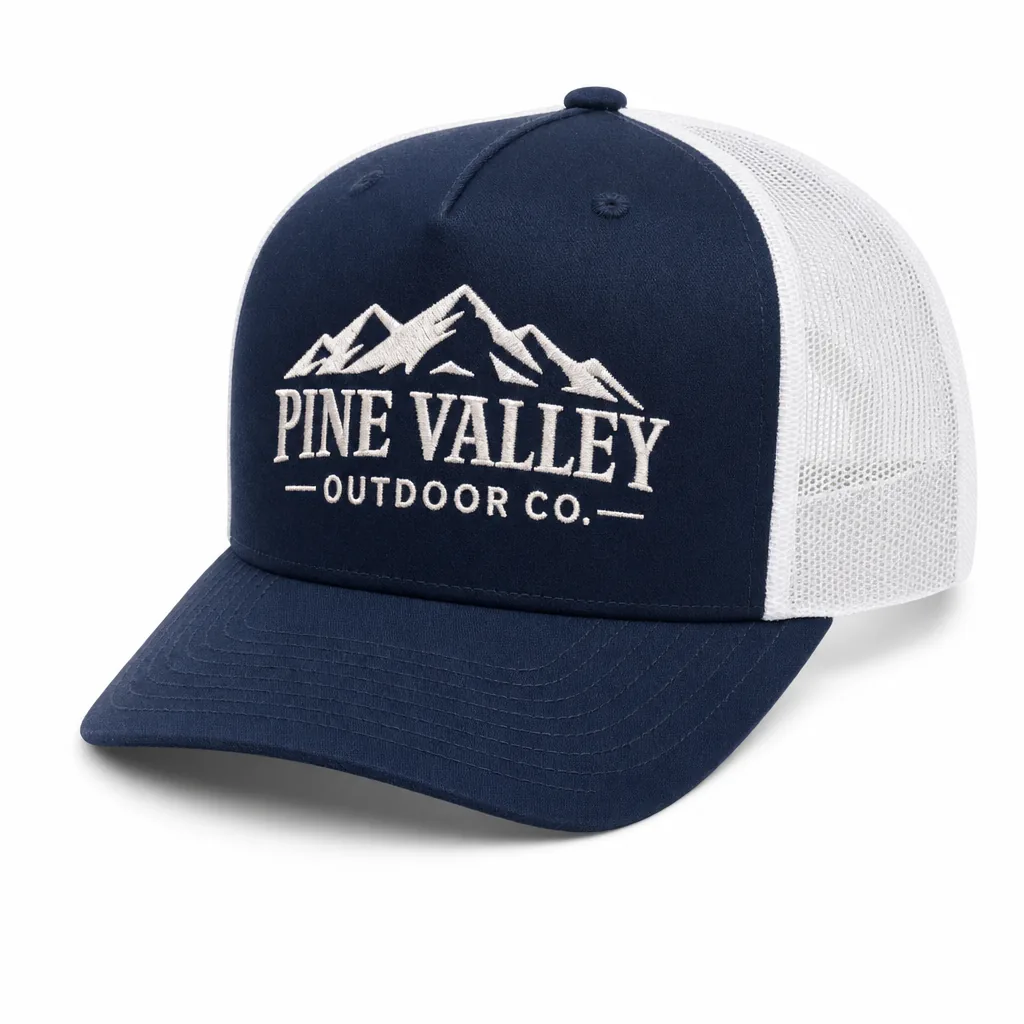
Every week, our sales team answers detailed questions about custom made trucker hat: the 2026 sourcing & manufacturing playbook (2026 update) (2026 update) - 2026 buyer's guide - supplier checklist (2026 update). We wrote this guide so that wholesalers, streetwear brands, corporate buyers and promotional resellers can compare options with full information, and avoid the traps that show up only after production has started.
Custom Embroidered Hats
Embroidery is the first place a custom made trucker hat gets judged, and the logo usually fails because the cap body was wrong for the file, not because the art was bad. A cap file built for a structured 5-panel cotton twill front with buckram will not run clean on a foam-front trucker with 3-5 mm EVA lamination; the same stitch density, pull compensation, and underlay will either cut the foam, tunnel, or close up fine detail. On Tajima, Barudan, and ZSK cap frames, we normally digitize separately by substrate and target stitch-count bands instead of forcing one DST across all bodies. As a rule, small text under about 4.5-5.0 mm cap height is risky on foam fronts, while 3D puff holds best when satin columns are at least 2.5 mm wide and the puff sheet stays around 2-3 mm. If a logo mixes tatami fills, satin borders, and puff layers, expect speed to drop and registration risk to rise. Color matching also needs realistic tolerances. Polyester embroidery thread can usually be matched to a visual Delta-E below 2.0 under D65 light, but thread sheen means Pantone TCX is still a reference, not a guarantee. Side and rear embroidery on 70D-120D polyester mesh need their own review because net panels distort under cap-driver tension unless backing, top tension, and hoop pressure are dialed in for mesh rather than twill. The RFQ should state front substrate, mesh denier, crown height, logo size in millimeters, stitch-count bracket, puff thickness, and whether metallic, appliqué, or multi-location embroidery is required. In Zhejiang, embroidery is commonly quoted in tiers such as under 5,000 stitches, 5,000-8,000, and 8,000-12,000+, with metallic thread or 3D puff charged separately because machine speed can fall from roughly 750 rpm to 500-650 rpm.
Pricing gets unreliable fast when the buyer only sends a logo and says “trucker cap.” For a usable FOB quote, the factory needs panel count, visor shape, closure type, sweatband material, seam tape requirement, front-panel construction, and all decoration locations. In current Ningbo terms, 300-500 pieces of a standard polyester foam/mesh custom made trucker hat with one front embroidery run is typically around $2.30-$3.90 FOB. Add side embroidery, a woven flag label, custom seam tape, a higher-grade snapback, or molded patch combinations, and the real working range is closer to $3.60-$5.90 FOB. MOQ with stock fabrics is often 144-300 units per colorway, but custom-dyed fronts, proprietary mesh, or mixed decoration programs usually make 500-1,000 pieces the practical floor because sampling, material minimums, and machine setup costs stop being efficient below that. Inspection should focus on embroidery-specific defects before general sewing points, because a hat can pass stitch-per-inch and still look cheap at retail distance. The common failures are satin-edge pull, registration drift between puff and flat layers, thin fill coverage from top-thread breaks, loose bobbin tails behind the sweatband, and logo placement drifting more than 3 mm off crown center. On foam fronts, check for needle-cut marks and tunneling caused by excessive density; on mesh side panels, inspect snagging, heat glazing, and distortion around the hoop line. AQL 2.5 is workable for most private-label programs, but licensed, university, or chain-store orders should require 100% inline logo approval on the first run plus measured placement checks by carton. Our standard practice is to make the pre-production sample on the exact bulk cap body, not a substitute shell, because embroidery that looks clean on a flat swatch often breaks down once it is sewn onto a high-profile trucker crown.
Custom Hat Embroidery
Embroidery quality on a custom made trucker hat is mostly fixed in digitizing, long before the first cap reaches a Tajima or Barudan head. The file has to be built around the actual front-panel architecture: a 5-panel EVA foam trucker can carry a bold center-front much better than a 6-panel cotton twill cap with buckram and a seam running through the logo. On a usable front area around 110-120 mm wide by 55-60 mm high, structured foam usually handles 6,000-12,000 stitches cleanly, while softer twill needs lower fill density, stronger edge-walk underlay, and calibrated pull compensation to avoid tunneling, flagging, and panel puckering. A buyer should ask for the production spec, not just a PDF mockup: DST or DSB format, Madeira or Gunold cone reference, 40 wt polyester vs rayon, needle size 11/75 or 12/80, backing weight in gsm, and the maximum logo width approved for that cap profile. Color and artwork control is where approvals break down. If the logo is keyed to Pantone TCX or Pantone C/U, require a thread mapping sheet and approve a sewn strike-off under D65 light; workshop LED photos are not a color standard. Embroidery thread will rarely hit Pantone exactly, so the factory should disclose the nearest cone number and flag any visible variance before sampling. Fine serif text below 2.5 mm, linework under 0.7 mm, and tonal gradients are still bad candidates for direct embroidery because light reflection from thread exaggerates distortion on curved fronts. For those cases, a woven patch, printed twill patch, or silicone heat transfer usually reproduces brand artwork more honestly and with fewer rejects than forcing detail into satin and tatami stitches.
The biggest cost mistakes happen when buyers approve embroidery by appearance instead of by stitch plan. In Zhejiang, digitizing for a custom made trucker hat usually runs $15-50 per logo depending on layer count, sequencing, trims, and whether 3D puff or appliqué is involved. Production is then quoted by stitch band and location: a simple front hit under 5,000 stitches is commonly $0.18-0.35 per piece, a center-front design in the 7,000-10,000 range is more often $0.45-0.90, and a program with side plus back embroidery can land at $0.80-1.50 total decoration cost per cap. Metallic thread, chain stitch, and 3D puff increase both machine time and reject risk, so the practical MOQ often rises from 144-300 pieces per colorway to 500 or more once thread changes and extra QC are factored in. Inspection has to focus on embroidery failure points, not just finished-carton appearance. I want an in-line first-off approval after the first 20-30 caps on each ZSK, Tajima, or Barudan head because one tension issue can spoil several hundred fronts before final QC catches it. For bulk orders, AQL 2.5 is standard, but the checkpoints should be written into the PO: placement tolerance within +/- 3 mm of the approved centerline, no bobbin show-through, no skipped stitches in satin columns, no trapped thread tails inside fills, no frame marks on foam fronts, and no crushed 3D puff after polybag packing. Our standard practice is to confirm repeat-order continuity against a retained gold seal sample and to treat text under 4 mm cap height as a high-risk point, since counters close quickly once the cap crown curves under real wear conditions.
Custom Trucker Hat
A custom made trucker hat should be quoted as a single engineered build, because the front crown, mesh back, brim board, and decoration method all affect shape retention and defect rate. The default factory spec in Zhejiang is still a 5-panel high-profile body, but “5-panel trucker” is too vague for production. You need to lock front panel material and structure: cotton twill at 180–240 gsm, brushed chino around 210 gsm, or 140–160 gsm polyester if the program needs lower moisture pickup and better colorfastness. For the back, soft polyester mesh in 40D–50D gives a better hand feel, while firmer 60D–70D athletic mesh survives carton compression and shelf display better. The visor insert is usually PE board at 1.8–2.2 mm; 1.8 mm packs flatter and saves freight cube, while 2.2 mm holds a cleaner retail curve. If the buyer wants a flatter streetwear bill, define the brim radius and profile at sample stage, because post-sewing hand reshaping is never consistent across 500 or 5,000 pieces.
Decoration is where trucker programs usually go wrong. On Tajima, Barudan, or ZSK heads, a standard front logo on twill may run 6,000–12,000 stitches, but foam-front truckers fail from bad digitizing density more often than from stitch count itself. Overpacked fills tunnel the foam, distort satin borders, and leave pressure dents after steaming and packing. A usable tech pack should state logo size in millimeters, max embroidery height relative to the crown break, underlay type, pull compensation, stitch density, and whether the crown is suitable for flat embroidery, 3D puff, woven patch, or heat-transfer application. Buyers with stable repeat orders also spec the details most factories otherwise guess: crown height tolerance, mesh denier, sweatband composition, snapback resin grade, visor stitch rows, seam tape color, Pantone TCX references, and polybag thickness. In real FOB Ningbo terms, stock-material programs usually start around 144–300 pcs per colorway; a basic trucker with flat embroidery lands around $2.10–$3.80 at 300–500 pcs, while custom-dyed fabric, rope trim, woven patches, and retail box packing push it closer to $4.20–$6.50.
The costly failures on a custom made trucker hat are usually repeatability issues, not obvious disasters. The first defects I check are a drifting center-front seam, left-right brim asymmetry, puckering where the mesh joins the front panel, exposed buckram edges, snapback tabs that do not engage cleanly, and embroidery push-pull that makes the logo look off-center even when placement is technically correct. Shade variation is another common claim point: front twill, underbill, top button, and thread should be approved to a realistic standard, typically Delta-E 1.5–2.0 for dyed fabric and 2.5–3.0 for embroidery thread, because thread lot variation is less stable than most buyers assume. Lightweight mesh also needs a flex test for needle cutting; damage often shows only after handling, not during static final inspection.
AQL 2.5 is still the practical final inspection level for most volume orders, but licensed retail, team merchandise, and e-commerce programs should tighten visual workmanship and packaging checkpoints, especially barcode accuracy, label position, ratio pack-outs, and carton marking. Final inspection alone is not enough. The control point that actually saves money is the top-of-production review after the first 20–30 pieces, when brim curve, logo placement, thread tension, and mesh-to-crown sewing balance can still be corrected before cartons are built. At CrownsForge, the useful sequence is PPS approval, then TOP sign-off against the sealed sample, with measured checks for crown height, brim symmetry, closure pull strength, and logo position tolerance. A supplier that can hold those variables across repeat POs is worth more than one that undercuts the first order by $0.18 per cap and misses the second run.
Custom Trucker Hats
A custom made trucker hat fails or succeeds on structure, not on the sketch. Most factory disputes start when the PO says “foam trucker” but never defines the front build, so the line uses low-density 2.5-3.0 mm foam with 75D-100D polyester mesh, a PE visor insert, PP snap closure, and a basic 110-130 gsm polyester sweatband. That build is acceptable for promo volume at roughly $2.20-$3.20 FOB Ningbo, but it loses shape in humid storage, and embroidery on the front panel often creates rippling or tunnel marks. If you want a cleaner retail silhouette, specify a 210-230 gsm brushed cotton twill or 230-260 gsm poly/cotton front, backed with 0.45-0.55 mm medium buckram instead of relying on foam alone. On a higher-profile 5-panel crown, that usually adds only $0.18-$0.35 per piece and materially improves panel memory and stitch support. Decoration has to be engineered around the substrate. Flat embroidery on Tajima, Barudan, or ZSK heads works well for compact marks, but large fill areas on foam fronts need lighter density, wider travel, and reduced underlay or the panel will pucker after capping. For raised logos, 3D puff with 2-3 mm EVA under satin columns is more stable than forcing heavy flat fills. If the design includes gradients, halftones, or serif text below 4 mm cap height, switch to a woven patch, sublimated patch, or heat-transfer badge. Color control should also be written into the RFQ: front fabric matched to Pantone TCX, trims to coated Pantone where applicable, and a Delta-E target below 1.5 for dyed fronts, visor binding, and top buttons. Without that, reorders in black, charcoal, khaki, and navy routinely drift enough to look split-lot at retail.
The RFQ for a custom made trucker hat should read like a technical cap sheet, not a reference collage. Lock the panel count, crown height, profile, visor length, brim curve radius, number of visor stitch rows, mesh denier, front-panel gsm, buckram thickness, sweatband composition, closure resin grade, top button material, eyelet callout, artwork size, decoration method, and packing ratio. Add finished tolerances by measurement point: visor length typically plus or minus 3 mm, crown height plus or minus 3 mm, finished circumference plus or minus 5 mm, and logo placement within 2-3 mm from approved centerline. MOQ on stock materials is usually 144-300 pieces per colorway, but once you specify custom-dyed mesh, woven main labels, branded seam tape, TPU patches, or custom-molded closures, the practical floor moves to 500-1,000 pieces. In 2026, a realistic FOB range is $3.30-$5.40 for a twill-front trucker with one-location embroidery and branded internals, and $5.00-$7.80 for multi-decoration or specialty mesh programs. The defects that actually reject trucker caps are routine and measurable: visor asymmetry, mesh skew, bubbling at the front panel, off-center embroidery, cracked snap tabs after cold transit, and sweatband joins that open after light wear. Use AQL 2.5 for majors and 4.0 for minors, but add trucker-specific checkpoints the generic QC sheet misses: side-profile retention after 24-hour carton compression, mesh needle cuts, embroidery density consistency across caps, seam tape alignment, and closure cycling. Ask for inspection photos from at least 10 random units per lot showing front, side, back closure, underbrim, and inside seams; straight-on sample photos hide profile collapse. At CrownsForge, in-line checks on logo position, visor symmetry, and snap function catch more real problems than a late final inspection, and factories with current sedex-audit-cap-supplier-guide.html">BSCI 2.0 or Sedex SMETA 4-Pillar discipline usually outperform cheaper suppliers over repeat orders because they hold mesh lots, stitch settings, and packing pressure more consistently.
Hat Trucker Custom
A custom made trucker hat is won or lost on the front panel, not the snapback. For a retail-grade build, specify whether you need a 5-panel seamless foam front, a 6-panel structured twill crown, or a hybrid with buckram backing; those choices change the logo surface, crown memory, and steaming behavior. Typical front materials run 160-260 gsm cotton twill, polyester twill, or foam-laminated fabric, paired with 100-140 gsm polyester mesh in 75D-150D yarn. The visor insert should be called out as 2.0-2.5 mm PE, not just “curved brim,” and the fit should state finished circumference, usually 58 cm adult OSFA with a 7-hole plastic snapback. A usable tech pack lists crown height in millimeters, panel count, mesh denier, sweatband width, visor length, curve depth, seam tape color, closure color, packing method, and carton quantity. Pantone TCX references should be separated for front fabric, mesh, visor top, visor bottom, and button, with Delta-E under 1.5 for licensed retail programs and under 2.0 for promotional orders.
Decoration has to be engineered before the first sample because foam-front truckers punish lazy digitizing. Tajima, Barudan, and ZSK heads can run clean flat embroidery and 3D puff, but lettering below 5 mm often closes up unless the file uses proper underlay, pull compensation, satin density, and foam knockout. Once a front logo passes roughly 8,000-12,000 stitches, it can change crown tension and create puckering around the side seams; oversized puff logos also need compression testing after steam shaping. Woven patches are better for crests and small text, sublimated patches handle gradients and photo effects, and PVC patches add weight plus mold charges, typically USD 80-250 per design. For pricing, a stock-mesh trucker with one front embroidery placement usually starts around 144-300 pieces per color at USD 3.20-5.80 FOB China. Custom-dyed mesh, sandwich visors, printed seam tape, private PVC molds, barcoded hangtags, or individual polybags can push MOQ to 500-1,000 pieces and move FOB into the USD 5.50-9.50 range.
Inspection should focus on shape, logo position, and wear comfort, because those are the defects buyers notice before they read the carton label. The common failures are twisted crowns, off-center embroidery, puckering around 3D puff, uneven mesh tension, visor warping after steam, sharp snapback edges, loose top buttons, and sweatband seams that rub the forehead. Require a sealed pre-production sample, top-of-production photos, and final inspection under AQL 2.5 for major defects and AQL 4.0 for minor defects. For retail, sports-license, or franchise orders, hold logo placement to +/-2 mm from the approved sample, not “visually acceptable.” Measure crown height, visor length, curve depth, finished circumference, front-panel symmetry, and embroidery position across cartons from different production bundles. CrownsForge quotes BSCI 2.0, Sedex SMETA 4-Pillar documentation, and DDP logistics separately because audit records, duty, VAT, and last-mile delivery are real cost centers, not decoration options that can be hidden inside a low FOB number.
Trucker Custom Hat
A custom made trucker hat should be costed from its bill of materials, not from a product photo. A typical 5-panel foam trucker uses 4.0-5.5 mm laminated polyester foam, 120-160 gsm face fabric, 80-120 gsm polyester mesh, a 1.5-1.8 mm PE visor insert, 6-row visor stitching, and a 7-hole PP snapback. Change the foam density, mesh denier, or visor insert and the same cap will sit differently on the head. For 6-panel truckers, front panels are usually cotton twill, brushed canvas, ripstop, recycled polyester, or nylon taslan with buckram support instead of foam, so crown height and front-panel tension need separate approval. I would freeze crown height, visor length, front-panel width, mesh denier, sweatband width, seam tape color, closure mold, carton count, and polybag method in the tech pack before accepting any FOB quote.
Decoration should be engineered before panels are sewn, because trucker fronts distort easily. Flat embroidery, 3D puff, and chain stitch normally run on Tajima, Barudan, or ZSK heads at the panel stage; a 65-75 mm wide front logo may range from 5,000 to 12,000 stitches, while puff embroidery needs wider satin columns and fewer tight corners. Woven, felt, leather, silicone, and TPU patches are often applied after blocking so the crown shape is already set. A proper sample request should include Pantone TCX fabric references, Madeira or Gunold thread codes, logo size in mm, stitch count estimate, patch backing, edge finish, and placement tolerance. Approve fabric and thread under a D65 light box, with Delta-E under 1.5 for brand-critical colors and under 2.0 for general promotional programs.
China pricing moves quickly once the cap stops using stock components. A basic foam trucker with stock mesh, stock snapback, and one front embroidery usually starts at 144-300 pieces per color, with FOB Ningbo or Shanghai around USD 2.40-4.20 depending on stitch count and packing. Cotton twill fronts, contrast sandwich visors, woven patches, puff embroidery, private-label taping, inside labeling, or custom carton marks commonly push MOQ to 300-600 pieces and add USD 0.30-1.20 per unit. Molded rubber or silicone patches often need USD 80-180 tooling, and embroidery digitizing is usually USD 20-50 per logo. Our standard inspection practice is AQL 2.5 major and AQL 4.0 minor, checking logo placement within +/-3 mm, circumference within +/-5 mm, visor centering, snapback post strength, mesh seam tension, thread trimming, carton compression, and foam recovery after steaming.
Working with CrownsForge for custom made trucker hat programs
The first failure point in a custom made trucker hat program is usually the production file, not the mesh or embroidery machine. Freeze the cap body before pricing artwork: 5-panel or 6-panel pattern, crown height in millimeters, visor radius, foam front versus buckram, mesh weight in gsm, snapback grade, sweatband width, and Pantone TCX targets for shell, mesh, thread, and underbrim. A rendered mockup is not a tech pack. The factory needs DST or EMB files, estimated stitch count, logo placement tolerance, patch border method, and backing requirements before sampling. Flat embroidery or a woven patch normally samples in 7 to 10 days; 3D puff, applique, silicone badges, sublimated mesh, or printed seam tape usually pushes approval samples to 12 to 18 days. For retail colorways, approve lab dips under D65 light and set a Delta-E limit, typically Delta-E 1.5 to 2.0 for visible shell panels. Dark navies like TCX 19-4023 and olive tones drift fast if dye lots are not controlled.
MOQ is set by component customization more than by the headline order quantity. Stock mesh, standard plastic snaps, existing brim molds, and running fabric colors can support 100 to 300 pieces per color, but piece-dyed cotton twill, private-label sweatbands, custom seam tape, molded rubber patches, UPC stickers, and retailer carton marks move the efficient floor to 500 to 1,000 pieces per color. Decoration should follow the logo structure. Tajima, Barudan, and ZSK heads are reliable for flat embroidery, 3D puff, chain stitch, and applique, while woven patches are cleaner for lettering under 4 mm or tight sponsor lockups. A foam-front trucker with one front embroidery, woven label, snapback, and individual polybag typically lands around $3.20 to $5.80 FOB Ningbo at 500 pieces; the real cost drivers are stitch count, mesh denier, patch construction, and whether the front panel needs fused backing to prevent puckering.
Order control starts after the approved sample, when small assumptions become chargebacks. The locked file should include approved sample photos, material cards, Pantone references, DST or EMB files, barcode position, carton marking, pack method, carton dimensions, gross-weight limits, and AQL 2.5 criteria before fabric cutting. In-line checks should focus on front-panel symmetry, visor centering, embroidery registration, puff height, snapback pull strength, sweatband stitch density, seam-tape alignment, and mesh tension; final inspection alone catches these defects too late. Licensee, promotional, and retailer programs may require BSCI 2.0, Sedex SMETA 4-Pillar, REACH, CPSIA, Prop 65 review, or country-of-origin marking, but claim language and market compliance still sit with the buyer. A custom made trucker hat shipping to Amazon FBA, a U.S. stadium store, and an EU distributor needs separate packing files. DDP cartons should stay courier-safe, usually under 15 kg gross, while FOB Ningbo or Shanghai orders need earlier vessel booking before March-April and September-October congestion.
Frequently Asked Questions
How long does production take?
Sampling takes 7 to 12 days. Bulk production runs 20 to 30 days depending on quantity, fabric availability and decoration complexity. Inspection and packing adds another 3 to 5 days before shipment.
Do you support sustainability certifications?
Yes. We work with GOTS organic cotton, GRS-certified recycled polyester, OEKO-TEX Standard 100 fabrics, and are BSCI and Sedex audited. Certification documentation can be provided per order.
What file format should I send for my logo?
Vector files (AI, EPS, PDF) are ideal. High-resolution PNG or JPG at 300 dpi on transparent background works as a fallback. Provide Pantone color references for accurate reproduction.
What is the minimum order quantity (MOQ) for custom hats?
Our standard MOQ is 100 pieces per design and color, with sampling available from 1 piece. For complex multi-color logos or premium fabric upgrades, the MOQ can be lowered with a small per-piece surcharge.
Can I order a sample before bulk production?
Yes. We strongly recommend approving a pre-production sample before mass production. Samples are charged at 35 to 60 USD each plus express shipping, fully refundable against confirmed bulk orders over 500 pieces.
How does ordering custom hat trucker work?
When evaluating custom hat trucker, the key considerations are construction quality, decoration capability, MOQ flexibility and lead time. Cover everything buyers ask about custom embroidered hats: how it's manufactured, what specs to request from a factory, typical MOQ and pricing, common quality issues to inspect for, and how this ties back to the broader custom made trucker hat sourcing decision. Cover everything buyers ask about custom hat embroidery: how it's manufactured, what specs to request from a…
How does ordering custom embroidered trucker hats work?
When evaluating custom embroidered trucker hats, the key considerations are construction quality, decoration capability, MOQ flexibility and lead time. Cover everything buyers ask about custom embroidered hats: how it's manufactured, what specs to request from a factory, typical MOQ and pricing, common quality issues to inspect for, and how this ties back to the broader custom made trucker hat sourcing decision. Cover everything buyers ask about custom trucker hats: how it's manufactured, what specs to request from a…
How does ordering custom made hats for men work?
When evaluating custom made hats for men, the key considerations are construction quality, decoration capability, MOQ flexibility and lead time. Cover everything buyers ask about custom embroidered hats: how it's manufactured, what specs to request from a factory, typical MOQ and pricing, common quality issues to inspect for, and how this ties back to the broader custom made trucker hat sourcing decision. Cover everything buyers ask about custom trucker hats: how it's manufactured, what specs to request from a…
How does ordering high quality custom trucker hats work?
When evaluating high quality custom trucker hats, the key considerations are construction quality, decoration capability, MOQ flexibility and lead time. Cover everything buyers ask about custom embroidered hats: how it's manufactured, what specs to request from a factory, typical MOQ and pricing, common quality issues to inspect for, and how this ties back to the broader custom made trucker hat sourcing decision. Cover everything buyers ask about custom trucker hats: how it's manufactured, what specs to request from a…
Looking for a reliable hat manufacturer in China?
CrownsForge has produced custom hats for 800+ brands across 40 countries. From 100-piece launches to 100,000-piece retail programs, we deliver on time and on spec.
Get in touchRelated guides
Custom Leather Patch Hat Low Minimum: A 2026 B2B Sourcing Guide
Read article →
Mens Beanies: Properties, Costs and How to Spec It Right
Read article →
Custom Hat Patch: When to Use It, Costs, and What to Ask Your Factory - Cost & MOQ Breakdown (2026 Update)
Read article →We hope this guide demystifies custom made trucker hat: the 2026 sourcing & manufacturing playbook (2026 update) (2026 update) - 2026 buyer's guide - supplier checklist (2026 update) and helps you move forward with confidence. If you have questions specific to your project, our English-speaking sales engineers are one message away.