
Custom Hat Trucker: The 2026 Sourcing & Manufacturing Playbook - Cost & MOQ Breakdown
Every week, our sales team answers detailed questions about custom hat trucker: the 2026 sourcing & manufacturing playbook - cost & moq breakdown. We wrote this guide so that wholesalers, streetwear brands, corporate buyers and promotional resellers can compare options with full information, and avoid the traps that show up only after production has started.
Custom Embroidered Hat
Embroidery is still the most forgiving decoration method for a custom hat trucker, but only if the digitizing is done for the exact cap body. The factory should convert artwork into a stitch file for Tajima, Barudan, or ZSK heads, then tune stitch density, underlay, pull compensation, and small-text legibility to the substrate in hand. On a foam-front 5-panel trucker, a 3 mm satin column can sink or warp if the underlay is too heavy; on cotton twill or brushed canvas, the same file often needs lower density to avoid puckering. A proper order sheet should specify logo width and height in millimeters, target stitch count, thread brand if color consistency matters, and Pantone TCX references for the fabric plus thread match notes. For color-critical jobs, define Delta-E tolerance separately for body fabric and thread, because dyed shells and thread lots drift on different schedules in production.
The spec sheet that prevents the most mistakes is a full construction sheet, not just artwork. For a custom hat trucker, that means front-panel fabric and gsm, mesh type and denier, crown height, visor curve, sandwich brim yes or no, closure type, seam tape color, sweatband composition, eyelet layout, and exact embroidery position by panel. For the decoration, call out flat or 3D puff, backing material, thread sheen, and whether you allow run-stitch details below 1.2 mm line width. In 2026, a normal MOQ for a 5-panel or 6-panel embroidered custom hat trucker is 144 pieces per colorway, though some factories will take 50 to 100 pieces with a surcharge if they are using a stock body and only changing thread. A realistic FOB Zhejiang range is $2.40 to $4.20 for basic flat embroidery on a polyester mesh cap, with 3D puff, applique, side hits, or interior branding pushing it to $4.80 to $7.50. Sample digitizing should be priced separately, usually $15 to $40 per logo, because the stitch file is real labor and not a throw-in.
The defects worth checking are usually setup errors, not operator mistakes. Inspect for flagging at sharp logo corners, loose trims on the back, registration drift between flat and puff layers, needle cuts on foam-front panels, visor embroidery off-center by more than 3 mm, and crown collapse from excessive stitch density. For bulk inspection, use AQL 2.5 on packed goods, but also run in-line checks after the first dozen embroideries; a bad file can ruin 500 fronts before anyone stops the machine. Ask for test photos before full production, especially for custom hat trucker orders with small lettering, gradients converted into fill patterns, or logos crossing a center seam. Embroidery changes the sourcing decision: it can force a sturdier front panel, raise MOQ if multiple thread changes are involved, and add 3 to 5 days if strike-offs need revision. For tactile logos and retail durability, it is usually the right call; for halftones or ultra-fine detail, it is often the wrong decoration even when the base cap body is otherwise correct.
Custom Embroidered Hats
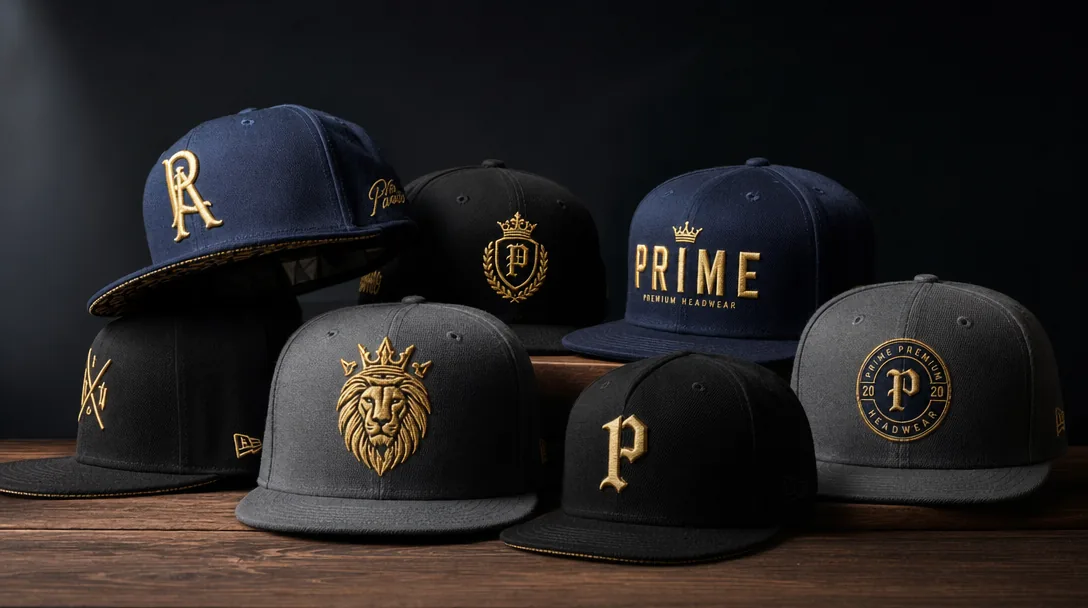
Embroidery is still the cleanest way to make a custom hat trucker look intentional, but only if the artwork is built for the machine, not the mockup. A proper front logo starts as a digitized DST or EMB file for Tajima, Barudan, or ZSK heads, with stitch angle, density, underlay, pull compensation, and tie-in order set before bulk sewing starts. On foam-front truckers, embroidery is usually run before full assembly so the operator can keep registration tight and avoid collapsing the foam; on standard 5-panel and 6-panel mesh-back caps, the factory should quote logo width and height in millimeters, stitch count, and whether the job is flat embroidery, 3D puff, or a hybrid. Small text is where bad specs die: anything under 4 mm cap height often closes up, and line work below roughly 0.8 mm is not a stitchable element. A serious sample room will flag that at proto stage, not after 5,000 pieces are already committed.
The spec sheet matters more than the decoration choice. For a custom hat trucker, define crown construction, face fabric, mesh denier, visor shape, closure type, sweatband material, seam tape, backing type, and thread color against Pantone TCX or coated references, then lock placement tolerance to plus or minus 2 mm. For 3D embroidery, add puff foam thickness, backing weight, and thread sheen, and require daylight photo approval of the first-off sample so shade shift and edge fray show up before bulk. MOQ is usually 144 pieces per colorway for a fully custom program, while stock-body programs can start around 48 to 72 pieces. In Yiwu, a basic embroidered cap in 210 to 240 gsm chino twill with 100% polyester mesh typically lands around $2.10 to $3.40 FOB at 300 pieces, while a 260 gsm cotton canvas trucker with woven label, branded taping, and 3D puff embroidery usually runs $3.80 to $6.20 FOB depending on stitch count and trim stack.
The defects that show up in shipment are usually boring and expensive: thread breaks hidden by over-trimming, registration drift across panels, satin columns that tunnel, puckering from bad tension, and crown distortion because the hooping or backing was wrong. On white or light-front custom trucker hats, check for oil marks near the embroidery field, loose bobbin tails inside the crown, and visor alignment after final assembly; a logo can be centered on the face and still look wrong if the bill is off by 5 mm. For inspection, use AQL 2.5 and compare every critical embroidery detail against the approved sample, because some factories quietly reduce stitch density on repeats to save machine time. If embroidery is the main visual, it should drive the sourcing decision: foam fronts handle bold logos better, brushed cotton twill holds stitches more cleanly than stretchy blends, and cheap mesh can distort panel tension during sewing. Buyers comparing print, patch, and direct embroidery should judge not only decoration cost, but whether the factory can hold shape, color, and stitch quality across the full order.
Custom Hat Embroidery
The inspection sheet should spell out defect limits before the first hundred caps leave the machine. The usual problems on a custom hat trucker order are off-center placement, color registration drift, loose bobbin loops inside the crown, thread breaks that leave gaps, puckering around dense fills, and 3D puff edges collapsing after carton compression. For licensed or brand-sensitive work, set logo placement tolerance at plus or minus 2 mm, confirm color against the approved thread card, and specify pack-out so embroidered fronts are not crushed in transit. During inline and final inspection, AQL 2.5 is normal for appearance, but embroidery-heavy orders need tighter carton sampling because one bad tension setting can affect dozens of caps before anyone catches it. If embroidery is inconsistent, the sourcing math changes fast: a cheaper cap body with weak buckram or unstable foam will sew worse, rework slower, and create a higher claim rate than a better blank with cleaner structure.
Custom Made Trucker Hat
A custom hat trucker is brutally easy to judge because the silhouette exposes mistakes that a low-profile cap can hide. The tall front crown, wide mesh opening, and pre-curved visor make off-center logos, visor skew, and wavy sweatbands visible from two meters away. Standard builds are 5-panel foam trucker or 6-panel structured trucker, typically using 210-250 gsm cotton twill, brushed polyester canvas, or microsuede on the front, with 40D-75D polyester mesh on the back. If you want a true high-profile shape, the front panels usually need 2-4 mm PE foam or EVA foam lamination; without it, the crown collapses after packing. The manufacturing order matters more than buyers realize: cut panels, laminate foam, run embroidery or apply patches before crown assembly, set the sweatband, join the visor, top-stitch, then shape on a heated cap press. On Tajima, Barudan, or ZSK heads, 3D puff embroidery on foam fronts needs reduced stitch density and wider satin coverage, otherwise you get tunneling, edge collapse, and foam exposure after carton compression.
Repeatable quality starts with geometry in the tech pack, not just artwork. For a custom hat trucker, lock crown height in millimeters, visor length and curvature, front panel stiffness, mesh color by Pantone TCX or approved stock swatch, snap closure type, sweatband composition, seam tape print, and eyelet requirement on the front panels. Decoration should carry real tolerances: logo center deviation within +/-2 mm, crown height within +/-3 mm, visor skew under 3 mm, and patch placement measured from the center front seam. Pricing then becomes much easier to control. A stock-body program using existing mesh colors, a standard 7-hole PVC snap, and one flat embroidery logo is usually realistic at 144-200 pieces per colorway, with 2026 FOB China pricing around $2.10-$3.40 each. Once you add dyed-to-match fabric, custom underbill, woven labels, inside taping print, TPU badge, or retail pack-out, MOQ usually moves to 300-500 pieces and FOB lands closer to $3.60-$5.80. Pre-production samples with digitizing, mold or screen setup, and DHL courier typically cost $60-$180, and that is where most first-time buyers under-budget.
Inspection should focus on shape-control defects before general sewing cleanliness. The most common bulk failures on a custom hat trucker are asymmetrical front panels, visor twist, snap misalignment, foam thickness variation that distorts embroidery, and polyester mesh that yellows under heat or cracks at high-tension seam points. For color-sensitive programs, front fabric should be checked under D65 lighting against approved Pantone standards, and decoration should hold within Delta-E 1.5-2.0 depending on brand tolerance. Final inspection at AQL 2.5 is standard, but logo placement and crown symmetry usually need tighter internal limits than the factory default or the lot can pass inspection and still look weak at retail. Pack-out also changes the outcome more than many buyers expect: 25 pieces per inner with tissue support holds crown shape far better than 50 bulk-packed pieces and reduces brim deformation in transit. sedex-audit-cap-supplier-guide.html">BSCI 2.0 and Sedex SMETA 4-Pillar matter for compliance, but they do not tell you whether a supplier actually controls rework by defect family such as patch lift, crown collapse, visor skew, or snap failure.
Custom Trucker Hat
A custom hat trucker lives or dies on body spec control, not the artwork. The decisions that matter first are panel count, front rise, and mesh recovery. A retail 5-panel trucker usually needs a 10.5-11.5 cm front height to hold a clean foam face for embroidery or a patch; a 6-panel body fits rounder on head but gives up usable logo width because the center seam interrupts decoration. Standard materials are 3-5 mm polyester foam or buckram-backed front panels, 8x8 or 10x10 cotton twill at 180-240 gsm, polyester or nylon mesh around 100-140 gsm, PE visor board, and a PP snapback. When a buyer sends only a reference photo, many factories simply map the logo onto a stock shell, which is why you get shallow crowns, collapsing fronts, and mesh that turns brittle after one summer. A workable RFQ for a custom hat trucker should lock panel count, crown height, visor curve, mesh hole size, sweatband composition, closure grade, and target hand feel before sampling begins.
Decoration has to match the cap architecture. On a foam-front custom hat trucker, 3D embroidery needs proper digitizing, underlay control, and realistic machine speed; on Tajima or Barudan heads, 600-750 spm is usually the safe range for tall satin letters, because pushing past 850 often causes outline walk, foam cutting, and distorted columns. If brand color matters, specify Pantone TCX for shell fabric, approve thread separately, and hold the main body to a Delta-E below 1.5; twill and mesh lots rarely match on their own. MOQ for a stock-body trucker is commonly 144-300 pieces per color, but once you add custom panels, printed seam tape, woven labels, or a branded snap mold, the real floor is typically 500-1,000 pieces. For 2026 sourcing, expect FOB China pricing around $2.20-$3.80 for basic foam-front mesh builds, $3.90-$6.50 for cleaner retail twill-and-mesh versions, and $6.80+ when you add suede brims, applique, or multi-position embroidery.
Inspection is where trucker margins are protected. The defects that actually generate claims are wavy front panels, off-center patches, uneven brim rows, mesh tearing at side seams, loose snap posts, top-button drift, and embroidery that walks because the panel was poorly hooped or under-backed. Bulk goods should be checked to AQL 2.5, with logo placement held to plus or minus 2 mm, crown symmetry compared against the sealed sample, and visor curve verified under consistent lighting. Packing also deserves more scrutiny than most buyers give it: trucker crowns crush faster than low-profile caps, so nesting ratio, crown support inserts, polybag thickness, and master carton compression strength directly affect sellable yield after ocean freight. The supplier question is not whether they can make one good pre-production sample; it is whether they can reproduce the same custom hat trucker on the second and third reorder without shade drift, mesh substitution, or crown shape loss.
Custom Trucker Hats
A custom hat trucker lives or dies on crown architecture, not the artwork. The baseline commercial build is usually a 5-panel high-profile or 6-panel mid-profile body with either a 2.2 to 3.0 mm foam front for the classic U.S. promo silhouette or buckram-backed front panels at roughly 0.35 to 0.50 mm for a cleaner retail shape. Mesh spec matters more than most buyers realize: standard polyester mesh in the 110 to 140 gsm range can vary a lot in aperture, rebound, and seam strength, which directly affects crown height and how the cap wears after steaming. Pair that with a pre-curved PE visor, a cotton or poly-cotton sweatband, and a 7-hole PVC snap, and you already have several variables that can shift the finished look. A vague tech pack that says only “trucker cap” is how one supplier ships a shallow crown with soft mesh while another delivers a taller body with hard front support and claims full compliance. Lock the spec before sampling: panel count, finished crown height, visor curve, mesh hole size, sweatband fiber content, snap color, top-button finish, seam tape artwork, and decoration method. Front support must match the logo process. Dense embroidery on foam fronts can tunnel or ripple, while buckram fronts usually hold registration better on Tajima or Barudan machines for flat embroidery, woven patches, and cleaner edge definition. A usable tech pack should state logo size in millimeters, stitch count or patch dimensions, Pantone TCX references for fabric and thread, and logo placement tolerance. In production, plus or minus 3 mm for front logo centering is the outer limit I’d accept; trucker caps expose asymmetry immediately, especially on white foam fronts, contrast mesh, or rope styles where the eye catches every drift.
Cost and MOQ only become honest once you separate stock trims from true customization. A stock-material custom hat trucker using mill-available black or white mesh, a standard matching snap, and flat front embroidery can start at 144 pieces per colorway, but that is a pricing floor, not an efficient production level. Once you add dyed mesh, custom seam tape, woven labels, molded rubber patches, rope, printed under-visors, or branded closures, most factories in China want 300 to 500 pieces per style-color to control waste and maintain line speed. In current FOB China terms, a basic build at that volume usually lands around $2.10 to $3.40 per piece; layered decoration such as woven patch plus embroidery, chenille, or silicone heat transfer pushes it closer to $3.20 to $5.20. Very small runs often look affordable until digitizing, embroidery tape-outs, patch molds, and trim overages get loaded into the unit cost. Inspection is where margin gets protected, because trucker defects show fast at retail. The repeat failures are off-center logos, inconsistent visor curvature, mesh splitting at side seams, exposed foam near the sweatband, mixed snap color lots, and loose thread trimming that makes new caps look already handled. AQL 2.5 is a practical bulk standard, but trucker styles need extra checkpoints for crown symmetry, top-button alignment, visor profile consistency, and patch adhesion after heat aging if transfers or molded badges are involved. When dyed components must match across mesh, binding, visor edge, and closure, Delta-E 1.5 to 2.0 is a realistic control band; anything looser becomes obvious under daylight. Our standard practice is to inspect the cap both flat and after steaming/forming, because a crown that passes on the table can still twist, collapse, or torque once it is actually worn.
Working with CrownsForge for custom hat trucker programs
The fastest way to de-risk a custom hat trucker program is to freeze the sample path before arguing over $0.10 on FOB. A photo sample in stock 10x10 cotton twill with standard 100% polyester mesh normally takes 5 to 7 working days; once you add Pantone TCX fabric matching, molded TPU or silicone patches, woven flag labels, or a printed sweatband, 7 to 12 working days is the real schedule. The delay is usually upstream, not at sewing: vector cleanup, embroidery digitizing, patch mold approval, and trim strike-offs consume more time than panel assembly. A 3D front logo running on Tajima or Barudan heads often needs 0.35 to 0.45 mm pull compensation, lighter foam density, and revised edge underlay so the satin top line does not sink after capping and wear. Approve one pre-production sample against hard measurements, not just photos: crown height, visor length, front panel angle, seam alignment, and snapback placement. A 3 mm crown-height deviation can pass unnoticed on one desk sample and still trigger claims across a 3,000-piece shipment once the cartons are opened. CrownsForge standard practice is to lock the tech pack, embroidery file, trim list, and approved sample before bulk cutting; that sounds procedural, but it is what prevents repeat sampling charges, last-minute artwork edits, and avoidable lead-time drift. If your spec includes matching shell and underbill colors, define the Pantone reference and acceptable Delta-E at the start, because arguments over “close enough” usually begin after fabric is already dyed and laminated buckram is already fused.
MOQ looks negotiable until materials start carrying the order. A basic custom hat trucker using brushed cotton twill, stock polyester mesh, shared plastic snapback closures, and standard PE buckram can sometimes start at 144 pieces per colorway when the factory is building from in-stock bodies. Once you move into dyed-to-match shell fabric, custom seam tape, branded inner labels, sandwich brims, or split-size runs, the practical MOQ usually shifts to 300 to 500 pieces per style. That is not a sales tactic; it comes from fabric mill minimums, trim supplier MOQs, patch tooling, and line changeover loss. For 2026 buying, a clean 5-panel or 6-panel trucker with flat embroidery typically lands around $2.20 to $3.80 FOB China. Add molded patches, chenille, chain stitch, sublimated underbrims, or all-over printed panels, and the workable range is closer to $4.50 to $7.50 FOB depending on quantity and packing method. The expensive mistake is choosing the lowest quote without checking process control. A reliable custom hat trucker supplier should verify lab dips and strike-offs against Pantone references, hold fabric shade to an agreed tolerance such as Delta-E below 1.5 to 2.0, and run the order through tech pack review, material approval, pre-production sample signoff, inline inspection, and final random inspection to AQL 2.5. Ask how they check visor curvature consistency, mesh recovery, seam puckering, and embroidery registration after steaming and packing. Saving $0.18 per cap is irrelevant if the bulk lot arrives with weak crown stiffness, distorted mesh, off-center logos, or a visor profile that no longer matches the approved sample.
Frequently Asked Questions
What is the minimum order quantity (MOQ) for custom hats?
Our standard MOQ is 100 pieces per design and color, with sampling available from 1 piece. For complex multi-color logos or premium fabric upgrades, the MOQ can be lowered with a small per-piece surcharge.
Do you support sustainability certifications?
Yes. We work with GOTS organic cotton, GRS-certified recycled polyester, OEKO-TEX Standard 100 fabrics, and are BSCI and Sedex audited. Certification documentation can be provided per order.
How long does production take?
Sampling takes 7 to 12 days. Bulk production runs 20 to 30 days depending on quantity, fabric availability and decoration complexity. Inspection and packing adds another 3 to 5 days before shipment.
What logo decoration techniques do you offer?
3D puff embroidery, flat embroidery, woven patch, leather patch, PVC patch, screen printing, sublimation, applique and laser etching, all in-house with no subcontracting.
Can I order a sample before bulk production?
Yes. We strongly recommend approving a pre-production sample before mass production. Samples are charged at 35 to 60 USD each plus express shipping, fully refundable against confirmed bulk orders over 500 pieces.
How does ordering custom embroidered patch hat work?
When evaluating custom embroidered patch hat, the key considerations are construction quality, decoration capability, MOQ flexibility and lead time. Cover everything buyers ask about custom embroidered hat: how it's manufactured, what specs to request from a factory, typical MOQ and pricing, common quality issues to inspect for, and how this ties back to the broader custom hat trucker sourcing decision. Cover everything buyers ask about custom embroidered hats: how it's manufactured, what specs to request from a…
How does ordering custom embroidery patches for hats work?
When evaluating custom embroidery patches for hats, the key considerations are construction quality, decoration capability, MOQ flexibility and lead time. Cover everything buyers ask about custom embroidered hats: how it's manufactured, what specs to request from a factory, typical MOQ and pricing, common quality issues to inspect for, and how this ties back to the broader custom hat trucker sourcing decision. Cover everything buyers ask about custom hat embroidery: how it's manufactured, what specs to request from a factory,…
What's the MOQ for custom embroidered trucker hats no minimum?
When evaluating custom embroidered trucker hats no minimum, the key considerations are construction quality, decoration capability, MOQ flexibility and lead time. Cover everything buyers ask about custom embroidered hats: how it's manufactured, what specs to request from a factory, typical MOQ and pricing, common quality issues to inspect for, and how this ties back to the broader custom hat trucker sourcing decision. Cover everything buyers ask about custom embroidered hat: how it's manufactured, what specs to request from a…
How does ordering custom leather patch trucker hat work?
When evaluating custom leather patch trucker hat, the key considerations are construction quality, decoration capability, MOQ flexibility and lead time. Cover everything buyers ask about custom embroidered hat: how it's manufactured, what specs to request from a factory, typical MOQ and pricing, common quality issues to inspect for, and how this ties back to the broader custom hat trucker sourcing decision. Cover everything buyers ask about custom embroidered hats: how it's manufactured, what specs to request from a…
Ready to start your custom hat project?
Send us your tech-pack, sketch or even just an inspiration photo. We will respond with a detailed quotation and digital mock-up within 24 hours.
Request a free quoteRelated guides
Refreshing a Hat Collection: A Repeat-Order Playbook for Established Brands
Read article →
Ball Caps for Women: A 2026 Sourcing Playbook for International Buyers - 2026 Buyer's Guide
Read article →
Festival Bucket Hats Reorder Planning Guide for Custom Hat Buyers
Read article →We hope this guide demystifies custom hat trucker: the 2026 sourcing & manufacturing playbook - cost & moq breakdown and helps you move forward with confidence. If you have questions specific to your project, our English-speaking sales engineers are one message away.