
Cotton vs Polyester vs Wool: A Cap Fabric Decision Tree (2026 Update)
Every week, our sales team answers detailed questions about cotton vs polyester vs wool: a cap fabric decision tree (2026 update). We wrote this guide so that wholesalers, streetwear brands, corporate buyers and promotional resellers can compare options with full information, and avoid the traps that show up only after production has started.
The three dominant cap fabric families
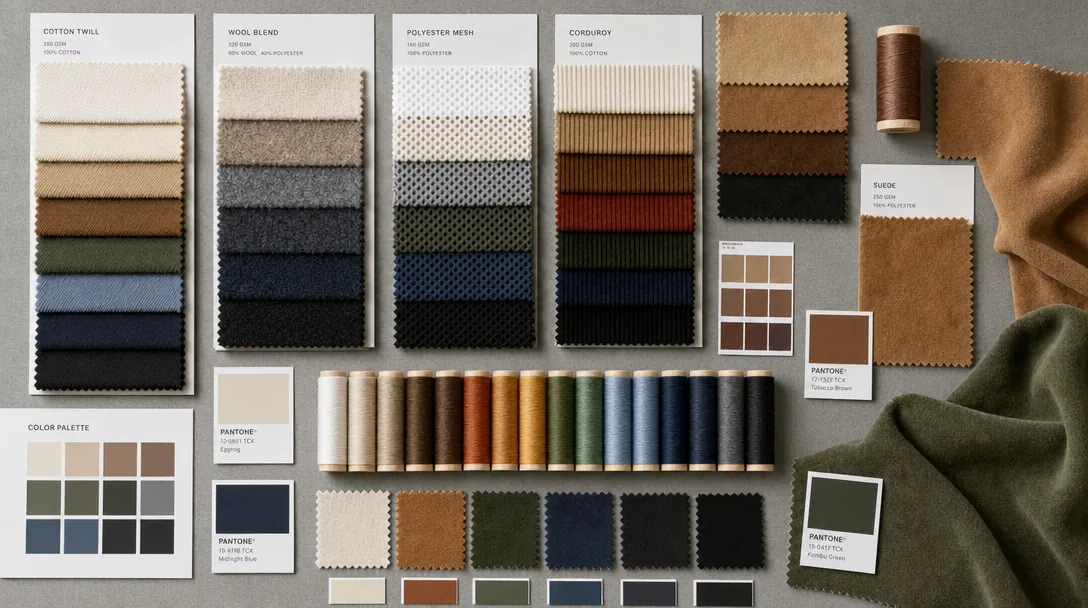
If you strip away trend fabrics and capsule drops, almost every production cap still lands in three fabric families: cotton, polyester, or wool blend. In our sampling records, roughly 95% of custom cap programs run on brushed cotton twill, cotton canvas, polyester twill, polyester microfiber, or wool-blend melton; the other 5% is split across corduroy, denim, faux suede, and lightweight nylon ripstop. That is why any serious cotton vs polyester cap conversation should start with construction rather than mood board language. A 16x12 cotton twill at 260-280 gsm behaves very differently from a 75D polyester microfiber at 140-160 gsm, even if both are dyed to the same Pantone TCX. On the factory floor, the dominant decision variables are stitch stability, colorfastness, crown memory, and how the shell reacts after fusing, embroidery, and sweat exposure.
Cotton remains the easiest fabric family for buyers who want a natural handfeel and predictable sewing performance. Most custom baseball caps use cotton twill or canvas in the 220-320 gsm range, with canvas giving a drier, firmer hand and twill offering cleaner drape over a structured front panel. For a fabric for embroidered cap, cotton usually gives the most forgiving needle penetration and least thread skating, especially on flat embroidery run on Tajima or Barudan heads at medium stitch density. The tradeoff is that cotton absorbs moisture, fades faster under UV, and can show a wider lot-to-lot shade shift if the mill does not control Delta-E below 1.0 to 1.5 against the approved lab dip. When buyers ask for the best fabric for custom hats in lifestyle retail, cotton wins on touch and perceived value, but not on technical performance.
Polyester and wool blend sit on opposite ends of the use-case spectrum. Polyester twill and microfiber dominate teamwear, promo, and outdoor programs because they resist shrinkage, hold color well, and make more sense when you need moisture wicking cap fabric with low maintenance; a good 150D or 300D polyester shell will usually outperform cotton in sweat drying time and repeated washing. Wool blend, usually 80/20 acrylic-wool for classic snapbacks or 100% melton for higher-end structured crowns, gives the richest surface and best shape retention, but it also raises material cost, typically by $0.45 to $1.20 per cap versus standard cotton twill depending on origin and yarn quality. In wool vs cotton hat decisions, wool blend looks sharper for premium streetwear and licensed headwear, while cotton is easier to wash and easier to source consistently at volume. At CrownsForge, specialty fabrics still matter, but for cap fabric selection at commercial scale, these three families carry almost the whole market because they are the most stable under embroidery, QC, and AQL 2.5 inspection.
When cotton wins
If you sell on hand-feel first, cotton usually wins the first branch of the decision tree. In the cotton vs polyester cap debate, a 6.4 to 7.5 oz cotton twill is still the default for streetwear because it feels broken-in without looking flimsy, and it gives a cleaner, more expensive read at retail than most entry-level polyester. For dad hats and casual baseball caps, I prefer 100% cotton twill in the 270 to 320 gsm range with a brushed face and tight 3/1 twill construction; that combination holds crown shape well enough for an unstructured profile while still softening nicely after enzyme wash or pigment garment wash. If the brand story leans on "natural," vintage, or everyday wear, cotton does the job with less explanation to the customer. It also develops a better-used look after 15 to 20 home washes, which matters for lifestyle drops where a cap should age like denim rather than stay slick and technical.
Embroidery is another reason cotton stays in the conversation when buyers ask for the best fabric for custom hats. A stable cotton twill gives digitizers a predictable base for 3D satin borders, flat fill areas, and small lettering down to around 4.5 to 5 mm, especially when paired with the right backing and a medium crown stiffness. Compared with slippery low-denier polyester shells, cotton shifts less under the hoop, so registration stays tighter on Tajima or Barudan heads and edge definition is cleaner on left-chest style logos adapted to cap scale. For a fabric for embroidered cap programs, I usually spec pre-shrunk twill and test colorfastness after wash because dark cotton shades can drift more than buyers expect; keeping panel-to-panel shade variance within Delta-E 1.5 to 2.0 is a realistic factory target. Our standard practice is to run a wash trial before bulk if the cap includes contrast embroidery on black, navy, or olive bodies.
Cotton is not the universal winner, but it is the right answer when comfort, retail texture, and wash character matter more than high-performance moisture management. That is where wool vs cotton hat decisions usually split: wool gives more structure and cooler-season appeal, while cotton is easier to sell across spring, summer, and year-round casual assortments. For cap fabric selection, cotton also plays well with finishing techniques that add value without pushing cost out of range: softener wash, light sanding, vintage pigment dye, and internal seam taping all lift perceived quality on a cap that may land around $2.20 to $3.80 FOB in China at 300 to 1,000 pieces depending on closure, embroidery count, and wash complexity. If the brief calls for a moisture wicking cap fabric for golf, running, or team issue, cotton is usually the wrong branch. But for retail capsules, music merch, and founder-led streetwear drops, cotton still beats synthetic options on shelf appeal and first-touch impression.
When polyester wins
Polyester wins when the cap has to manage sweat, dry fast, and keep its shape after hard use. That is why most athletic, golf, fishing, and outdoor programs have moved away from brushed cotton twill and into 100% polyester microfiber, mechanical-stretch woven polyester, or recycled rPET blends in the 110 to 180 gsm range. In a practical cotton vs polyester cap decision, polyester is the safer choice whenever the wearer is active for more than an hour, especially in hot or humid conditions. A good moisture wicking cap fabric pulls perspiration off the forehead, spreads it across the face fabric, and dries noticeably faster than cotton drill, which tends to hold water, darken with sweat, and feel heavy by the back nine or the fourth quarter. Polyester also keeps panel tension more consistent, so structured fronts are less likely to relax after repeated wear, and laser-perforated side panels or mesh overlays can be added without destabilizing the crown.
Print performance is the second reason polyester takes the lead. If the design depends on bright gradients, photographic artwork, sponsor-heavy side panels, or all-over pattern placement, microfiber polyester handles dye-sublimation far better than natural fibers, with cleaner edge definition and better shade repeat across bulk production. On team and festival orders, we usually approve lab dips or print strike-offs against Pantone references with a Delta-E tolerance around 1.5 to 2.0, because polyester can reproduce electric blues, neon pinks, and saturated reds that are difficult to hold on cotton. That makes it a strong answer for esports merch, running clubs, and outdoor brand programs where visual impact matters as much as wear comfort. For buyers comparing cotton vs polyester cap options, this is usually the tipping point: cotton feels more familiar in hand, but polyester delivers better color yield, lower drying time, and fewer complaints about sweat loading during events.
Polyester is not automatically the best fabric for custom hats, but it is usually the best fabric for embroidered cap programs that mix performance requirements with modern decoration. The key is matching the base cloth to the stitch density. Lightweight 75D or 150D microfiber can pucker if the digitizing is too dense, so clean underlay, wider columns, and backing selection matter more than on heavier cotton chino. Our standard practice is to test logos on Tajima or Barudan heads using the actual shell fabric before approving bulk, especially for low-profile unstructured caps where every needle penetration shows. Compared with wool vs cotton hat discussions, polyester sits in a different lane entirely: less heritage, more function, lower moisture retention, and better repeatability in outdoor use. It is the right call for athletic team caps, festival performance lines, and promotional programs that need washable, colorfast inventory at realistic FOB targets, often around $2.20 to $4.80 per piece depending on fabric spec, closure, and decoration.
When wool blend wins
If you need a cap that reads premium from three feet away, an 80/20 acrylic-wool melton still beats most alternatives. The reason is not nostalgia; it is structure. A good 20 to 22 oz melton, typically around 430 to 470 gsm depending on finishing, has enough body to hold a high-profile 6-panel crown without relying on overly stiff buckram or foam. That makes it the sweet spot when the cotton vs polyester cap debate misses the real retail question: does the cap feel substantial in hand and stay clean after embroidery? Wool blend does. Dense satin stitches, 3D puff underlays, and direct logo fills sit flatter on melton than on many brushed cotton twills because the surface is tighter and the crown panels resist collapse during hooping. For pro-style snapbacks, fitteds, and winter capsules, this is still the fabric buyers choose when they want that old-school MLB and varsity energy without jumping to full 100% wool cost and shrink risk.
In a practical wool vs cotton hat comparison, wool blend wins when shape retention, visual depth, and cold-weather sell-through matter more than wash simplicity. Cotton twill at 260 to 320 gsm is easier for summer programs, but it softens faster at the front seam and tends to show needle perforation more clearly on high-density logos. Polyester can be the smarter moisture wicking cap fabric for performance caps, but it often looks too technical for heritage retail unless you deliberately want that athletic finish. An 80/20 acrylic-wool melton gives you a cleaner middle ground: warmer handfeel than polyester, more resilient crown memory than cotton, and better edge definition for merrowed patches, chain stitch, and satin embroidery. On Barudan and Tajima heads, we usually slow down to around 650 to 750 stitches per minute for dense front logos on melton, not because the fabric is weak, but because that speed keeps penetration consistent and reduces heat shine on darker shades like black, navy, and 19-4007 TCX equivalents.
The tradeoff is that wool blend is a style fabric, not a universal answer in cap fabric selection. It costs more—typically about $1.10 to $1.90 higher per cap than standard cotton brushed twill at factory level, depending on fabric origin, crown construction, and whether the melton is yarn-dyed or piece-dyed. Color control also needs more discipline: dark heathers and team colors should be lab-dipped against Pantone TCX with a practical Delta-E target under 1.5 for retail programs, because wool-acrylic blends can shift after steaming and blocking. You also need stricter incoming inspection for pilling, shade lot consistency, and panel skew, then final inspection at AQL 2.5 because melton hides some seam issues until the crown is fully formed. At CrownsForge, our standard practice is to reserve this fabric for premium streetwear, licensed sports styling, and colder-season launches where the buyer specifically wants the best fabric for custom hats that will carry bold embroidery and a structured silhouette.
Cost differential and retail positioning
Fabric cost moves the FOB by cents, but retail positioning moves the MSRP by dollars. On a standard 6-panel structured cap, 6.4 oz cotton twill is the baseline most factories quote against; upgrading to a better hand-feel 7.5 oz cotton twill usually adds only $0.20 to $0.40 per piece at volume, while microfiber polyester adds about $0.20 to $0.50 depending on yarn denier, finish, and whether the mill is doing moisture management or a basic peach finish. Recycled polyester with GRS paperwork typically lands another $0.40 to $0.70 above standard poly because the certification chain, lower minimums, and segregation rules all cost money. In practical cotton vs polyester cap decisions, that spread is small enough that the real question is not material cost alone, but what story the fabric supports at retail and whether the customer will feel the difference in hand, drape, and performance.
Wool changes the math faster than cotton or polyester. An acrylic-wool blend commonly adds $0.80 to $1.20 over baseline cotton twill, and true 100% wool melton often adds $1.50 to $2.30 before you factor in slower cutting, extra fusing control, and higher rejection risk for shade variation. Buyers comparing wool vs cotton hat programs should understand that wool is not just a fabric upgrade; it shifts the whole product into a different retail lane. Melton hides seams nicely and gives embroidery a dense, premium face, but it can show color lot variation if Pantone matching is pushed too aggressively, especially when the acceptable Delta-E tolerance is under 1.5. For a fabric for embroidered cap, wool also demands cleaner digitizing and tighter thread tension because needle heat and pile resistance can make small text look muddy if the machine operator treats it like twill.
The margin opportunity is why the best fabric for custom hats is rarely the cheapest one on the quote sheet. A cap that costs $0.40 more in premium cotton or $0.70 more in recycled polyester can easily support a retail increase of $6 to $15 if the brand positions it around heavier weight, sustainability claims, or a better crown shape after wash testing. Wool is even more dramatic: I have seen a $2 material upgrade justify a 2x to 4x retail jump once the cap is merchandised as heritage, varsity, or licensed team product. Our standard practice is to review cap fabric selection against decoration method, target margin, and claim risk before sampling, because a moisture wicking cap fabric for corporate running events should not be judged by the same pricing logic as a melton snapback for boutique streetwear. If the end user will never notice the finish, keep the baseline twill; if they touch the cap before buying, fabric drives conversion more than most buyers admit.
Decoration receptiveness by fabric
If decoration flexibility is the priority, cotton is still the safest answer in any cotton vs polyester cap decision. A mid-weight cotton twill or brushed chino, usually 180 to 260 gsm, will accept almost every common cap decoration without fighting the operator: 3D puff embroidery, flat fill, satin borders, woven patches, leather patches, screen print, and even direct transfer labels on sweatband areas. The reason is simple on the factory floor: cotton gives a stable needle bite and predictable thread sink, so digitizing on Tajima or Barudan heads is straightforward unless the fabric has excessive enzyme wash or heavy brushing. For a fabric for embroidered cap, we usually run 40 wt rayon or polyester thread with standard cap-frame tension, then adjust underlay density only if the face cloth has a soft raised nap. Cotton also handles edge fold-over on patch placement better than slippery synthetics, which matters when you are running 500 pieces and trying to keep rejection under AQL 2.5.
Polyester is less forgiving in appearance but more specialized in print performance. Sublimation only works properly on polyester or high-poly blends, and in practice you want at least 65% polyester content to hold bright color without washout; 100% poly gives the cleanest transfer and the lowest Delta-E shift from approved artwork. That makes polyester the obvious choice when the artwork has gradients, camouflage, or sponsor logos that would be too expensive to build in stitches. Flat embroidery, 3D puff, TPU patches, and heat-applied badges also run well on polyester, but you need to watch needle heat and hoop slippage, especially on 150D to 300D performance fabrics with PU backing. For buyers asking about moisture wicking cap fabric or the best fabric for custom hats in hot-weather sports programs, polyester wins on function, but decoration planning has to start earlier because glossy or tightly woven faces can expose registration errors that cotton hides.
Wool melton gives the richest embroidered look, especially for heritage baseball caps and licensed team styles, but it rewards disciplined machine setup. On 16 oz to 20 oz melton, dense flat embroidery and 3D puff look sharp because the surface has body and the crown panels resist distortion; small serif lettering also holds better than on soft brushed cotton. Patches work, but a small woven label or merrow-edge emblem often looks more premium than covering the wool face with oversized heat seal. Wool vs cotton hat decoration also differs in tension behavior: brushed cotton and wool both need lower top tension, careful presser-foot pressure, and sometimes a sharper needle selection to avoid drag marks or pile disruption, especially on ZSK heads running high-speed fills above 700 spm. Our standard practice is to test one strike-off per fabric lot, because melton thickness can vary enough between mills to affect puff height, stitch coverage, and final hand feel.
Sustainability framing
If you are framing sustainability honestly, the strongest move is to tie the claim to a third-party standard instead of vague words like eco or conscious. For a cotton vs polyester cap decision, GOTS organic cotton, GRS-certified recycled polyester, and RWS-certified wool are the three claims buyers can actually defend in retail copy, compliance reviews, and importer questionnaires. GOTS matters because it covers fiber origin, chemical inputs, and chain-of-custody, not just that the yarn started as organic cotton. In practice, a brushed 260 to 320 gsm organic cotton twill usually adds around $0.18 to $0.45 per cap versus conventional cotton, depending on MOQ, color count, and whether the mill already holds current scope certificates. That premium is modest, but it only means something if the trim package is also controlled; if your sweatband, buckram, or sewing thread falls outside the certified bill of materials, the claim gets weak fast.
Recycled polyester is the easiest sustainability story to scale, mostly because the supply chain is deeper and lead times are more predictable than certified cotton. GRS-certified rPET in 150D to 300D woven twill or microfiber commonly adds about $0.12 to $0.35 per cap over virgin polyester, and it pairs well with performance builds where buyers also want a moisture wicking cap fabric story. The catch is that recycled content does not automatically mean lower complaint rates or better hand feel. I have seen rPET lots vary more in luster and shade, so for black, navy, or team colors you need tighter lab dip control and a realistic Delta-E target, usually under 1.0 to 1.5 against the approved standard. Our standard practice is to confirm whether the factory is using GRS transaction certificates at bulk stage, because recycled claims fall apart quickly when sourcing shifts mid-production.
Wool is the most niche but usually the most premium sustainability narrative, especially for heritage retail, golf, and licensed headwear programs where customers still associate melton and flannel with value. RWS certification is the relevant benchmark because it speaks to animal welfare and land management, which gives more substance than a generic wool vs cotton hat comparison. On actual cap fabric selection, though, RWS wool costs more sharply than the other two routes: a 16 to 21 oz melton or wool-blend face fabric can add $0.35 to $0.90 per cap, and sometimes more if the mill is in Japan or Italy rather than China. That surcharge can be justified when the cap also carries higher embroidery density, leather straps, or retail packaging, because the fabric story supports the total price architecture. If the question is simply the best fabric for custom hats, sustainability alone will not answer it; the right answer depends on target margin, embroidery load, and whether the fabric for embroidered cap needs stability, softness, or moisture management first.
Frequently Asked Questions
What is the minimum order quantity (MOQ) for custom hats?
Our standard MOQ is 100 pieces per design and color, with sampling available from 1 piece. For complex multi-color logos or premium fabric upgrades, the MOQ can be lowered with a small per-piece surcharge.
Which shipping methods do you support?
We support FOB, CIF and DDP shipping. Air express for samples and small orders, sea LCL for 100 to 500 pieces, sea FCL for 5,000+ pieces. Door-to-door DDP available for US, EU, UK, Canada and Australia.
Do you support sustainability certifications?
Yes. We work with GOTS organic cotton, GRS-certified recycled polyester, OEKO-TEX Standard 100 fabrics, and are BSCI and Sedex audited. Certification documentation can be provided per order.
Can I order a sample before bulk production?
Yes. We strongly recommend approving a pre-production sample before mass production. Samples are charged at 35 to 60 USD each plus express shipping, fully refundable against confirmed bulk orders over 500 pieces.
What file format should I send for my logo?
Vector files (AI, EPS, PDF) are ideal. High-resolution PNG or JPG at 300 dpi on transparent background works as a fallback. Provide Pantone color references for accurate reproduction.
What's the MOQ for custom embroidered trucker hats no minimum?
When evaluating custom embroidered trucker hats no minimum, the key considerations are construction quality, decoration capability, MOQ flexibility and lead time. Cotton (woven twill or canvas), polyester (woven twill or microfiber performance), and wool blend (typically 80/20 acrylic-wool or 100% melton). 95% of custom caps fall into one of these three families; specialty fabrics (corduroy, denim, suede, nylon ripstop) appear in 5% of orders. Cotton twill 6.4-7.5 oz is the streetwear and casual retail default. Soft hand-feel, takes…
What's the MOQ for custom embroidered baseball caps no minimum?
When evaluating custom embroidered baseball caps no minimum, the key considerations are construction quality, decoration capability, MOQ flexibility and lead time. Cotton (woven twill or canvas), polyester (woven twill or microfiber performance), and wool blend (typically 80/20 acrylic-wool or 100% melton). 95% of custom caps fall into one of these three families; specialty fabrics (corduroy, denim, suede, nylon ripstop) appear in 5% of orders. Cotton twill 6.4-7.5 oz is the streetwear and casual retail default. Soft hand-feel, takes…
How does ordering custom trucker hat near me work?
When evaluating custom trucker hat near me, the key considerations are construction quality, decoration capability, MOQ flexibility and lead time. Cotton (woven twill or canvas), polyester (woven twill or microfiber performance), and wool blend (typically 80/20 acrylic-wool or 100% melton). 95% of custom caps fall into one of these three families; specialty fabrics (corduroy, denim, suede, nylon ripstop) appear in 5% of orders. Cotton twill 6.4-7.5 oz is the streetwear and casual retail default. Soft hand-feel, takes…
What's the MOQ for custom embroidered hats no minimum no setup fee?
When evaluating custom embroidered hats no minimum no setup fee, the key considerations are construction quality, decoration capability, MOQ flexibility and lead time. Cotton (woven twill or canvas), polyester (woven twill or microfiber performance), and wool blend (typically 80/20 acrylic-wool or 100% melton). 95% of custom caps fall into one of these three families; specialty fabrics (corduroy, denim, suede, nylon ripstop) appear in 5% of orders. Cotton twill 6.4-7.5 oz is the streetwear and casual retail default. Soft hand-feel, takes…
Is cotton or polyester better for a cap?
Polyester twill offers superior durability and wrinkle resistance compared to its cotton counterpart. This synthetic fabric is highly resistant to stretching and shrinking, ensuring hats maintain their shape and size over time.
Need a low-MOQ test order?
We help emerging brands launch with as few as 100 pieces. Premium fabric, in-house embroidery, retail-ready packaging.
Start a small orderRelated guides
5 Panel Hat Vintage: A 2026 B2B Sourcing Guide
Read article →
Custom Embroidered Hat: The 2026 Sourcing & Manufacturing Playbook
Read article →
Golf Hats For Men Supplier Audit Checklist for Custom Hat Buyers
Read article →We hope this guide demystifies cotton vs polyester vs wool: a cap fabric decision tree (2026 update) and helps you move forward with confidence. If you have questions specific to your project, our English-speaking sales engineers are one message away.