
Cotton Hats for Men: Properties, Costs and How to Spec It Right
Cotton Hats for Men: Properties, Costs and How to Spec It Right is one of the most-asked questions we receive from international buyers, and for good reason. With dozens of factories competing for your order and an alphabet soup of technical terms in every supplier quote, even experienced importers can feel lost. This guide consolidates what we have learned producing custom hats for clients in 40+ countries.
cotton hats for men sourcing: the questions buyers actually ask
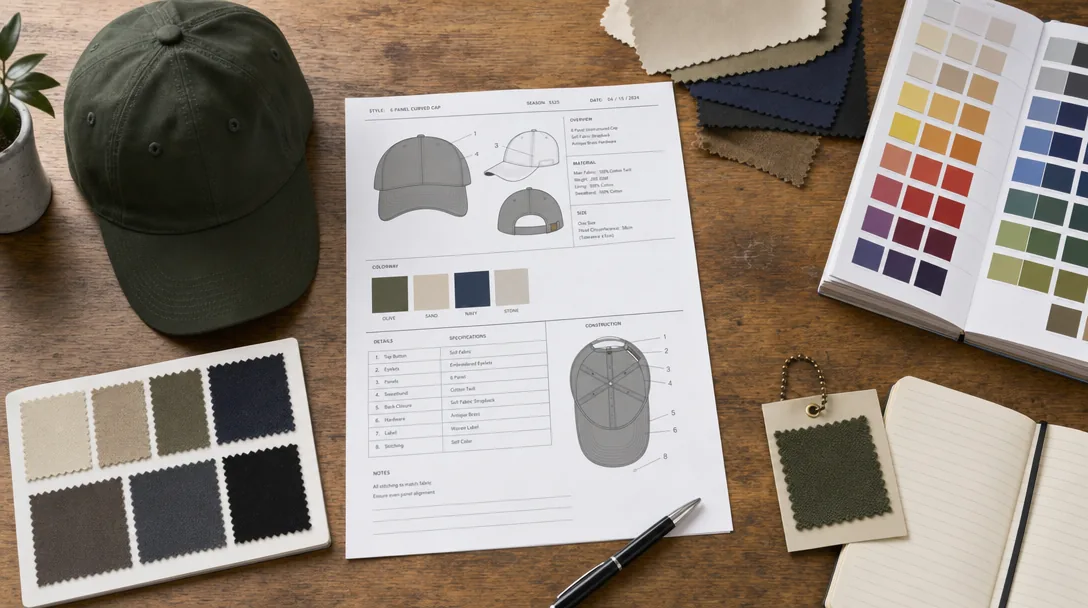
The fastest way a cotton hats for men program fails is approving a showroom sample that the bulk line cannot repeat. Do not release fabric deposit, buckles, cartons, or embroidery thread purchase until the PP sample is made from the actual dyed lot, actual sweatband, closure, buckram or unstructured crown, embroidery file, wash recipe, and export carton compression method. A sample room can make a 10 oz cotton twill cap look clean by slow blocking, hand steaming, and cutting loose threads one by one; bulk production goes through die cutting, bundle sewing, automatic eyelet setting, heat pressing, washing, drying, and 5-ply carton stacking. Put measurable tolerances in the tech pack: head circumference 58 cm ±0.7 cm, brim length ±3 mm, brim curve ±5 mm, crown height ±5 mm, eyelet position ±2 mm, logo centerline ±2 mm, and front-panel symmetry within 3 mm. For 3D puff, specify 2 mm or 3 mm EVA foam, Madeira or Gunold polyester thread, tear-away or cut-away backing, underlay sequence, satin density, and maximum stitch count. Run the strike-off on the same Tajima, Barudan, or ZSK heads planned for bulk, because washed cotton puckers fast when satin columns are too dense or backing is too rigid.
“100% cotton” is not a specification; it tells the cutting room almost nothing about shrinkage, hand feel, fading, or blocking. Cotton hats for men can be made from 160 gsm poplin, 220–260 gsm chino twill, 280–320 gsm brushed twill, 10 oz canvas, cotton ripstop, or pigment-dyed washed cotton, and each reacts differently to enzyme wash, steam pressing, needle punching, and 30 days in a humid container. For black, navy, forest green, burgundy, and red, require lab dips matched to Pantone TCX and write color tolerance into the PO: Delta-E under 1.5 for fashion retail, under 2.0 for promo orders. Ask for test reports covering dimensional change, dry and wet crocking, pH, formaldehyde, and azo-free dyes; dark cotton may pass dry rubbing and still stain a white sweatband during ocean freight. Seam slippage, bar-tack strength, strap-anchor pull strength, and back-opening reinforcement are critical on low-profile dad caps because washing weakens structure. At CrownsForge, the sealed PP sample, shade band, and embroidery strike-off are kept in QC and used as the reference for inline and final inspection.
A useful quotation separates fabric, decoration, washing, packing, testing, compliance, and logistics instead of hiding every risk inside one unit price. In Yiwu and the surrounding Zhejiang supply chain, a men’s 6-panel cotton dad cap in 220–260 gsm twill with self-fabric strap, antique brass buckle, and flat embroidery is typically US$2.10–3.20 FOB at 1,000–3,000 pieces per color, assuming normal stitch count, standard polybag packing, and no retail box. Pigment dye, enzyme wash, sandwich brim, metal clasp upgrade, woven label, printed seam tape, custom hangtag, or barcode sticker usually adds US$0.10–0.60 each. 3D puff embroidery adds about US$0.15–0.45 depending on foam height, stitch count, thread changes, and logo size. Realistic MOQ is 300–500 pieces per color with stock fabric and 1,000–2,000 pieces for custom dyeing. Final inspection should follow ANSI/ASQ Z1.4, general inspection level II, with AQL 2.5 major and 4.0 minor. Define rejection rules for shade variation, broken stitches, oil marks, needle holes, warped brims, loose buckles, metal contamination, and carton mix-ups. Chain retailers should also request sedex-audit-cap-supplier-guide.html">BSCI 2.0 or Sedex SMETA 4-Pillar files, needle-control logs, broken-needle records, and metal detection reports.
Custom Corduroy Hats Australia
Australian corduroy caps fail when they are specified like plain cotton twill. For cotton hats for men, the fabric line must state wale count, weight, stretch content, and fusing behavior before sampling starts. 8-wale corduroy gives a heavy 1970s look but runs hot on summer crowns; I would keep it for brims, side panels, winter buckets, or fashion drops. 11-wale at 280-340 gsm is the safest commercial choice for 5-panel and 6-panel caps because it blocks cleanly and holds embroidery without looking bulky. 14-wale looks sharper on retail shelves, but the finer ribs crush faster during steaming, heat pressing, and carton compression. For unstructured dad caps, 220-240 gsm can work if the front panel has light woven fusing; without it, the crown collapses after wear. If the cloth contains 2-3% spandex, test recovery after embroidery and steam pressing, because poor recovery leaves permanent puckering around the logo. UPF 50+ claims need a certified fabric or lining report; brass eyelets and cotton sweatbands are not sun-protection evidence.
Nap direction is the detail that makes dark corduroy look premium or defective. Black, dark navy, bottle green, and chocolate brown panels must be cut in the same pile direction, or the cap will look like mixed dye lots under D65 light even when the Pantone TCX lab dip is within Delta-E 1.5. Our standard practice at CrownsForge is to mark nap direction on the cutting ticket, shade-check panels before stitching, and reject directional mismatch before embroidery, because fixing it after assembly is impossible. Logo density also needs restraint: on 11-wale corduroy, a 55-65 mm front embroidery should usually stay below 8,000-10,000 stitches. Tajima, Barudan, or ZSK heads with 75/11 sharp needles, moderate top tension, and tearaway backing normally give cleaner edges than heavy cutaway, which can make the front panel feel boardy. For kids’ bucket hats sold in Australia, confirm chin-cord removability, stopper material, strap width, and pull-test requirement early; major retailers often reject dangling cords on safety grounds.
Realistic Australia orders start at 100-300 pieces per color from available corduroy, while custom dye normally needs 500-1,000 pieces with Pantone TCX approval and Delta-E under 1.5. Plain corduroy dad caps usually price around USD 3.80-6.50 FOB China; flat embroidery raises that to roughly USD 5.20-8.80 depending on stitch count, backing, and logo position. Structured corduroy bucket hats with chin strap, eyelets, lining, and size grading often land at USD 6.50-10.50 before freight, duty, and 10% GST. QC should go beyond cosmetic inspection: use AQL 2.5 for final inspection, check brim symmetry within 3 mm, logo placement within 2 mm, seam slippage at crown and strap points, and dry/wet crocking because dark corduroy can stain pale sweatbands. A useful RFQ for custom corduroy hats Australia should include wale count, gsm, panel shape, Pantone TCX reference, logo size, embroidery type, strap specification, MOQ target, and delivery term such as FOB Ningbo, CIF Sydney, or DDP Australia.
Organic Cotton Hat
Organic cotton is a fiber claim with paperwork behind it, not a hat style, so spec the fabric first and the certification language second. For cotton hats for men, the practical range is 10S-16S organic cotton canvas at 260-320 gsm for 5-panel and 6-panel caps, 20S organic twill at 240-280 gsm for softer dad caps, 21W or 16W organic corduroy for fall caps, and 1x1 or 2x2 rib knit for beanies. Never accept “eco cotton” as a buying spec. State whether the order must be GOTS, OCS 100, OCS Blended, or only “made with organic cotton.” GOTS covers chemical inputs and social criteria; OCS mainly verifies organic-content chain of custody. For dyed fabric, call out Pantone TCX, D65 light source, and bulk tolerance of Delta-E 1.5-2.0. Black, dark navy, and forest green organic cotton lots drift more often than conventional combed cotton, so approve lab dips and keep one sealed pre-production sample before cutting bulk.
Cost moves with gsm, dye route, certification scope, and trims, not the word “organic” alone. A basic 6-panel organic cotton twill cap with self-fabric strap, metal buckle, and flat embroidery usually lands at US$3.20-4.80 FOB Yiwu at 500-1,000 pcs. A structured version with recycled buckram, sandwich brim, woven label, and 3D puff embroidery on Tajima or Barudan heads is more realistically US$5.20-7.50, depending on stitch count, front-panel stiffness, and blocking time. Organic cotton beanies sit around US$2.80-4.60, driven by yarn count, knit density, cuff height, and label type. MOQ is usually 300 pcs per color if stock greige fabric is available, 500-1,000 pcs for custom-dyed organic cotton, and about 500 pcs for knit beanies. At CrownsForge, our standard practice is to push small programs toward shared fabric lots because custom dyeing 200 pcs per color gives poor pricing and higher shade risk.
QC should focus on the defects buyers notice first: shrinkage, crocking, seam strength, embroidery puckering, and certification claims that do not match the transaction certificate. Require pre-production shrinkage testing; for unstructured cap panels, keep shrinkage under 3% after washing, because crown shrinkage greater than the sweatband creates ripples near the front seam and side panels. For bucket hats with straps, test strap pull strength at 7-10 kg and inspect eyelets for cracked coating, rust risk, and sharp burrs. Run embroidery at production speed on Tajima, Barudan, or ZSK heads before bulk approval, since low-twist organic cotton can pucker when satin columns exceed 8 mm without proper edge-run and zigzag underlay. Final inspection should use AQL 2.5 for major defects and AQL 4.0 for minor defects, including shade banding, loose threads, logo placement more than 2 mm off center, and hangtag wording that overstates the organic claim.
Cotton Beanie Women
A women’s cotton beanie is a knit product, so the spec should begin with yarn count, gauge, finished weight, and recovery, not crown panels or brim construction like most cotton hats for men. For spring retail, 12-gauge combed cotton at 180-230 gsm gives a dry hand, good breathability, and a cuff that folds without becoming bulky. For colder drops, 7-gauge or 5-gauge cotton-acrylic at 260-340 gsm is more stable because 100% cotton relaxes after repeated wear and wash cycles. I would not spec pure cotton for a tight skull-fit beanie unless weak rebound is acceptable; 95/5 cotton-spandex or 60/40 cotton-acrylic holds shape better. Flat knitting with a linked crown seam gives cleaner shaping, while circular knitting is faster but can leave a rough top closure if linking tension is uneven. Specify shade by Pantone TCX, approve lab dips to Delta-E 1.5 or tighter, and require proper reactive dye soaping for black, navy, forest green, and burgundy, where rushed finishing can push wet crocking below grade 3-4.
MOQ is usually controlled by yarn availability, not knitting capacity. Stock yarn colors can run at 300-500 pieces per color, with realistic FOB Yiwu pricing around USD 2.10-3.80 for 100% cotton and USD 2.40-4.30 for cotton-spandex before hangtags, belly bands, polybags, carton marks, and third-party testing. Custom-dyed yarn normally pushes MOQ to 800-1,000 pieces per color because dyehouses often require 50-80 kg per shade, and leftover yarn is still the buyer’s cost. Organic cotton is not a simple upgrade: GOTS or OCS yarn usually adds 15-35%, and the claim only holds if the yarn lot, transaction certificate, and factory scope certificate match the purchase order. Compared with acrylic, cotton costs more per finished gram, dries slower, and rebounds less, but it feels cleaner on the skin and makes sense when the same brand is already selling cotton hats for men, cotton canvas dad caps, or bucket hats in a shared Pantone color story.
QC should focus on faults the wearer feels immediately: unstable sizing, scratchy linking, twisted cuffs, shade drift, and poor stretch recovery. A practical women’s beanie spec is 20-22 cm half-width, 20-23 cm body height, and a 6-8 cm cuff; streetwear slouch fits usually add 2-4 cm in height. Measure stretch recovery after 30 minutes, crown seam tension, cuff depth, and shrinkage after a 30 C wash, with shrinkage capped at 5% unless the yarn has been compacted or pre-shrunk. Bulk inspection should run AQL 2.5 for major defects and AQL 4.0 for minor defects, with rubbing colorfastness at grade 4 dry and grade 3-4 wet. Check needle lines, barre, hard linking knots, off-center woven labels, loose care-label edges, and forehead irritation from label backing. Our standard practice at CrownsForge is to keep sealed shade bands from lab dip, pre-production sample, and shipment cartons, so color disputes are judged by Delta-E readings rather than phone photos.
Organic Cotton Beanie
An organic cotton beanie should be specified from yarn and gauge first; the finished height only matters after the knit structure is locked. For cotton hats for men, 12-gauge flat knitting gives a cleaner retail rib, less bulk under a hood, and better logo readability on a cuff patch. A 7-gauge rib is heavier and more workwear-looking, but it also grows more after wear if the yarn twist is loose. Common builds are 100% GOTS or OCS organic cotton, or 95/5 organic cotton-spandex when the buyer needs recovery after repeated stretching. I normally spec combed ring-spun 21S/2 for a fuller winter hand and 32S/2 for a smoother, lighter beanie that can sell across seasons. Yarn-dyed lots should be controlled to Delta-E 1.5-2.0 against the approved Pantone TCX target. Garment dye works for washed streetwear, but approve bulk shrinkage and torque because cotton cuffs can flare or twist. A practical men’s spec is 20-22 cm body height, 7-8 cm cuff, 44-48 cm relaxed circumference, and 54-60 cm stretch circumference after 30 seconds on a head-form gauge.
MOQ and price are driven by yarn color, certification paperwork, and knitting setup, not sewing labor. Stock organic cotton colors can usually run at 300-500 pieces per color, while custom Pantone TCX yarn dyeing often starts at 1,000-1,500 pieces because dye houses need enough weight to keep shade stable and vats clean. Realistic FOB Ningbo or Shanghai pricing is USD 2.20-3.80 for a plain 100% organic cotton beanie, USD 3.20-5.50 with jacquard artwork or a woven patch, and USD 4.50-7.00 when the order needs GOTS transaction certificates, recycled paper hangtags, and individual kraft sleeves. Acrylic is usually USD 0.60-1.20 cheaper and rebounds better after washing, but it does not support a natural-fiber or organic claim. Do not buy this style like a cut-and-sewn baseball cap. The real failure points are crown linking, rib tension, cuff growth, torque after wash, and legally correct fiber-content labeling.
QC has to stress stretch recovery, twisting, shade drift, and claim control because beanie defects often show after wear, not on the packing table. I use AQL 2.5 major / 4.0 minor, with 10-piece measurements per color and at least 3 pieces washed at 30 C gentle cycle, flat dried, then checked for shrinkage under 5% lengthwise and 6% widthwise. Cuff height should hold within +/-3 mm, label placement within 2 mm, and patch or embroidery pull strength should be tested when branding is added. Tajima, Barudan, or ZSK embroidery heads can distort soft cotton ribs if backing, hoop pressure, and thread tension are wrong, so approve decorated samples after washing, not only fresh off the machine. For GOTS or OCS claims, the PO must state the certification body, license number, fiber percentage, and whether transaction certificates are required per shipment. BSCI 2.0 and Sedex SMETA 4-Pillar audits verify social compliance; they do not prove organic content.
Acrylic Beanie Hats
Acrylic beanies make sense when the brief is saturated winter color, low shrinkage, and a sharp price; they are a poor fit when the retail claim needs to sit beside cotton hats for men as natural, breathable, or spring-weight. Most production uses 100% acrylic yarn in 2/28s or 2/32s count, knitted as 1x1 rib, 2x2 rib, fisherman rib, waffle, or jacquard, then linked, steamed, shaped, needle-checked, and packed. With correct steaming, post-wash shrinkage at 30°C should stay under 3%, and stretch recovery is usually better than cotton after repeated wear. The downside is hand feel and positioning: acrylic is warmer, less breathable, and more static-prone, so it should not be sold as a cotton watch cap substitute. If the buyer needs a natural-fiber story, specify BCI cotton, organic cotton, or a cotton-rich blend, then test crown growth, cuff tension, and torque after wash because cotton knit beanies can relax badly if yarn twist and rib tension are not controlled.
A stable RFQ needs more than “acrylic beanie, one size.” Specify fiber content, yarn count, knit structure, finished flat width, uncuffed height, cuff height, target gram weight, logo method, care label wording, packing, and color standard. A normal adult cuff beanie finishes 21-22 cm wide flat, 20-23 cm high before cuffing, with a 7-9 cm cuff and a practical head-fit range of 55-62 cm. For yarn-dyed solids, call Pantone TCX and approve bulk shade within Delta-E 1.5 for black, navy, charcoal, and gray; heather and melange yarns often need Delta-E 2.0 because mixed fibers do not read like lab-dipped cotton twill. Keep cuff embroidery compact: 3,000-6,000 stitches on Tajima, Barudan, or ZSK heads normally sits cleanly, while a dense 12,000-stitch fill crushes the rib and turns the cuff stiff. For larger branding, woven labels, PU patches, silicone badges, or debossed leather patches usually look cleaner and cost less rework.
Stock acrylic yarn can usually support 300-500 pieces per color, but custom-dyed yarn is normally 1,000-2,000 pieces per color because dye houses will not hold shade consistency on tiny lots. At 1,000 pieces, a basic 100% acrylic cuff beanie typically lands around $1.20-$2.10 FOB Ningbo or Shanghai; jacquard artwork, pom-poms, fleece lining, metallic yarn, embroidery, or custom patches can push the range to $2.40-$4.20. That is still often cheaper than many cotton hats for men, especially structured caps with 3D embroidery, but the fiber content must match the care label, commercial invoice, and import declaration. Bulk QC should check stretch recovery, linking strength, shade banding, cuff height within +/-5 mm, logo placement within +/-3 mm, weight within +/-5%, and broken needle control. Use AQL 2.5 for major defects and AQL 4.0 for minor defects, with a sealed pre-production sample confirming yarn composition, Pantone TCX reference, finished measurements, artwork size, packing method, MOQ, and FOB price.
100 Percent Cotton Beanie
A 100 percent cotton beanie should be engineered around recovery, because cotton yarn does not rebound like acrylic, merino, or nylon-spandex blends. For cotton hats for men, I would spec 21s/2 combed cotton when the target is a dense streetwear beanie with a dry, firm hand; 32s/2 works better for a softer indoor-weight cap, but it relaxes faster after repeated wear. A single-layer 1x1 rib usually finishes at 70-95 g, while a double-layer cuff beanie should sit around 110-145 g depending on gauge, finished height, and cuff depth. Use 1x1 rib when opening recovery matters, 2x2 rib only if the buyer accepts more growth at the hem, and jersey only for slouch or loose-fit styles. For organic cotton, require GOTS or OCS transaction certificates linked to the yarn lot and dye house; a hangtag claim without TC documentation is not traceability.
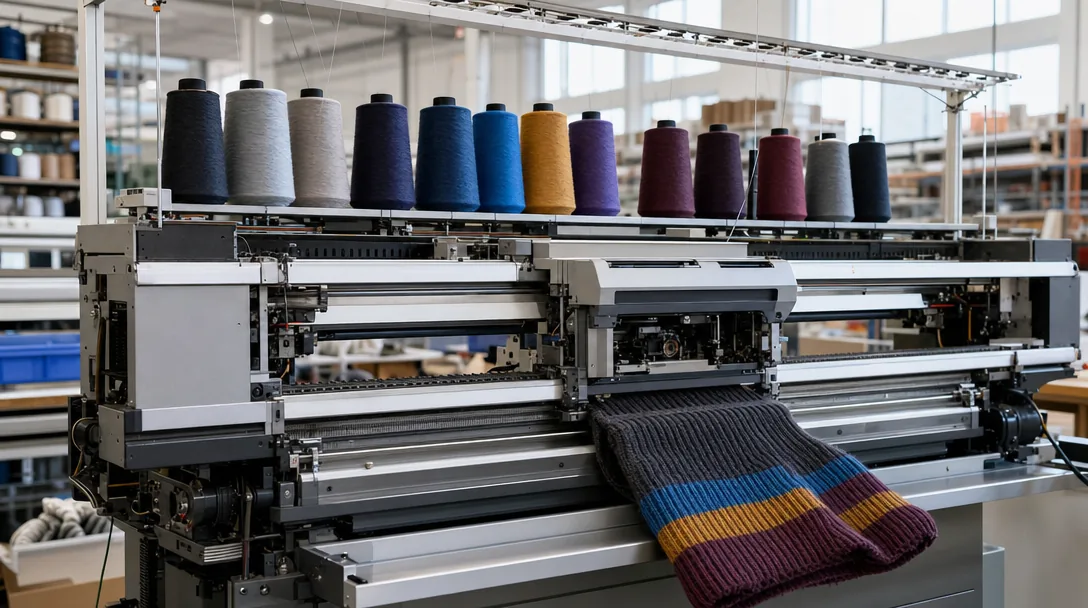
Beanie production is closer to sweater knitting than cut-and-sew cap assembly: the tube or shaped body is knitted, linked or overlocked, washed, pressed, labeled, and packed flat. Embroidery on rib knit must stay conservative because the fabric moves under the needle. Keep chest-style logos under about 6,000 stitches, avoid wide satin columns over 6 mm, and use tearaway or water-soluble backing with controlled hoop tension on Tajima, Barudan, or ZSK heads. Too much pull tunnels the ribs, and steam pressing can twist the mark even if it looked acceptable on the machine. Approve Pantone TCX by lab dip before bulk, with Delta-E under 1.5 for black, navy, and solid fashion colors. Reactive-dyed cotton can still shift between dye lots, so approve bulk shade bands before finishing; a beanie is one continuous color surface, and a half-shade mismatch is obvious on a retail peg.
Realistic MOQ is 300-500 pieces per color for conventional combed cotton and 800-1,000 pieces for certified organic cotton, because yarn dyeing minimums usually set the floor. FOB China pricing is typically USD 1.85-2.80 for a basic single-layer cotton beanie and USD 2.60-4.20 for double-layer, heavier-gauge, or certified organic versions. Add USD 0.25-0.60 for woven labels, embroidery, barcode stickers, hangtags, and retail polybags; DDP to the U.S. commonly adds USD 0.55-1.10 per piece depending on carton density, HS code treatment, duty, and final-mile terms. QC should call out finished circumference tolerance of +/-1 cm, height tolerance of +/-0.8 cm, wash shrinkage below 5 percent, colorfastness to rubbing, seam slippage, needle holes, loose linking, oil marks, and AQL 2.5 for major defects. Our standard practice is to lock yarn count, knit structure, finished gram weight, Pantone TCX, certification scope, MOQ, and FOB/DDP terms before counter-sampling.
Working with CrownsForge for cotton hats for men programs
Most failures in cotton hats for men start with a loose tech pack, not a bad fabric choice. Freeze the cap body before approving decoration: 16x12 cotton twill at 260-300 gsm for structured 6-panel caps, 21-wale cotton corduroy around 280 gsm for soft fashion drops, 10 oz washed cotton canvas for bucket hats, and 180-220 gsm cotton jersey or interlock for beanies. At CrownsForge, a fit sample normally takes 5-7 working days after the buyer confirms Pantone TCX color, crown height, visor length, closure, size grading, and logo scale. Embroidery strike-offs add 2-3 days when lettering falls below 4 mm, because satin columns close quickly on brushed cotton, pigment-dyed panels, and garment-washed fabric. For enzyme wash, stone wash, or pigment dye, approve the pre-production sample from the bulk fabric lot; a lab dip can read Delta-E under 1.5 under D65 light and still shift after finishing, pressing, and drying.
MOQ and FOB cost are controlled by fabric availability, dye loss, cutting yield, and decoration setup. Stock cotton twill programs can usually start at 100-300 pieces per style, while custom-dyed cotton, GOTS organic yarn, contrast corduroy panels, and washed finishes usually need 500-1,000 pieces because vat loading, shrinkage testing, and shade sorting create real waste. A basic 6-panel cotton cap with flat embroidery typically lands at US$2.20-US$3.80 FOB Yiwu, depending on stitch count, buckle grade, sweatband, lining, and carton packing. A washed cotton bucket hat with strap and metal eyelets is usually US$3.50-US$5.20. An organic cotton beanie commonly runs US$2.80-US$4.60, but the yarn lot must be reserved early or shade consistency becomes a production risk. Tajima, Barudan, and ZSK heads can handle flat embroidery, 3D puff, applique, woven patches, leather patches, heat transfer, and screen print, but I reject 3D puff on very soft unstructured cotton because the edge collapses after steaming, trimming, and compression packing.
Good order control turns taste arguments into measurable checkpoints before cartons are sealed. The control sheet should lock fabric gsm, Pantone TCX color, panel count, crown height, visor length, sweatband material, closure type, logo size, placement tolerance, thread color, needle detector requirement, polybag rules, carton marks, and barcode format. For retail or licensed cotton hats for men, final inspection should normally use AQL 2.5 for major defects and AQL 4.0 for minor defects, with tighter limits when the buyer has a chargeback manual. Inline QC should check panel symmetry, skipped stitches, thread tails, shade banding, visor curve, strap pull strength, sweatband twist, dirty handling marks on light cotton, and embroidery registration within +/-2 mm. Compliance files may include BSCI 2.0, Sedex SMETA 4-Pillar, OEKO-TEX fabric declarations, and GOTS transaction certificates when organic cotton is claimed. I flag category errors early: a smaller women’s corduroy block should not be forced into a men’s fit, and an acrylic beanie cannot be labeled cotton because it feels soft.
Frequently Asked Questions
Which shipping methods do you support?
We support FOB, CIF and DDP shipping. Air express for samples and small orders, sea LCL for 100 to 500 pieces, sea FCL for 5,000+ pieces. Door-to-door DDP available for US, EU, UK, Canada and Australia.
What is the minimum order quantity (MOQ) for custom hats?
Our standard MOQ is 100 pieces per design and color, with sampling available from 1 piece. For complex multi-color logos or premium fabric upgrades, the MOQ can be lowered with a small per-piece surcharge.
Can I order a sample before bulk production?
Yes. We strongly recommend approving a pre-production sample before mass production. Samples are charged at 35 to 60 USD each plus express shipping, fully refundable against confirmed bulk orders over 500 pieces.
What logo decoration techniques do you offer?
3D puff embroidery, flat embroidery, woven patch, leather patch, PVC patch, screen printing, sublimation, applique and laser etching, all in-house with no subcontracting.
Do you support sustainability certifications?
Yes. We work with GOTS organic cotton, GRS-certified recycled polyester, OEKO-TEX Standard 100 fabrics, and are BSCI and Sedex audited. Certification documentation can be provided per order.
Need a low-MOQ test order?
We help emerging brands launch with as few as 100 pieces. Premium fabric, in-house embroidery, retail-ready packaging.
Start a small orderRelated guides
Performance & Athletic Caps: Moisture-Wicking, UPF and Buyer Specs (2026 Update) - 2026 Buyer's Guide
Read article →
Mens Bucket Hat with String: A Vertical-Specific Sourcing Guide - Cost & MOQ Breakdown
Read article →
Custom Golf Hats: A Manufacturer's Guide to Performance Headwear - Cost & MOQ Breakdown - Cost & MOQ Breakdown - Supplier Checklist
Read article →Sourcing custom hats does not have to be complicated. With the right manufacturing partner, clear specifications and a small upfront investment in sampling, you can launch a retail-quality product in 30 to 45 days.