What's in a Cap Tech-Pack: A Specification Template for Buyers - Supplier Checklist - Supplier Checklist
What's in a Cap Tech-Pack: A Specification Template for Buyers - Supplier Checklist - Supplier Checklist is one of the most-asked questions we receive from international buyers, and for good reason. With dozens of factories competing for your order and an alphabet soup of technical terms in every supplier quote, even experienced importers can feel lost. This guide consolidates what we have learned producing custom hats for clients in 40+ countries.
Why a tech-pack saves you weeks of email back-and-forth
A proper cap tech pack template removes the expensive guessing that happens when a buyer sends loose references and the factory fills in the gaps from habit. If front panel height, crown depth, visor length, stitch count, panel count, and closure type are not written down, the sample room will make reasonable but wrong assumptions. I have seen a simple 6-panel dad cap burn through three sample rounds because the buyer expected a 58 mm mid-crown profile while the factory drafted a deeper 62 mm block. Put the numbers on the page first: crown height in millimeters, visor length from center front to edge, seam allowance, embroidery scale, and exact trim positions. That is what turns a style reference into a buildable cap specification sheet instead of a vague mood board.
The fastest way to lose two weeks is to scatter decisions across email threads instead of one headwear tech pack. A clean cap tech pack template should lock down dimensions, Pantone TCX references, logo placement in millimeters from CF and side seam, stitch density, eyelet count, sweatband width, and closure callouts before sampling starts. When those details are consolidated, the sample team can cut, sew, and digitize without stopping for clarifications. In practice, that usually cuts first-sample lead time from about 14 days to 7 to 9 days and reduces revision rounds from 3 or 4 to 1 or 2, because the tech pack for hat manufacturer use is already telling the factory what to make, not asking it to guess.
The real value is variance control before production starts. A cap design specification that includes graded tolerances, artwork files, embroidery stitch maps for Tajima, Barudan, or ZSK heads, and packaging instructions gives procurement, sampling, and QC the same reference point. That matters when an inline check and the final AQL 2.5 inspection need to judge the same sample against the same baseline. CrownsForge’s standard practice is to freeze the first approved tech pack as the production master, because once the sample matches that document, the factory is no longer interpreting intent on the fly. That is how you avoid rework, late approvals, and the margin loss that comes from fixing preventable mistakes after fabric has already been cut.
The seven sections of a complete cap tech-pack
A cap tech pack template only works when it turns design intent into factory instructions that can be measured, sampled, and verified. The seven sections I expect before a hat factory quotes are tech sketches, fabric spec, color spec, decoration spec, construction spec, packaging spec, and label/hangtag spec. That is the minimum for a serious order. A mood board or one-page brief will not stop expensive mistakes. A usable headwear spec sheet states panel count, crown height, visor curve, stitch type, seam allowance, logo position, and tolerance notes in millimeters, so the first sample lands near production reality instead of a guess. If those details are missing, every round of sampling becomes a translation exercise between sales, merchandisers, and the sewing floor.
Start with the tech sketches because they anchor the rest of the cap tech pack template. Front, back, side, and top views should show panel lines, eyelets, visor shape, closure type, and decoration zones, with dimensions in mm. The fabric spec should name the exact material and weight, for example 100 percent cotton twill at 280 gsm, polyester ripstop at 210 denier, or brushed canvas with fused buckram. Color spec should use Pantone TCX or a physical swatch approval, not vague words like navy or stone. Decoration needs method and limits: flat embroidery, 3D puff, woven patch, silicone transfer, heat transfer, stitch count range, patch size, thread reference, and placement dimensions. At sample stage, that level of precision is what lets the factory quote and digitize correctly on Tajima, Barudan, or ZSK embroidery heads.
Construction, packaging, and labeling are where sloppy buyer documents usually fail. The construction section should specify whether the cap is structured or unstructured, the number of panels, eyelet style, sweatband material, closure hardware, and whether the visor is flat or pre-curved. A six-panel structured cotton twill cap with self-fabric strap and antique brass buckle is not the same build as a five-panel foam trucker with mesh back and plastic snap closure, and the labor cost will not be close. Packaging should state folding method, polybag thickness in microns, carton quantity, carton marks, and master carton dimensions. Label and hangtag spec should cover woven label position, size, care label text, country-of-origin marking, barcode format, and whether the hangtag is sewn, looped, or pin-fixed. In a cap tech pack template, those details are not decoration; they are the difference between an accurate quote, a clean pre-production sample, and avoidable rework on the line.
Tech sketches: front, side, back, optional underbrim
Treat the sketch page as the control document, because everything downstream depends on it. The front panel height, side panel angle, back opening, underbrim color, and stitch spacing should read like build instructions, not product copy. For a custom cap spec sheet, that also means stating whether the visor is flat, gently curved, or fully pre-curved, whether the sweatband is self-fabric, cotton twill, or poly twill, and whether the underbrim is matching, contrast, or dark green for glare control. If the cap tech pack template leaves those points open, the factory may default to its house standard, which is how buyers end up approving the wrong underbrim, wrong crown depth, or a closure that sits 10 mm higher than intended. The cleanest tech sketches also protect embroidery digitizing and sampling from avoidable churn. Note where the logo can sit without crossing seam lines, whether the front panel is structured with buckram or unstructured, and whether the side panels need an applique, woven patch, or direct stitch. Our standard practice is to freeze these details before sampling, because it cuts back-and-forth on digitizing, cutting, and mold setup and gives the sample room one set of dimensions to build against. For international buyers, that means the tech sketch page should be detailed enough that a Tajima or Barudan operator, a pattern maker, and a QC inspector all read the same intent without a conference call to translate it.
Fabric and color spec: GSM, weave, Pantone references
Fabric sits near the top of a cap spec because it drives hand feel, seam stability, shrinkage, and how the visor locks into shape. In a cap tech pack template, “cotton” or “poly-cotton” is not enough. Call out the exact construction: 100% cotton twill, brushed cotton twill, recycled polyester twill, acrylic-wool blend, nylon taslon, or polyester mesh, and lock the basis weight in GSM. A structured 6-panel dad cap might use 250 GSM 3/1 twill with buckram-backed front panels; a lighter promo cap may use 180 GSM plain weave; winter headwear often lands at 300 to 350 GSM wool blend. That matters because fabric weight changes crown recovery, stitch bite, sweatband compression, and how hard the front panel resists embroidery distortion. It also reduces supplier room to swap in cheaper cloth that looks acceptable in photos but behaves badly at sewing and pressing.
Color needs the same level of discipline. Use Pantone TCX, not loose names like navy or forest green, and state the match method: dyed yarn, piece-dyed fabric, or finished garment color. The same Pantone TCX can read differently on brushed twill, garment-washed cotton, and wool-blend fabric, so a tolerance note belongs in the spec. For core brand colors, Delta-E 1.0 to 2.0 is a realistic target; textured or washed fabrics may need a wider band if surface reflectance breaks the match. A cap tech pack template should also name the approved reference: lab dip, physical chip, or signed-off production sample, because a PDF swatch is not a color standard and drifts immediately under factory light.
Do not bury the differences between body, visor, undervisor, closure, and sweatband if they are not identical. A black crown with a khaki undervisor and self-fabric strap is a different build from an all-over black cap, and the spec should say so. Record finish too: solid, heathered, pigment-dyed, garment-washed, stonewashed, or sand-washed, since those treatments change apparent shade and sheen even before dye variation enters the picture. If the order is going through sourcing or supplier review, tie one approved physical reference to each colorway and list it beside the BOM line item. That is what keeps the factory from working off a flattened PDF and making decisions from memory, which is how cap programs drift by the third round of production.
Decoration spec: technique, placement, dimensions, color count
Decoration specs fail most often on placement and scale, not artwork. In a usable cap tech pack template, define the technique, exact location, maximum footprint, and color count in production terms the floor can execute: front center 58 mm W x 45 mm H, bottom of artwork 12 mm above visor seam, centered on seam for a 6-panel or offset 3 mm to avoid seam bulk on a foam trucker. Call out the method by name—flat embroidery, 3D puff embroidery, twill appliqué, woven patch, screen print, silicone transfer, or soft PVC badge—and give technical limits. Example: 3D puff front logo, 3 mm EVA foam, max satin width 8 mm, no text under 5 mm cap height; flat embroidery side hit, 70D rayon thread, 5 colors max, stitch count target 7,000 to 9,000; screen print on cotton twill, Pantone Black C + 186 C, ΔE under 2.0 against approved standard. If you want clean sampling, also state whether outlines can be compensated in digitizing and whether small counters in letters may be opened for readability.
Patch specs need the same precision because edge finish and attachment method change both appearance and failure risk. Specify patch construction as a full recipe: 60 mm round woven patch, 100% polyester ground, merrowed border in Pantone Black C, heat-seal backing plus edge stitch, applied at front center with 2.5 mm margin from patch edge to stitch line. If the patch is laser-cut TPU or PU, say so, and note that raw laser edges are acceptable only if there is no yellowing, lifting, or adhesive squeeze-out after pressing. For embroidered patches, define border type, backing, and text limits—for example, satin border 3 mm, paper backing removed after sew-down, minimum readable text height 4 mm. Approval control should be one separate line: submit digital proof, embroidery sew-out, and physical patch sample on the actual cap body before bulk; freeze the approved strike-off to the PO and tolerance set. A mockup will not show crown tunneling, seam deflection, thread coverage, or placement drift beyond ±3 mm, which is where most supplier disputes start.
Packaging and label spec: polybag, hangtag, sticker, carton
Packaging belongs in the cap tech pack template because it drives labor, carton utilization, and retail compliance as directly as crown height or visor curvature. For the polybag, specify flat size in millimeters, film type, and thickness instead of saying “standard bag.” In practice, 40 to 60 micron LDPE is common for basic packing; if you want recycled-content PE, name the resin grade and required recycle mark so the claim survives customs and retailer compliance review. State whether the bag needs a suffocation warning, the exact text, language, and print position, and whether each cap is bagged individually or packed as a bundle in one master sleeve. That single choice changes packing time, carton count, and freight density, so it belongs in the cap tech pack template, not in a passing email.
Hangtags need the same level of control. Put artwork size, stock, finish, and attachment method into the headwear tech pack so the factory does not substitute a thinner card or a different loop. A 350 gsm matte art card with spot UV is typical for premium streetwear; 250 to 300 gsm is usually enough for promotional programs. Specify the string material, knot or pin style, and exact attachment point, because a tag clipped through the wrong seam can distort the cap body or interfere with embroidery. If the tag carries SKU, barcode, or retail price, define the variable-data rules and barcode standard, usually EAN-13 or UPC-A. Also state whether the hangtag sits on the side seam, sweatband, or hang loop. That detail looks minor until the packing line starts, and then it is the difference between a clean shelf presentation and a delayed carton build.
Stickers and cartons should be written with the same precision. For stickers, call out size, shape, adhesive strength, and location: brim, under-brim, or polybag label. If it is an under-brim sticker, specify the exact diameter or outline in millimeters and the finish, such as matte, gloss, or metallic foil, because that surface gets handled, rubbed, and bagged before the cap ever reaches retail. For cartons, define pack count, gross weight target, outer carton dimensions, and shipping marks, plus any inner dividers if the caps are structured or the hangtags can scuff each other. A proper cap tech pack template should also note stacking limits, carton compression tolerance, and humidity exposure for sea freight. Those numbers prevent crushed brims, bulged cartons, and receiving failures when the destination warehouse checks count and condition against the packing list.
Frequently Asked Questions
What is the minimum order quantity (MOQ) for custom hats?
Our standard MOQ is 100 pieces per design and color, with sampling available from 1 piece. For complex multi-color logos or premium fabric upgrades, the MOQ can be lowered with a small per-piece surcharge.
What file format should I send for my logo?
Vector files (AI, EPS, PDF) are ideal. High-resolution PNG or JPG at 300 dpi on transparent background works as a fallback. Provide Pantone color references for accurate reproduction.
How long does production take?
Sampling takes 7 to 12 days. Bulk production runs 20 to 30 days depending on quantity, fabric availability and decoration complexity. Inspection and packing adds another 3 to 5 days before shipment.
Can I order a sample before bulk production?
Yes. We strongly recommend approving a pre-production sample before mass production. Samples are charged at 35 to 60 USD each plus express shipping, fully refundable against confirmed bulk orders over 500 pieces.
Do you support sustainability certifications?
Yes. We work with GOTS organic cotton, GRS-certified recycled polyester, OEKO-TEX Standard 100 fabrics, and are BSCI and Sedex audited. Certification documentation can be provided per order.
How does ordering custom patch trucker hat work?
When evaluating custom patch trucker hat, the key considerations are construction quality, decoration capability, MOQ flexibility and lead time. Technique (3D puff / flat embroidery / patch), placement (front center, side, back), dimensions (e.g. 5cm wide × 3cm tall), stitch count if known, color count and Pantone references. Without a tech-pack, your factory invents details that contradict your assumptions. With one, sampling lead time drops from 14 days to 7 and revision rounds drop from 4 to 1.
How does ordering baseball cap custom work?
When evaluating baseball cap custom, the key considerations are construction quality, decoration capability, MOQ flexibility and lead time. Without a tech-pack, your factory invents details that contradict your assumptions. With one, sampling lead time drops from 14 days to 7 and revision rounds drop from 4 to 1. Tech sketches, fabric spec, color spec, decoration spec, construction spec (panels, closure, eyelets, sweatband), packaging spec, label/hangtag spec.
How does ordering custom baseball cap motorcycle helmet work?
When evaluating custom baseball cap motorcycle helmet, the key considerations are construction quality, decoration capability, MOQ flexibility and lead time. Without a tech-pack, your factory invents details that contradict your assumptions. With one, sampling lead time drops from 14 days to 7 and revision rounds drop from 4 to 1. Tech sketches, fabric spec, color spec, decoration spec, construction spec (panels, closure, eyelets, sweatband), packaging spec, label/hangtag spec.
How does ordering custom bucket hat embroidered work?
When evaluating custom bucket hat embroidered, the key considerations are construction quality, decoration capability, MOQ flexibility and lead time. Without a tech-pack, your factory invents details that contradict your assumptions. With one, sampling lead time drops from 14 days to 7 and revision rounds drop from 4 to 1. Tech sketches, fabric spec, color spec, decoration spec, construction spec (panels, closure, eyelets, sweatband), packaging spec, label/hangtag spec.
Ready to start your custom hat project?
Send us your tech-pack, sketch or even just an inspiration photo. We will respond with a detailed quotation and digital mock-up within 24 hours.
Request a free quoteRelated guides
Custom Made Trucker Hat: The 2026 Sourcing & Manufacturing Playbook (2026 Update) - Cost & MOQ Breakdown
Read article →
Blank Hats MOQ And Pricing Plan for Custom Hat Buyers
Read article →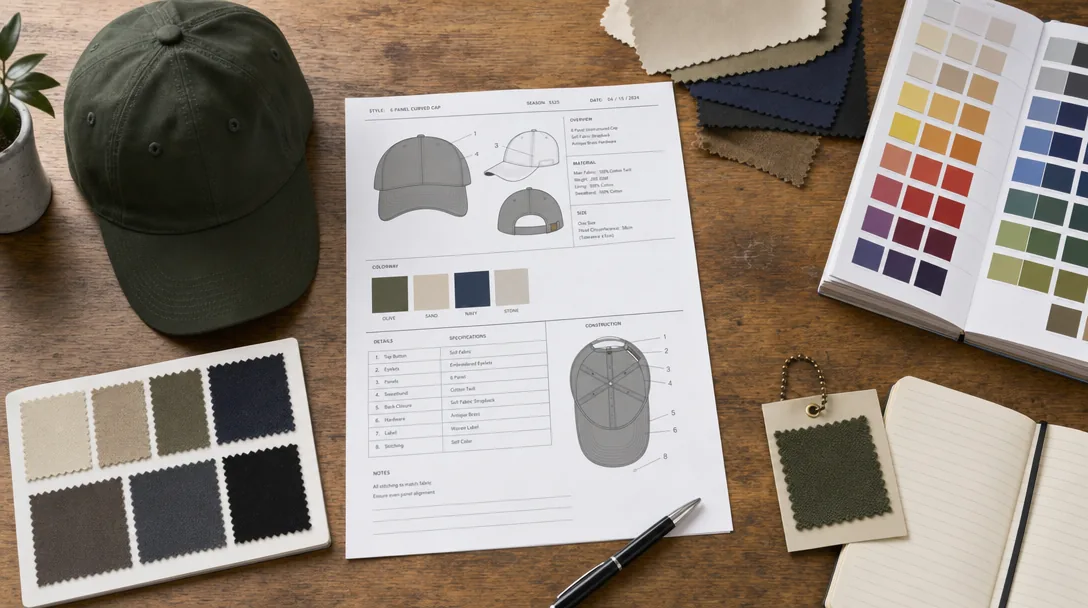
Performance & Athletic Caps: Moisture-Wicking, UPF and Buyer Specs - Supplier Checklist - 2026 Buyer's Guide - 2026 Buyer's Guide - Supplier Checklist
Read article →If you are ready to take the next step on what's in a cap tech-pack: a specification template for buyers - supplier checklist - supplier checklist, our team can put a tailored quotation and digital mock-up in your inbox within 24 hours. Send the inquiry form on our contact page or message us directly on WhatsApp.