
Bulk Trucker Hats Export Shipping Checklist for Custom Hat Buyers (2026 Update)
Every week, our sales team answers detailed questions about bulk trucker hats export shipping checklist for custom hat buyers (2026 update). We wrote this guide so that wholesalers, streetwear brands, corporate buyers and promotional resellers can compare options with full information, and avoid the traps that show up only after production has started.
Why bulk trucker hats export shipping checklist needs a separate sourcing plan
A real bulk trucker hats export shipping checklist needs a separate sourcing plan because trucker caps fail in transit for different reasons than full-fabric baseball caps, and those failure points are designed into the SKU long before booking space. The weak spots are predictable: 3 mm laminated foam fronts crease under top load, polyester mesh rebounds poorly after crush, PVC snap closures scuff adjacent sweatbands, and pre-curved PE visors create wasted cube that inflates freight cost per dozen. A 5-panel foam trucker packed 144 pcs per master carton at 62 x 52 x 58 cm behaves nothing like a 6-panel cotton twill front with hard buckram and hex mesh packed 96 pcs per carton. If a supplier applies one carton spec to both, you may save $0.02-$0.04 per cap on pack-out and lose $0.20-$0.50 in claims, resorting, or retailer deductions. Buyers searching for a bulk trucker hats export shipping checklist are usually trying to control those exact variables: crown profile, front-panel structure, visor curl, closure type, and master-carton compression tolerance.
Generic cap sourcing focuses on embroidery, fabric hand, and ex-works price; trucker-hat export planning is more technical. U.S. entries routinely get delayed when shell composition, mesh percentage, or visor material are declared one way on the commercial invoice and another on the packing list or broker worksheet. In the EU, REACH SVHC screening, azo dye restrictions, and packaging reporting can matter more than whether the logo is flat stitch or 3D puff. Decoration also changes freight risk: 3D embroidery on Tajima or Barudan heads stiffens the front crown, metallic thread abrades neighboring panels, and silicone patches can pressure-mark foam fronts if inner packing is too tight. On a 12,000-piece order, a jump from 4,000 stitches to 8,000 stitches per cap can add several machine days across the line, which directly affects vessel cutoff, warehouse appointment timing, and whether you ship FOB Ningbo, FOB Shanghai, or have to roll to the next sailing.
The biggest cost and compliance decisions are made before bulk cutting, not when the cartons are on the dock. MOQ by color, stock mesh versus custom-dyed panels to Pantone TCX, visor shade tolerance at Delta-E below 1.5 or 2.0, carton count by style, and whether outer cartons are 5-ply or 7-ply all move the landed cost. Buyers often compare only the ex-factory number and miss the hidden export variables: burst-strength requirements, carton marks, needle-detection rules for licensed retail, polybag warnings, and whether final inspection is held at AQL 2.5 instead of AQL 4.0. At CrownsForge, standard practice is to lock carton dimensions, labeling format, inner-pack method, and booking window before embroidery starts, because once front panels are fused, visors are matched, and mesh lots are allocated, the cheap fix is gone. That is why a trucker-specific checklist is not clerical paperwork; it is a sourcing control document that protects margin, timeline, and claim rate.
Factory capability checks before quoting
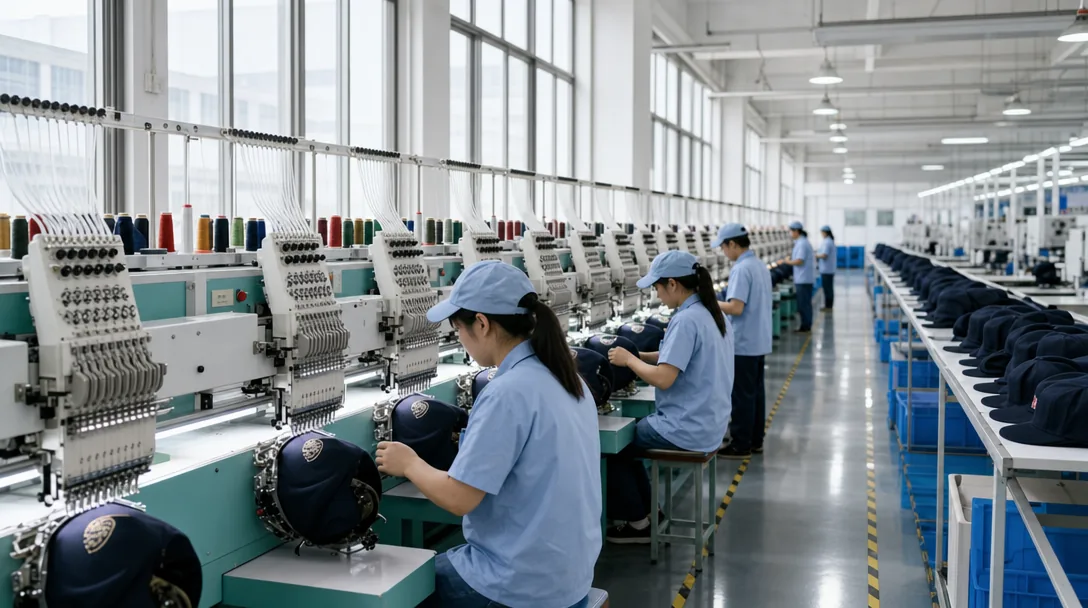
Do not ask for pricing until the factory proves it can run your decoration mix at production speed, not sample-room speed. For embroidery, ask for the actual floor list: how many Tajima, Barudan, or ZSK heads are installed, how many stations are set for 270-degree cap frames, and what daily output they can hold at a realistic 8,000 to 12,000 stitches per cap. A line claiming 1,500 caps per day on paper may drop under 900 once you add 3D puff, side hits, and center-seam registration. For foam truckers, confirm whether they run 2 mm or 3 mm EVA under the front panel, whether digitizing is done in-house, and how they compensate for stitch pull over laminated foam and the center seam. If the digitizer only tests on flat twill, the file can look clean in the PDF and still collapse into the foam face during the first sew-out. Patch programs need the same scrutiny because heat, adhesive, and stitch method affect both yield and transit risk. Merrowed twill, woven patches, PVC, suede microfiber, and PU leatherette all behave differently under needle penetration and heat press dwell time. For any factory on your bulk trucker hats export shipping checklist, ask whether patches are heat-positioned and lock-stitched, or attached with adhesive only. Adhesive-only placement is a common shortcut, and it fails in real logistics: container interiors can exceed 50 to 60°C on long ocean lanes, especially during transshipment. Also ask what they reject for—edge lift, thread grin, patch skew beyond 2 mm, or color mismatch outside an agreed Delta-E tolerance—because that tells you whether the factory is controlling defects before quoting or planning to argue after shipment.
Material specs and cap architecture expose very quickly whether you are talking to a real factory or a trading office moving the order through subcontractors. Ask for a panel-by-panel bill of materials: front panel and visor fabric such as 260 to 280 gsm cotton twill or brushed canvas, mesh weight around 100 to 120 gsm, buckram type, foam density, sweatband composition, visor board material, seam tape width, and snapback grade. A capable maker should explain the build difference between a 5-panel foam trucker, a 6-panel structured twill trucker, and a low-profile unstructured mesh cap, because those choices change crown angle, front-panel stiffness, seam tension, taping sequence, and sweatband attachment method. Closure choice also affects cost and failure rate at scale: a standard PP 7-hole snap, nylon snap, hook-and-loop strap, or metal buckle can shift unit cost by $0.06 to $0.28 and change carton cube once you reach 10,000 pieces. The sample process is usually where weak suppliers reveal themselves. A competent room should turn a counter sample in 3 to 5 working days, a revision in another 5 to 7 days, and a pre-production sample only after BOM, embroidery strike-off, carton marks, and packing method are frozen. Ask who signs off logo placement, underbill color, visor curve, and measurement tolerances such as crown height plus or minus 3 mm or visor length plus or minus 2 mm before bulk cutting starts. If the merchandiser cannot issue a clean English BOM, measurement sheet, and export carton layout with net and gross weights, the quote is not mature. Compliance is the last hard filter: the factory should already understand sedex-audit-cap-supplier-guide.html">BSCI 2.0 or Sedex SMETA 4-Pillar expectations, hold broken-needle or metal-control logs where required, and inspect finished goods to AQL 2.5 for appearance, assortment, and packing accuracy. Our standard practice is to treat those as pre-quote checks, because a cheap FOB offer usually unravels when rework, missed ETD, or a failed final inspection hits the booking window.
MOQ, pricing and sample approval
MOQ on trucker hats is set by the component with the highest vendor threshold, not by the sewing line. A stock 5-panel or 6-panel build in 10x8 cotton twill, 100% polyester mesh, standard PE snap, and a common pre-curve can often run at 144 to 300 pieces per colorway if the shell fabric, mesh, and visor board are all mill-stock. Once you introduce custom-dyed fabric to a Pantone TCX reference, sublimated camo, woven seam tape, molded PVC, or die-cast metal trims, the practical MOQ usually shifts to 500, 1,000, or 1,200 pieces because trim suppliers and dye houses impose their own minimums. That is why a serious bulk trucker hats export shipping checklist starts by matching MOQ across shell, patch, label, and packaging suppliers before artwork is approved. Buyers get into trouble when the cap factory accepts 300 pieces, but the patch vendor needs 1,000 and the woven label mill wants 500 per design. FOB pricing only means something when decoration density, trim count, and reject risk are spelled out in manufacturing terms. At 500 pieces, a basic trucker with stock twill, polyester mesh, and 5,000 to 8,000 stitches of flat embroidery commonly lands around $2.20 to $3.40 FOB China. Move to 12,000 to 18,000 stitches, add 3D foam run on Tajima or Barudan multi-head machines, suede underbill, branded seam tape, woven labels, and retail polybags with barcode stickers, and the cap usually climbs to $3.80 to $5.80 FOB. Digitizing typically runs $25 to $60 per logo, while tooling for PVC, silicone, or metal trims is often $120 to $300 before unit cost. Our standard practice is to lock Pantone references and acceptable color tolerance at quote stage, usually Delta-E under 1.5 for dyed fabric and slightly looser for embroidery thread, because shade disputes after packing are expensive and usually unfixable.
PPS approval is where margin is protected and schedule risk gets exposed. The pre-production sample needs to match the bulk build in crown height, visor curve, front panel stiffness, mesh shade, closure resin tone, embroidery stitch count, logo position, internal labels, and export packing configuration, not just the front artwork. On foam-front truckers, over-dense embroidery is a common mistake: a fill density around 0.35 to 0.40 mm with proper underlay generally runs cleaner than overpacked satin columns, which can pucker the foam, distort the panel, and telegraph defects after steaming. Approve all trims at the same stage, especially button color, sweatband handfeel, woven tape spelling, barcode placement, and patch attachment method, because these are recurring fails in inline inspection and at final audit under AQL 2.5. Lead time should be quoted like a factory schedule, not a sales promise. For 500 to 1,000 pieces, a realistic sequence is 5 to 7 days for sample revision, 3 to 5 days for PPS sign-off, 18 to 30 days for bulk production, and another 5 to 10 days for packing, carton marking, and vessel booking during peak season. Add 7 to 14 days if the order includes custom dyeing, molded patch tooling, or retail-ready packaging such as hangtags, inserts, and individual barcoding. Carton planning also belongs inside sample approval: standard export packing may be 25 pieces per polybag and 100 to 150 pieces per 5-ply master carton, but structured crowns often require lower pack counts, tissue support, or cap frames to hold shape. Lock carton dimensions, target gross weight, shipping marks, and spare ratio before bulk cutting, or your landed cost and booking plan will drift after production is already committed.
Quality inspection and shipping risk
The expensive mistakes happen after production is “finished,” not during stitching. For a workable bulk trucker hats export shipping checklist, I always put final random inspection ahead of vessel booking because an AQL 2.5 pass can still hide size drift or mixed packing if the sampling plan is weak. For caps, we usually inspect to ANSI/ASQ Z1.4, General Level II, with critical defects at 0, major at 2.5, and minor at 4.0. On trucker styles, major defects typically include crooked front panels, distorted crowns, broken snap closures, visor shape collapse, and obvious embroidery registration errors over 1.5 mm. Measurement tolerance needs to be written on the PO, not assumed: crown height usually ±5 mm, visor length ±3 mm, head circumference ±5 mm, and embroidery position ±2 mm from approved placement. If you are buying bulk custom trucker hats across multiple colorways, require the inspector to sample each color separately because black-on-black embroidery and white-on-khaki mesh fail for different reasons. Color and stitching claims should be verified with instruments and wash/rub tests, not supplier photos. For dyed cotton twill fronts, I want color checked against Pantone TCX or coated references under D65 light, with Delta-E kept under 1.5 for premium retail programs and under 2.0 for most promo work. Perspiration and crocking matter more than many buyers realize, especially when dark sweatbands bleed onto white seam tape in summer shipments. A basic colorfastness protocol should include dry and wet rubbing plus light perspiration testing before ex-factory release. On embroidery, watch for thread breaks, loose trims, birdnesting on the reverse, poor underlay showing through thin foam, and uneven satin density that makes logos sink after packing. On Tajima, Barudan, or ZSK runs, clean files still stitch badly if the digitizing ignores mesh backing stability; that is why bulk custom embroidered hats need sealed strike-off samples and a retained golden sample signed against production. Shipping risk is mostly documentation discipline. Cartons should carry PO number, style number, color, quantity, carton sequence, gross/net weight, carton size in cm, country of origin, and any retailer routing marks; if one label format changes mid-run, the warehouse will charge relabeling or refuse delivery. For FOB, the buyer controls freight and usually gets better visibility on consolidations, but responsibility transfers once goods are on board, so late carton correction at port becomes your cost. For DDP, confirm who is acting as importer of record, whether duties on cotton/poly headwear are included, and how customs exam charges are handled; too many first-time buyers think “door delivered” means unlimited liability coverage. Reorder documentation should be built before shipment leaves: approved tech pack, BOM with fabric gsm and mesh denier, Pantone references, embroidery file version, carton pack-out, final inspection report, and photos of master cartons and inner packing. At CrownsForge, our standard practice is to archive that pack against the PO so the next custom bulk trucker hats order does not restart from memory or WhatsApp screenshots.
Buyer checklist for the next RFQ
A usable RFQ starts with construction and packing data, not mood-board photos. If you want a same-day quote, define the hat like a technician: 5-panel foam trucker or 6-panel cotton-twill/mesh build, finished crown height in centimeters, front panel backing type, visor curve, closure spec, mesh denier, sweatband composition, and target pack-out per export carton. A 5-panel style in 100% polyester foam with 70D nylon mesh, 58 cm standard sizing, and a basic PE snapback commonly lands around $2.10 to $3.40 FOB Ningbo at 3,000 pieces; upgrade to 10 oz brushed cotton twill, a sandwich visor, woven flag label, and HDPE comfort snap, and you are usually in the $3.20 to $5.20 range before freight. Add Pantone TCX references for shell, mesh, seam tape, and button, logo dimensions in millimeters, quantity by colorway, and any retailer carton marks, FNSKU, or UPC placement. That is the spine of a serious bulk trucker hats export shipping checklist: if crown profile, materials, and carton specs are vague, the factory is estimating twice and booking freight blind.
Artwork is where buyers quietly burn both calendar and margin. Send editable vector art in AI, EPS, or layered PDF, plus a placement sheet that shows front, side, back, closure, and underbill locations with exact logo size and margin from seams. Specify decoration by panel, not just by logo: 6 mm flat embroidery, 3 mm EVA 3D puff, merrowed patch, laser-cut twill applique, woven loop label, or heat-transfer care label. A 7,000-stitch front embroidery and a raised puff build do not run the same on Tajima, Barudan, or ZSK heads; digitizing density, underlay, needle changes, and cap-frame speed all change, and so does the reject rate on foam fronts. If color accuracy matters, write the tolerance into the RFQ: Delta-E under 1.5 is a lab-dip standard, while under 2.0 is more realistic on production lots. Before asking for a landed price, include destination port or ZIP code, Incoterm, requested ex-factory date, CPSIA labeling needs, AQL 2.5 final inspection, and whether the shipment is FCL, LCL, air, or DDP. Our standard practice is to lock shipping assumptions before sampling because foam-crown carton dimensions can move freight cost per cap by 8% to 15%.
Working with CrownsForge
The quickest way to derail a bulk trucker hats export shipping checklist is to treat sampling, decoration approval, and freight booking as separate workstreams. On a structured trucker cap, they are physically linked: 5 mm EVA foam versus 3 mm foam changes crown rebound, buckram stiffness affects front panel stability under embroidery, and a 24-piece carton versus a 48-piece carton changes both compression risk and cubic volume. A workable approval flow needs three hard gates: digital art and sew-out comments within 24-48 hours, a physical pre-production sample in 5-7 working days, and one sealed counter-sample signed against Pantone TCX references, mesh color, snapback finish, bill curve, logo placement, and a stated tolerance such as +/-2 mm on front embroidery. For 3D puff, merrow-edge patch, or applique work, the strike-off has to run on the actual foam-front body using Tajima or Barudan cap frames, not on flat twill scraps. Once stitch density pushes past roughly 0.40-0.45 mm on a structured front, tunneling, capping, and panel distortion become predictable, and those defects later show up as claim disputes over crushed crowns, off-center logos, or rejected retail cartons.
Most export claims on custom trucker hats are visual, so the factory file has to lock the decoration spec before the first bulk bundle reaches the line. That means documenting thread brand and ticket size, backing weight, needle specification, patch border construction, visor sandwich color, inside taping copy, carton assortment, and approved shade bands under D65 lighting. Where dyed cotton twill is paired with polyester mesh, a signed color tolerance matters; for retail programs, a Delta-E above 1.5-2.0 is often visible enough to trigger complaints. Our standard practice is to verify incoming mesh denier, foam thickness, sweatband gsm, and snap closure plating before cutting, then log in-line embroidery registration, seam alignment, loose thread removal, and rework segregation by lot. Final inspection should be run to AQL 2.5 with carton drop checks, packing ratio verification, needle control logs, and document matching against the PI, packing list, and commercial invoice. For U.S.-bound shipments, 24 or 48 caps per carton with gross weight held around 12-16 kg is usually the safe range; a woven label that adds $0.06-$0.18 per cap rarely hurts margin, but poor carton planning can easily cost more through dimensional-weight charges, relabeling, rolled bookings, or split delivery penalties in peak season.
Frequently Asked Questions
Can I order a sample before bulk production?
Yes. We strongly recommend approving a pre-production sample before mass production. Samples are charged at 35 to 60 USD each plus express shipping, fully refundable against confirmed bulk orders over 500 pieces.
What is the minimum order quantity (MOQ) for custom hats?
Our standard MOQ is 100 pieces per design and color, with sampling available from 1 piece. For complex multi-color logos or premium fabric upgrades, the MOQ can be lowered with a small per-piece surcharge.
How long does production take?
Sampling takes 7 to 12 days. Bulk production runs 20 to 30 days depending on quantity, fabric availability and decoration complexity. Inspection and packing adds another 3 to 5 days before shipment.
Which shipping methods do you support?
We support FOB, CIF and DDP shipping. Air express for samples and small orders, sea LCL for 100 to 500 pieces, sea FCL for 5,000+ pieces. Door-to-door DDP available for US, EU, UK, Canada and Australia.
What logo decoration techniques do you offer?
3D puff embroidery, flat embroidery, woven patch, leather patch, PVC patch, screen printing, sublimation, applique and laser etching, all in-house with no subcontracting.
How does ordering custom embroidered trucker hat work?
When evaluating custom embroidered trucker hat, the key considerations are construction quality, decoration capability, MOQ flexibility and lead time. Explain the buyer intent behind bulk trucker hats export shipping checklist, when it differs from generic hat sourcing, and what decisions affect cost, lead time and compliance. Describe how CrownsForge manages bulk trucker hats export shipping checklist programs with sampling, decoration, QC and export coordination.
What should I know about custom trucker hats bulk?
When evaluating custom trucker hats bulk, the key considerations are construction quality, decoration capability, MOQ flexibility and lead time. Explain the buyer intent behind bulk trucker hats export shipping checklist, when it differs from generic hat sourcing, and what decisions affect cost, lead time and compliance. Describe how CrownsForge manages bulk trucker hats export shipping checklist programs with sampling, decoration, QC and export coordination.
What's the MOQ for custom embroidered trucker hats no minimum?
When evaluating custom embroidered trucker hats no minimum, the key considerations are construction quality, decoration capability, MOQ flexibility and lead time. Explain the buyer intent behind bulk trucker hats export shipping checklist, when it differs from generic hat sourcing, and what decisions affect cost, lead time and compliance. Describe how CrownsForge manages bulk trucker hats export shipping checklist programs with sampling, decoration, QC and export coordination.
What should I know about custom rope hat wholesale bulk?
When evaluating custom rope hat wholesale bulk, the key considerations are construction quality, decoration capability, MOQ flexibility and lead time. Explain the buyer intent behind bulk trucker hats export shipping checklist, when it differs from generic hat sourcing, and what decisions affect cost, lead time and compliance. Describe how CrownsForge manages bulk trucker hats export shipping checklist programs with sampling, decoration, QC and export coordination.
What is the best shipping method for hats?
In general, you can safely package most hats inside cardboard boxes. You should wrap them in a protective layer or place enough packing material inside to protect the hat from any residue that leaks onto the box. Most hats have a hard brim, visor, bill, or crown that must retain its shape during shipping.
What size box is needed to ship a hat?
Down. So this is the 1686. All right perfect for your dozen hats dozen plus. So this one here this is the 2488. And this one here of course to ship out the higher quantity.
How much does an average hat weigh?
The typical weight of a baseball cap ranges from 3 to 4 ounces (about 85 to 113 grams). This can vary slightly depending on the materials used, the design of the cap, and any added features like embellishments or mesh backs. The weight of a baseball cap can affect your comfort and performance.
How are baseball caps shipped?
For baseball caps, a box around 8x8x4 inches usually works well. Next, use protective materials like tissue paper, bubble wrap, and packing peanuts or air cushions. If you're just starting out, dollar stores are a good place to find these items.
Need a low-MOQ test order?
We help emerging brands launch with as few as 100 pieces. Premium fabric, in-house embroidery, retail-ready packaging.
Start a small orderRelated guides
Sustainable Cap Packaging: Options, Costs and Retail-Buyer Demands - 2026 Buyer's Guide
Read article →Bucket Hat Corduroy Fabric And Trim Spec Guide for Custom Hat Buyers
Read article →Sustainable Cap Packaging: Options, Costs and Retail-Buyer Demands - Cost & MOQ Breakdown
Read article →Sourcing custom hats does not have to be complicated. With the right manufacturing partner, clear specifications and a small upfront investment in sampling, you can launch a retail-quality product in 30 to 45 days.