
Bucket Hat Strings: Properties, Costs and How to Spec It Right
Bucket Hat Strings: Properties, Costs and How to Spec It Right is one of the most-asked questions we receive from international buyers, and for good reason. With dozens of factories competing for your order and an alphabet soup of technical terms in every supplier quote, even experienced importers can feel lost. This guide consolidates what we have learned producing custom hats for clients in 40+ countries.
Corduroy Hat Wholesale
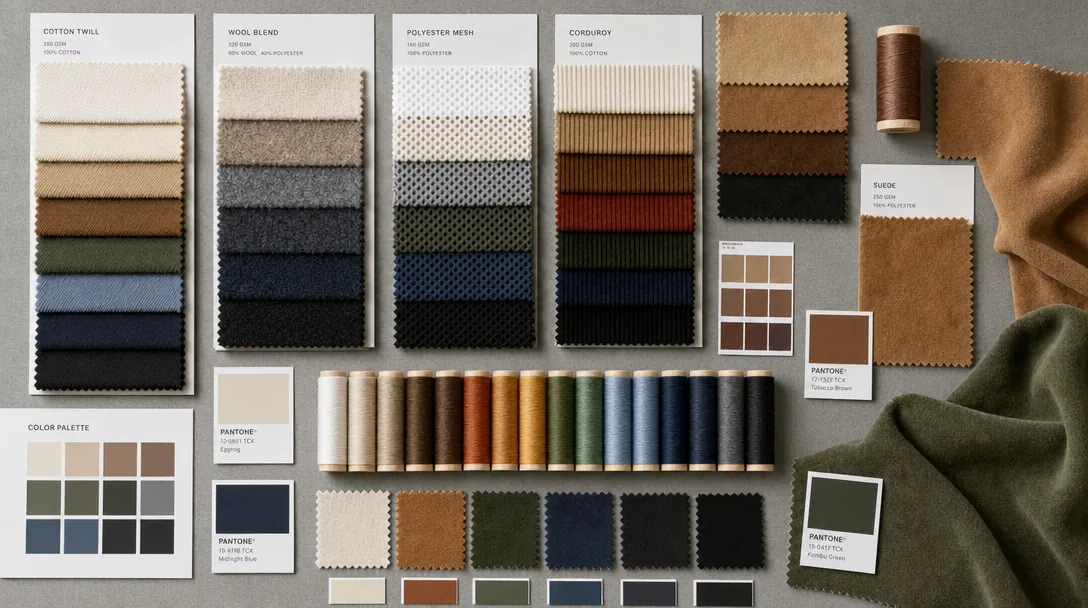
Corduroy hat wholesale is not complicated, but buyers get burned when they treat it like a standard twill cap. The fabric is usually 8-wale or 11-wale corduroy, cut with a known nap direction so the panels match shade under light. A decent factory will ask for the crown depth, brim curve, sweatband type, and whether you want self-fabric or cotton twill lining. For a corduroy hat brown program, I usually specify 100 percent cotton corduroy at 280 to 350 gsm, pre-shrunk if the order will be garment washed, and a matching thread shade based on Pantone TCX. If you are comparing it with a cotton twill baseball cap or an organic cotton hat, corduroy is heavier, warmer, and more sensitive to panel distortion during sewing, so the pattern and stitch density matter more than buyers expect. The real difference is in cutting and pressing, not just the fabric roll.
On pricing, low-volume wholesale is usually driven by labor, not cloth. For 300 to 500 pieces, a basic corduroy five-panel or six-panel hat can land around USD 3.20 to 5.80 FOB depending on embroidery, lining, and packaging. MOQ is often 300 pieces per color for stock corduroy, but custom-dyed shades can push that to 500 to 1,000 pieces because mills want a dye lot to amortize. CrownsForge treats bucket hat strings and other trim decisions as separate line items because cord, aglets, and eyelets change the assembly time and defect rate. If you are sourcing a straw bucket hat or a lighter summer profile, you can usually accept cheaper trims and fewer reinforcement steps; corduroy needs cleaner seam control because the pile shows needle marks and skipped stitches immediately.
The common quality failures are easy to spot if you know where to look: off-grain crown panels, crushed wale direction, seam puckering near the brim, and color mismatch between the main body and visor binding. I also check embroidery registration on dense corduroy because a Tajima or Barudan head will punch differently into a thick pile than on a smooth cotton twill baseball cap. Ask the factory for a pre-production sample, a size spec with tolerances of plus or minus 0.5 cm on crown circumference, and a wash test if the hat will be garment dyed or shipped into humid markets. For bulk buying, insist on AQL 2.5 inspection for major defects, plus a trim checklist if the order includes bucket hat strings, metal eyelets, or custom labels. If the buyer wants one product line to cover both winter and summer, the corduroy and the string spec should be locked together at the sample stage, not after production starts.
Wholesale Hat Manufacturers Usa
Wholesale hat manufacturers usa usually build bucket hats with cut-and-sew lines rather than fully automated cap production, so the real control points are fabric stability, stitch density, and trim attachment. For a standard cotton twill or brushed twill bucket hat, ask for shell fabric by weight in gsm, liner content if any, seam allowance, and topstitch spacing. If the style includes bucket hat strings, specify cord diameter, end finish, bartack length, attachment points, and whether the cord is sewn into a seam or inserted through eyelets. That matters because a loose cord on a corduroy bucket hat behaves differently than on a straw bucket hat, and the wrong attachment method will pull out under wash or sun exposure. Our standard practice is to quote production against a physical proto, a tech pack, and Pantone TCX color targets, because “black” or “brown” is not enough when a buyer wants a corduroy hat brown that matches the rest of a seasonal line.
For MOQ, domestic factories often want 100 to 300 pieces per color for a simple bucket hat, with 500-plus if you need custom woven labels, printed lining, or specialty hardware. Pricing moves fast with fabric and trim choices: a basic cotton twill baseball cap may land lower than a lined organic cotton hat, while a corduroy bucket hat or straw bucket hat usually costs more because of material handling and slower sewing. Expect the first sample round to cost more than bulk, especially if the spec includes custom bucket hat strings, metal cord locks, embroidery, or washed finishes. A factory should be able to tell you needle count, thread type, and whether the binding tape is cotton or poly, because those details drive both handfeel and failure rate. If the supplier cannot break out those inputs, the bulk quote is probably hiding rework risk.
The quality issues buyers should inspect are boring but expensive: skipped stitches at the side seam, twisted crown panels, inconsistent brim stiffness, shade variation across dye lots, and cord attachment that fails a pull test. For bucket hat strings, the key checks are cord abrasion, lock slippage, and whether the cord frays after one wash cycle or UV exposure. For sewn goods we normally see AQL 2.5 on major defects and 4.0 on minor ones, with extra attention to shade banding on corduroy and puckering on dense twills. If you are comparing wholesale hat manufacturers usa against overseas sourcing, the real decision is not geography alone; it is whether the factory can hold repeatable spec control on a small run, a larger replenishment, and mixed materials in the same order. That is what separates a workable program from a one-off sample that never repeats in production.
Corduroy Hat Vintage
A good corduroy bucket hat starts with the cloth, not the trim. For a vintage look, buyers usually want 8W to 12W wale corduroy in cotton or a cotton-spandex blend, with a face weight around 250 to 350 gsm so the brim holds shape without turning stiff. Ask the factory for the cord direction, nap brushing, and a wash test, because the pile can shift color under different lighting and make a corduroy hat brown look cheaper than the lab dip approved. If you are matching a corduroy bucket hat to an organic cotton hat program, request Pantone TCX approval on the shell, a shrinkage target under 3 percent after wash, and a brim insert spec if you want structure. Vintage does not mean sloppy: the panel seam pitch, topstitch density, and sweatband attachment need to be defined before sampling, or the hat will come back looking handmade in the wrong way.
MOQ and pricing depend on decoration and whether the hat uses a simple self-fabric lining or a more finished interior with tape, woven label, and size tag. For a standard corduroy bucket hat, 300 to 500 pieces per color is normal for first orders, while a more custom run with enzyme wash, embroidery, or contrast underbrim usually needs 800 to 1,000 pieces to keep unit cost sane. Factory ex-works pricing often lands around $3.20 to $5.80 for basic builds, then moves up fast if you add custom dyeing, metal eyelets, or wide-wale imported fabric. Compare that against a cotton twill baseball cap or a straw bucket hat and the economics are different: corduroy is heavier, slower to cut cleanly, and more sensitive to color variation. The bucket hat strings decision matters here too, because removable cords, cord locks, and bartacked anchors add both labor and inspection points.
The biggest quality problems are not dramatic; they are the small things buyers notice after the first retail returns. Look for crushed or flattened wale from poor pressing, uneven panel alignment at the crown, twisted brim stitching, and shade banding between panels from mismatched dye lots. If the hat includes bucket hat strings, check cord diameter, tip finishing, and pull strength, because a weak anchor or loose bartack fails quickly in wear tests. I would specify a 20 to 30 N pull test on the string attachment, 3 mm stitch spacing on visible topstitching, and AQL 2.5 inspection on major defects. For branded programs, require color tolerance within Delta-E 2.0 against the approved master, and ask for preproduction samples under daylight and warm indoor light. That is how you avoid the common mistake of approving a sample that looks vintage on a desk and cheap on headwear once production starts.
Bucket Hat Corduroy
Corduroy bucket hat production starts with the fabric, not the brim. Good bucket hat corduroy usually uses 8-wale to 11-wale cotton corduroy at 280 to 350 gsm, then gets cut with the wale direction consistent across the crown and brim so the nap does not shift between panels. If you are ordering a corduroy bucket hat in a dyed shade like corduroy hat brown, ask for a lab dip against Pantone TCX and a wash test after one cycle, because pigment-dyed corduroy can move 0.5 to 1.5 Delta-E after finishing. The crown structure is usually unlined or lightly lined, but the seam allowance and topstitch density matter more than buyers expect. For bucket hat strings, specify the cord material up front: 2 to 3 mm cotton cord, polyester drawcord, or waxed cotton, plus the stopper style, bartack size, and pull-force target.
On specs, the factory should quote the hat body separately from the trim package. Request fabric composition, gsm, wale count, shrinkage limit under 3 percent, seam stitch density around 8 to 10 SPI, and colorfastness at or above grade 4 for dry rub and 3 to 4 for wet rub if the hat will see heavy outdoor use. A typical MOQ for a corduroy bucket hat is 300 to 500 pieces per color with custom trim; if you want special labels, metal eyelets, or branded bucket hat strings, expect 500 to 1,000 pieces for cleaner pricing. In bulk, FOB China pricing often lands around $3.20 to $6.50 per piece for standard cotton corduroy, depending on lining, embroidery, and wash treatment. At CrownsForge, the biggest cost jumps usually come from yarn-dyed fabric, custom cord ends, and repeated sampling on cap shapes that were never graded properly from a flat pattern.
The quality checks are straightforward but easy to miss if you only inspect the surface. Look for skewed ribs, brim waviness, skipped stitches at the side seams, uneven crown height, and shrinkage that twists the brim after steam pressing. On corduroy, the pile crushes fast if the cartons are overpacked, so carton spec and polybag size matter as much as sewing quality. For QC, ask for AQL 2.5 on major defects and 4.0 on minor defects, plus a wash test if the hat uses cotton or a cotton blend. The sourcing decision is not just whether the hat is corduroy or twill; it is whether the same factory can control trim, stitching, and finishing across a corduroy bucket hat, a cotton twill baseball cap, an organic cotton hat, or even a straw bucket hat without changing the tolerances. If the answer is no, the defect rate usually shows up in the strings first, then in the brim.
Corduroy Bucket Hat
A corduroy bucket hat is usually built from 8-wale or 11-wale cotton corduroy with a brushed face, then cut into crown panels and a circular or stitched brim. For a clean production run, specify fabric weight in the 250-320 gsm range, shrinkage under 3%, color fastness at grade 4 or better, and a matching topstitch thread count so the ribs do not distort around the brim. If you want a corduroy hat brown shade, ask for a Pantone TCX target and strike-off approval before bulk cutting. The factory should also confirm lining, sweatband material, brim width, and whether the brim is soft, foam-reinforced, or lightly interfaced. Compared with a cotton twill baseball cap, a corduroy bucket hat is less forgiving on seam alignment because the nap shows every mismatch; compared with a straw bucket hat, it is heavier, warmer, and better for fall retail.
For MOQ, most factories will quote 300-500 pieces per color for a simple corduroy bucket hat, with pricing usually landing around USD 2.20-4.20 FOB for basic unlined builds and USD 4.50-7.50 for heavier fabric, lining, washed finishes, or custom labeling. If you add embroidery, woven labels, or garment dyeing, expect the number to move quickly because each step creates a separate setup cost. CrownsForge’s standard practice is to separate fabric confirmation, trim confirmation, and pre-production sample approval so buyers do not discover late-stage cost creep. Buyers comparing an organic cotton hat program to corduroy need to remember that certified fiber, dye compliance, and audit paperwork often add more to total landed cost than the fabric itself. If the order is promotional and price-sensitive, keep the spec tight and avoid unnecessary trim complexity.
The main quality problems are rib crushing, panel skew, brim waviness, uneven pile direction, and color variation between dye lots. On a dark corduroy hat brown run, the seam line can look acceptable on the table but still twist after steaming, so the factory should check symmetry after final pressing, not only after stitching. For inspection, ask for AQL 2.5 on major defects, plus a dedicated check for sweatband continuity, needle damage, and cord alignment at the brim edge. This is where bucket hat strings belong in the sourcing decision: if the hat uses a chin cord, the attachment point must be bar-tacked into the seam allowance and the cord finish should match the garment level, otherwise the hat feels underbuilt even when the crown is fine. Buyers who spec the strings early avoid the usual problem of a good-looking sample that fails in wear testing or gets rejected for weak attachments at bulk inspection.
Organic Cotton Hat
An organic cotton hat starts with certified fiber, not a marketing claim. I would ask for GOTS or at least OEKO-TEX Standard 100 documentation on the fabric, plus the actual yarn count, weave, and shrinkage target before the factory cuts anything. For a 6-panel or 5-panel organic cotton hat, most buyers spec 100% combed cotton twill at 260 to 320 gsm, with enzyme wash only if they want a softer hand. The good factories can run clean cutting and consistent topstitching on Juki or Brother flatbeds, but the important part is fabric control: color should be checked against Pantone TCX, and shading should stay within Delta-E 1.5 to 2.0 on repeat production. If you are sourcing bucket hat strings for the same program, keep the cord material aligned with the crown fabric story, because a recycled polyester cord on an organic cotton hat looks wrong unless the brand is deliberately mixing materials.
On cost, most buyers underestimate how much the trims and compliance paperwork affect the landed price. A basic organic cotton hat in 1,000 to 3,000 pcs usually lands around $2.10 to $3.40 FOB if the decoration is a simple woven label or flat embroidery; structured caps with sandwich visor, sweatband tape, and custom inner taping move higher. Small runs below 500 pcs often carry a $0.40 to $0.80 penalty per unit because fabric waste and setup time are real. For comparison, a cotton twill baseball cap is usually cheaper to execute than an organic cotton hat because the fabric sourcing is simpler, while a straw bucket hat or a corduroy bucket hat can swing higher depending on body stiffness and trim complexity. If the style also includes bucket hat strings, specify cord diameter, end finish, and attachment point early, because adding cord loops after sample approval usually triggers a re-cost.
The failures I inspect most are shrinkage mismatch, poor colorfastness, twisted sweatbands, and loose cord attachments at the side seams. Organic cotton can feel premium and still fail if the fabric was not pre-shrunk or if the wash recipe was too aggressive; I want wash testing, pilling checks, and seam strength confirmation before bulk. On the line, a decent factory will keep AQL 2.5 for major defects and check needle damage, skipped stitches, and panel symmetry under a simple fixture, not by eye alone. If you are comparing a corduroy hat brown, a straw bucket hat, and an organic cotton hat in the same range, do not let the supplier treat bucket hat strings as an afterthought: the cord must be color-matched, abrasion-tested, and tied off or bartacked correctly, especially for outdoor and kids' programs. Our standard practice is to approve trim placement and cord tension in the pre-production sample, because that is where most avoidable claims start.
Working with CrownsForge for bucket hat strings programs
For bucket hat strings programs, the first thing I look at is whether the factory can turn a clean pilot sample fast enough to catch problems before they become expensive. Our standard practice at CrownsForge is a 5 to 7 day sample lead time for simple cotton cord sets, and 10 to 14 days when the order needs dyed cord, metal aglets, or stitched reinforcements at the eyelets. That window is tight enough to test how the string sits on a corduroy bucket hat, a straw bucket hat, or a corduroy hat brown colorway without locking the buyer into a bad construction choice. I also push first-time buyers to approve both the hand feel and the pull strength, because a soft-looking cord can still fail after repeated cinching if the yarn count is wrong or the knotting is too loose.
MOQ is where a lot of new programs get distorted, so I prefer to keep the starting point practical. For stock cotton braid or polyester cord, 300 to 500 pieces per color is workable for a test run, while custom-dyed runs usually need 1,000 pieces to make dye matching efficient. That matters if the strings need to coordinate with an organic cotton hat, a cotton twill baseball cap, or a branded retail line that has to sit within a tight Pantone TCX range. I also quote based on the actual build, not just the cord diameter: 3 mm spun cotton, 4 mm waxed polyester, or round braided nylon all behave differently in sewing and finishing, and the delta shows up in both price and failure rate.
Decoration and compliance are where the order gets de-risked, not just cosmetically finished. We keep embroidery, woven labels, heat transfer, and basic sewn appliques in-house, so a customer can put a logo on the panel, the brim, or the string tab without splitting production across three vendors. Tajima and Barudan heads are better for dense logos on thicker fabrics, while lighter placements on a straw bucket hat usually need a more restrained stitch count to avoid puckering. For scale-up brands, I want the paperwork fixed early: sedex-audit-cap-supplier-guide.html">BSCI 2.0 or Sedex SMETA 4-Pillar, fiber content and country-of-origin labels, and AQL 2.5 inspection terms on the carton pack. The order-management part is simple but strict: approve the pre-production sample, lock the cord spec, freeze the color standard against the approved lab dip, then schedule bulk with a written checkpoint at cutting, sewing, and final packing.
Frequently Asked Questions
Can I order a sample before bulk production?
Yes. We strongly recommend approving a pre-production sample before mass production. Samples are charged at 35 to 60 USD each plus express shipping, fully refundable against confirmed bulk orders over 500 pieces.
Do you support sustainability certifications?
Yes. We work with GOTS organic cotton, GRS-certified recycled polyester, OEKO-TEX Standard 100 fabrics, and are BSCI and Sedex audited. Certification documentation can be provided per order.
What logo decoration techniques do you offer?
3D puff embroidery, flat embroidery, woven patch, leather patch, PVC patch, screen printing, sublimation, applique and laser etching, all in-house with no subcontracting.
What file format should I send for my logo?
Vector files (AI, EPS, PDF) are ideal. High-resolution PNG or JPG at 300 dpi on transparent background works as a fallback. Provide Pantone color references for accurate reproduction.
What is the minimum order quantity (MOQ) for custom hats?
Our standard MOQ is 100 pieces per design and color, with sampling available from 1 piece. For complex multi-color logos or premium fabric upgrades, the MOQ can be lowered with a small per-piece surcharge.
What should buyers know about organic cotton baseball cap?
When evaluating organic cotton baseball cap, the key considerations are construction quality, decoration capability, MOQ flexibility and lead time. Cover everything buyers ask about organic cotton hat: how it's manufactured, what specs to request from a factory, typical MOQ and pricing, common quality issues to inspect for, and how this ties back to the broader bucket hat strings sourcing decision. Cover everything buyers ask about corduroy hat wholesale: how it's manufactured, what specs to request from a factory,…
What should buyers know about organic cotton bucket hat?
When evaluating organic cotton bucket hat, the key considerations are construction quality, decoration capability, MOQ flexibility and lead time. Cover everything buyers ask about organic cotton hat: how it's manufactured, what specs to request from a factory, typical MOQ and pricing, common quality issues to inspect for, and how this ties back to the broader bucket hat strings sourcing decision. Cover everything buyers ask about corduroy hat wholesale: how it's manufactured, what specs to request from a factory,…
What should buyers know about brown corduroy bucket hat?
When evaluating brown corduroy bucket hat, the key considerations are construction quality, decoration capability, MOQ flexibility and lead time. Cover everything buyers ask about corduroy hat wholesale: how it's manufactured, what specs to request from a factory, typical MOQ and pricing, common quality issues to inspect for, and how this ties back to the broader bucket hat strings sourcing decision. Cover everything buyers ask about corduroy hat vintage: how it's manufactured, what specs to request from a factory,…
What should buyers know about cotton twill army cap kangol?
When evaluating cotton twill army cap kangol, the key considerations are construction quality, decoration capability, MOQ flexibility and lead time. Cover everything buyers ask about organic cotton hat: how it's manufactured, what specs to request from a factory, typical MOQ and pricing, common quality issues to inspect for, and how this ties back to the broader bucket hat strings sourcing decision. Cover everything buyers ask about corduroy hat wholesale: how it's manufactured, what specs to request from a factory,…
Ready to start your custom hat project?
Send us your tech-pack, sketch or even just an inspiration photo. We will respond with a detailed quotation and digital mock-up within 24 hours.
Request a free quoteRelated guides
Winter Beanie & Knit Cap Manufacturing: The Complete Wholesale Guide
Read article →
Private Label vs White Label Caps: Which Model Fits Your Brand?
Read article →
FOB vs CIF vs DDP: Incoterms Compared for Hat Imports
Read article →We hope this guide demystifies bucket hat strings: properties, costs and how to spec it right and helps you move forward with confidence. If you have questions specific to your project, our English-speaking sales engineers are one message away.