
Winter Beanie & Knit Cap Manufacturing: The Complete Wholesale Guide
For brand owners, wholesalers and procurement teams entering the custom headwear category, winter beanie & knit cap manufacturing: the complete wholesale guide is one of the highest-leverage decisions you will make. Get it right and your unit economics, retail story and reorder cycle all improve. Get it wrong and you carry the cost for years.
Knit cap construction basics
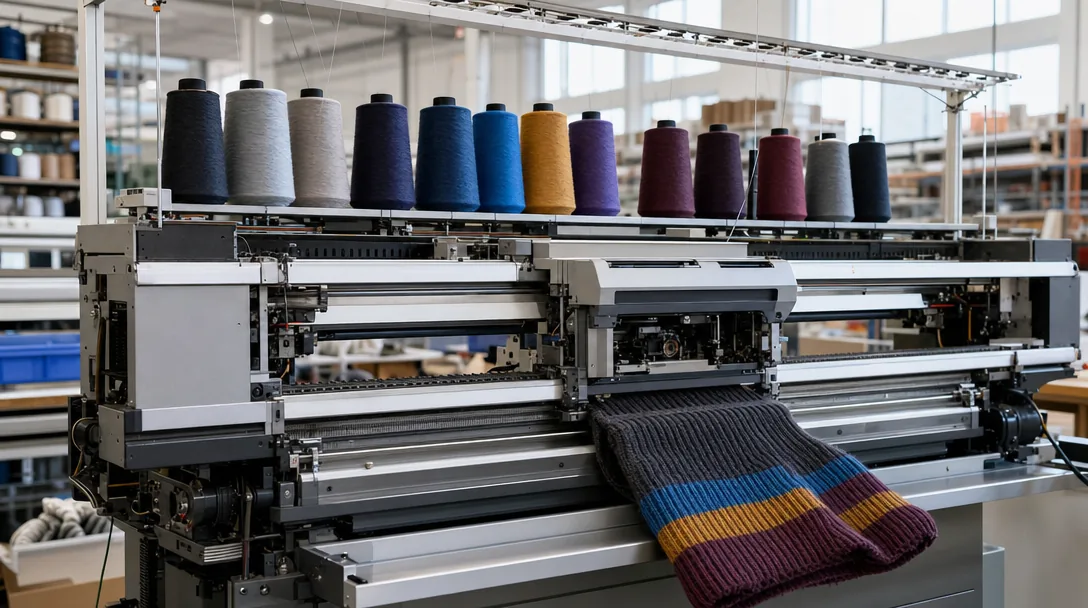
Knit cap construction starts with gauge, and that is where a lot of buyers get it wrong. A 7gg machine produces a chunkier, warmer fabric with larger loops, while 12gg fine knit gives a tighter surface, cleaner stitch definition, and less bulk under a logo patch or embroidery. For wholesale knit caps, gauge affects more than handfeel: it changes stretch recovery, seam behavior, and how much the cap grows after washing. A winter hat factory will usually spec yarn in the 2/28 to 2/48 range depending on the target density, then knit test panels before approving bulk. If you want an embroidered beanie that keeps its shape after repeated wear, fine-gauge construction is usually the safer choice, especially for fashion programs or school accounts that care about a cleaner silhouette.
Cuff design changes both fit and decoration options. A standard cuffed beanie supplier will usually offer 2.5-inch, 3-inch, and 4-inch folded cuffs, and that fold directly affects where embroidery sits and how much front panel space you actually have. Ribbed construction, usually 1x1 or 2x2 rib, gives better elasticity and is the default for most custom embroidered beanie caps because it hugs the head without needing aggressive stretch yarn. Flat knit looks cleaner and more minimal, but it does not recover as well and can feel looser after a few wears. If the buyer wants a custom beanie manufacturer to hit a specific profile, cuff depth and rib structure should be locked before sampling, not after. Changing them later means rebalancing the entire pattern and often the stitch count.
Double-layer construction is the real dividing line between a cheap promo hat and a proper winter beanie. A single-layer knit can work for mild weather or low-cost giveaways, but a true winter beanie usually uses double-thickness body or an added fleece lining to cut wind penetration and hold heat. In practice, double-layer knit can add 20 to 35 grams per piece depending on yarn count and gauge, which matters for shipping weight and retail feel. At CrownsForge, the standard practice is to check seam bulk, inner label placement, and cuff alignment after linking, because sloppy finishing shows up immediately on a double-layer cap. For buyers comparing custom beanie manufacturer options, ask for GSM, stretch recovery, and a wash test result rather than just a photo, because those three numbers tell you whether the hat will survive real use or just pass a studio sample shoot.
Yarn options
Acrylic is still the workhorse for wholesale knit caps because it is cheap, stable, and forgiving on the machine. A decent 100% acrylic yarn for a winter hat factory usually runs 3/8 to 5/32 gauge knitting depending on the hand feel, and it holds color well across Pantone TCX targets without the lint issues you get from lower-grade wool. For budget programs, acrylic gives you the best landed cost control: factory ex-works pricing can stay around $1.10 to $1.80 per piece on basic cuffed beanie supplier specs, while embroidered beanie orders with a sewn label or small logo patch add only a little labor. The downside is obvious to anyone who has worn one in damp weather: acrylic traps heat but does not breathe like natural fiber, so it feels sweaty if the fit is too tight or the gauge is too dense.
Wool blend is the most practical middle ground for brands that want a better retail hand feel without paying for full merino. A common spec is 50/50 wool-acrylic or 70/30 wool-polyester, usually in 12-gauge or 7-gauge knit depending on whether you want a slim fashion profile or a chunkier streetwear silhouette. This is the sweet spot for many custom beanie manufacturer programs because the wool gives loft and warmth, while the synthetic content improves wash stability and reduces pilling. On production runs, I look closely at shrinkage after steaming and wash tests; good wool blend yarn should stay within 3% to 5% dimensional change and keep color drift under Delta-E 1.5 to 2.0 if the dyelot is controlled properly.
Merino wool is the premium choice because it solves the two problems buyers complain about most: itch and odor. Fine merino, typically 17.5 to 19.5 micron, has a much softer touch than standard wool and works well for custom embroidered beanie caps sold through outdoor retail or higher-end promotional channels. It is also more expensive to source and harder to knit cleanly, which is why a winter hat factory will usually charge a sharp premium over acrylic, often landing in the $2.80 to $5.50 ex-works range before decoration depending on yarn origin and gauge. Cashmere blends sit above merino as a luxury tier, but I only recommend them when the customer can accept strict care instructions, higher breakage risk, and tighter QC on pilling; even a 5% to 10% cashmere blend can materially raise yarn cost, so it makes sense only for a true premium embroidered beanie program or a small capsule run.
Decoration techniques for beanies
Flat embroidery is still the default choice for an embroidered beanie because it survives wash cycles, looks clean on rib knit, and does not add much stiffness to the crown. On a 12-gauge acrylic or acrylic/wool blend, a standard front logo usually runs 6,000 to 10,000 stitches; once you push past about 12,000 stitches on a soft knit, the fabric starts to pucker unless the backing and needle choice are right. For a custom beanie manufacturer, the real work is not the stitching itself but controlling density, pull compensation, and cap tension so the logo sits flat instead of warping the rib. On darker yarns, I also check thread contrast under daylight, because a thread that looks perfect under factory LEDs can disappear outside.
Woven labels and leather patches are better when the customer wants a quieter, more premium read than embroidery. A woven label usually comes in at 6 to 8 cm wide and is sewn into the cuff seam or folded over the edge; it is cheap, consistent, and very stable for wholesale knit caps, especially when the artwork has small text or fine lines that embroidery would blur. PU leather patches and genuine leather patches give a stronger streetwear look, but they need careful testing because heat-press adhesives can fail on textured knit unless the surface is flattened first. In a winter hat factory, we usually recommend stitching the patch perimeter instead of relying only on glue if the hat is meant for retail, resale, or cold-weather sports use.
Jacquard knit and dye-sublimation cuff treatments solve different problems, and neither is interchangeable with surface decoration. Jacquard is the best option when the logo needs to live inside the structure of the beanie; it works well for stripes, repeating patterns, and all-over branding, but it adds yarn cost and limits sharp detail, so it is better for volume runs than for highly detailed custom embroidered beanie caps. Dye-sublimation is only practical on synthetic cuff panels or sewn-on polyester patches, not on raw acrylic knit, because the color transfer needs a coated or printable substrate. For a cuffed beanie supplier, the key decision is simple: embroidery for small logos and fast turnaround, woven or leather for premium branding, and jacquard when the design is built into the product from the start.
Lining options
Fleece lining is the cheapest way to make a knit cap feel like a real winter product instead of a basic acrylic shell. In practice, we spec 180 to 220 gsm brushed polar fleece, usually 100% polyester, because it blocks wind better than a bare knit and still sews cleanly without adding too much bulk at the cuff. On a custom beanie manufacturer order, a full fleece liner typically adds about $0.35 to $0.80 per piece at factory level depending on quantity, color, and whether the liner is cut-and-sewn or tube-finished. The trade-off is breathability: fleece traps heat fast, so it works best for sports, outdoor promo, and budget wholesale knit caps sold in colder markets. For an embroidered beanie, I usually keep the liner slightly shorter than the shell so the backstitch does not show through the knit.
Satin lining is the better choice when the buyer cares about hair friction, makeup transfer, and a cleaner retail feel. A 190T or 210T polyester satin lining, or a softer charmeuse-style finish, gives a smooth surface that reduces snagging on curls, braids, and textured hair, which is why it sells well for fashion-led custom embroidered beanie caps and women’s retail programs. It costs more than fleece — usually another $0.20 to $0.50 per unit depending on the fabric and sewing complexity — but it also changes the perceived quality immediately when customers try the hat on. In a winter hat factory, the main technical point is seam placement: if the lining is poorly drafted, it twists inside the crown and ruins the handfeel, even if the outer knit is good.
For a cuffed beanie supplier, the real decision is not just warmth versus softness; it is how the lining interacts with embroidery, logo patching, and fit. Heavy fleece can stiffen the crown and shrink the usable stretch, so if the cap already has dense front-panel embroidery or a woven badge, I usually recommend a partial fleece ear-band instead of full lining. Satin works better inside retail-focused styles because it preserves stretch and keeps the silhouette closer to the original knit gauge, especially on fine-gauge 1x1 rib or 12-gauge acrylic blends. Our standard practice is to test both liner types on a pilot run, then check seam slippage, head opening recovery, and whether the lining causes visible distortion at the cuff after steaming and packing.
Pricing and MOQ
For a custom beanie manufacturer, the pricing curve is steep at 200 pcs and then flattens fast once the knitting program, yarn dye lot, and embroidery setup are already paid for. On a basic acrylic 1x1 rib cuffed beanie with a small one-color embroidered beanie logo, I would expect roughly USD 4.20 to 6.50 at 200 pcs, depending on yarn weight, stitch density, and whether the logo is flat embroidery or 3D puff. At 500 pcs, the same hat usually lands around USD 3.20 to 4.60. At 1,000 pcs, it often drops to USD 2.65 to 3.75, and at 5,000 pcs, you can sometimes get to USD 1.95 to 2.85 if the spec is simple and the yarn is standard acrylic or acrylic-wool blend. If the buyer wants custom woven labels, private packaging, or a leather patch, add another USD 0.15 to 0.80 depending on the method and labor content.
Wholesale knit caps are sensitive to the decoration method more than most buyers realize. Embroidery setup is not expensive by itself, but it gets spread over the order size, so a 200-piece run of custom embroidered beanie caps can feel unreasonably expensive even when the factory margin is thin. A simple 6,000-stitch logo on a Tajima or Barudan head is one thing; dense fills, small text, metallic thread, or multi-location branding can add USD 0.25 to 1.20 per piece. A winter hat factory will also price differently if the beanie is fully custom knit with jacquard patterning, because that requires a separate machine program and often a higher minimum on yarn color matching. If the client is asking for a branded cuffed beanie supplier package with hangtags, size stickers, carton markings, and polybagging, the true landed unit cost is usually 8 to 15 percent higher than the sewing price alone.
MOQ is usually tied to three realities: yarn minimums, knitting efficiency, and decoration batching. For stock yarn colors, 200 pcs is workable, but the cost is not attractive unless the buyer is testing a new line. Most factories prefer 500 pcs as the practical floor for wholesale knit caps, because that quantity balances setup cost and labor utilization without forcing ugly shortcuts on quality. At 1,000 pcs, you can usually negotiate better yarn rates and cleaner embroidery pricing, especially for a standard acrylic or acrylic-polyester build in 85 to 120 gsm equivalent knit density. At 5,000 pcs, the discussion shifts to color control, carton efficiency, and inspection tolerance rather than basic feasibility. A custom beanie manufacturer with disciplined production should still run AQL 2.5 on appearance, measurement, and stitching, because low-MOQ orders are where buyers get hit with inconsistent cuff height, twisted seams, and logo placement drift.
Seasonal planning
If you want Q4 stock on shelves in September and October, place your beanie program in May through July. That window gives a winter hat factory enough room to buy yarn, reserve knitting capacity, run lab dips, sample cuff shapes, and still absorb corrections before peak congestion hits in August and September. By late summer, the calendar gets ugly fast: knitting lines are booked, freight rates start moving, and any change to Pantone TCX, logo size, or fold depth adds another week or two. A serious custom beanie manufacturer will treat your PO date as a production constraint, not a suggestion, because one delayed approval can push the whole order into a higher-cost freight lane.
Chinese New Year is the real trap. Most mills and trim suppliers shut down for 2 to 3 weeks, but the actual disruption is longer because workers leave early, raw material purchases slow down, and production restarts unevenly in the first month back. If you are sourcing wholesale knit caps for a retailer, club, or promotion calendar, the safest approach is to finish bulk production before late November and ship by early December. Waiting until December for an embroidered beanie order often means you are competing with spring pre-bookings, and any issue with needle count, yarn lot variation, or size tolerance gets stuck behind orders that were already in the queue.
For a cuffed beanie supplier, the planning math is simple: build 8 to 12 weeks for production and 3 to 6 weeks for ocean freight, then add buffer if your design includes jacquard knitting, woven labels, or custom embroidered beanie caps with dense stitch counts. Our standard practice is to lock artwork and measurements before tooling starts, because a 1 cm change in cuff height or a revised logo placement sounds small but affects needle programming and packaging compliance. Buyers who plan early usually get better yarn selection, cleaner color matching, and fewer air shipments at $4 to $8 per kg that destroy margin on low-ASP winter accessories.
Frequently Asked Questions
Can I order a sample before bulk production?
Yes. We strongly recommend approving a pre-production sample before mass production. Samples are charged at 35 to 60 USD each plus express shipping, fully refundable against confirmed bulk orders over 500 pieces.
Which shipping methods do you support?
We support FOB, CIF and DDP shipping. Air express for samples and small orders, sea LCL for 100 to 500 pieces, sea FCL for 5,000+ pieces. Door-to-door DDP available for US, EU, UK, Canada and Australia.
How long does production take?
Sampling takes 7 to 12 days. Bulk production runs 20 to 30 days depending on quantity, fabric availability and decoration complexity. Inspection and packing adds another 3 to 5 days before shipment.
What file format should I send for my logo?
Vector files (AI, EPS, PDF) are ideal. High-resolution PNG or JPG at 300 dpi on transparent background works as a fallback. Provide Pantone color references for accurate reproduction.
What is the minimum order quantity (MOQ) for custom hats?
Our standard MOQ is 100 pieces per design and color, with sampling available from 1 piece. For complex multi-color logos or premium fabric upgrades, the MOQ can be lowered with a small per-piece surcharge.
What's the MOQ for custom embroidered baseball caps no minimum?
When evaluating custom embroidered baseball caps no minimum, the key considerations are construction quality, decoration capability, MOQ flexibility and lead time. Knitting gauge (7gg, 12gg fine knit), cuff options, ribbed vs flat knit, double-layer thickness. Acrylic (budget), wool blend (retail), merino wool (premium), cashmere blend (luxury).
How does ordering custom embroidered ball cap work?
When evaluating custom embroidered ball cap, the key considerations are construction quality, decoration capability, MOQ flexibility and lead time. Knitting gauge (7gg, 12gg fine knit), cuff options, ribbed vs flat knit, double-layer thickness. Acrylic (budget), wool blend (retail), merino wool (premium), cashmere blend (luxury).
What's the MOQ for custom embroidered hats no minimum no setup fee?
When evaluating custom embroidered hats no minimum no setup fee, the key considerations are construction quality, decoration capability, MOQ flexibility and lead time. Knitting gauge (7gg, 12gg fine knit), cuff options, ribbed vs flat knit, double-layer thickness. Acrylic (budget), wool blend (retail), merino wool (premium), cashmere blend (luxury).
How does ordering etsy custom embroidered hat work?
When evaluating etsy custom embroidered hat, the key considerations are construction quality, decoration capability, MOQ flexibility and lead time. Knitting gauge (7gg, 12gg fine knit), cuff options, ribbed vs flat knit, double-layer thickness. Acrylic (budget), wool blend (retail), merino wool (premium), cashmere blend (luxury).
Ready to start your custom hat project?
Send us your tech-pack, sketch or even just an inspiration photo. We will respond with a detailed quotation and digital mock-up within 24 hours.
Request a free quoteRelated guides
Custom Logo Hats: When to Use It, Costs, and What to Ask Your Factory
Read article →
Launching a Hat Brand: Marketing Playbook for the First 12 Months
Read article →
Refreshing a Hat Collection: A Repeat-Order Playbook for Established Brands
Read article →We hope this guide demystifies winter beanie & knit cap manufacturing: the complete wholesale guide and helps you move forward with confidence. If you have questions specific to your project, our English-speaking sales engineers are one message away.