
Bucket Hat Corduroy Sample Approval Process for Custom Hat Buyers - 2026 Buyer's Guide
Every week, our sales team answers detailed questions about bucket hat corduroy sample approval process for custom hat buyers - 2026 buyer's guide. We wrote this guide so that wholesalers, streetwear brands, corporate buyers and promotional resellers can compare options with full information, and avoid the traps that show up only after production has started.
Why bucket hat corduroy sample approval process needs a separate sourcing plan
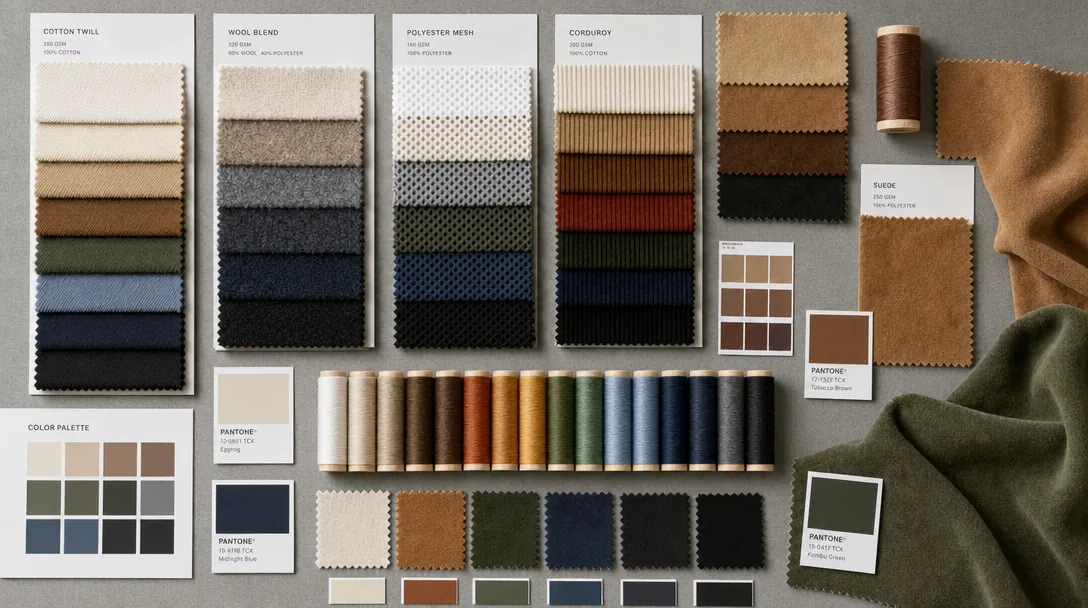
The bucket hat corduroy sample approval process needs a separate sourcing plan because corduroy is a directional pile fabric, not a neutral shell like cotton twill. Wale count, pile height, brushing, and nap direction can make the same dye lot read as two colors if the crown, side band, and brim are cut inconsistently. I have rejected dark brown, bottle green, navy, and black corduroy under a D65 light box when the lab dip was acceptable but the brim ran against nap and the crown ran with nap. The sourcing brief should freeze fabric before the first pattern sample: 260–320 gsm for regular 100% cotton corduroy, 280–340 gsm for organic cotton, and a named construction such as 8-wale, 11-wale, or 14-wale. Use Pantone TCX or a physical color standard, then write the tolerance clearly. Delta-E ≤1.5 is reasonable for lab dips; after bulk dyeing, brushing, steaming, and relaxation, a practical finished-fabric tolerance is usually Delta-E ≤2.0 with visual approval under D65 and TL84.
Construction has to be locked early because corduroy exposes small pattern changes. The tech pack should specify crown depth, brim width, brim stiffness, panel count, seam tape, lining, sweatband width, topstitch spacing, and exact logo position on the front crown, brim, or side panel. A 5 mm brim change or one additional topstitch row can bend the wale differently and make the hat look twisted even when the sewing is straight. Embroidery is the biggest decoration risk. On Tajima, Barudan, or ZSK heads, dense flat embroidery can crush the pile and leave a shiny pressure mark unless the digitizer adjusts underlay, pull compensation, stitch density, topping film, and backing. A 5,000-stitch flat logo typically adds $0.25–$0.45 per piece in bulk; chain stitch, felt applique, and 3D puff need separate sew-outs because corduroy does not rebound like chino twill. Wash approval also belongs in sourcing, not only finishing: garment wash or enzyme wash can shrink cotton corduroy 3%–5% and soften the brim enough to invalidate the approved fit sample.
Cost, lead time, and compliance change when buyers treat corduroy as a material program instead of a logo placement exercise. A stock-color corduroy bucket hat sample can normally ship 7–10 days after fabric reaches the cutting room, but custom dyeing adds 12–18 days for lab dips, strike-off approval, bulk dyeing, shade-band inspection, and fabric relaxation before cutting. Organic cotton claims require GOTS or OCS transaction certificates and chain-of-custody records if the claim appears on hangtags, polybags, invoices, or product pages. CrownsForge separates proto sample, fit sample, pre-production sample, and bulk approval, then inspects finished hats to AQL 2.5 for major defects and AQL 4.0 for minor appearance defects. If the buyer needs sedex-audit-cap-supplier-guide.html">BSCI 2.0, Sedex SMETA 4-Pillar, REACH, California Prop 65, or azo-free dye documentation, confirm it before the purchase order. Otherwise, the sample may look approved while production stalls on audit scope, fiber-claim paperwork, or a shade tolerance nobody priced into the fabric order.
Factory capability checks before quoting
Do not ask for a unit price until the supplier proves it can decorate corduroy at production speed, not only produce one clean showroom sample. In a bucket hat corduroy sample approval process, the first capability gate is embroidery control: Tajima, Barudan, and ZSK heads are all acceptable, but hoop pressure, backing, needle choice, and digitizing density decide whether the logo sits on top of the pile or sinks between the ribs. On 8-wale cotton corduroy at 280–320 gsm, a 0.8 mm satin stroke often disappears; I normally require 1.2–1.5 mm minimum satin width, 75/11 or 80/12 sharp needles, medium cutaway backing, and 10–15% lower stitch density than flat cotton twill. For 3D puff, the factory should test on loose panels before crown assembly because finished-hat puff on soft corduroy usually pulls the crown out of shape. For woven patches, felt appliqué, leather deboss patches, and PVC labels, confirm edge sealing, stitch path, heat-press temperature, dwell time, and corner lift after a 24-hour rest. If the factory cannot explain pile direction, rib shadowing, and logo sinkage, it is not ready to quote a premium corduroy bucket hat.
Fabric capability must be verified with swatches, mill data, and shrinkage results, not catalog photos. Ask for wale count, composition, weight, dye method, roll width, and residual shrinkage: 6-wale 100% cotton corduroy at 300 gsm folds and feeds very differently from 14-wale poly-cotton at 220 gsm, and the wrong fabric changes brim body, crown drape, seam tension, and packing recovery. If the brief calls for organic cotton, require GOTS or OCS transaction certificates tied to the actual mill lot; a generic sustainability PDF is not evidence. Color approval is also less forgiving than on flat twill because nap direction changes perceived shade. Review lab dips under D65 and TL84, set Delta-E tolerance at 1.0–1.5 for lab dips and around 2.0 for bulk, and require panel photos with the pile running in the approved direction. Construction checks should cover existing production patterns for two-panel, four-panel, and six-panel bucket crowns, brim widths from 5.5–7.5 cm, 6–10 brim stitch rows, self-fabric sweatbands, cotton lining, metal or sewn eyelets, and top seam binding. A workshop built mainly for knit beanies or low-cost baseball caps often lacks brim-feed control and blocking discipline.
Before quoting bulk, the sample room should build a true pre-production sample using production-equivalent corduroy, interfacing, thread, labels, trims, and packaging method. A salesman mockup made from substitute fabric with hand-placed labels tells you almost nothing about bulk risk. Our standard practice at CrownsForge is to record crown height, brim width, circumference, panel symmetry, seam allowance, needle size, stitches per inch, label position, and dimensional change after steam pressing or a 30°C wash test before releasing the approval sample. For drawcords, chin straps, toggles, snap buttons, or hidden size adjusters, require pull-force testing, nickel-free hardware where applicable, and needle or metal detector control for children’s and retail programs. The final factory capability check is documentation discipline. Ask for current BSCI 2.0, Sedex SMETA 4-Pillar, WRAP, or ISO 9001 records, plus incoming fabric inspection forms and final AQL 2.5 workflow. A serious merchandiser should answer within 24 hours with photos, measurements, material codes, decoration limitations, and a realistic sample lead time: typically 5–7 days for blank corduroy and 7–12 days with embroidery or patches.
MOQ, pricing and sample approval
MOQ is the first hard gate in any bucket hat corduroy sample approval process because corduroy is controlled by fabric lot, wale count, pile direction, and wash behavior, not just sewing capacity. For cut-and-sew bucket hats, 300 pcs per color is realistic only when 8-wale, 11-wale, or 14-wale cotton corduroy is already in stock. Dyed-to-order fabric normally starts at 500 pcs per color, while custom wale, GOTS/OCS cotton, recycled lining, special brushing, or garment wash can push the practical MOQ to 1,000 pcs per color. A 300-pc unlined style with self-fabric brim binding and cotton sweatband usually lands at USD 4.20–6.80 FOB Ningbo or Shanghai; at 1,000 pcs, the same construction often drops to USD 3.40–5.20. Cost moves quickly: 280–320 gsm corduroy, contrast lining, metal eyelets, quilted crown, wired brim, or drawcord with cord lock typically adds USD 0.25–0.90 per piece. Treat decoration separately: flat embroidery digitizing USD 35–60, 3D puff USD 50–80, woven label setup USD 45–90, and custom metal trim tooling USD 80–150 before unit charges. Do not approve brown, olive, rust, cream, or washed black from screen images; under D65, corduroy pile can shift red, yellow, or gray after brushing or enzyme wash even when the lab dip passes.
An approvable sample must be a true PPS, not a nice-looking proto made from leftover roll ends. It should use bulk corduroy, bulk thread, final sweatband, final lining, labels, trims, packaging, and the same sewing route planned for production. Our standard practice at CrownsForge is Delta-E below 1.5 against Pantone TCX for solid-dyed corduroy and below 2.0 after garment wash, because pile direction changes reflectance even when the dye lot is acceptable. Require shade-band photos from crown, brim, and side panels under D65 and TL84, and request a physical swatch if the color is tied to a licensed brand standard. Embroidery approval must be a sewn strike-off on the actual corduroy, not a JPG mockup. On 11-wale cotton corduroy, small front logos often need 0.35–0.45 mm stitch spacing; satin columns wider than 6 mm can sink into the pile unless the Tajima, Barudan, or ZSK operator uses water-soluble topping film and adjusts edge-run underlay. Before sign-off, check care label, size label, country of origin, barcode, carton mark, and polybag wording against the PO and compliance file.
Lead time usually slips because buyers approve the appearance but leave production conditions open. A first proto takes about 5–7 days with stock corduroy; a corrected PPS usually needs another 7–10 days after comments; bulk production for 300–2,000 pcs is normally 25–35 days after deposit and PPS approval. Add 10–15 days for custom dyeing, brushing, enzyme wash, lab-dip rework, or wash-panel testing, and verify BSCI 2.0 or Sedex SMETA 4-Pillar documentation if dyeing, embroidery, or washing is subcontracted. Freeze packaging before PPS, not after bulk sewing: recycled individual polybags add USD 0.05–0.09 per piece, kraft hangtags USD 0.04–0.08, barcode stickers USD 0.02–0.04, and retailer carton labels add both handling cost and inspection time. Final inspection should use at least AQL 2.5 major / 4.0 minor with defect definitions agreed before cutting. Common rejects are brim stitch deviation over 2 mm, twisted panels, nap-shade mismatch, visible oil marks, loose embroidery threads, crooked woven labels, wrong carton quantity, and crushed pile from overpacked cartons. Corduroy is unforgiving under inspection lights; shade bands and waviness missed in approval photos often become obvious in bulk cartons.
Quality inspection and shipping risk
The biggest risk in a bucket hat corduroy sample approval process is approving a “nice-looking” sample without inspection limits that can survive bulk production. Put ANSI/ASQ Z1.4 directly in the PO: General Inspection Level II, AQL 2.5 for major defects, AQL 4.0 for minor defects, and zero tolerance for critical defects such as mold, broken needle fragments, wrong COO label, restricted-substance failure, or children’s drawcord/safety violations. Define hard measurement tolerances before cutting: crown height ±0.3 cm, brim width ±0.3 cm, head circumference ±0.5 cm, top diameter ±0.4 cm, logo placement ±0.2 cm, and brim tilt difference no more than ±0.4 cm from left to right. Corduroy is tricky because pile compresses, bias panels relax after steaming, and a soft bucket hat can be stretched by hand to “pass.” Inspectors should condition samples for 24 hours, measure flat on a table, and record actual readings, not average away bad pieces.
Shade and nap direction are shipment issues, not cosmetic debates after the cartons land. Approve corduroy against a sealed lab dip or Pantone TCX target under D65 and TL84 light, with Delta-E under 1.5 for main panels where practical and under 2.0 only if the buyer signs off. Every cut panel must follow the same wale and nap direction; one reversed side panel on navy, chocolate, forest, or burgundy corduroy can look like a different colorway in store lighting. For dark shades, require ISO 105-X12 rubbing fastness: dry grade 4 minimum and wet grade 3–4 minimum. If the care label says machine washable, add ISO 105-C06 wash fastness and dimensional stability after laundering; pigment-dyed or enzyme-washed corduroy often belongs under “spot clean only” unless testing proves otherwise. Decoration QC should reject thread tails over 3 mm, backing show-through, birdnesting, broken stitches, puckering around dense satin columns, wrong Madeira or Robison-Anton thread references, and lettering below 4 mm that closes after sewing. Tajima, Barudan, and ZSK heads all need edge-run underlay, pull compensation, reduced fill density, and usually cutaway backing on corduroy.
Packing approval must be part of final QC, not a warehouse decision after hats are sealed. Carton marks should list PO, style, color, size ratio, quantity, gross and net weight, carton dimensions, COO, and customer routing data such as GS1-128, UCC-128, Amazon FNSKU, or licensee barcode labels. Do not overcompress corduroy bucket hats: a 58 cm hat packed crown-to-crown under high carton pressure for 30 days in a humid vessel can retain pile crush and brim distortion even after steaming. Use vented polybags where legally accepted, moisture-resistant export cartons during South China rainy season, and 2–4 g silica gel per inner bundle depending on carton size and destination humidity. FOB Ningbo or Shanghai gives buyers cleaner control over consolidation, marine insurance, ISF filing, and broker instructions; DDP is simpler but can blur responsibility for duty, customs exams, storage, and last-mile damage. At CrownsForge, the shipment file keeps the sealed sample, fabric lot card, Delta-E record, embroidery DST, final AQL report, needle-control log, and carton label proof to prevent reorder drift.
Buyer checklist for the next RFQ
Start the RFQ with dimensions a pattern maker can cut, not “best price for corduroy bucket hat.” State finished head circumference by size, crown height, top diameter, brim width, brim drop angle, panel count, seam allowance, and tolerance; a 58 cm hat with an 8.0 cm crown and 6.5 cm semi-stiff brim is a different block from a 60 cm relaxed fit with a 5.5 cm floppy brim. Define brim build: shell only, double fabric, woven fusible, or 120–180 gsm nonwoven interlining. For corduroy, list wale count, composition, weight, and pile direction. 8-wale cotton corduroy at 320 gsm behaves much heavier at the seam than 16-wale cotton/spandex at 260 gsm or 21-wale baby corduroy at 220 gsm, especially around the crown-to-brim join. Give Pantone TCX targets for shell, lining, sweatband, drawcord, eyelets, embroidery thread, and label ground, with lab-dip tolerance such as Delta-E ≤1.5 under D65. For washed black, tobacco, rust, and olive, send a physical swatch; corduroy pile can shift one full visual shade under LED light versus daylight.
Attach reference photos that can be measured: front, side, top, inside crown, underside brim, and flat-lay views with a ruler or caliper in frame. Competitor links are useful for silhouette only; they do not replace a tech pack with millimeter dimensions, seam construction, topstitch spacing, and label placement. Artwork should arrive as AI, EPS, editable PDF, DST, or EMB, with placement measured from center front, side seam, brim edge, or crown seam. For embroidery, specify logo width in mm, stitch type, thread brand and code such as Madeira Classic 40 or Gunold Poly 40, backing type, and whether 3D puff is approved. Tajima, Barudan, and ZSK heads can embroider bucket hats, but corduroy ribs need extra pull compensation, reduced density versus twill, and consistent wale direction or the logo will look twisted after pressing. Your bucket hat corduroy sample approval process should name the approval checkpoints before cutting: fabric handfeel, pile direction, brim stiffness, crown shape, stitch color, sweatband softness, label position, drawcord length, hangtag location, polybag style, carton marks, and barcode placement.
Put commercial, logistics, and compliance requirements in the first RFQ, not after the proto sample looks right. Break quantity by color and size, then state incoterm and route: FOB Ningbo/Shanghai, EXW Yiwu, or DDP to a named warehouse ZIP code. Include retail packaging, UPC/EAN rules, suffocation-warning text, carton weight limits, carton dimensions, and whether metal detection is mandatory. Name the standards that actually apply: BSCI 2.0, Sedex SMETA 4-Pillar, CPSIA, California Prop 65, REACH SVHC, azo-free dye testing, formaldehyde limits, or nickel release for eyelets and cord locks. Do not combine a corduroy bucket hat, washed twill cap, and acrylic beanie into one price line; they have different fabric loss, machine setup, sewing minutes, and AQL checkpoints. CrownsForge normally quotes sample charge, bulk unit price, digitizing or mold fees, lead time, and AQL 2.5 inspection basis only after these inputs are complete. Set the revision rule clearly: one proto, one corrected sample, and one pre-production sample is normal; extra “make it more premium” rounds are paid development, typically USD 50–120 per sample depending on trim and decoration.
Working with CrownsForge
CrownsForge treats the bucket hat corduroy sample approval process as the production freeze point, not a cosmetic sales sample. Before cutting, the approval file must lock crown height, top diameter, brim width, panel count, seam allowance, stitch gauge, eyelet position, lining, sweatband width, label placement, care content, and packing method. For corduroy, fabric cannot stay vague: specify 8-wale, 11-wale, or 14-wale cotton corduroy, typically 260–320 gsm for fall/winter buckets and 220–250 gsm for lighter fashion programs. Yarn-dyed fabric gives better shade depth on dark brown, navy, and black; piece-dyed fabric is cheaper and more flexible for low-MOQ custom colors, but I want lab dips and cut-panel shrinkage data before pattern grading is frozen.
I do not accept mill shrinkage claims on corduroy without a small-panel test after steam pressing and one light wash, because wale-direction shrinkage and cross-grain shrinkage can move differently by 1–2%. Color approval should use Pantone TCX, a signed physical swatch, and D65 light; for bulk, a Delta-E target of 1.5 is realistic for premium retail, while promotional orders often live closer to 2.0. Pile direction must be written into the sample comments. A color like Pantone 19-1118 TCX can look rejected even when dyed correctly if the crown panels and brim are brushed opposite ways. If organic cotton is claimed, GOTS or OCS transaction certificates need checking before sampling, not after bulk fabric is already cut.
Decoration must be approved on the actual production corduroy, not on cotton twill or a digital mockup. On 8-wale fabric, embroidery edges can fall into the ribs, so Tajima, Barudan, or ZSK files usually need adjusted underlay, lower stitch density, wider satin columns, extra pull compensation, and revised trim sequencing. I am conservative with 3D puff on bucket hats: soft unstructured crowns and curved panels make raised letters under 6 mm distort quickly. Fine marks often survive better as woven patches, felt appliqué, debossed PU patches, silicone labels, or low-density chain stitch. A first prototype normally takes 7–10 calendar days after artwork, fabric, and trims are confirmed; a correction sample is usually 5–7 days if no redyeing or new mold is needed. Photos can confirm logo position, but not pile bruising, brim stiffness, crown collapse, or hand feel, so physical sign-off still matters.
Bulk cutting should wait until the signed sample, measurement chart, bill of materials, color standard, packaging spec, and defect list are frozen together. Common corduroy bucket hat failures are brim asymmetry, crown-height drift, seam puckering, sweatband twisting, label miscentering, loose pile around needle holes, panel shade variation, and pressure marks from tight packing. Practical tolerances are ±0.5 cm on crown height and head circumference, but brim width should be held to ±0.3 cm because 0.7 cm changes the silhouette. Inline inspection should begin after the first 50–100 pieces, before a bad presser setting or folder alignment ruins the lot. Final inspection is commonly AQL 2.5 major and 4.0 minor; licensed retail programs may require 100% logo inspection. Approval should also lock HS code, carton strength, suffocation warnings, UPC or FNSKU labels, carton marks, and FOB Ningbo or Shanghai routing.
Frequently Asked Questions
How long does production take?
Sampling takes 7 to 12 days. Bulk production runs 20 to 30 days depending on quantity, fabric availability and decoration complexity. Inspection and packing adds another 3 to 5 days before shipment.
Do you support sustainability certifications?
Yes. We work with GOTS organic cotton, GRS-certified recycled polyester, OEKO-TEX Standard 100 fabrics, and are BSCI and Sedex audited. Certification documentation can be provided per order.
What file format should I send for my logo?
Vector files (AI, EPS, PDF) are ideal. High-resolution PNG or JPG at 300 dpi on transparent background works as a fallback. Provide Pantone color references for accurate reproduction.
What is the minimum order quantity (MOQ) for custom hats?
Our standard MOQ is 100 pieces per design and color, with sampling available from 1 piece. For complex multi-color logos or premium fabric upgrades, the MOQ can be lowered with a small per-piece surcharge.
Can I order a sample before bulk production?
Yes. We strongly recommend approving a pre-production sample before mass production. Samples are charged at 35 to 60 USD each plus express shipping, fully refundable against confirmed bulk orders over 500 pieces.
What should buyers know about organic cotton bucket hat?
When evaluating organic cotton bucket hat, the key considerations are construction quality, decoration capability, MOQ flexibility and lead time. Explain the buyer intent behind bucket hat corduroy sample approval process, when it differs from generic hat sourcing, and what decisions affect cost, lead time and compliance. Describe how CrownsForge manages bucket hat corduroy sample approval process programs with sampling, decoration, QC and export coordination.
What should buyers know about brown corduroy bucket hat?
When evaluating brown corduroy bucket hat, the key considerations are construction quality, decoration capability, MOQ flexibility and lead time. Explain the buyer intent behind bucket hat corduroy sample approval process, when it differs from generic hat sourcing, and what decisions affect cost, lead time and compliance. Describe how CrownsForge manages bucket hat corduroy sample approval process programs with sampling, decoration, QC and export coordination.
What should buyers know about bucket hat men nike?
When evaluating bucket hat men nike, the key considerations are construction quality, decoration capability, MOQ flexibility and lead time. Explain the buyer intent behind bucket hat corduroy sample approval process, when it differs from generic hat sourcing, and what decisions affect cost, lead time and compliance. Describe how CrownsForge manages bucket hat corduroy sample approval process programs with sampling, decoration, QC and export coordination.
What should buyers know about acrylic beanie hat?
When evaluating acrylic beanie hat, the key considerations are construction quality, decoration capability, MOQ flexibility and lead time. Explain the buyer intent behind bucket hat corduroy sample approval process, when it differs from generic hat sourcing, and what decisions affect cost, lead time and compliance. Describe how CrownsForge manages bucket hat corduroy sample approval process programs with sampling, decoration, QC and export coordination.
Looking for a reliable hat manufacturer in China?
CrownsForge has produced custom hats for 800+ brands across 40 countries. From 100-piece launches to 100,000-piece retail programs, we deliver on time and on spec.
Get in touchRelated guides
Custom Leather Patch Hat Low Minimum: A 2026 B2B Sourcing Guide
Read article →
Mens Beanies: Properties, Costs and How to Spec It Right
Read article →
Bulk Trucker Hats Export Shipping Checklist for Custom Hat Buyers - Cost & MOQ Breakdown - Supplier Checklist
Read article →We hope this guide demystifies bucket hat corduroy sample approval process for custom hat buyers - 2026 buyer's guide and helps you move forward with confidence. If you have questions specific to your project, our English-speaking sales engineers are one message away.