
Sports Team Hats: A Vertical-Specific Sourcing Guide - 2026 Buyer's Guide
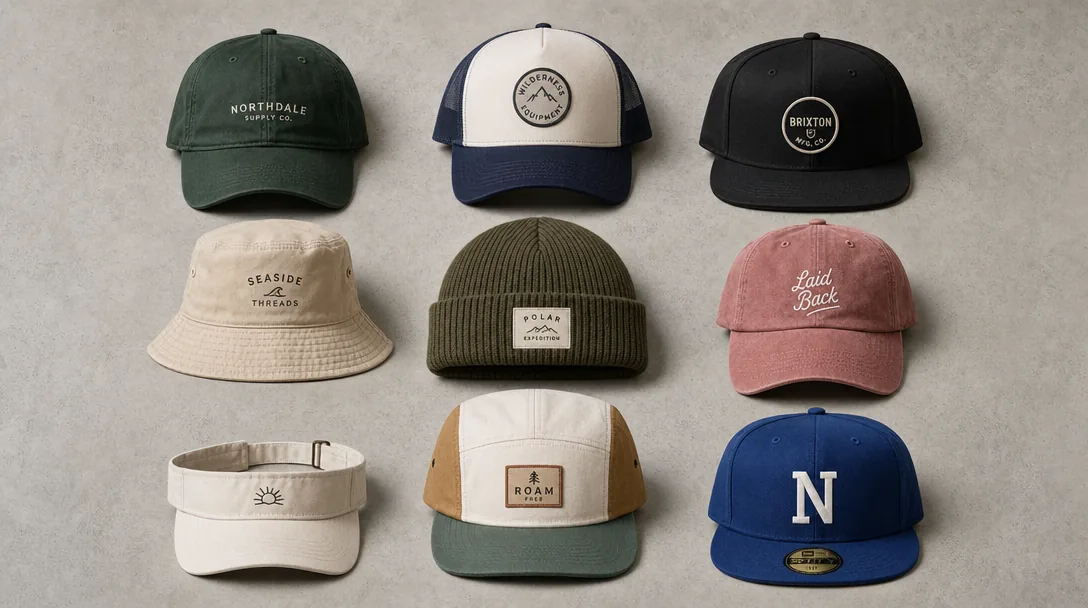
Every week, our sales team answers detailed questions about sports team hats: a vertical-specific sourcing guide - 2026 buyer's guide. We wrote this guide so that wholesalers, streetwear brands, corporate buyers and promotional resellers can compare options with full information, and avoid the traps that show up only after production has started.
Custom Baseball Team Hats
The fastest way to overspend on custom baseball team hats is to buy them like generic promo caps. Real team programs lock the build before artwork goes to digitizing: usually a 6-panel structured crown with 3.0-3.5 mm PE buckram for dugout, travel, and on-field use, while unstructured washed twill is better reserved for fan merchandise. Fabric needs to be written by composition and weight, not by soft marketing names: 10x10 brushed cotton twill at 260-280 gsm for a traditional hand feel, poly-cotton twill around 220 gsm for lower shrink risk, or 140-160 gsm polyester interlock with a moisture-management sweatband for training caps. If the cap has to match home, away, and alternate uniforms across repeat POs, require Pantone TCX references, approved lab dips, and Delta-E below 1.5; otherwise you will see visible shade drift between crown panels, top button, visor binding, and closure tape under warehouse lighting or daylight.
Decoration quality on sports team hats is won or lost in the digitizing file and at the embroidery head, not in the PDF mockup. Write the method by logo position: flat embroidery for side hits and fine copy, 3D foam for bold front marks, twill applique for varsity styling, and silicone heat transfer where stitch bulk would distort a lightweight polyester shell. On Tajima, Barudan, or ZSK machines, clean output depends on stitch density, edge-run underlay, thread tension, push-pull compensation, and center-out hooping so the front logo does not torque off grain. For licensed or retail programs, define logo dimensions in millimeters, thread brand and sheen, stitch-count range, and minimum edge clarity at 30-40 cm viewing distance. A factory told only to “match sample” will usually reduce stitch count to save thread and machine time, which is exactly how front marks lose sharp borders and interior detail.
The RFQ should remove every place a supplier can quietly downgrade the cap. Specify crown height in centimeters, visor length and curvature, sandwich color, eyelet construction, seam taping, sweatband material, closure type, top button, interior label package, and finished head-circumference tolerance; for adult baseball caps, +/-0.5 cm is a reasonable production standard. If the program touches retail shelves or league licensing, add colorfastness to crocking, perspiration, saliva where relevant for youth, and light-fastness requirements, plus carton pack-out limits to prevent crushed structured crowns during ocean transit. In China, stock-fabric programs often start around 144-300 pieces per colorway, but custom-dyed fabric, split sizing, or player-issued builds push practical MOQ closer to 500-1,000 pieces. In 2026, a basic embroidered cap typically lands at about $2.80-$4.60 FOB China at 300 pieces, while premium sports team hats with molded patches, custom inside taping, woven labels, and branded metal closures usually run $4.80-$7.50 FOB. AQL 2.5 is common, but front-logo appearance is better controlled at AQL 1.5 with pre-production approval and in-line embroidery, sewing, and packing checks rather than relying on final random inspection alone.
Baseball Hats Canada
For a baseball hats Canada program, the expensive mistakes are almost never aesthetic; they sit in fit consistency, decoration engineering, and import labeling. Most reliable sports team hats still start as 6-panel structured builds in 260-320 gsm cotton twill or brushed chino, or 140-180 denier polyester for performance SKUs, with 2.0-2.5 mm buckram in the front crown and a pre-curved PE visor. If one cap has to serve team retail, tournament merch, and promo resale, the tech pack cannot hide behind “standard fit.” Lock crown height, visor length, strapback or snapback construction, sweatband fiber blend, seam tape color, and logo position measured from the visor seam and center front. Decoration needs the same discipline: tell the factory whether the file is being tuned for Tajima, Barudan, or ZSK heads, and whether the front mark is flat embroidery, 3D puff, or twill appliqué. A stitch file that runs clean on a high-profile structured crown can wrinkle or sink on a lower-profile shape, especially once foam height, satin density, and seam clearance are not defined.
Canadian compliance is where smaller importers quietly bleed margin. For caps entering Canada, bilingual English-French fiber-content and care labeling, country-of-origin marking, and retail sticker format should be approved before bulk, because post-entry relabeling routinely costs CAD 0.18-0.40 per cap once unpacking, relabel labor, and rebagging are added. Color control also needs to be tighter than many buyers assume: call out Pantone TCX references for shell, undervisor, top button, eyelets, and sweatband, then set Delta-E at 1.0-1.5 under D65 lighting if you expect repeatable navy, black, or team red across reorders. The spec sheet should read like an inspection document. Set fabric tolerance at plus or minus 5%, closure pull strength at roughly 90 N for hook-and-loop and 120 N for snapback assemblies, and embroidery registration tolerance at no more than 2 mm off center. On cost, stock-material programs usually open around 144-300 pieces per colorway, while licensed builds with woven labels, molded metal buckles, custom inside taping, and retail packaging land closer to 500-1,200 pieces per style. In current China sourcing, a basic embroidered cap is typically USD 2.40-4.20 FOB; more technical builds in recycled polyester with multi-location embroidery and custom pack-out are usually USD 4.80-7.50 FOB before duty and DDP freight.
Inspection points on baseball caps are predictable, which is exactly why buyers should write them into the approval process instead of discovering them at final random inspection. The recurring failures are front logos drifting more than 2 mm off center, eyelet puckering, visor twist after carton compression, needle cuts on lightweight polyester, abrasive sweatband joins, and panel shading caused by mixed dye lots. For performance styles, ask about moisture-wicking sweatbands, laser-perforated side panels, and anti-microbial finishes at the quoting stage, because those trims can add 7-15 days if the mill does not hold stock. Use AQL 2.5 for appearance and AQL 4.0 for minor trim defects, and carton-drop test any e-commerce packout with the actual inner packaging configuration. Our standard practice is to hold bulk release until the sealed swatch card, approved fit sample, and embroidery strike-off all match, because once a factory loses control of crown depth, visor arc, or logo registration on a baseball cap, the rest of the sports team hats program usually drifts with it.
Fitted Hats with Patches
Patch construction is the first call to make on fitted caps, because it drives both the sewing sequence and the risk of distorting the crown. On licensed sports team hats, the three patch formats that actually scale are embroidered twill with a satin border, merrowed-edge appliqué, and molded TPU or silicone badges. They do not behave the same on a structured six-panel fitted. A wool serge or wool-acrylic shell at 280 to 320 gsm with firm front buckram will carry a front patch load that a softer brushed twill crown simply will not. If the finished badge is above about 2.5 mm thick, the factory needs to decide pre-assembly versus post-make attachment before sampling, because stitching a heavy patch onto a closed crown often pulls the seam centerline off spec, flattens the front profile, and creates visible tunneling around the stitch path. On better runs, larger front patches are set with a laser guide to about ±1.5 mm and sewn on a programmable pattern sewer such as a Juki AMS rather than a basic single-needle station where drift is routine.
A serious tech pack for fitted sports team hats has to lock the shape and the patch at the same time: crown profile, size run from 6 7/8 to 7 5/8, visor board, underbill color, eyelet finish, sweatband composition, seam tape artwork, and a full patch BOM. For the patch, specify base twill or polymer, border finish, stitch count or mold depth, Pantone TCX references, and acceptable color tolerance. For licensed team colors, Delta-E under 1.5 against approved lab dips is a practical control point, especially on white twill bases that show contamination fast during pressing. In Yiwu and Dongguan, MOQ is usually 288 to 500 pieces per colorway for stock wool-blend fitteds with sewn twill patches, but moves past 1,000 pieces if you open a custom silicone mold, add metallic thread, or split deliveries across several fitted sizes. Clean wool-blend fitteds with sewn twill patches typically land around $4.20 to $6.80 FOB China; molded TPU or raised PVC-style badges with tighter color control and branded interior taping usually sit closer to $6.50 to $9.50 FOB.
Inspection should prioritize structure before cosmetics, because the expensive failures on fitted patch caps are shape-related and hard to rework. The repeat defects are patch skew beyond 2 mm, puckering around the sew line, edge lift after heat or rub testing, visor mis-centering to the front logo, and crown depth drift across the size curve. I would inspect these sports team hats at AQL 2.5 with dedicated checkpoints for crown symmetry, seam alignment, logo orientation, sweatband join strength, and color migration from dark shell fabrics into light patch twill after finishing. If the patch is embroidery-based, ask what heads the supplier runs—Tajima, Barudan, and ZSK each handle dense satin borders a little differently—and then physically check thread tension, edge coverage, and backing trim. Poorly trimmed backing is still one of the most common forehead-pressure complaints on fitteds. A factory can hold sedex-audit-cap-supplier-guide.html">BSCI 2.0 or pass a Sedex SMETA 4-Pillar audit and still fail a licensed fitted program if it cannot keep patch placement stable and the crown profile consistent over the full size run.
Bucket Hats for Men
Men’s bucket styles work in licensed and promotional sports team hats only when the silhouette is engineered before decoration, not improvised after sampling. A usable tech pack should lock crown height at about 8.5-9.0 cm, brim width at 5.5-6.0 cm, brim slope, eyelet spacing, sweatband width, stitch-row count, and finished circumference tolerance to within plus or minus 0.5 cm. For North American men’s programs, 58 cm is still the standard base size, with 60 cm and 62 cm worth grading if the item is meant for stadium retail instead of giveaway use. On the sewing floor, the stable construction is a 3-piece body with crown top, sidewall, and a brim built from shell, underbrim, and 1.5-2.0 mm PE or EVA interlining. If brim topstitching drifts from 5 mm to 7 mm across quadrants, the brim will torque after wash or packing compression, and the hat looks low-grade immediately.
Fabric choice determines whether team branding stays clean through production and retail handling. A 7 oz cotton twill, roughly 240-260 gsm, remains the safest shell for direct embroidery because it holds needle tension well on Tajima, Barudan, or ZSK heads and resists puckering better than softer brushed chino. Chino can feel better in hand, but it is more prone to seam grin at the brim join and more movement after washing. For performance-driven programs, 210T nylon or Taslon polyester makes sense, but decoration usually needs to shift to woven patches, matte heat transfers, or sublimated panels instead of dense fill embroidery. If the bucket sits inside a wider sports team hats range, color control cannot be done by eye: specify Pantone TCX references for dyed fabric, ask for lab dips before bulk, and hold bulk shade to Delta-E below 1.5 under D65 lighting so the bucket does not drift against matching caps, beanies, or sideline bags.
Quoting and inspection are where buyers either protect margin or give it away. Bucket hats offer less flat sewing area than a six-panel cap, so decoration method has to match the geometry: small left-front or side logos can run pre-assembly, but wrap prints, camouflage layouts, and all-over wordmarks are better handled with screen print on cut panels, sublimation on polyester shells, or post-sewn woven patches. In the current China market, stock-color cotton buckets typically land around $2.20-3.80 FOB at 500 pieces, while performance versions with custom inner taping, woven labels, and two-position branding are more often $3.90-6.20 FOB. Once you add custom-dyed fabric, licensed trims, or branded packaging, the practical MOQ usually moves from 300-500 units to 800-1,000. I would inspect to AQL 2.5, pull 13 samples from a standard lot, and measure circumference, brim width, eyelet centering, and shade consistency between crown and brim. At CrownsForge, embroidery distortion beyond 3 mm, twisted brim seams, and visible panel mismatch are rejectable because they show up instantly under arena lighting and in e-commerce photography.
Fitted Hats Women
Women’s fitted caps usually fail at the block stage, not the logo stage. A true women’s fitted profile normally needs crown depth reduced about 3-5 mm from a standard men’s full-profile block, a slightly tighter front-panel angle, and a cleaner sweatband-to-visor transition so the cap sits low instead of floating like a generic 59FIFTY-style shell. If the tech pack only says “women’s fit,” most factories will pull the nearest existing aluminum block and grade from there, which is exactly how repeat orders start drifting. For sports team hats, lock the geometry in writing: finished crown height, visor length, visor curvature radius, opening circumference by size, sweatband width, shell fabric weight, buckram spec, and sewing tolerances for a no-closure construction. A practical size run is 54, 55.5, 57, 58.5, and 60 cm, with finished circumference held to ±3 mm and every size approved on a physical head form, not just a paper nest. On softer builds, I would also specify buckram weight around 160-220 gsm instead of the stiffer men’s standard, because overly rigid front panels are what make women’s fitted caps look tall and unstable on the head.
Licensed graphics on women’s fitted styles need tighter controls because the lower crown and shorter visual face leave less room to hide errors. Front embroidery placement should be held to ±1.5 mm, visor center alignment to ±2.0 mm, and logo height should be approved against the actual curved front panel after blocking, not from a flat strike-off. For team colors, use Pantone TCX or coated references only as the starting point; on polyester twill or recycled poly, require lab dips and keep Delta-E under 1.5 under D65 light, or under 1.0 when matching a regulated franchise navy or scarlet. Smaller crown curves also change embroidery behavior: on Tajima, Barudan, or ZSK multi-heads, dense satin borders and aggressive underlay will pucker faster, especially around serif letters under 4 mm tall, so the digitizing usually needs lighter edge-run density and reduced machine speed. In China, realistic MOQs are 144-288 pieces per colorway for stock fabrics, but once you split across fitted sizes, stable production is closer to 300-500 pieces. Basic acrylic-wool sports team hats typically land around $4.50-$6.50 FOB; melton wool, brushed cotton twill, or recycled poly twill with 3D embroidery and branded inside taping usually runs $7.80-$11.80 FOB. Bulk inspection should stay at AQL 2.5 with size-set approval before sewing, plus crocking and perspiration fastness checks on dark navy, black, and red shades because color transfer at the hairline generates claims faster than minor stitching defects.
Winter Bucket Hats for Men
The shell-and-lining stack decides whether a winter bucket sells through or comes back as dead stock. For cold-weather sports team hats, the most reliable commercial build is a 240-280 gsm brushed cotton twill or 120 denier nylon taslon shell matched with either 180-220 gsm anti-pill polar fleece for sideline use or 160-180 gsm diamond-quilt lining for cleaner retail presentation. I would not approve sampling without a full spec pack covering finished crown height, brim width, seam allowance, stitch density, lining join method, and brim insert. A 2.0 mm EVA brim insert consistently recovers better after 35-45 days in ocean cartons than soft nonwoven, while laminated buckram usually makes the brim feel too hard for fanwear. That rebound point gets missed all the time: if the brim collapses after compression, the hat arrives looking cheap; if it is overbuilt, it wears like costume merch instead of practical winter headwear. The real failures sit inside the construction, not on the outside. Shell and lining are normally sewn as separate assemblies and joined before 6-8 rows of concentric brim topstitching lock the shape. If there is front embroidery, the shell should be stabilized before it goes onto Tajima, Barudan, or ZSK heads; otherwise the logo tunnels once fleece or sherpa adds bulk behind it. For licensed programs, require lab dips against approved Pantone TCX standards and keep shade tolerance at Delta-E 1.0-1.5 under D65 light, especially when the bucket has to match scarves, puffers, or sideline jackets. Be honest on weather claims too: most bucket hats are not engineered like seam-sealed outerwear, so a C0 or C6 DWR finish on the shell is credible, while “waterproof” usually is not.
Winter bucket MOQ and cost move up fast because every extra layer adds cutting, bundling, and sewing time. In the Yiwu cap supply chain, 300-500 pieces per colorway is workable if you use stock twill, taslon, or standard fleece, but custom plaid flannel, faux fur, or quilted lining generally pushes efficient production closer to 800-1,000 pieces. In 2026, a standard embroidered winter bucket for sports team hats typically prices around $4.20-$6.80 FOB China at 500 pieces. Recycled nylon, metal eyelets, woven binding, satin seam taping, or retail-ready inner packing can push that to $7.50-$9.50. The first thing I pin down with buyers is whether they want merchandise durability or fashion trim, because faux-fur edging and low-volume color matching change both factory fit and cost structure immediately. Inspection has to target the defects that only show up after packing and transit. I would hold licensed or retail programs at AQL 2.5, check finished circumference within plus or minus 0.5 cm, and pay special attention to brim warping, lining twist, seam abrasion at the ear, and uneven topstitch spacing, which is obvious on black or navy shells. On nylon and coated polyester styles, eyelet puckering is a repeat issue, and any heat-transfer logo should survive at least 20 dry rubs with no edge lift. Dark-shell-to-light-lining migration under humidity is another failure buyers catch too late, so crocking checks matter. At CrownsForge, we also review packed CBM and carton drop resistance before booking, because winter buckets consume more cube than standard caps and collapse faster when master cartons are under-spec'd.
Working with CrownsForge for sports team hats programs
Licensed sports team hats usually break in development, not in bulk, and the failure points are predictable: embroidery strike-off accuracy, crown geometry, visor curve consistency, and trim approval. A realistic sample calendar is 7 to 10 calendar days for the first proto once the tech pack is complete and the buyer has already frozen Pantone TCX references, logo size, closure type, visor profile, and interior branding callouts. If the front mark needs revised satin density, twill appliqué edge width, or woven label color corrections, expect another 3 to 5 days per revision cycle. Running multiple bodies in parallel adds time because a structured 6-panel acrylic-wool snapback, a low-profile enzyme-washed cotton twill cap, and a bucket hat each need separate patterns, sewing trials, embroidery pathing, and fit checks on different headforms. MOQ is where many team programs become unrealistic. Buyers often ask for 48 or 72 pieces per color, but that only works when you stay on stock chino twill, stock PE buckram, standard snap closures, and shared trims already on the floor. The moment the program shifts to custom-dyed shell fabric, molded TPU or silicone patches, contrast seam tape, printed internal taping, or branded metal hardware, the workable MOQ usually moves to 144 to 300 pieces per style-color. That is not a factory preference; it is the math of dye minimums, embroidery setup, patch molding charges, and cutting waste. For sports team hats tied to licensed color standards, it is also the only sensible way to control shade variation and hold Delta-E within about 1.0 to 1.5 across shell, visor binding, and trim components.
Decoration capacity matters more than a big silhouette catalog because each application creates a different failure mode. Front logos on sports team hats can run cleanly on Tajima, Barudan, or ZSK multi-head embroidery machines, but side hits, underbill embroidery, laser-cut twill appliqué, chenille, satin border patches, and HD silicone heat transfers all change panel stability and sewability. Heavy brushed canvas often needs lower stitch density and a firmer backing to avoid puckering; lightweight poly mesh can tunnel if the underlay is too aggressive; sherpa and faux fur simply swallow fine serif lettering under 3 millimeters. A capable factory flags those issues before bulk instead of copying a photo sample that only looked acceptable under studio lighting. The useful conversation is always measurable. Lock crown height in millimeters, visor radius, mesh denier, shell fabric weight in gsm, sweatband blend, stitch count range, backing spec, and color tolerance before pre-production, then hold the line in manufacturing. Our standard practice is to release bulk only after BOM lock and PPS approval, then inspect inline at roughly 20 to 30 percent output to catch embroidery drift, seam appearance, and closure mix-ups before cartons are packed. Final random inspection should be set to AQL 2.5, with carton marks, barcode placement, and assortment verified against the PO, while social compliance paperwork is kept current to BSCI 2.0 or Sedex SMETA 4-Pillar if the buyer needs audit-ready documentation for licensed programs.
Frequently Asked Questions
What logo decoration techniques do you offer?
3D puff embroidery, flat embroidery, woven patch, leather patch, PVC patch, screen printing, sublimation, applique and laser etching, all in-house with no subcontracting.
Can I order a sample before bulk production?
Yes. We strongly recommend approving a pre-production sample before mass production. Samples are charged at 35 to 60 USD each plus express shipping, fully refundable against confirmed bulk orders over 500 pieces.
What is the minimum order quantity (MOQ) for custom hats?
Our standard MOQ is 100 pieces per design and color, with sampling available from 1 piece. For complex multi-color logos or premium fabric upgrades, the MOQ can be lowered with a small per-piece surcharge.
How long does production take?
Sampling takes 7 to 12 days. Bulk production runs 20 to 30 days depending on quantity, fabric availability and decoration complexity. Inspection and packing adds another 3 to 5 days before shipment.
What file format should I send for my logo?
Vector files (AI, EPS, PDF) are ideal. High-resolution PNG or JPG at 300 dpi on transparent background works as a fallback. Provide Pantone color references for accurate reproduction.
What should buyers know about bucket hat men?
When evaluating bucket hat men, the key considerations are construction quality, decoration capability, MOQ flexibility and lead time. Cover everything buyers ask about bucket hats for men: how it's manufactured, what specs to request from a factory, typical MOQ and pricing, common quality issues to inspect for, and how this ties back to the broader sports team hats sourcing decision. Cover everything buyers ask about winter bucket hats for men: how it's manufactured, what specs to request from a factory,…
What should buyers know about nike bucket hats for men?
When evaluating nike bucket hats for men, the key considerations are construction quality, decoration capability, MOQ flexibility and lead time. Cover everything buyers ask about bucket hats for men: how it's manufactured, what specs to request from a factory, typical MOQ and pricing, common quality issues to inspect for, and how this ties back to the broader sports team hats sourcing decision. Cover everything buyers ask about winter bucket hats for men: how it's manufactured, what specs to request from a factory,…
How does ordering custom racing team trucker hat work?
When evaluating custom racing team trucker hat, the key considerations are construction quality, decoration capability, MOQ flexibility and lead time. Cover everything buyers ask about custom baseball team hats: how it's manufactured, what specs to request from a factory, typical MOQ and pricing, common quality issues to inspect for, and how this ties back to the broader sports team hats sourcing decision. Cover everything buyers ask about baseball hats canada: how it's manufactured, what specs to request from a factory,…
What should I know about vintage trucker hats wholesale?
When evaluating vintage trucker hats wholesale, the key considerations are construction quality, decoration capability, MOQ flexibility and lead time. Cover everything buyers ask about custom baseball team hats: how it's manufactured, what specs to request from a factory, typical MOQ and pricing, common quality issues to inspect for, and how this ties back to the broader sports team hats sourcing decision. Cover everything buyers ask about baseball hats canada: how it's manufactured, what specs to request from a factory,…
Looking for a reliable hat manufacturer in China?
CrownsForge has produced custom hats for 800+ brands across 40 countries. From 100-piece launches to 100,000-piece retail programs, we deliver on time and on spec.
Get in touchRelated guides
BSCI vs Sedex vs WRAP vs WCA: Compliance Audit Standards Compared (2026 Update) - 2026 Buyer's Guide
Read article →
Sustainable Cap Packaging: Options, Costs and Retail-Buyer Demands - 2026 Buyer's Guide
Read article →Bucket Hat Corduroy Fabric And Trim Spec Guide for Custom Hat Buyers
Read article →Sourcing custom hats does not have to be complicated. With the right manufacturing partner, clear specifications and a small upfront investment in sampling, you can launch a retail-quality product in 30 to 45 days.