
Patch Hats Decoration QC Checklist for Custom Hat Buyers - Cost & MOQ Breakdown - 2026 Buyer's Guide
For brand owners, wholesalers and procurement teams entering the custom headwear category, patch hats decoration qc checklist for custom hat buyers - cost & moq breakdown - 2026 buyer's guide is one of the highest-leverage decisions you will make. Get it right and your unit economics, retail story and reorder cycle all improve. Get it wrong and you carry the cost for years.
Why patch hats decoration qc checklist needs a separate sourcing plan
A patch cap usually fails at the join between the emblem and the crown, so a patch hats decoration qc checklist needs its own sourcing plan instead of borrowing rules from direct embroidery. The cap body, patch substrate, and attachment method all carry different tolerances. A woven label can hold 0.7 mm line detail but distort after merrow edging; a 1.2 mm silicone or TPU patch may pass abrasion but bridge on a low-profile unstructured crown; chenille can match Pantone 19-4052 TCX in the lab and still shed fibers after 30 minutes in a carton vibration test. With direct embroidery, one Tajima, Barudan, or ZSK sew-out often exposes thread tension, registration, and puckering. With patch hats, buyers need separate sign-offs: patch strike-off, placement sample on the approved crown block, and attachment durability after sewing, heat press, or adhesive bonding. The costly rejects are usually small measurement failures: Delta-E above 2.0 against approved trim, placement drift over +/-3 mm on a foam trucker front, gloss marks on brushed cotton twill from a 160 C press, or needle cutting around a PU leather edge.
Sourcing changes as soon as the patch supplier is not the same workshop making the cap, which is normal for molded rubber, woven jacquard, chenille, debossed leather, and high-density heat-transfer patches. A plain sample cap may take 7-10 days, but a patch program often needs 12-20 days because jacquard loom setup, TPU mold engraving, deboss tooling, Pantone matching, and backing-film tests happen before the cap line can even start confirmation samples. MOQs stack as separate commitments: 144-288 pieces for cap bodies, 300 pieces per woven patch design, 500 pieces per molded TPU colorway, and 1,000 pieces for efficient PU leather laser cutting. Costing should be split the same way. In Yiwu, a sewn embroidered patch typically adds $0.28-$0.55 per cap, while a custom molded rubber patch with Pantone color matching and heat-transfer backing often lands at $0.70-$1.40 before duty, inland trucking, and DDP handling. Our standard practice at CrownsForge is to quote patch fallout, attachment labor minutes, and replacement allowance as separate lines, because a blended FOB price hides the real risk.
Compliance and transport testing are the other reasons patch hats need a dedicated checklist. PVC, PU, silicone, adhesive film, metallic thread, and faux leather can trigger REACH Annex XVII, California Proposition 65, phthalate, azo dye, heavy-metal, and retailer RSL screening that a basic cotton twill cap may avoid. Leather claims also need fiber-content discipline; bonded leather, split leather, and PU-coated microfiber are not interchangeable on a customs invoice or product page. Container heat is a practical failure point: if the hot-melt film is weak, 50-60 C transit temperatures can start edge lift before cartons reach the distribution center. The floor checklist should lock edge finish, patch thickness tolerance, stitch count or weld consistency, glue spread, press temperature, dwell time, peel strength, needle damage, crown distortion, and final appearance under AQL 2.5 or the buyer’s stricter defect table. A flat-board patch approval is not enough. Once the patch sits on a curved buckram front, platen pressure, brim clearance, crown tension, and operator alignment change the result, and that is where commercial rejects usually appear.
Factory capability checks before quoting
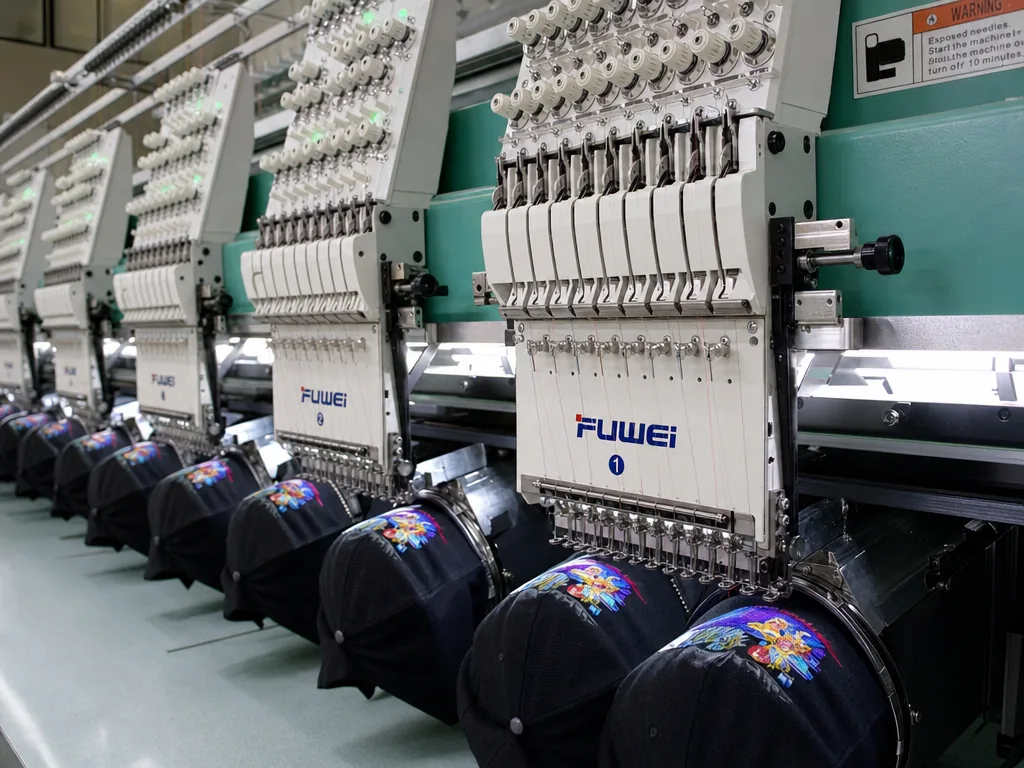
The first quoting filter is production control, not unit price. For a usable patch hats decoration qc checklist, ask the factory to document the exact decoration setup before they mention MOQ: machine brand and model range, total embroidery heads, cap-frame versus flat-frame capacity, and the smallest text they can run repeatedly without fill-in. A real answer sounds like “Tajima TFMX-C1501 or Barudan 12-head cap line, minimum readable embroidered text 3.0-3.5 mm, satin column minimum 0.8 mm, standard tatami density 0.40-0.45 mm pitch.” For woven patches, they should specify loom density, minimum line width, whether damask or taffeta is used, and when 75D versus 100D yarn is required to keep serif edges clean. For embroidered twill, felt, or chenille patches, they need to state edge method—merrow, hot cut, laser cut, or overlock—and the backing system, whether heat seal, Velcro hook, stitch-down, or pressure-sensitive adhesive. Color and placement tolerances should be written as measurable controls, not “factory standard.” Patch face colors should reference Pantone TCX for textiles and Pantone Coated for PVC, silicone, or printed label components, with a target Delta-E no higher than 1.5-2.0 under D65 light for major visible colors. Placement should be defined from seam landmarks, such as center front alignment within +/-2 mm and rotation tolerance within 2 degrees. Ask how they verify this at line speed: template jigs, laser guides, or first-piece approval at the sewing station. CrownsForge’s standard practice is to reject quotes built around vague phrases like “similar color” or “handmade deviation,” because those are usually code for no process capability data and no repeatable QC standard.
Cap construction determines whether the patch sits flat or deforms the crown, so material specs must be detailed before pricing is credible. A competent factory should quote the shell fabric by composition, weight, and construction: 270 gsm cotton twill in 108x58 construction, 600D polyester, 16-wale corduroy, washed chino with residual shrinkage below 3%, or 80/20 acrylic-wool for structured snapbacks. They also need to specify front-panel buckram type and stiffness, sweatband material and width, seam tape width, visor board thickness, and closure hardware gauge. Those details directly affect decoration risk. A 5-panel foam trucker with a laminated front panel can carry a 90 x 50 mm woven or sublimated patch without telegraphing, while an unstructured dad cap in enzyme-washed twill may need a thinner woven badge, lower stitch count, or reduced patch size to avoid crown collapse and puckering around the seam. The sample room tells you whether the supplier is a manufacturer with process control or a trader spreading work across unknown subcontractors. Before bulk pricing, they should be able to produce embroidery strike-offs, woven patch loom-offs, PVC or TPU color chips, chenille trials if requested, and one full pre-production cap in production-intent fabric with the actual closure. Typical timing is 5-7 working days for embroidered or woven patches and 10-14 working days for molded PVC, TPU, or chenille because tooling, curing, and color correction add steps. Ask for current sedex-audit-cap-supplier-guide.html">BSCI 2.0 or Sedex SMETA 4-Pillar audit status, needle control records, incoming fabric inspection forms, crocking and colorfastness test results, and the final inspection template at AQL 2.5. If they cannot define approval gates for artwork, strike-off, PP sample, inline inspection, and final random inspection, the quote is only a placeholder, not a controlled production plan.
MOQ, pricing and sample approval
MOQ on patch programs is driven by how many custom processes you stack onto the hat, not by the shell alone. On stock 6-panel cotton twill or chino blanks, 144 pieces per colorway is a workable minimum for one standard patch application: woven, embroidered, TPU, or PU leather. Once you specify custom-dyed fabric, printed seam tape, branded taping, private-label trims, or more than one patch SKU on the same PO, the practical floor moves to 300 pieces, and 500 to 1,000 pieces is normal when molded silicone, custom metal closures, or retail packaging are involved. In 2026, realistic one-time charges are $40 to $90 for embroidery digitizing on Tajima or Barudan heads, $80 to $160 for woven patch graphing and loom setup, and $100 to $220 for silicone, debossed PU, or genuine leather tooling. FOB pricing at 300 pieces usually lands around $3.40 to $5.80 for a basic cotton twill cap with one sewn patch, $5.80 to $8.60 for corduroy, brushed canvas, or wool-blend bodies, and $8.20 to $12.50 when the closure, labels, sweatband, and packing are all custom. Any usable patch hats decoration qc checklist should split tooling, sample charges, and repeat-order unit price on the quote; if those buckets are blurred, first-order cost arguments are guaranteed.
PPS approval is where buyers either control claims or invite them. Do not approve from photos alone. Require a physical pre-production sample and record tolerances on the sign-off sheet: patch placement within +/-2 mm, visor-to-crown center alignment within +/-3 mm, left-right panel symmetry, crown height, merrow edge uniformity, stitch count, and any adhesive bleed if the patch has heat-seal backing before perimeter sewing. Color standards need to be written in production language, not vague comments: Pantone TCX for fabric, Pantone C or U for printed trims, with Delta-E <=1.5 on solid reactive-dyed cotton or polyester and a looser <=2.0 on washed, heather, or pigment-dyed goods where shade variation is structurally higher. For embroidered patches, 0.35 to 0.45 mm stitch spacing is a safe production window; tighter fills create puckering and cupping, while 3D puff requires wider satin columns and foam compensation so the edge does not cut through during sewing. Lock packaging and trims at the same PPS stage. A buckle plating change, sweatband gsm revision, or switch from sewn patch to hook-and-loop after approval routinely adds 5 to 10 calendar days plus $30 to $100 in rework or resampling. Honest 2026 timing is 5 to 7 days for artwork and digitizing, 7 to 12 days for PPS, 22 to 35 days for bulk, then 3 to 5 days for AQL 2.5 inspection and export packing.
Quality inspection and shipping risk
Most chargebacks on decorated caps are not seam issues; they start where the patch meets the crown. A usable patch hats decoration qc checklist should treat attachment integrity as a primary defect category, not a cosmetic afterthought. For finished-goods inspection, I would set ANSI/ASQ Z1.4, General Inspection Level II, with Critical 0, Major 2.5, Minor 4.0. In practice, any lifted corner, visible glue bleed at 50 cm, skipped merrow stitch, patch rotation over 2 degrees, or placement drift beyond ±2 mm from the center-front seam is Major, because those faults worsen after carton compression and humidity swings in transit. I would also measure crown height within ±5 mm, brim width within ±3 mm, and strap cut length within ±5 mm so the patch sits consistently on the cap silhouette buyers approved. Decoration-specific defects need harder limits than most factories write on paper. On embroidered patches, loose merrow tails over 3 mm, puckering above 1.5 mm around the sew line, trapped thread trims under the border, or visible needle cuts on suede, felt, or PU patch faces should all be called out before packing. On Tajima, Barudan, or ZSK cap frames, small text under 4.5 mm height is risky unless digitizing is opened up; stitch spacing tighter than about 0.40-0.45 mm will close counters on e, a, and o, especially with 120D polyester thread. Satin columns wider than 6-7 mm need edge-walk plus zigzag underlay, or the stitches split after flexing. If the patch is heat-applied, test peel after 24 hours and again after a 50°C hold for 12 hours, particularly on nylon taslan and sub-300D polyester where adhesive release is common.
Shipping loss usually comes from packing shortcuts and paperwork mismatch, not ocean transit itself. Before booking, the outbound patch hats decoration qc checklist should reconcile PO number, SKU, color code, country-of-origin label, carton mark, carton count, and gross/net weight against the packing list and commercial invoice. A carton spec around 58 x 45 x 38 cm is normal for 100-120 structured caps or 120-150 unstructured caps; loading above that to save CBM is where foam fronts dent, curved brims flatten, and raised patch edges print into neighboring panels. If the shipment will route through Ningbo or Shanghai during rainy season or involve transshipment, use 5-ply export board and run a basic drop check on sealed master cartons, because weak cartons fail first at the lower corners and moisture-softened tape joints. Color and material compliance should be locked before goods are on the water. Approve patch and body color under D65 lighting with Pantone TCX for textiles or Pantone Coated where applicable, and hold core brand shades to Delta-E 1.5 max, secondary trims to 2.0 max, using a calibrated spectrophotometer. Dark navy, black, and red patch grounds should pass ISO 105-X12 crocking at Grade 4 minimum in both dry and wet rub, especially when the patch face is brushed twill or heavy felt. For repeat orders, control the exact technical record: approved BOM, fabric gsm, patch base material, DST or EMB file, pressing temperature/time/pressure, and sealed sample tied to the style code. Our standard practice is to reject undocumented substitutions such as twill dropping from 280 gsm to 240 gsm or a heat-film backing being swapped for PSA, because those are the changes that quietly create repeat-order disputes.
Buyer checklist for the next RFQ
Fix the decoration method before asking for prices; otherwise every quote is padded for uncertainty. A 60 x 50 mm front patch ranges from roughly US$0.18 to US$0.28 for a printed twill heat-seal, US$0.35 to US$0.55 for a woven label patch with merrow border, US$0.45 to US$0.80 for an embroidered patch, and US$0.90 to US$1.40 for molded PVC or full-grain leather once edge finish and attachment labor are included. Your RFQ should read like a tech pack, not a concept note: cap silhouette, panel count, crown height, buckram or unstructured front, visor shape, closure, shell fabric, and target weight such as 260 gsm brushed cotton twill, 300D polyester, or 100% nylon taslon. Call out color references correctly: Pantone TCX for dyed textiles, Pantone Solid Coated for printed patch art, and an acceptable Delta-E tolerance. If you do not state Delta-E, most factories will approve by visual match under D65 or store lighting, which is how shade disputes start.
A usable patch hats decoration qc checklist must define the patch like a production order. Specify material, finished size in millimeters, border construction, backing, and placement from the visor seam and center front line; “centered on front” is not a measurable instruction. Add placement tolerance, usually ±2 mm for front patches and ±3 mm on side or back locations. If the patch crosses a center seam, state whether bridging is allowed. On a 6-panel structured cap, a 75 mm patch often needs split embroidery, pre-curved pressing, or a switch to woven construction to avoid tunneling, flagging, and puckering over the seam ridge. If embroidery is part of the build, write the minimum legible text height into the RFQ: below 4.5 mm for satin lettering, readability falls off fast unless the artwork is simplified during digitizing on Tajima, Barudan, or ZSK heads.
Do not request a firm FOB or DDP price until the artwork package is complete. Send vector AI, EPS, or layered PDF files, plus a 300 dpi PNG at actual size, so the factory can estimate stitch count, mold depth, line thickness, and failure risk. For embroidered patches, ask for estimated stitch count; 7,000 stitches versus 12,000 stitches materially changes machine time, thread consumption, and needle-break frequency on dense fills. For PVC, leather, or microfiber suede patches, include side-profile references because thickness, bevel, deboss depth, and edge paint affect tooling cost and whether a curved heat-press jig is required. Before release, attach the four items factories actually need to cost and control quality: marked-up artwork, packaging spec, compliance requirement, and inspection standard. Write the acceptance criteria into the patch hats decoration qc checklist: AQL 2.5, no glue bleed beyond 1 mm from edge, no skipped stitches, no loose merrow loops, no raw-edge exposure, and color within approved standard. State BSCI 2.0, Sedex SMETA 4-Pillar, CPSIA, or REACH at RFQ stage, not after sampling.
Working with CrownsForge
Most patch failures are set in motion before bulk starts, not at final inspection. A workable patch hats decoration qc checklist begins with three hard references that stay on the line: the approved blank cap fit sample, the sealed patch standard, and the attachment SOP with measured tolerances. In practice, a blank fit sample usually needs 5-7 calendar days, and a decorated PPS another 4-6 days after artwork, size, and placement are frozen. That PPS should carry actual specs, not markup notes on a photo: patch size tolerance within +/-1.0 to 1.5 mm, placement tolerance within +/-2.0 mm from center front seam or panel edge, border width, stitch count, backing type, and the exact attachment sequence. For color-sensitive programs, patch shade needs to be checked under D65 lighting against Pantone TCX, coated Pantone, or a buyer control swatch, with Delta-E under 1.5 for branded logos and under 2.0 for less critical promo work. Patch construction also has to be locked by material, because failure modes are different. A merrowed embroidered patch, laser-cut woven patch, satin-frame badge, chenille emblem, TPU badge, and 3D PVC patch do not behave the same during sewing, pressing, or carton compression. The tech pack should freeze edge construction, backing, target coordinates by panel, and shell fabric data such as 260 gsm brushed cotton twill versus 120 gsm nylon taslon or 80/20 acrylic-wool blend. The same patch that sits flat on a structured buckram front can torque a soft unstructured crown by 3-4 mm. If there is any heat-assist before stitch-down, record adhesive type, pre-press temperature, dwell time, cooling time, and release method; otherwise one lot gives edge lift and the next shows shine marks or foam telegraphing on trucker fronts.
Repeatability comes from freezing process variables that too many factories leave verbal. Embroidered patches run on Tajima, Barudan, or ZSK heads should have thread brand, sheen, denier, needle size, backing, and stitch density approved before bulk; if not, border coverage, fill pull, and small-letter clarity drift between lines. Woven patches need loom density and yarn denier confirmed up front, because cap text below about 2.0-2.2 mm letter height will close up quickly on low-density construction. For heat-applied TPU, sublimated emblems, or printed labels, press temperature, pressure, dwell time, and peel strength should be tested on the actual shell fabric, not a lab swatch. Recycled polyester, foam-front truckers, washed cotton twill, and water-resistant taslon all react differently, especially once curved over a crown. Final inspection has to tie decoration quality to shipment risk, otherwise clean-looking hats still become claims. The finished-goods patch hats decoration qc checklist should include tilt over 3 degrees, off-center placement beyond 3 mm, skipped stitches, loose thread tails over 5 mm, puckering, crown distortion, weak bond, raw-edge fray, contamination, wrong patch version, and carton assortment mistakes. A sensible control plan is in-line inspection at roughly 20% output, then finished goods to AQL 2.5 for major defects and 4.0 for minor defects unless the PO calls tighter. At CrownsForge, export review is done against the same approved standard set, including shipping marks, carton dimensions, gross and net weight, needle control records, and social compliance files such as BSCI 2.0 or Sedex SMETA 4-Pillar. QC and shipping paperwork have to be linked; when they are split, mixed SKUs, noncompliant cartons, and wrong decoration versions are exactly what still gets loaded.
Frequently Asked Questions
What file format should I send for my logo?
Vector files (AI, EPS, PDF) are ideal. High-resolution PNG or JPG at 300 dpi on transparent background works as a fallback. Provide Pantone color references for accurate reproduction.
What logo decoration techniques do you offer?
3D puff embroidery, flat embroidery, woven patch, leather patch, PVC patch, screen printing, sublimation, applique and laser etching, all in-house with no subcontracting.
Which shipping methods do you support?
We support FOB, CIF and DDP shipping. Air express for samples and small orders, sea LCL for 100 to 500 pieces, sea FCL for 5,000+ pieces. Door-to-door DDP available for US, EU, UK, Canada and Australia.
How long does production take?
Sampling takes 7 to 12 days. Bulk production runs 20 to 30 days depending on quantity, fabric availability and decoration complexity. Inspection and packing adds another 3 to 5 days before shipment.
Do you support sustainability certifications?
Yes. We work with GOTS organic cotton, GRS-certified recycled polyester, OEKO-TEX Standard 100 fabrics, and are BSCI and Sedex audited. Certification documentation can be provided per order.
How does ordering custom hat leather patch work?
When evaluating custom hat leather patch, the key considerations are construction quality, decoration capability, MOQ flexibility and lead time. Explain the buyer intent behind patch hats decoration qc checklist, when it differs from generic hat sourcing, and what decisions affect cost, lead time and compliance. Cover embroidery, patch, fabric, panel construction, closure options, sample room capability, audit readiness and communication checks.
What's the MOQ for custom leather patch hat low minimum?
When evaluating custom leather patch hat low minimum, the key considerations are construction quality, decoration capability, MOQ flexibility and lead time. Explain the buyer intent behind patch hats decoration qc checklist, when it differs from generic hat sourcing, and what decisions affect cost, lead time and compliance. Cover embroidery, patch, fabric, panel construction, closure options, sample room capability, audit readiness and communication checks.
How does ordering custom leather patches for hats work?
When evaluating custom leather patches for hats, the key considerations are construction quality, decoration capability, MOQ flexibility and lead time. Explain the buyer intent behind patch hats decoration qc checklist, when it differs from generic hat sourcing, and what decisions affect cost, lead time and compliance. Describe how CrownsForge manages patch hats decoration qc checklist programs with sampling, decoration, QC and export coordination.
How does ordering custom patch trucker hats work?
When evaluating custom patch trucker hats, the key considerations are construction quality, decoration capability, MOQ flexibility and lead time. Explain the buyer intent behind patch hats decoration qc checklist, when it differs from generic hat sourcing, and what decisions affect cost, lead time and compliance. Describe how CrownsForge manages patch hats decoration qc checklist programs with sampling, decoration, QC and export coordination.
What do I need to put patches on hats?
So what you'll need is a post bed sewing. Machine we use a FAF. Machine i mean it's not cheap it's like $3 $4,000. For the FAF. But really you need a sewing machine that has a raised bed.
What must you inspect on the hard hat?
Check the hard hat for excessive fading in colour as this can be a sign of deterioration from UV exposure. Inspect the suspension system closely for cracks, cuts or frayed shell straps, torn headband, loss of pliability or other signs of wear. Replace the suspension if you find any damage.
Need a low-MOQ test order?
We help emerging brands launch with as few as 100 pieces. Premium fabric, in-house embroidery, retail-ready packaging.
Start a small orderRelated guides
Custom Made Trucker Hat: The 2026 Sourcing & Manufacturing Playbook (2026 Update) (2026 Update) - 2026 Buyer's Guide
Read article →
Corduroy Hat Vintage Supplier Audit Checklist for Custom Hat Buyers
Read article →
Bulk Trucker Hats Export Shipping Checklist for Custom Hat Buyers - Cost & MOQ Breakdown - Cost & MOQ Breakdown
Read article →We hope this guide demystifies patch hats decoration qc checklist for custom hat buyers - cost & moq breakdown - 2026 buyer's guide and helps you move forward with confidence. If you have questions specific to your project, our English-speaking sales engineers are one message away.