
Hat Fabric Shade Control in Bulk Orders: Buyer Checklist
For brand owners, wholesalers and procurement teams entering the custom headwear category, hat fabric shade control in bulk orders: buyer checklist is one of the highest-leverage decisions you will make. Get it right and your unit economics, retail story and reorder cycle all improve. Get it wrong and you carry the cost for years.
What hat fabric shade control means in real production
Hat fabric shade control is not a vague “match the sample” promise; in production it means controlling dye lot, fiber source, finishing route, and cutting sequence so the crown, visor, sweatband-facing, and back closure all land in the same acceptable color family under standard light. In a custom headwear RFQ, the buyer should ask for the fabric base spec first: cotton twill 260-280 gsm, acrylic-wool blend, polyester performance mesh, or washed chino, because each reacts differently to dye and heat. A good custom hat manufacturer will state the target color standard as Pantone TCX or Pantone C, plus an allowed tolerance like Delta-E ≤ 1.5 on bulk lots and ≤ 2.0 between trim components. If they cannot tell you whether the body fabric is piece-dyed, yarn-dyed, or garment-washed, they are not really controlling shade; they are hoping the bulk lot is close enough.
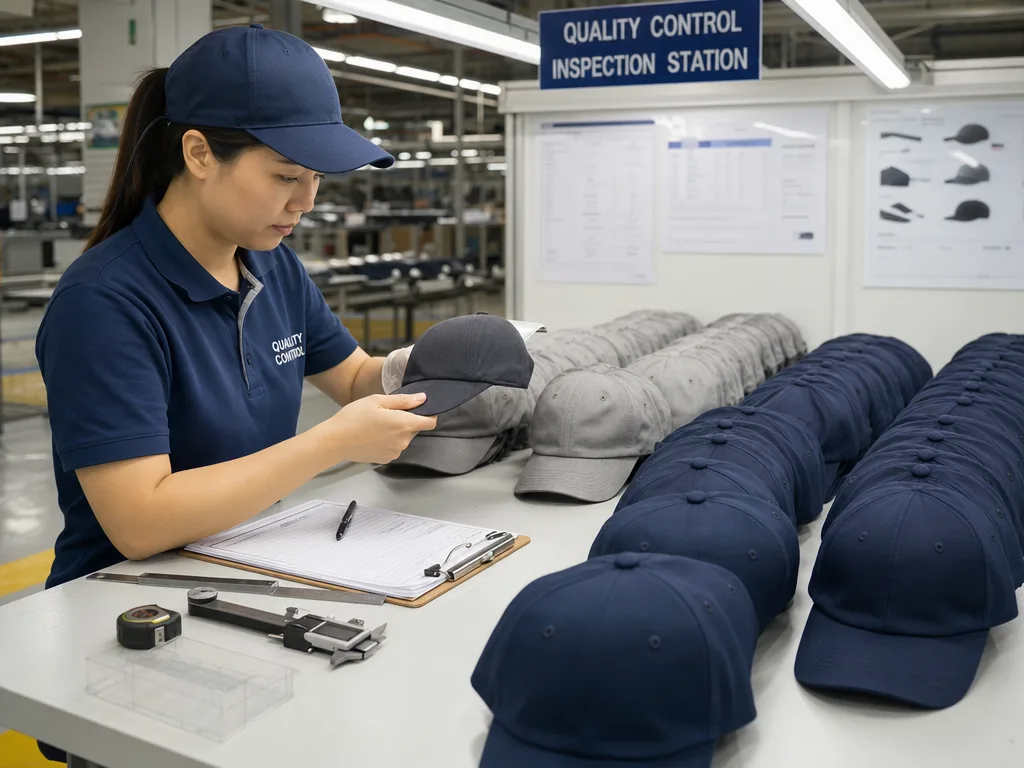
Before sampling, require the factory to show the exact shade approval path: lab dip, strike-off, bulk swatch, and pre-production sealing sample. A serious private label hat supplier or custom hat manufacturer china should name the dye house, the lot code, and whether the same lot will cover all panels in the first production run; mixing lots is where most shade drift starts. For structured caps, I check crown panels under D65 and TL84 light boxes, then compare front panel to side panel, visor underlayer, and stitched logos because thread sheen can make a “matched” cap look off in retail lighting. If you are working with a headwear factory china or custom cap factory, ask for a written color-control sheet: fabric supplier, finishing temperature, washing recipe, heat-set parameters, and the AQL plan for shade variation. Without that paperwork, you are not buying consistency, you are buying a guess.
In bulk orders, hat fabric shade control also has to cover component-level behavior after sewing and packing. Nylon sandwich bills, underbrims, binding tape, and Velcro or snapback tape often come from different mills, so you need the factory to confirm whether they are matching to a master standard or to the main body fabric. CrownsForge’s standard practice is to approve a sealed master set before cutting, then check first-article output against the master and run inline inspections at AQL 2.5 for visible shade deviation, not just defects like skipped stitches or dirty marks. Buyers should also ask how the factory stores fabric rolls: climate-controlled warehouse, FIFO roll usage, and no mixed rolls on the same style unless the shade band is documented. That is the difference between a clean bulk run and a warehouse full of caps that look like four different orders.
Specs to request before a quote
If you want a usable quote, do not start with logo placement. Start with the fabric spec sheet. For hat fabric shade control, ask the factory to confirm exact fabric type, weave, weight, and finish: for example, 100% cotton twill at 260 gsm, polyester ripstop at 120 gsm, or acrylic wool blend at 290 gsm. Then lock the color standard with a Pantone TCX or Pantone C reference, and require a practical tolerance, not a vague promise. For solid panels, I usually see buyers specify Delta-E ≤ 1.0 for first production lot approval and ≤ 1.5 for bulk, because dye lots drift once the order moves from lab dips to large runs. Also request dimensions in millimeters for crown height, brim length, panel count, and sweatband width, plus allowable variance, such as ±3 mm on brim and ±2 mm on crown seam placement. Any custom hat manufacturer worth the tooling should be able to state these numbers before sampling, not after.
Decoration files matter just as much as fabric. Send vector artwork in AI, EPS, or PDF with outlined fonts, stitch count targets for embroidery, and exact placement measurements from center front, side seam, and visor edge. If the design uses a 3D puff or patch, specify thread type, merrow border width, patch thickness, and heat-press or sew-on method. A capable custom cap factory should return a proof showing stitch simulation, panel mapping, and the embroidery machine logic for Tajima, Barudan, or ZSK heads if the design is dense. For packing, require carton dimensions, inner polybag size, desiccant use, and master carton pack-out, such as 50 pcs per carton with a gross weight under 14 kg for easier warehousing. If the supplier is a real custom hat manufacturer china operation, they should also provide carton drop-test readiness and confirm whether the labels match the destination market’s carton mark rules.
The quote should include a formal inspection plan, not just a unit price. Ask for AQL 2.5 for major defects and AQL 4.0 for minor defects at minimum, or tighter if the order is for licensed sports or retail programs. A competent headwear factory china source should show pre-production lab dip approvals, fabric shade banding records, in-line inspection sheets, and final random inspection photos against the approved standard. I also want to see proof of incoming fabric control: roll maps, shade segregation tags, and batch coding tied to dye lot numbers, because that is where hat fabric shade control usually fails. If the supplier cannot show sample swatches under D65 light, measurement reports, and a clear approval chain from PPS to bulk, treat the quote as a placeholder. A serious private label hat supplier will provide all of this without being asked twice; if they resist, they are not set up for repeatable bulk production.
CrownsForge’s standard practice is to attach a technical pack with material specs, tolerance table, artwork files, packing instruction, and inspection targets before pricing, because a clean quote depends on controlled inputs. Ask the factory to state which standard they audit against as well — sedex-audit-cap-supplier-guide.html">BSCI 2.0, Sedex SMETA 4-Pillar, or a customer-specific compliance program — and to confirm whether their QC records are traceable to lot numbers and operator shifts. If they cannot provide a pre-production sample report, color swatch evidence, and a written exception list for any spec they cannot meet, you are not getting an apples-to-apples price. The best custom hat manufacturer teams will also tell you where the risk sits: yarn dye variation, visor board thickness, embroidery distortion, or carton compression during export. That level of transparency is what separates a real custom hat manufacturer china partner from a broker quoting from memory.
Factory risks and quality checks
The biggest production risk is not a dramatic color mismatch; it is small, cumulative drift across rolls, panels, and replenishment lots. On polyester twill and brushed cotton, I see shade variation from dye bath inconsistency, different greige suppliers, and heat-setting changes between runs. A lot can pass by eye in the cutting room and still fail once 3,000 caps are laid side by side under 5000K inspection lights. For hat fabric shade control, buyers should require a sealed master swatch, Pantone TCX reference where applicable, and a Delta-E target before bulk cutting starts. At a good custom hat manufacturer, the first thing checked is not embroidery but fabric lot numbering, roll mapping, and whether trim colors like sandwich visor tape or undervisor cloth come from the same dye lot. If the order uses multiple panels or contrast sandwich details, lock every visible component before production; otherwise a private label hat supplier will end up stitching together materials that look fine individually but read as mismatched on the finished cap.
Inspection needs to happen at three gates: incoming fabric, pre-cut approval, and in-line assembly. On a headwear factory china setup, I expect 100% roll inspection for major programs and at least AQL 2.5 lot sampling for dimension and shade checks, with defects logged by roll ID and panel position. Common defects include barre marks, color banding, oil stains, lot-to-lot difference after washing, and embroidery backing shadowing that makes the crown look darker in certain light. The cleanest approval flow is a sealed pre-production sample, then a top-of-line sample from actual bulk fabric, then a golden sample signed off against the same lot before mass cutting. A custom cap factory that skips this sequence usually discovers problems only after sewing, when re-dyeing is impossible and rework means ripping seams, re-cutting panels, and missing ship dates. CrownsForge’s standard practice is to freeze fabric lots before embroidery digitizing is released, because thread choice can change how the shade reads on camera and in person.
To prevent rework or late shipment, write the shade tolerance into the purchase order, not just the tech pack. State the approved fabric code, acceptable Delta-E range, inspection light source, and who pays if the supplier ships a substitute roll without written approval. For larger runs, I would also require a lab dip or strike-off for every colorway, plus a production floor reference board kept at sewing, trimming, and packing stations. A custom hat manufacturer china operation that manages multiple factories should also track replenishment risk: if one color runs short and a new lot is opened mid-order, the buyer needs a re-approval step before those caps enter assembly. The safest schedule buffer is 7 to 10 days for shade-related checks alone, because one rejected batch can force a full line reset. If the buyer wants international compliance on top of color control, tie the same inspection points to BSCI 2.0 or Sedex SMETA 4-Pillar audit records so there is a paper trail when a lot is held, reworked, or scrapped.
MOQ, lead time, and cost drivers
MOQ changes the math faster than most buyers expect. On a 300-piece run, a custom hat manufacturer is spreading pattern setup, embroidery digitizing, thread matching, and first-article approval over very few units, so a $40 to $90 setup burden can sit inside every cap. Push the order to 3,000 pieces and that same work becomes noise. But if the spec includes brushed cotton twill at 280 gsm, sandwich brims, contrast undervisors, or a six-color woven label, the unit cost climbs again because each trim adds a separate sourcing line and an extra QC checkpoint. For hat fabric shade control, low MOQ is where color drift hurts most: one bad roll can consume 10% of the lot before anyone catches a Delta-E issue under a light box.
Labor is the other silent cost driver. A basic 6-panel cotton dad cap with flat embroidery might take 8 to 10 minutes of sewing and finishing time; add structured buckram, 3D puff, sewn eyelets, and a metal buckle closure, and you can easily add 3 to 5 minutes per piece. At a headwear factory China buyers also need to budget for testing and inspection: AQL 2.5 final inspection, needle detection where required, colorfastness checks, and batch shade sorting by fabric roll. CrownsForge treats shade control as a production step, not a decorative detail, because if the crown panels are cut from mixed dye lots, the whole shipment can look off even when each panel passes individually.
Packaging and shipping can swing landed cost by more than the sewing line. Polybag + size sticker is cheap; insert cards, hangtags, barcode labels, and carton dividers add labor and materials, and folded caps packed with crown protection use more carton volume than smashed-in bulk packing. Ocean freight is still the lowest FOB route for volume, but DDP pricing can jump fast when cartons are oversized or when the buyer wants air shipment for a tight drop date. A private label hat supplier or custom cap factory will usually quote lower per-unit pricing only when artwork is final, trims are standardized, and shade control tolerances are written clearly; otherwise the margin gets eaten by rework, extra dye-lot sorting, and missed vessel cutoffs.
How CrownsForge manages this order type
For shade-sensitive programs, the first mistake is approving fabric from a photo. CrownsForge’s standard practice is to lock shade control before bulk cutting by issuing a physical lab dip or cut yardage swatch against the buyer’s Pantone TCX target, then recording the acceptance with daylight D65 and a Spectra-based color reading. If the program needs tight matching across panels, we also separate lot codes by roll and avoid cross-mixing within one order. That matters on 5-panel cotton twill, polyester brushed twill, and washed chino because each finish shifts color differently after enzyme wash, heat setting, or resin curing. On real bulk runs, I treat Delta-E 1.0 to 1.5 as a workable target for core panels; beyond that, the customer usually starts seeing it under retail lighting and on camera.
Documentation is what keeps hat fabric shade control from turning into a blame game later. A serious custom hat manufacturer should give you a fabric spec sheet, Pantone reference, approved swatch photo under controlled light, roll number, dye lot, and packing list by colorway before production starts. As a custom hat manufacturer china operation, we also keep trim records for thread, visor undervisor, seam tape, sweatband, and eyelet materials, because a black sweatband can make a navy cap look inconsistent even when the crown fabric is correct. If the buyer is a private label hat supplier or licensed program manager, I’d insist on signed sample approval, a pre-production sample, and an inline inspection plan with AQL 2.5 for visual shade variation, stitch quality, and logo placement. That is the only way a headwear factory china can prove consistency across repeat orders.
Reorder support is where a good custom cap factory earns its keep. We archive approved master samples, color comments, production photos, and the exact fabric source, so the next PO does not restart from zero. If the same SKU is reordered six months later, we can request the same mill lot where available; if not, we do a fresh lab dip and flag any shade drift before bulk cloth is booked. For repeat buyers, the useful part is not just speed, it is stability: matching the previous run within a tight tolerance, not chasing a perfect but different navy. In practice, that means clear communication on lead time, a pre-shipment report, and fast feedback if the buyer’s retail sample or warehouse return shows variance. A competent custom hat manufacturer should make hat fabric shade control boring on reorder, because boring is what protects margin.
Frequently Asked Questions
Do you support sustainability certifications?
Yes. We work with GOTS organic cotton, GRS-certified recycled polyester, OEKO-TEX Standard 100 fabrics, and are BSCI and Sedex audited. Certification documentation can be provided per order.
How long does production take?
Sampling takes 7 to 12 days. Bulk production runs 20 to 30 days depending on quantity, fabric availability and decoration complexity. Inspection and packing adds another 3 to 5 days before shipment.
What logo decoration techniques do you offer?
3D puff embroidery, flat embroidery, woven patch, leather patch, PVC patch, screen printing, sublimation, applique and laser etching, all in-house with no subcontracting.
What is the minimum order quantity (MOQ) for custom hats?
Our standard MOQ is 100 pieces per design and color, with sampling available from 1 piece. For complex multi-color logos or premium fabric upgrades, the MOQ can be lowered with a small per-piece surcharge.
Can I order a sample before bulk production?
Yes. We strongly recommend approving a pre-production sample before mass production. Samples are charged at 35 to 60 USD each plus express shipping, fully refundable against confirmed bulk orders over 500 pieces.
How do I find a reliable custom waterproof cap manufacturer?
When evaluating custom waterproof cap manufacturer, the key considerations are construction quality, decoration capability, MOQ flexibility and lead time. Explain hat fabric shade control in the context of a custom headwear RFQ, with the production details a buyer should verify before sampling. Cover dimensions, materials, tolerances, decoration files, carton requirements, AQL level, and the evidence a capable factory should provide.
How do I find a reliable custom hat manufacturer usa?
When evaluating custom hat manufacturer usa, the key considerations are construction quality, decoration capability, MOQ flexibility and lead time. Explain hat fabric shade control in the context of a custom headwear RFQ, with the production details a buyer should verify before sampling. Cover dimensions, materials, tolerances, decoration files, carton requirements, AQL level, and the evidence a capable factory should provide.
What should I know about custom golf cap rope bulk?
When evaluating custom golf cap rope bulk, the key considerations are construction quality, decoration capability, MOQ flexibility and lead time. Explain hat fabric shade control in the context of a custom headwear RFQ, with the production details a buyer should verify before sampling. Cover dimensions, materials, tolerances, decoration files, carton requirements, AQL level, and the evidence a capable factory should provide.
What should I know about custom rope hat wholesale bulk?
When evaluating custom rope hat wholesale bulk, the key considerations are construction quality, decoration capability, MOQ flexibility and lead time. Explain hat fabric shade control in the context of a custom headwear RFQ, with the production details a buyer should verify before sampling. Cover dimensions, materials, tolerances, decoration files, carton requirements, AQL level, and the evidence a capable factory should provide.
Need a low-MOQ test order?
We help emerging brands launch with as few as 100 pieces. Premium fabric, in-house embroidery, retail-ready packaging.
Start a small orderRelated guides
Custom Rope Hat Wholesale Bulk: A 2026 B2B Sourcing Guide
Read article →
How to Choose a Custom Baseball Cap Manufacturer in China — 2026 Buyer's Guide
Read article →Custom Hat Embroidery: The 2026 Sourcing & Manufacturing Playbook
Read article →Sourcing custom hats does not have to be complicated. With the right manufacturing partner, clear specifications and a small upfront investment in sampling, you can launch a retail-quality product in 30 to 45 days.