
Fitted vs Snapback vs Adjustable: A Closure-Type Buyer's Guide - Cost & MOQ Breakdown
Fitted vs Snapback vs Adjustable: A Closure-Type Buyer's Guide - Cost & MOQ Breakdown is one of the most-asked questions we receive from international buyers, and for good reason. With dozens of factories competing for your order and an alphabet soup of technical terms in every supplier quote, even experienced importers can feel lost. This guide consolidates what we have learned producing custom hats for clients in 40+ countries.
Fitted caps: how the tooling and sizing works
A fitted cap earns its cleaner silhouette by giving the factory almost no room to hide. A true fitted program runs as a graded size set, typically US 6 7/8 to 8 in 1/8 increments, and each size is a separate SKU with its own pattern, sweatband length, size tape, carton ratio, and final measurement standard. On the floor, that means size-specific cutting markers, separate sweatband joins, and inline checks on bottom opening, crown height, and finished circumference. For a size 7 1/4 fitted, most factories work to about +/-3 mm on finished circumference; push past that and the customer feels it immediately because there is no back closure to absorb error. In any fitted cap vs snapback comparison, that is the first real cost driver: a snapback tolerates minor variance through the plastic backstrap, while a fitted cap has to come off the line correct.
MOQ is where buyers usually underestimate the complexity. If the style MOQ is 144 pcs per color and you need six sizes from 7 to 7 5/8, those units should be allocated on a realistic curve such as 1:2:3:3:2:1, not split evenly just to make the spreadsheet look tidy. The fringe sizes may only be 12 to 24 pcs, but they still require their own cutting bundles, WIP tracking, size tabs, barcode labels, and carton assorting. That is why fitted styles commonly land about $0.25 to $0.60 more per cap than an adjustable build on an FOB China basis before freight, and the spread gets wider when the buyer asks for size-specific woven labels, retail prepack, or mixed-size master cartons. The embroidery machine does not change; the same Tajima, Barudan, or ZSK heads sew the logo either way. What changes is process discipline. On wool-blend team builds, 16x16 melton or 20x20 twill with 100-120 gsm buckram is common, and AQL 2.5 inspection should include a full size-set measurement audit, because mislabeled sizes and mixed size runs cause more chargebacks than cosmetic defects.
Snapback: the universal adjustable
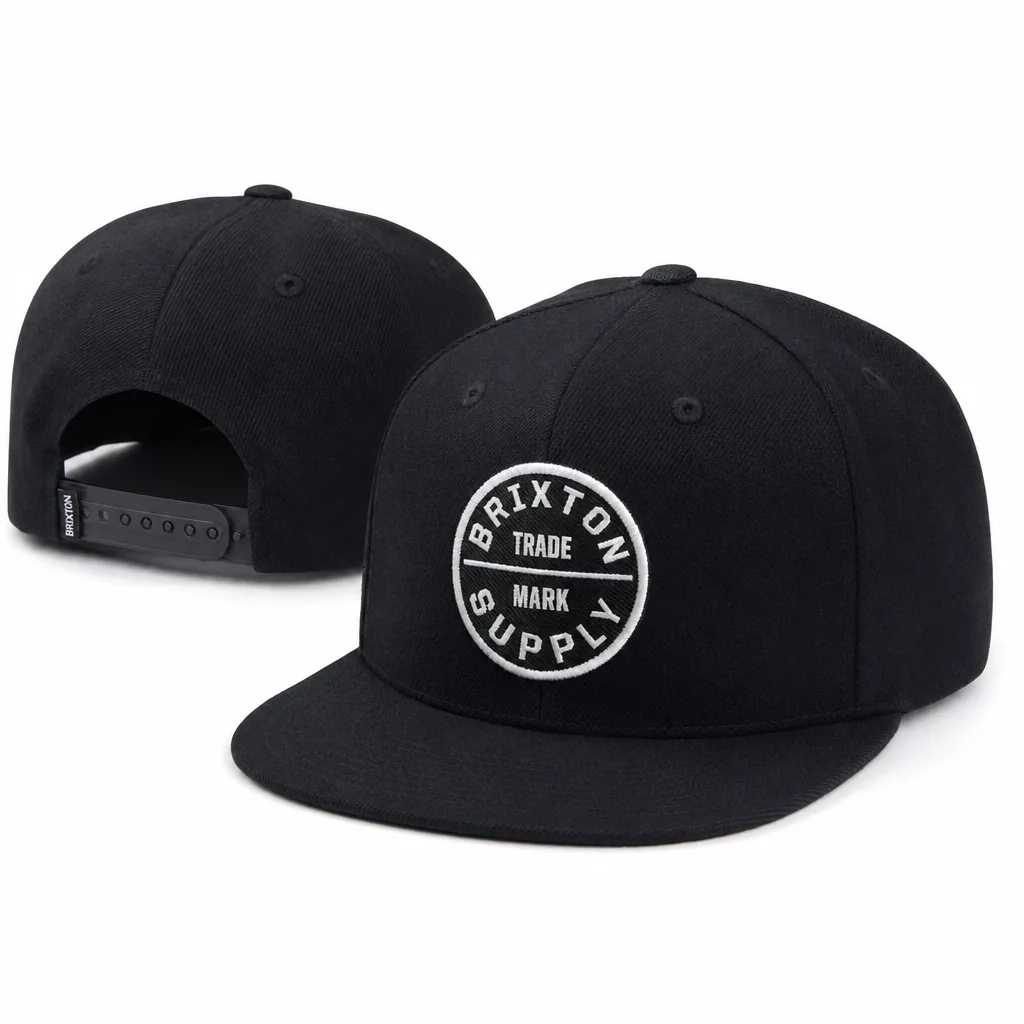
Snapback remains the safest volume buy because one closure covers most adult sizing without forcing size-SKU inventory. A standard 7-hole plastic snap on an adult 58 cm block will usually fit roughly 54-62 cm head circumference, which is enough for most streetwear, promo, and event programs. That matters more in planning than in styling: a fitted run often needs 5-7 size SKUs, typically 6 7/8 through 7 3/8, and every extra size creates carton splits, slower pick-pack, and dead stock in the wrong curve. When buyers debate fitted cap vs snapback for a first order, snapback usually wins on inventory risk unless the brand depends on true on-field sizing, MLB-style authenticity, or a customer base that already buys by exact fitted size. In real factory terms, one-size adjustable is simply more forgiving when the sales forecast is still unproven.
The closure is inexpensive, but the quality gap is obvious the moment you handle the cap. Cheap PE snaps tend to stress-whiten around the peg holes, turn brittle below 5 C in winter transit, and miss color against the crown by a full shade at retail. A better specification is injection-molded PP with a matte finish, 7-8 mm tab width, and color matching held within Delta-E 1.5-2.0 to approved Pantone references such as Black 6 C or 2965 C. On a 6-panel 80/20 acrylic-wool snapback or a 270-300 gsm cotton twill cap, the snap closure usually adds only about $0.08-$0.18 per piece versus a sewn fitted back. MOQ is where snapback becomes especially practical: 144 pieces is workable for many factories, while 300-600 pieces gives cleaner fabric yield, better embroidery efficiency on Tajima or Barudan heads, and more stable FOB pricing. For QC, specify AQL 2.5 with checkpoints on cracked tabs, off-center strap setting, rear opening symmetry, and 9-10 SPI topstitching around the back arch.
Strapback: fabric strap with buckle
Strapback earns its place when the brand wants adjustable sizing without the cheap back-view of a molded PE snap. On the line, it is a different construction, not a trim swap: the back opening curve, sweatband join, back seam reinforcement, and operator sequence all change once you add a self-fabric strap, 300D-600D nylon webbing, or PU/genuine leather with a slider, tuck buckle, or clamp buckle. The cleanest executions are usually on washed chino dad caps, unstructured 6-panels, golf lifestyle caps, and heritage programs where a 10-12 oz cotton twill strap reads like retail headwear instead of promo stock. In a fitted cap vs snapback comparison, strapback sits between the two: you keep one-size inventory, but the hand feel and closure presentation land much closer to specialty retail than standard team snapbacks. The fit range is the real commercial upside. A typical adult snapback is built around about 58 cm with 7-8 peg positions; a strapback can usually cover roughly 54-61 cm with finer adjustment, provided the crown depth and strap length are drafted correctly. That wider range matters if the buyer wants fewer size complaints across DTC and event channels. It also raises the sewing standard. Good strapbacks need even 8-10 SPI topstitching, balanced bartacks at the back opening, clean turn-ins on strap ends, and consistent buckle threading. When the line rushes, the defects show immediately: twisted straps, raw-edge exposure, uneven tail drop, skewed back openings, and weak bartacks that fail after a few pulls.
Cost is wider than most buyers budget because both hardware and material push price and MOQ. At 1,000 pieces, a self-fabric strap with a stock nickel-finish slider is usually only $0.18-$0.35 above a standard plastic snap closure. Move to branded nylon webbing with clamp hardware and the uplift is more like $0.28-$0.50 per cap. Genuine leather with debossing, edge paint, and antique brass hardware typically adds $0.45-$0.90 before freight, and custom buckle molds or non-stock plating can force trim minimums into the 1,000-3,000 set range even when the cap order itself is smaller. That is where low-MOQ private label programs usually get trapped. Color and hardware control are where strapback programs either look premium or fall apart. Self-fabric straps should come from the same dye lot as the crown; otherwise the shade break is obvious under store lighting, especially on navy, olive, stone, and washed black. Webbing and leather should be approved to Pantone TCX with a practical Delta-E tolerance, not a visual guess in the sample room. Final inspection should check plating consistency, stitch density, strap pull strength, back-opening symmetry, and buckle function under AQL 2.5. For major retail, I would also lock nickel release, coating adhesion, and abrasion resistance on the metal hardware before bulk, because closure defects get noticed faster than slight panel sewing variation.
Velcro / hook-and-loop
Hook-and-loop is still the lowest-cost adjustable closure on most cap BOMs, and the savings become meaningful once an order moves beyond sample quantities. On a standard 6-panel brushed cotton twill cap, a 20 mm nylon hook-and-loop strap usually adds about $0.08 to $0.15 per unit at 3,000 to 10,000 pieces. By comparison, a generic polypropylene snap closure is typically $0.18 to $0.30, while a metal buckle with self-fabric or PU strap is more often $0.35 to $0.70 depending on plating class, strap width, and scrap from assembly. That pricing keeps hook-and-loop relevant for school programs, race events, municipal uniforms, and training caps, even when the broader fitted cap vs snapback debate is driven by retail image rather than utility. The practical advantage is sizing tolerance: no snap-post breakage, no hole alignment issues, and fewer fit complaints when one size has to cover a wide head-size spread. The downside is perception, and buyers should treat that as a real commercial risk, not a cosmetic detail. Exposed tape reads promotional the moment the customer turns the cap around, especially on adult streetwear, licensed sports product, or golf lines built around cleaner trims. You can spec 270 gsm chino twill, 110x76 brushed cotton, or recycled 75D performance polyester on the body, but a cheap-looking closure will still pull the product downmarket. In most cases, hook-and-loop belongs on youth, cadet, institutional, and giveaway programs where function, speed, and cost control matter more than shelf appeal.
Most closure failures come from bad tape specification and weak sewing, not from the hook-and-loop format itself. The common factory mistake is using light 150D or 210D tape with poor edge stability, then securing it with a shallow stitch box that twists after repeated use. Once that happens, the loop side pills, the hook side loads unevenly, and holding strength falls off well before the cap should age out. A better build uses woven nylon tape from a stable mill, a dense box-X stitch pattern, and bartacks at both strap anchors, with reinforcement around the back opening so the arc does not collapse after wash or wear testing. On production lines running basic Juki or Brother sewing stations, that extra reinforcement adds very little time but prevents a lot of rejects. QC on this closure is simple but easy to neglect. A tape misplacement of even 3 mm to 5 mm is visible on the back opening, and once the strap sits off-center the whole cap looks crooked on head. Placement should be checked inline, then verified again at final inspection under AQL 2.5, along with peel strength, stitch density, and edge fray. MOQ is usually forgiving because the components are stock: 144 to 300 pieces per colorway is normal, and production is often 2 to 4 days faster than custom molded snaps or branded metal hardware. Our standard practice is to push hook-and-loop only when the order is price-sensitive or size coverage is the priority, because on fashion-led retail the few cents saved rarely outweigh the drop in perceived value.
Buckle (metal slide or tuck-buckle)
A metal buckle closure makes sense when the cap needs adjustable sizing without the busy back view of a plastic snap. On low-profile 6-panel dad hats, the most stable spec is 180-260 gsm washed cotton twill, brushed chino twill, or 8-10 oz enzyme-washed canvas with a self-fabric strap and either antique brass or matte nickel hardware. That combination survives garment wash better than lightweight peach twill, and it keeps the rear profile flat instead of projecting outward like a snapback tab. In a fitted cap vs snapback discussion, buckle styles usually win when the buyer wants a softer crown, smaller back opening, and broader size tolerance for DTC sales, but does not want the overtly athletic look of a snap closure. The real production risk is the strap tunnel, not the metal piece. If the fold width drifts more than 1.5 mm, or the fusible under the back arch is too soft after washing, puckering shows immediately around the opening. Light shades such as stone, khaki, and washed black expose that defect fast, especially after enzyme wash or heavy silicon rinse. Our standard practice is to reinforce the strap area with lightweight woven fusible before sewing, then check the opening symmetry and bartack density during inline QC; otherwise a cap can pass final packing and still look twisted once the strap is pulled through by the customer.
Slide buckle and tuck-buckle should be quoted as separate trims because the labor and reject rates are different. A standard zinc-alloy or brass slide buckle usually adds about $0.18-$0.35 per cap FOB China at 300-500 pieces, depending on plating, engraving, and whether the finish can pass a 24-hour salt-spray test without visible oxidation. Tuck-buckle hardware, where the strap end folds back under a clasp, is more typically $0.28-$0.45 because edge paint, fold accuracy, and alignment have to be cleaner to avoid a sloppy tail. Against a basic plastic snap, expect a premium of roughly $0.15-$0.30 per cap before packaging upgrades. MOQ moves quickly once the hardware stops being stock. Off-the-shelf buckle colors can run from 144-300 pieces per color, but custom molds, debossed leather tabs, or Pantone-matched woven labels usually push the workable MOQ to 500-1,000 pieces because trim suppliers will not open a plating run for tiny lots. Inspection should focus on crooked buckle set, sharp burrs, weak bartacks at the strap anchor, and plating variation between repeat orders; metal color is harder to control than fabric, and you cannot hide a Delta-E shift on exposed hardware the way you can on an inside seam. If the factory is using Barudan or Tajima embroidery up front, the back closure still deserves the same discipline at AQL 2.5 because that is where premium adjustable caps often fail visually.
Cost comparison and fit tolerance
The real cost gap in a fitted cap vs snapback program is inventory complexity, not the closure itself. A fitted run for U.S. retail usually means 6 to 8 sizes, most often 6 7/8 through 7 5/8, and every size becomes its own SKU with separate carton ratios, size stickers, and replenishment risk. On a 1,000-piece order in 12 oz brushed cotton twill or a 300 gsm wool-acrylic blend, a structured 6-panel fitted cap typically lands at $3.90 to $5.70 FOB China; the same crown, visor, buckram, and embroidery in snapback format is more often $3.25 to $4.75. The sewing delta is only a few cents. The real penalty comes when one size like 7 1/4 sells through and 7 1/8 stalls, because those leftovers are not interchangeable stock. Below about 480 pieces, fitted programs usually get inefficient unless the buyer accepts a narrow size range or very aggressive ratio planning.
Fit tolerance is where weak factories get exposed. For fitted caps, the control point is finished internal circumference after sweatband setting, not just paper pattern spec, and a practical production tolerance is typically within plus or minus 0.5 cm by size. Hitting that consistently requires stable sweatband elasticity, accurate blocking, and in-line measurement during sewing and finishing. Heavy front embroidery can also pull crown geometry differently across sizes, especially on structured shells running on Tajima or Barudan heads, so size consistency is not only a cutting issue. Snapback stays the operational default because one adult body size, usually built around a 58 cm nominal circumference, can cover roughly 54 to 61 cm through the snap closure. That is why the fitted cap vs snapback decision is usually about sell-through efficiency and return risk, not appearance alone: one size-off error in a fitted program creates more damage than the small FOB savings buyers argue over in sampling.
Frequently Asked Questions
How long does production take?
Sampling takes 7 to 12 days. Bulk production runs 20 to 30 days depending on quantity, fabric availability and decoration complexity. Inspection and packing adds another 3 to 5 days before shipment.
Can I order a sample before bulk production?
Yes. We strongly recommend approving a pre-production sample before mass production. Samples are charged at 35 to 60 USD each plus express shipping, fully refundable against confirmed bulk orders over 500 pieces.
What file format should I send for my logo?
Vector files (AI, EPS, PDF) are ideal. High-resolution PNG or JPG at 300 dpi on transparent background works as a fallback. Provide Pantone color references for accurate reproduction.
Do you support sustainability certifications?
Yes. We work with GOTS organic cotton, GRS-certified recycled polyester, OEKO-TEX Standard 100 fabrics, and are BSCI and Sedex audited. Certification documentation can be provided per order.
What logo decoration techniques do you offer?
3D puff embroidery, flat embroidery, woven patch, leather patch, PVC patch, screen printing, sublimation, applique and laser etching, all in-house with no subcontracting.
How does ordering baseball cap custom embroidery work?
When evaluating baseball cap custom embroidery, the key considerations are construction quality, decoration capability, MOQ flexibility and lead time. Fitted caps are stitched at exact size (6 7/8 through 8). Production requires per-size dedicated runs. MOQ effectively multiplies by number of sizes you stock. Fan-favorite for pro sports retail. Plastic snap closure with 8 standard positions. Universal sizing fits most adults (54-62 cm). The streetwear default for 30+ years.
How does ordering custom embroidered trucker hat work?
When evaluating custom embroidered trucker hat, the key considerations are construction quality, decoration capability, MOQ flexibility and lead time. Fabric or leather strap with metal slide buckle. Premium streetwear (dad hat aesthetic), heritage retail. Adjustable across a wider range than snapback but slightly slower to adjust. Fitted caps are stitched at exact size (6 7/8 through 8). Production requires per-size dedicated runs. MOQ effectively multiplies by number of sizes you stock. Fan-favorite for pro sports retail.
How does ordering custom dad hat embroidery work?
When evaluating custom dad hat embroidery, the key considerations are construction quality, decoration capability, MOQ flexibility and lead time. Fabric or leather strap with metal slide buckle. Premium streetwear (dad hat aesthetic), heritage retail. Adjustable across a wider range than snapback but slightly slower to adjust. Premium retail standard for dad hats and unstructured caps. Brass slide buckle is the heritage default. Tuck-buckle (the small flat metal clip) is also popular on Japanese-influenced premium…
How does ordering custom embroidered baseball caps work?
When evaluating custom embroidered baseball caps, the key considerations are construction quality, decoration capability, MOQ flexibility and lead time. Fitted caps are stitched at exact size (6 7/8 through 8). Production requires per-size dedicated runs. MOQ effectively multiplies by number of sizes you stock. Fan-favorite for pro sports retail. Cheapest closure, easiest to adjust, but visually downmarket. Common on promotional caps, kids' caps, military-style cadet caps.
Do MLB players wear fitted or snapbacks?
MLB Authentic On-Field caps are the official baseball hats worn by players during Major League games. They feature performance materials, official team branding, and the iconic New Era 59FIFTY fitted design.
Are snapbacks or fitted hats more popular?
Style & Popularity Since then, fitted caps have gone in and out of style, with snapback designs being the preferred choice in the mainstream fashion scene. The classic design of snapbacks makes them incredibly versatile, lending themselves to virtually any outfit style.
Is a snapback a hat or cap?
A snapback is a type of baseball cap — but with a key difference: the closure.
Do MLB players wear fitted or snapback?
Most MLB Authentic On-Field caps sold at hatclub.com are produced in the New Era 59FIFTY fitted style. This fitted silhouette is one of the most recognized hats in baseball. Key features of the New Era 59FIFTY fitted cap include: Structured high crown.
Looking for a reliable hat manufacturer in China?
CrownsForge has produced custom hats for 800+ brands across 40 countries. From 100-piece launches to 100,000-piece retail programs, we deliver on time and on spec.
Get in touchRelated guides
Bulk Trucker Hats Reorder Planning Guide for Custom Hat Buyers
Read article →
Custom Hats for Men: A 2026 B2B Sourcing Guide - Cost & MOQ Breakdown
Read article →
Kids' & Children's Cap Manufacturing: CPSIA Compliance and Sizing - 2026 Buyer's Guide
Read article →Sourcing custom hats does not have to be complicated. With the right manufacturing partner, clear specifications and a small upfront investment in sampling, you can launch a retail-quality product in 30 to 45 days.