
Custom Hat Patch: When to Use It, Costs, and What to Ask Your Factory - Supplier Checklist (2026 Update)
Every week, our sales team answers detailed questions about custom hat patch: when to use it, costs, and what to ask your factory - supplier checklist (2026 update). We wrote this guide so that wholesalers, streetwear brands, corporate buyers and promotional resellers can compare options with full information, and avoid the traps that show up only after production has started.
Custom Logo Hats
Lock the patch construction before approving artwork, because that choice drives logo clarity, corner lift risk, and landed cost more than most buyers expect. A custom hat patch that looks clean on a flat strike-off can fail once it is sewn onto a curved crown. On structured 6-panel caps made from 300-380 gsm cotton twill with front buckram, embroidered or woven patches with a merrow or tight satin edge are the safest builds; they hide minor edge variation and seat better over crown curvature. On unstructured dad caps in 180-220 gsm washed chino, lighter woven labels, printed twill, or thin PU leather usually outperform thick PVC, which tends to tent at the corners after wash, compression packing, or repeated wear. The production spec should state finished patch size in millimeters, border type, substrate thickness, yarn denier or stitch density, backing, attachment method, and placement tolerance; if center-front tolerance is looser than +/-3 mm, you are inviting avoidable rejects. Artwork has to match the process. If text is under 3 mm cap height or lines fall below 0.6 mm, standard embroidery is the wrong tool even on well-tuned Tajima, Barudan, or ZSK heads; counters fill, edges soften, and sampling drags into extra revision rounds. In those cases, a woven or printed custom hat patch holds small details better and usually cuts development time. The tech pack should also call out crown height, buckram weight, visor board, closure type, sweatband content, and whether the patch is applied before or after cap assembly, because seam access changes distortion and stitch quality. In China, MOQ is commonly 144-300 pieces per colorway on stock blanks, while fully custom caps usually start at 300-500 pieces per style-color. Real FOB pricing is typically $2.20-$4.20 for embroidered patch caps, $2.40-$4.60 for woven patch caps, and $3.20-$6.80 for PVC or genuine leather patch caps, depending on fabric, closure hardware, and packing spec.
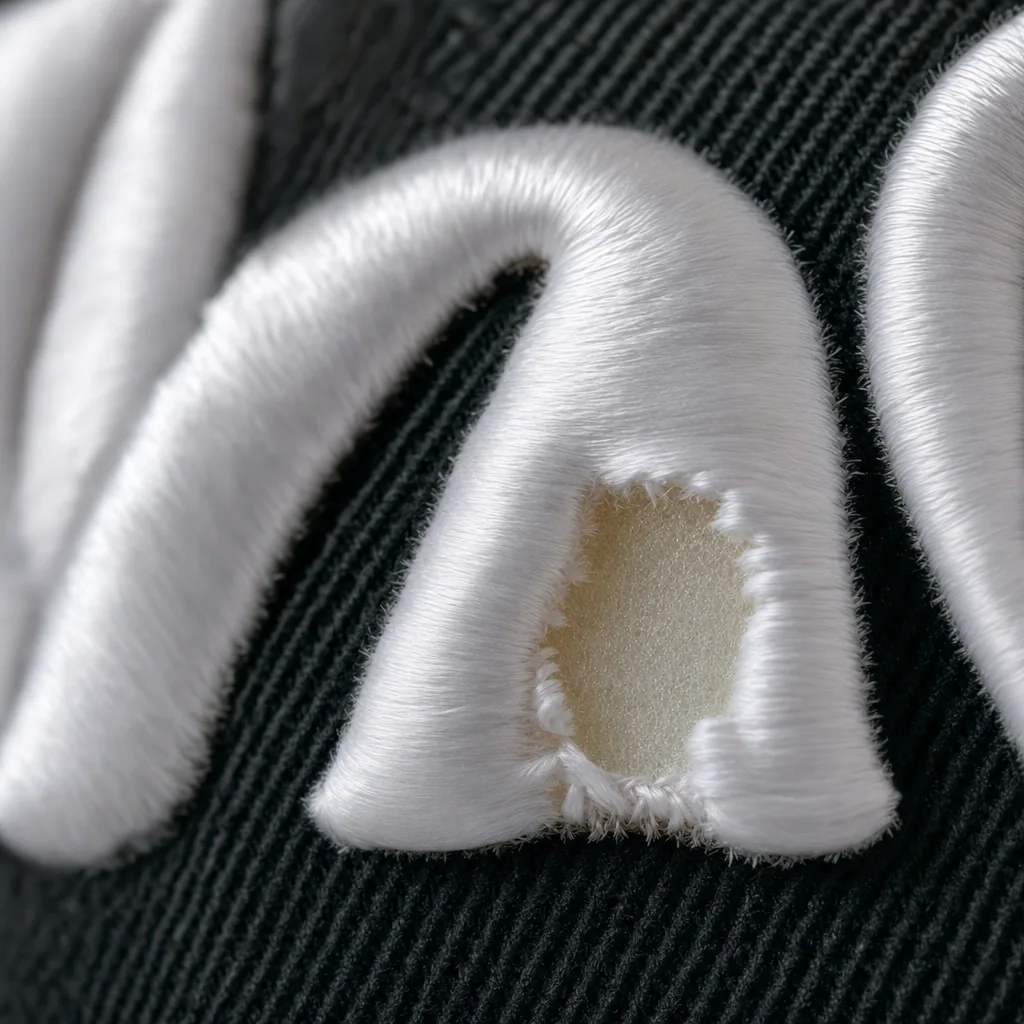
Most failures happen where the patch meets the cap, not in the cap body itself, so inspection has to stay focused on that interface. The repeat defects are consistent: placement off by more than +/-3 mm, top-edge skew against the visor seam, puckering from over-tight stitch-down, glue bleed on heat-applied patches, merrow fray, cracked edge paint on leather, and visible color drift against the approved standard. For branded orders, bulk should not release without a pre-production sample approved on the actual shell fabric, not just on a patch card. Color also needs a measurable standard. If the supplier claims lab-dip control or color management, ask what Delta-E tolerance they are holding in production; for visible brand shades, anything above 1.5-2.0 is usually obvious under normal retail lighting. Your checklist should require bulk inspection to AQL 2.5 with explicit checkpoints for adhesion, stitch security, needle damage, edge finish, and logo legibility at roughly 50 cm viewing distance. White patch grounds or white embroidery on dark cotton twill need extra scrutiny because dye migration can gray out the artwork; the practical fix is a bleed-resistant base, proper underlay, or switching the patch substrate entirely. Social compliance matters, and audits like sedex-audit-cap-supplier-guide.html">BSCI 2.0 or Sedex SMETA 4-Pillar are worth asking for, but they do not tell you whether the factory can hold patch placement, thread tension, or heat-press consistency on the line. A custom hat patch is not a minor trim detail; it changes MOQ, defect exposure, carton durability, and rework cost, so it should be treated as its own approval gate, separate from the cap body approval.
Custom Embroidered Patches
Embroidered patches are still the safest bet when a custom hat patch needs visible texture, a defined edge, and a unit cost that stays sane from roughly 300 to 3,000 caps. The limitation is not your vector file; it is stitch density against finished size. Most factories run these on polyester twill, cotton twill, or acrylic felt using Tajima, Barudan, or ZSK multi-head embroidery machines with 120D/2 rayon or trilobal polyester thread. In practice, once the patch drops much below 60 mm width, fine serif text, facial features, and tonal fades start to fill in or break apart. I would hold minimum line width at 1.0 mm, minimum text height at 4.5 to 5.0 mm, and thread colors at 6 to 8 if you want stable production speed and cleaner yield. Border choice matters: merrow gives the cleanest raised perimeter but only on simple shapes, while laser-cut or heat-cut edges suit irregular silhouettes and demand good edge sealing to control fray. Weight matters too; a dense patch can tunnel a 210 gsm cotton twill front panel, distort an unstructured dad cap, or sit unevenly on a rib-knit beanie.
Your spec sheet needs to call out the patch like a separate component, not a vague decoration. For any embroidered custom hat patch, ask for finished size in millimeters, size tolerance, placement tolerance, border type, backing type, stitch coverage, thread composition, and Pantone TCX references for every critical color. If the backing is heat-seal, confirm the adhesive film type and whether it is only for positioning before sew-down or expected to be the final bond; on caps, glue-only attachment fails faster than buyers expect, especially after heat, sweat, and carton compression. Serious suppliers should also state registration tolerance, backing thickness, and whether the patch is made in-house or subcontracted, because outsourced patch work is where merrow width drift, inconsistent density, and shade variation usually begin. In China, a standard 2.25 inch embroidered patch sewn onto a 5-panel or 6-panel hat typically adds about $0.35 to $0.90 per piece at normal volume. Once stitch coverage moves past 75%, or you add metallic thread, appliqué layers, or hook-and-loop backing, the real adder is closer to $1.10 to $1.80 FOB before duty and freight.
Inspection is where embroidered patch programs either stay profitable or become claim work. The repeat defects are puckering from over-digitized fills, exposed ground fabric at the merrow edge, loose thread tails, off-center sewing, heat-seal glue bleed, and thread colors that miss the approved standard. For branded work, I would hold practical color tolerance to Delta-E 2.0 to 2.5 against the signed lab dip or thread card, and keep patch placement within 2 mm of the approved centerline. Corners and edge points need a pull check after sewing so the patch does not lift in wear, and lightweight or brushed cap fabrics should be checked for edge show-through and crown deformation after packing. AQL 2.5 is the right final inspection baseline, but patches need their own checkpoint because one crooked badge can downgrade an otherwise clean carton. Embroidery remains the right custom hat patch for dimensional branding at mid-range cost; it is the wrong tool for tiny copy, photo-detail artwork, or ultralight performance hats where woven, printed, or molded TPU patches usually give better definition and higher yield.
Custom Hat with Patch
A custom hat patch is a separate component with its own tolerance, thickness, and failure mode, so the spec has to read like a trim sheet, not a mood board. For caps, the most stable constructions are still sewn-on patches: embroidered twill, woven damask, chenille, felt, microfiber suede, PVC, or leather with a stitch-down border. Glue-only applications are where claims start, especially after sweat exposure, summer container heat, or carton compression in transit. Lock the patch size in millimeters, not “small” or “oversized”: finished length and height, corner radius, merrow edge vs. laser-cut edge, backing type, thickness in mm, stitch coverage, and Pantone TCX or TPX references for both patch and shell fabric. Placement stage matters just as much. A front-center custom hat patch on a structured buckram crown is usually cleaner pre-assembly because you control centerline and reduce tunneling; side or rear patches on unstructured 6-panels are often safer post-sew because panel shape and seam tension shift after closing.
Most defects come from a bad interface between patch and cap body, not from the patch itself. Before approving a custom hat patch program, get the factory to confirm shell fabric composition, fabric weight in gsm, crown profile, seam allowance under the patch area, needle count, and total patch thickness including backing and border. A 2.0-2.5 mm PVC or thick split-leather patch can easily distort a low-profile crown, especially on brushed cotton twill below about 260 gsm or soft nylon under 200 denier. MOQ is usually 144 pieces per colorway for standard embroidered or woven patch caps, while chenille, molded PVC, and debossed leather are more often 300 pieces and up because mold cost, laser-cut setup, and hand placement have to be absorbed. In China, a basic embroidered patch commonly adds $0.28-$0.65 per cap at 300-500 units; woven patches run about $0.20-$0.45, molded PVC $0.55-$1.20, and genuine leather $0.80-$1.80 depending on thickness, edge paint, and deboss depth. If pricing looks suspiciously low, check whether digitizing, mold fees, laser cutting, and placement labor were excluded.
Inspection should judge the finished cap, not the loose patch approved at sampling. The failures that drive rework are usually placement drift beyond +/-2.0 mm, rotation, bubbling from incorrect heat-press dwell time, skipped border stitches over curved crowns, thread float at the edge, adhesive bleed, and shade mismatch against the approved standard. For retail programs, color should be checked under D65 lighting, with an agreed tolerance typically around Delta-E 2.0-3.0 depending on texture, sheen, and whether the patch is woven, embroidered, or leather. Leather and suede need extra checks for scorch, oil contamination, cracked deboss lines, and pressure marking after packed-carton testing. Our standard practice is to inspect custom hat patch orders at AQL 2.5 with special focus on placement consistency across the lot, because a cap can meet material spec and still fail at retail if the patch line visibly walks left or right from unit to unit.
Custom Patch for Hat
A custom hat patch fails or succeeds at the interface between the patch and the crown, not in the artwork alone. For fine copy, woven is usually the lowest-risk option once letter height drops below 3.0 mm or stroke width falls under 0.4 mm; embroidery simply starts filling in, especially on serif fonts or distressed art. Embroidered patches still win when you need relief and a heritage hand feel, but density has to be controlled—once stitch spacing gets tighter than about 0.40 mm, small counters close up fast. PVC patches outperform thread-based options in sweat, abrasion, and rain, but anything above roughly 1.8-2.0 mm finished thickness tends to fight the curve of an unstructured 6-panel front. Leather, PU, and microfiber suede can look premium, yet they also expose the most process variation: uneven deboss depth, edge-paint cracking, scorch marks from heat presses, and color drift between lots. Attachment method matters just as much as substrate. A merrow-edge sew-down is durable but bulky on small front logos; satin-stitch tack-down looks cleaner, though it can tunnel on 12-14 oz brushed cotton twill or acrylic-wool blends if thread tension and underlay are off. Heat-seal film is useful for positioning before sewing, but adhesive-only attachment is a bad bet for retail caps that will be steamed, flexed, or worn in sweat. If a buyer requests a custom hat patch without specifying substrate, border, backing, and attach method, the sample room is forced to guess, and that guess usually burns 3-7 days in revised strike-offs and unnecessary remake cost.
A usable custom hat patch spec sheet should read like a production order, not a mood board. Give patch size in millimeters with ±1.0 mm tolerance, submit art in AI or vector PDF, and call out Pantone Solid Coated for printed elements or Pantone TCX where textile reference is relevant; on dyed parts, a Delta-E target under 2.0 is reasonable for bulk approval. Construction details should be explicit: merrow, satin-wrap, laser-cut, or die-cut edge; embroidered coverage and thread sheen; woven yarn denier and weave density; or PVC Shore A hardness, mold depth, and matte versus gloss finish. Backing changes performance too—non-woven or paper backing for sew-down, hook backing for tactical programs, and heat-seal film by gsm if it is part of the build. Cost is driven more by patch construction than by the cap body. In China, woven and embroidered programs are usually workable at 100-300 pieces per colorway, while PVC, TPU, and debossed leather are more realistic at 300-500 because of mold or die cost. On a standard FOB cap, a woven or embroidered custom hat patch typically adds about $0.28-$0.85; PVC, TPU, or leather is more often $0.60-$1.50, plus roughly $35-$120 setup. The defects worth policing are predictable: placement off by more than 2.0 mm, crooked top edge against the center seam, loose edge stitching, adhesive bleed, frayed borders, and bubbling after crown forming. Inspect to AQL 2.5, confirm placement from center front and visor seam, and ask whether the factory can hold the same hand feel across repeat runs on Tajima, Barudan, or ZSK equipment under BSCI 2.0 or Sedex SMETA 4-Pillar controls.
Custom Patch Hat
A custom hat patch is its own production program, not a last-minute trim, and the wrong patch spec will fight the cap structure from day one. Woven patches outperform direct embroidery when copy drops below roughly 2.0 mm letter height or when you need thin serifs and tight registration; embroidered patches give more texture but lose clarity on small type. Molded PVC or TPU delivers crisp edge definition and weather resistance, but once thickness gets into the 1.2 to 1.8 mm range, the added stiffness can telegraph through soft crowns and distort low-profile dad hats. On the factory floor, those heavier patches run more cleanly on foam truckers, buckram-supported 6-panel snapbacks, and structured 5-panels than on washed cotton unstructured caps. The safe sequence is patch sampling first, then cap attachment after strike-off approval. Sewing remains the lowest-risk method for retail programs because heat-applied patches can lift after laundering if adhesive film weight, platen temperature, dwell time, and pressure are not tightly controlled. For a sewn custom hat patch, placement tolerance should be written at ±2 mm from center front and visor seam, not left to visual judgment.
Do not approve a custom hat patch from artwork alone; the tech pack should specify patch type, finished size in mm, edge finish, backing, attachment method, stitch count or seam type, and exact placement references. The cap body needs the same discipline: fabric like 260 gsm brushed cotton twill or 300D polyester, crown construction, sweatband content, closure, visor profile, and Pantone TCX targets for both shell and patch components. Color is where buyers usually lose time and money. Woven yarn, embroidery thread, leather, and PVC pigments will not hit Pantone exactly, so set an acceptable Delta-E tolerance before sampling and require a strike-off, handloom, or sealed pre-production sample. MOQ for sewn woven or embroidered patch caps is usually 144 to 300 pcs per colorway, while genuine leather, TPU, or molded PVC often pushes the practical MOQ to 500 pcs because of die, mold, or setup cost.
Cost moves more on patch complexity than on the hat shell. In China FOB terms, a structured 6-panel cotton twill cap with a basic sewn woven patch at 300 pcs usually lands around $2.20 to $3.40 FOB; embroidered patch versions often add $0.10 to $0.25 per piece, while molded PVC typically adds $0.35 to $0.80 depending on mold area, thickness, and color count. Leather is less predictable because hide yield, shade variation, and edge finishing can raise both unit cost and reject rate. Inspection should focus on the failure points that actually trigger claims: patch placement, top-line levelness, edge lifting, needle cuts around the seam, skipped stitches, puckering on unstructured fronts, and crown deformation caused by oversized patches. AQL 2.5 is workable for promotional orders, but fashion retail programs should tighten visual standards around alignment and shape consistency because most returns on custom hat patch orders are appearance-driven, not wear-driven.
Custom Patch Hats
A custom hat patch changes the production route more than most buyers expect because the patch and the cap body are often produced in two different workshops, which means two approval loops and two failure points. The patch itself may be woven damask in 50D to 75D polyester, embroidered on 108 x 58 cotton twill, molded TPU or PVC, debossed PU, or 1.2 to 1.6 mm genuine leather. Each material drives a different attachment method and defect profile. On structured 6-panel caps, perimeter stitching is still the safest choice because it holds shape through packing, ocean transit, and repeated wear. Adhesive-only application is risky on brushed cotton, corduroy, canvas, and other uneven surfaces where edge lift and bubbling show up fast. Heat press can work, but only if the supplier controls film specification, platen temperature, dwell time, and pressure against the actual crown curve; otherwise you get strike-through, warped patches, or lifted corners by the time cartons reach destination.
A proper custom hat patch spec sheet needs more detail than the cap tech pack alone. Lock the patch size in millimeters, corner radius, stitch margin, edge finish, backing type, and placement tolerance from visor seam or crown centerline before sampling starts. If the brief just says “vintage patch,” the factory will fill in the blanks, and those assumptions directly affect cost, look, and reject rate. Call out Pantone TCX or Pantone Solid Coated references for both patch and shell fabric, because color has to match across two supply chains; Delta-E under 1.5 is realistic on premium woven or TPU programs, but leather and heather fabrics usually need a wider tolerance. MOQ is commonly 144 to 300 pieces per colorway for simple woven or embroidered patches, while genuine leather, molded rubber, or custom dies usually push the practical minimum to 300 to 500 pieces. In China, a stitched woven patch on a cotton twill cap typically adds about $0.35 to $0.90 FOB per unit; molded rubber and real leather patches more often land at $0.80 to $1.80 depending on size, hand placement, stitch count, and whether the patch vendor is in-house or outsourced.
Inspection is where custom hat patch orders usually fail, because an approved loose patch can still look wrong once it is sewn or pressed onto a finished crown. The recurring defects are crooked placement, loose perimeter topstitching, bubbling after heat application, frayed laser-cut edges, embroidery pull on lighter fabrics, and visible needle holes after rework. For woven and printed patches, check logo registration, edge sealing, backing show-through in light areas, and whether the patch bridges cleanly across a front seam without tenting. For leather, watch for grain inconsistency, lot-to-lot shade shift, edge-paint rub-off, and excessive stiffness that prevents the patch from sitting flat. AQL 2.5 is acceptable for the finished cap lot, but patch alignment should be held tighter than general sewing tolerance: typically +/-2 mm on front-center placement and +/-3 mm on side placements. The practical rule is straightforward: woven or printed patches handle fine copy and small text best, while embroidered, TPU, and leather patches give more texture and depth. CrownsForge standard practice is to approve both the loose patch and a full pre-production sample, because many failures only appear after final application.
Working with CrownsForge for custom hat patch programs
The weak link in a custom hat patch program is almost always the handoff from approved art to patch production to cap assembly. A clean factory timeline is usually 5 to 7 business days for a patch strike-off and 7 to 12 business days for a wearable sample, but that only holds when the patch method matches the cap structure. Woven damask, merrowed embroidery, molded PVC, TPU heat-transfer badges, microsuede, and laser-engraved PU leather all behave differently once they land on a curved front panel. A patch that looks flat and centered on the sample table can skew on the finished hat if the front panel uses soft buckram, the center seam runs under the badge, or crown tension pulls the shape off-square during sewing or heat pressing. MOQ should follow material reality, not sales promises: 144 to 300 pieces per colorway is workable on stock 10x10 cotton twill at roughly 270 to 320 gsm or stocked 600D polyester, while custom-dyed shells, matched closure tape, or nonstandard buckram usually push the first run to 500 pieces because of mill minimums and trim loss.
Capability only counts if the factory can hold process numbers on the floor. The baseline serious setup is Tajima, Barudan, or ZSK embroidery heads for direct embroidery support, plus repeatable execution of woven patches, chenille, sublimated emblems, 2D or 3D silicone, and TPU transfers with logged platen temperature, pressure, and dwell time. For premium programs, color approval should be tied to Pantone TCX, coated Pantone references, or approved lab dips, with practical tolerance around Delta-E 1.5 to 2.0 on patch grounds and matching threads; looser control becomes obvious fast when the patch border has to match eyelets, underbrim tape, or the back strap. Leather and faux leather need harder questioning than most buyers give them: ask about backing thickness versus crown fabric weight, stitch density, needle size, edge-paint flexibility, and whether the patch has been tested for cracking after cooling and transit. A rigid badge sewn onto a light 180 gsm front panel, or a TPU patch pressed without enough cooling time, will tunnel, pucker, or split long before the carton reaches retail.
Scale is where a reliable supplier separates itself from a sample room. The correct sequence is tech pack review, construction sheet sign-off, digital mockup, patch strike-off approval, pre-production sample, inline inspection, and final audit to AQL 2.5 before sealing cartons. For a custom hat patch order, the checkpoints should include measurement reports and dated photos for crown height tolerance within about plus or minus 0.5 cm, visor curvature consistency, patch placement, loose-thread control, and basic pull testing on stitched or heat-applied badges. CrownsForge typically documents those checkpoints because patch programs fail in production through drift, not through one dramatic defect. Buyers selling into wholesale, teamwear, or licensed retail should also ask for current BSCI 2.0 and Sedex SMETA 4-Pillar audit reports, plus REACH or CPSIA declarations when the patch includes PVC, inks, adhesives, metal trims, or painted edges. That paperwork is operational, not cosmetic: it reduces customs holds, relabeling, and costly DDP delays into the EU, UK, and US.
Frequently Asked Questions
What is the minimum order quantity (MOQ) for custom hats?
Our standard MOQ is 100 pieces per design and color, with sampling available from 1 piece. For complex multi-color logos or premium fabric upgrades, the MOQ can be lowered with a small per-piece surcharge.
Which shipping methods do you support?
We support FOB, CIF and DDP shipping. Air express for samples and small orders, sea LCL for 100 to 500 pieces, sea FCL for 5,000+ pieces. Door-to-door DDP available for US, EU, UK, Canada and Australia.
Do you support sustainability certifications?
Yes. We work with GOTS organic cotton, GRS-certified recycled polyester, OEKO-TEX Standard 100 fabrics, and are BSCI and Sedex audited. Certification documentation can be provided per order.
Can I order a sample before bulk production?
Yes. We strongly recommend approving a pre-production sample before mass production. Samples are charged at 35 to 60 USD each plus express shipping, fully refundable against confirmed bulk orders over 500 pieces.
What file format should I send for my logo?
Vector files (AI, EPS, PDF) are ideal. High-resolution PNG or JPG at 300 dpi on transparent background works as a fallback. Provide Pantone color references for accurate reproduction.
How does ordering custom leather patch trucker hat work?
When evaluating custom leather patch trucker hat, the key considerations are construction quality, decoration capability, MOQ flexibility and lead time. Cover everything buyers ask about custom logo hats: how it's manufactured, what specs to request from a factory, typical MOQ and pricing, common quality issues to inspect for, and how this ties back to the broader custom hat patch sourcing decision. Cover everything buyers ask about custom embroidered patches: how it's manufactured, what specs to request from a factory,…
What's the MOQ for custom leather patch hats no minimum?
When evaluating custom leather patch hats no minimum, the key considerations are construction quality, decoration capability, MOQ flexibility and lead time. Cover everything buyers ask about custom logo hats: how it's manufactured, what specs to request from a factory, typical MOQ and pricing, common quality issues to inspect for, and how this ties back to the broader custom hat patch sourcing decision. Cover everything buyers ask about custom patch hats: how it's manufactured, what specs to request from a factory, typical MOQ…
How does ordering custom embroidered trucker hats work?
When evaluating custom embroidered trucker hats, the key considerations are construction quality, decoration capability, MOQ flexibility and lead time. Cover everything buyers ask about custom logo hats: how it's manufactured, what specs to request from a factory, typical MOQ and pricing, common quality issues to inspect for, and how this ties back to the broader custom hat patch sourcing decision. Cover everything buyers ask about custom embroidered patches: how it's manufactured, what specs to request from a factory,…
How does ordering custom baseball hats with logo work?
When evaluating custom baseball hats with logo, the key considerations are construction quality, decoration capability, MOQ flexibility and lead time. Cover everything buyers ask about custom logo hats: how it's manufactured, what specs to request from a factory, typical MOQ and pricing, common quality issues to inspect for, and how this ties back to the broader custom hat patch sourcing decision. Cover everything buyers ask about custom patch hats: how it's manufactured, what specs to request from a factory, typical MOQ…
Need a low-MOQ test order?
We help emerging brands launch with as few as 100 pieces. Premium fabric, in-house embroidery, retail-ready packaging.
Start a small orderRelated guides
Camouflage Bucket Hat: Properties, Costs and How to Spec It Right (2026 Update)
Read article →
Refreshing a Hat Collection: A Repeat-Order Playbook for Established Brands
Read article →
Embroidery Hats Machine: When to Use It, Costs, and What to Ask Your Factory - Cost & MOQ Breakdown
Read article →We hope this guide demystifies custom hat patch: when to use it, costs, and what to ask your factory - supplier checklist (2026 update) and helps you move forward with confidence. If you have questions specific to your project, our English-speaking sales engineers are one message away.