
Custom Flat Brim Snapback Bulk: A 2026 B2B Sourcing Guide (2026 Update)
Custom Flat Brim Snapback Bulk: A 2026 B2B Sourcing Guide (2026 Update) is one of the most-asked questions we receive from international buyers, and for good reason. With dozens of factories competing for your order and an alphabet soup of technical terms in every supplier quote, even experienced importers can feel lost. This guide consolidates what we have learned producing custom hats for clients in 40+ countries.
Custom Sun Visor Cap Bulk
A custom sun visor cap bulk order is not a stripped-down snapback; it is a different bill of materials. You are buying a crown band, sweatband, brim insert, and closure, not a full five- or six-panel build, so the cost base is lower than a custom flat brim snapback bulk program even with the same artwork. In production, most visors use 100 percent cotton twill or polyester twill in the 180 to 240 gsm range, with a PE or EVA insert for the precurved brim and a terry, poly-cotton, or self-fabric sweatband. A proper tech pack should specify crown band height, front band length, brim projection, brim thickness, closure type, and decoration method. For branding, send Pantone TCX references, placement in millimeters, stitch count, and patch dimensions; otherwise, a sample can drift 5 to 8 mm and still pass a casual inspection on the factory table.
MOQ for a basic visor program usually lands around 100 to 300 pieces per colorway, with FOB Yiwu pricing roughly USD 1.20 to 1.80 for screen print and USD 1.80 to 3.20 for embroidery, depending on stitch density, thread count, and closure hardware. Woven labels, reflective heat-transfer patches, or metal sliders move the number faster than the labor suggests because setup and cutting waste matter more on small accessories than on full caps. The defects to watch are crooked brim insertion, uneven left-right overhang, loose side-tab bartacks, and poor curve memory after packing. Check symmetry with a ruler, confirm stitch density in SPI at the crown band, and pull-test hook-and-loop or snap closures; for outdoor promos, a visor that looks fine indoors can still twist after a few hours in heat.
Buyers often compare sun visors with custom flat brim snapback bulk, custom dad hat low minimum, or custom bucket hat small batch because they are trying to stretch a mixed headwear budget across summer promos, sports events, and resale programs. That comparison is only useful if the measurement sheet is locked first, because lower fabric consumption does not automatically mean better value once decoration area, perceived retail price, and fit appeal are part of the brief. For seasonal giveaways, visors usually win on landed cost and visible branding. For streetwear or retail programs, a flat brim snapback still carries more structure, stronger shelf presence, and better margin room at a higher unit price. The practical move is to quote the same artwork across visor and snapback constructions, then compare true FOB, trim cost, and decoration time instead of judging from samples alone.
Custom Dad Hat Low Minimum
A real custom dad hat low minimum order starts with the crown, not the logo. Most factories build it as a 6-panel, unstructured cap in 100% cotton twill, brushed chino cotton, or pigment-dyed canvas, usually 280 to 350 gsm, with a soft front, pre-curved brim, self-fabric strap, and an antique brass or matte black buckle. Ask for the exact fabric weight, sweatband construction, buckle plating, and whether the front panel is single-piece or a two-piece cut, because those details change drape, stitch tension, and how embroidery settles after wash. Low-MOQ runs are normally hand-cut, sewn on flatbed and overlock lines, then embroidered on Tajima, Barudan, or ZSK heads before garment wash or enzyme wash if you want a broken-in hand feel. Compared with custom flat brim snapback bulk, the dad hat is easier to sample but less forgiving on crown symmetry, so the spec sheet has to be tighter, not looser.
Typical MOQ for a custom dad hat low minimum order is 48 to 200 pieces per colorway, with sample pricing usually around $25 to $60 depending on stitch count, wash treatment, and whether you need woven labels, seam taping, or a custom metal closure. At production quantity, simple embroidered caps often land around $3.80 to $7.50 FOB per piece, while washed or garment-dyed versions usually add $0.60 to $1.50. Buyers should request Pantone TCX color references, thread mapping, embroidery file approval, sweatband width, brim-core stiffness, and a tolerance on panel symmetry, because weak factories hide poor pattern control behind a clean front logo. The same buying logic applies to custom flat brim snapback bulk and custom bucket hat small batch: low minimum is not just about quantity, it is about controlling the parts that move quality when the order is small.
The common failures are predictable: puckering around dense embroidery, crooked center seams, inconsistent enzyme wash, cheap buckles that scratch plating, and crowns that collapse after one hand wash. Check logo placement with a ruler, not by eye, because 3 to 5 mm drift is normal on weak low-MOQ runs; inspect seam allowance, sweatband stitching, and brim curve consistency carton by carton. For a serious buyer, AQL 2.5 is still the right starting point, but add a simple wear test for crown recovery and brim memory, especially if the order will sit beside a custom fitted cap no minimum or a broader custom flat brim snapback bulk program. In practice, factories that handle unstructured dad hat wholesale well are usually better at repeat orders too, because they understand that the first order is about proving the pattern, not just placing a logo.
Custom Bucket Hat Small Batch
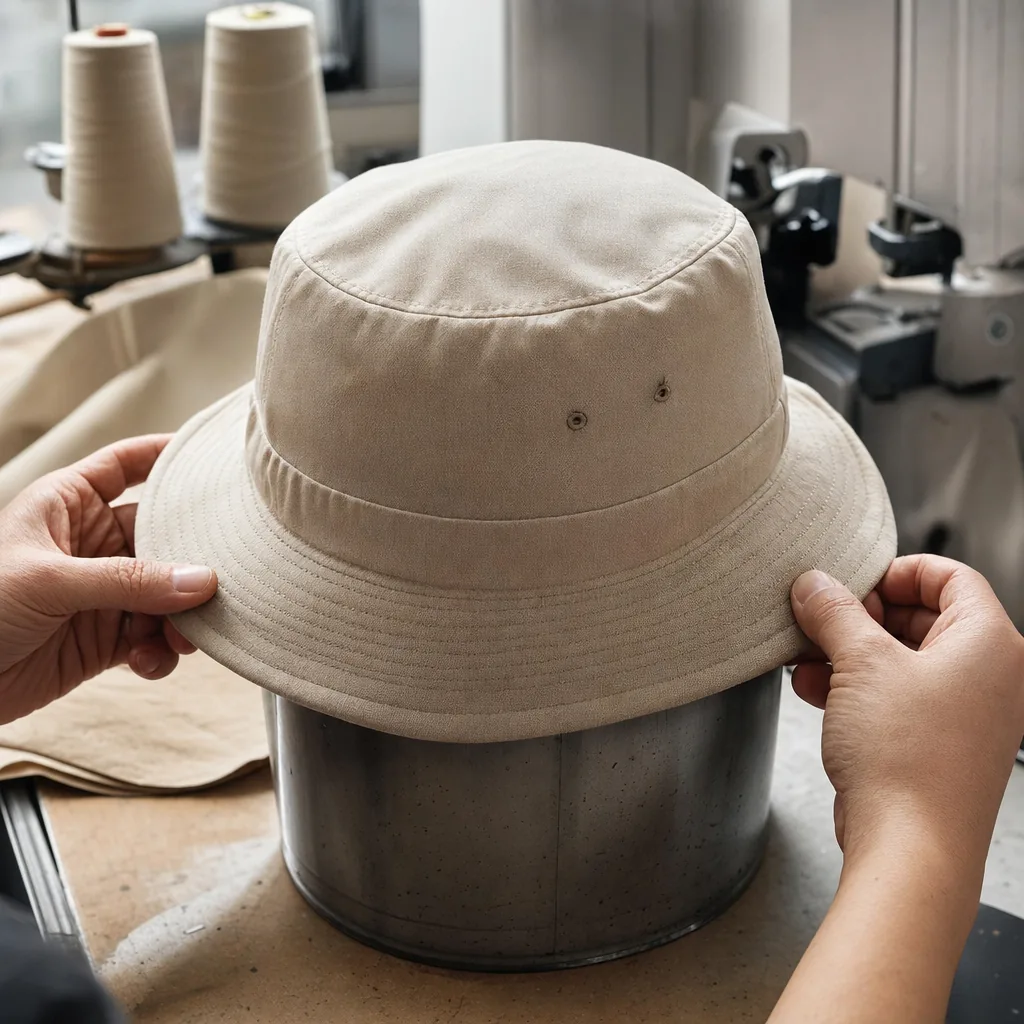
A custom bucket hat small batch order should be quoted as its own program, even if the same factory also handles custom flat brim snapback bulk. The patterning is simpler on paper, but the tolerance stack is tighter in practice: most mills will spec twill, washed cotton, nylon taslan, or polyester canvas at 220-360 gsm, then cut the crown, side band, and brim ring before closing the brim with 2-4 rows of topstitching. If you want embroidery, ask which heads they are running, typically Tajima, Barudan, or ZSK, and what the maximum stitch count is per panel; dense art on a soft crown tunnels and puckers faster than on a structured snapback. A usable tech pack should specify fiber content, fabric finish, crown depth, brim width, seam allowance, sweatband width, lining, wash target, Pantone TCX, and Delta-E tolerance. Do not approve a render alone; require a pre-production sample with final trim, thread, and stitch count.
For small batches, MOQ is usually 50-300 pieces per colorway, though 30-piece runs are possible if you accept a higher unit price and tighter fabric limits. In China, ex-works pricing is commonly $2.20-$4.80 for a basic cotton bucket hat, $4.80-$8.50 for washed or garment-dyed styles, and $6.50-$12.00 when you add dense embroidery, woven labels, printed tape, or custom inner taping. That benchmark sits below many custom flat brim snapback bulk programs, which usually carry a stiffer crown, laminated visor board, and more predictable carton packing, but often cost more on the cap body and visor build. The common defects are blunt: thin brim insert that collapses in compression, crooked topstitch spacing, off-center crown seams, and shrinkage from unwashed fabric. Our standard practice is to lock a sealed PPS sample, a brim-width and crown-height tolerance of plus or minus 0.3 cm, and an AQL 2.5 inspection plan before bulk release.
Custom Fitted Cap No Minimum
A real custom fitted cap no minimum offer is usually a sampling or short-run program, not a factory line with zero setup cost. The crown still needs a size-block pattern, stitched or fused buckram front panels, a cut sweatband, visor board, and a defined grading method if you are building more than one size. For a usable quote, specify crown height, panel count, brim curve, fabric weight in gsm, sweatband material, embroidery method, and whether the factory is grading from an existing block or cutting new size blocks. The control point is circumference tolerance: a 7 1/4 should land at 57.7 cm, and a result like 58.5 cm is a reject, not a near miss. Keep the fitted-cap spec separate from your custom flat brim snapback bulk line, or the factory will price it like an adjustable cap and miss the real labor.
Typical MOQ for a custom fitted cap no minimum program is often 24 to 100 pieces per size and colorway, with sample pricing around USD 18 to 35 per cap depending on embroidery density, woven labels, and whether a new block is required. At 300 to 500 pieces, FOB pricing for basic cotton twill or washed cotton usually falls around USD 5.50 to 9.50, while wool blends, structured fronts, 3D puff embroidery, contrast taping, and custom inner branding push it higher. Our standard practice is to treat no-minimum requests as controlled short runs, because the real cost drivers are still cutting, stitching, pressing, and inspection. The economics only work when the buyer accepts fewer sizes, fewer trims, and a narrower decoration spec than a full custom flat brim snapback bulk program.
Inspect fitted caps for seam symmetry, visor board alignment, sweatband skiving, and consistent circumference across the size run. The failures I see most often are crown twist, puckering around the front panels after embroidery, and size drift after steam shaping; all three can pass a casual top-view check and still fail on head fit. Ask for a pre-production size chart, one sealed-size golden sample, and AQL 2.5 inspection on circumference, panel alignment, and embroidery registration. Compared with a custom dad hat low minimum order or a custom bucket hat small batch run, fitted caps are less forgiving because there is no closure to hide variation, and the pattern has to hold shape on its own.
Foam Front Trucker Hat Custom
A foam front trucker hat custom program lives or dies on the front panel spec. The usual build is 2.5 to 3.5 mm EVA or PE foam laminated to a 100 percent polyester or nylon mesh back, with a 5- or 6-panel structured crown, plastic snapback, and a flat visor using a 2 to 3 mm PE board insert. The weak point is the foam itself: ask the supplier for density, compression recovery, and whether the front is heat-laminated or glue-bonded. Low-density foam crushes in carton, then never fully rebounds. For decoration, screen print and heat transfer print stay flatter on foam than full embroidery; if embroidery is required, the stitch density needs to be reduced and the panel backed properly or the needle holes will telegraph. Against custom flat brim snapback bulk, this style is usually lighter and cheaper, but it gives up the crisp hand feel and long-term shape retention of a fabric front cap.
For a realistic MOQ, plan on 300 to 500 pieces per colorway for a foam front trucker hat custom run, with 100 to 200 pieces possible only when the factory accepts a higher unit price and looser pack-out. In China, a workable ex-factory range is usually USD 2.10 to 3.80 at 500 to 1,000 units, depending on mesh GSM, print method, woven label or printed label, sweatband spec, and whether the visor uses standard PE board or a heavier paperboard insert. The spec sheet should not be vague: crown height, visor length, panel count, mesh weight, sweatband material, snap type, stitch count, and carton quantity all need to be written down before sampling. Lock Pantone TCX references early, because most disputes start with color drift on the foam print, not with the logo shape. CrownsForge’s standard practice is to approve a physical strike-off before bulk.
The defects that matter are uneven foam compression, warped front panels, print-edge lift, crooked mesh alignment, and visor boards that crease after a single bend cycle. I would not ship without a pre-production sample, an inline top-of-production check, and AQL 2.5 inspection for major defects, with extra attention on crown symmetry and front-seam slippage. Buyers sometimes try to fold this style into a custom sun visor cap bulk order or an unstructured dad hat wholesale program to save freight, but that comparison is wrong. A foam trucker behaves like a printed promotional cap, not a soft cotton five-panel, so it needs its own BOM, its own color approval, and its own QC notes. That separation is what keeps landed cost, rejection rate, and rework from drifting once production is underway.
Blank Flat Bill Snapback Wholesale
Blank flat bill snapback wholesale is usually built from five-panel or six-panel polyester twill, acrylic wool blend, or brushed cotton, with hard buckram in the front panels and a flat visor board made from EVA, ABS, or laminated cardboard. On the factory floor, the sequence is fixed: panel cutting, fusible backing, crown sewing, visor board insertion, edge topstitching, then sweatband, eyelets, closure, and final branding with a woven label or sticker. For custom flat brim snapback bulk, the specs that actually control outcome are crown height, front-panel stiffness, visor length, visor recovery after compression, seam match at center front, sweatband construction, and fabric weight. In practice, that means 260 to 320 gsm for polyester twill, 280 to 350 gsm for cotton twill, and a visor that stays visually flat after carton packing instead of curling into a shallow arc. If the buyer wants a streetwear silhouette that reads premium, specify hard buckram, a 180-degree flat bill, 2.5 to 3.0 mm edge binding, and a center seam that lands within 1 to 2 mm of true.
MOQ and pricing are where the cheap-looking catalogs start to fall apart. Stock blank snapbacks often sit at 300 to 500 pieces per colorway, while fully custom programs usually need 1,000 pieces or more if you want stable fabric lots, custom seam tape, branded interior labeling, and consistent sticker sets. FOB China pricing is commonly $2.20 to $4.80 per piece, depending on fabric, thread count, closure grade, and whether the cap uses pigment-dyed cotton, wool blend, or a basic poly twill shell. Lower quotes usually mean thinner visor board, softer crown support, sloppier stitch tolerance, and color drift between lots. Buyers comparing custom flat brim snapback bulk against custom fitted cap no minimum, unstructured dad hat wholesale, or custom sun visor cap bulk should remember that snapbacks cost more in structure and labor, but they give cleaner embroidery placement, better patch adhesion, and a more predictable resale shape when the pattern is right.
Inspection is where most programs either prove they understand caps or waste a season on returns. Check crown symmetry, visor flatness across the full bill, stitch density along the visor edge, missed stitches at the center seam, loose threads under the sweatband, exposed glue, and snap hardware that survives repeated opening without whitening or cracking. For color, Pantone TCX matching is fine for core corporate programs, but the real target should be a measured Delta-E under 2.0 on approved fabric panels, not a printed swatch under showroom light. CrownsForge’s standard practice is AQL 2.5 for general defects, with tighter attention on visor warp and front-panel collapse because those failures show up in wear, not just in carton inspection. That discipline matters: a flat bill cap can pass a quick visual check and still sit crooked on the head, which is the difference between a usable wholesale blank and a return pile.
Working with CrownsForge for custom flat brim snapback bulk programs
The first mistake buyers make with custom flat brim snapback bulk orders is treating sampling like a formality. It is the control point. A proper fit sample and decoration proof usually takes 5 to 10 working days after the bill of materials is locked, and it should confirm crown height, front panel buckram, brim board stiffness, visor edge shape, closure spec, seam allowance, and stitch count. For flat brim snapbacks, a 50-piece preproduction run reveals more than any polished mockup: if the mold line drifts or brim binding creeps by even 1 to 2 mm, it will show in retail photos and trigger complaints. The practical way to run custom flat brim snapback bulk is to lock Pantone TCX targets up front, do embroidery sew-outs on Tajima or Barudan heads, and check thread density before bulk cutting, because fixing tension or pull compensation after production starts wastes both time and fabric.
MOQ should follow setup cost, not brochure language. For custom flat brim snapback bulk programs, a realistic production lane is 100 to 300 pieces per colorway when you are using structured 6-panel caps, 100 percent cotton twill, acrylic-wool blends, or poly-cotton canvas with standard plastic snap closures. If the order is print-only, the floor can come down; if it includes 3D puff embroidery, woven labels, contrast undervisor fabric, custom taping, or metallic thread, the minimum moves up fast because digitizing, trim sourcing, machine changeover, and cutting waste do not shrink just because the PO is smaller. Buyers ask for low MOQs on every line item, but that is not how cap production works. The honest answer is that the minimum depends on fabric weight, decoration method, panel structure, and color count.
On compliance and scale-up, I would not release a bulk hat program without traceable fabric and trim records, color approval against a Delta-E target of 1.5 to 2.0, and final inspection to AQL 2.5 for critical defects. That is how you catch off-shade panels, skipped stitches, warped inserts, weak snap hardware, and distorted brim shape before cartons leave the floor. CrownsForge’s standard practice is to keep the handoff tight: one spec sheet, one approved sample, one production calendar, and one QC checkpoint before packing. That matters because custom flat brim snapback bulk buyers often change the order midstream, adding a woven label, swapping undervisor color, or asking for six logo placements without moving the delivery date. The value is not a low headline price; it is a process that survives change control without turning the order into rework and freight claims.
Frequently Asked Questions
How long does production take?
Sampling takes 7 to 12 days. Bulk production runs 20 to 30 days depending on quantity, fabric availability and decoration complexity. Inspection and packing adds another 3 to 5 days before shipment.
Can I order a sample before bulk production?
Yes. We strongly recommend approving a pre-production sample before mass production. Samples are charged at 35 to 60 USD each plus express shipping, fully refundable against confirmed bulk orders over 500 pieces.
What file format should I send for my logo?
Vector files (AI, EPS, PDF) are ideal. High-resolution PNG or JPG at 300 dpi on transparent background works as a fallback. Provide Pantone color references for accurate reproduction.
Do you support sustainability certifications?
Yes. We work with GOTS organic cotton, GRS-certified recycled polyester, OEKO-TEX Standard 100 fabrics, and are BSCI and Sedex audited. Certification documentation can be provided per order.
What logo decoration techniques do you offer?
3D puff embroidery, flat embroidery, woven patch, leather patch, PVC patch, screen printing, sublimation, applique and laser etching, all in-house with no subcontracting.
What's the MOQ for custom leather patch hat low minimum?
When evaluating custom leather patch hat low minimum, the key considerations are construction quality, decoration capability, MOQ flexibility and lead time. Cover everything buyers ask about custom dad hat low minimum: how it's manufactured, what specs to request from a factory, typical MOQ and pricing, common quality issues to inspect for, and how this ties back to the broader custom flat brim snapback bulk sourcing decision. Cover everything buyers ask about custom bucket hat small batch: how it's manufactured, what specs to…
What should I know about custom rope hat wholesale bulk?
When evaluating custom rope hat wholesale bulk, the key considerations are construction quality, decoration capability, MOQ flexibility and lead time. Cover everything buyers ask about custom dad hat low minimum: how it's manufactured, what specs to request from a factory, typical MOQ and pricing, common quality issues to inspect for, and how this ties back to the broader custom flat brim snapback bulk sourcing decision. Cover everything buyers ask about custom bucket hat small batch: how it's manufactured, what specs to…
What should I know about custom corduroy dad hat bulk?
When evaluating custom corduroy dad hat bulk, the key considerations are construction quality, decoration capability, MOQ flexibility and lead time. Cover everything buyers ask about custom dad hat low minimum: how it's manufactured, what specs to request from a factory, typical MOQ and pricing, common quality issues to inspect for, and how this ties back to the broader custom flat brim snapback bulk sourcing decision. Cover everything buyers ask about custom bucket hat small batch: how it's manufactured, what specs to…
How does ordering custom flat brim hat work?
When evaluating custom flat brim hat, the key considerations are construction quality, decoration capability, MOQ flexibility and lead time. Cover everything buyers ask about custom dad hat low minimum: how it's manufactured, what specs to request from a factory, typical MOQ and pricing, common quality issues to inspect for, and how this ties back to the broader custom flat brim snapback bulk sourcing decision. Cover everything buyers ask about custom bucket hat small batch: how it's manufactured, what specs to…
Looking for a reliable hat manufacturer in China?
CrownsForge has produced custom hats for 800+ brands across 40 countries. From 100-piece launches to 100,000-piece retail programs, we deliver on time and on spec.
Get in touchRelated guides
Compliance Documentation Checklist for First Hat Import to US/EU (2026 Update)
Read article →
Ball Caps for Men: A 2026 Sourcing Playbook for International Buyers - Cost & MOQ Breakdown
Read article →
Merino Wool Beanie: Properties, Costs and How to Spec It Right - Cost & MOQ Breakdown (2026 Update) (2026 Update)
Read article →Sourcing custom hats does not have to be complicated. With the right manufacturing partner, clear specifications and a small upfront investment in sampling, you can launch a retail-quality product in 30 to 45 days.