
Corduroy Hat Vintage Fabric And Trim Spec Guide for Custom Hat Buyers
Corduroy Hat Vintage Fabric And Trim Spec Guide for Custom Hat Buyers is one of the most-asked questions we receive from international buyers, and for good reason. With dozens of factories competing for your order and an alphabet soup of technical terms in every supplier quote, even experienced importers can feel lost. This guide consolidates what we have learned producing custom hats for clients in 40+ countries.
Why corduroy hat vintage fabric and trim spec guide needs a separate sourcing plan
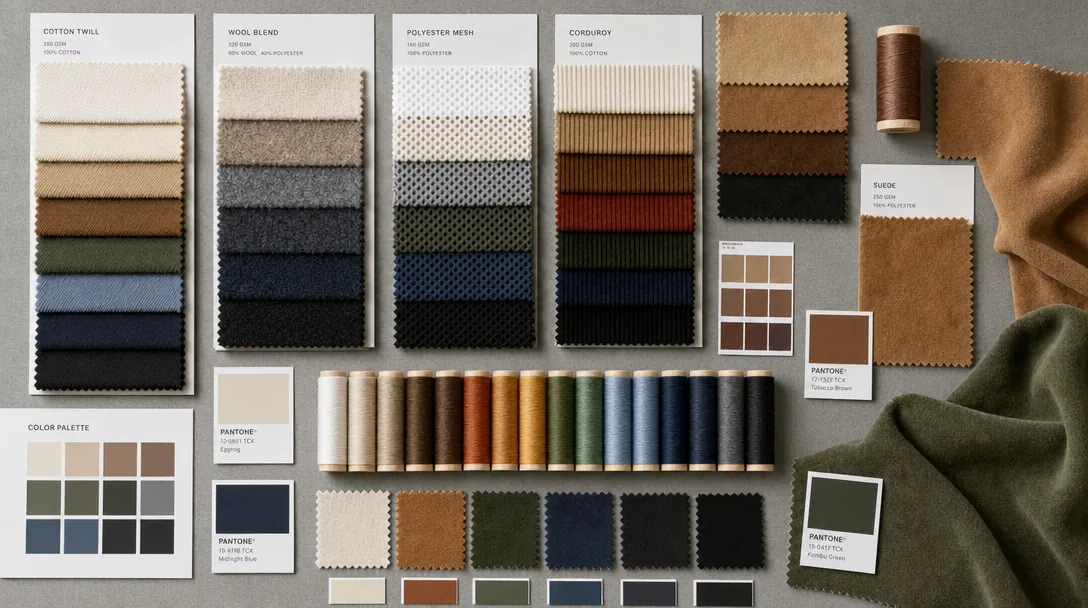
A corduroy program needs its own sourcing plan because the fabric behavior is not like plain cotton twill or polyester canvas. The buyer searching for a corduroy hat vintage fabric and trim spec guide is usually not asking for “any cap with ribs”; they are trying to lock a worn-in retail look without getting random wale width, shade drift, crushed pile, or cheap plastic trims. The first decision is wale count: 8-wale looks heavy and workwear, 11-wale is the safest vintage baseball-cap option, and 14–16-wale works better for a softer bucket hat corduroy shape. Fabric weight also matters. A 260–300 gsm cotton corduroy holds a 6-panel crown cleanly, while 220–240 gsm is easier for a corduroy bucket hat but may collapse if the brim is not fused correctly. If the buyer wants an organic cotton hat, we need GOTS or OCS chain-of-custody confirmation before lab dips, not after bulk cloth is booked.
Corduroy sourcing differs from generic hat sourcing most clearly at color and cutting. A corduroy hat brown sounds simple, but brown corduroy can shift red, olive, or gray depending on pile direction, dye lot, and lighting; I normally ask buyers to approve Pantone TCX plus a physical lab dip under D65 and TL84, with Delta-E under 1.5 for premium retail orders and under 2.0 for promotional orders. Cutting direction must be fixed in the tech pack because mixed nap panels make the cap look like it has two colors. Embroidery is another trap: dense satin stitches can sink into the pile, so digitizing needs heavier underlay, slightly wider column widths, and tension testing on Tajima or Barudan heads before PP sample approval. For small front logos, woven patches or felt appliqué often look cleaner than direct embroidery on high-pile corduroy.
Cost, lead time, and compliance are decided earlier than many buyers expect. Stock corduroy can support 300–500 pcs per color with about 20–30 days production after sample approval, but custom-dyed cotton corduroy usually needs 800–1,200 meters MOQ and adds 10–18 days for lab dips, dyeing, and shade continuity checks. Trim choices move the price more than buyers think: a brass buckle may add $0.18–$0.35 per cap, a leather strap $0.45–$0.90 depending on thickness and REACH testing, and a custom woven label $45–$80 in setup before unit cost. Our standard practice at CrownsForge is to check bulk fabric shrinkage, pile crush after steam pressing, nickel release for metal trims, and AQL 2.5 final inspection against approved PP samples. For licensed streetwear or team orders, sedex-audit-cap-supplier-guide.html">BSCI 2.0 or Sedex SMETA 4-Pillar documentation should be confirmed before deposit, because changing factory allocation later can cost more time than the sewing itself.
Factory capability checks before quoting
The first capability check is not price; it is whether the factory can execute the decoration without ruining the corduroy wale. For a corduroy hat vintage program, I ask which embroidery machines are on the floor and how they stabilize raised fabric. Tajima or Barudan heads with proper cap frames are standard; ZSK is useful for heavier 3D puff and mixed appliqué work. On 8-wale or 11-wale corduroy, dense satin stitches over 10,000 stitches can flatten the ridge and create shiny pressure marks, so the digitizer should show pull compensation, underlay choices, and backing type before quoting. For patches, confirm merrowed edge, laser-cut woven label, faux leather deboss, chenille, and felt appliqué options, plus minimum patch thickness that can still curve cleanly over a 5-panel or 6-panel crown.
Fabric confirmation must go beyond saying “cotton corduroy.” A serious corduroy hat vintage fabric and trim spec guide should state wale count, weight, fiber blend, color tolerance, and shrinkage target. Typical cap corduroy runs 220–320 gsm; 100% cotton gives the best vintage hand but shrinks more than cotton-spandex or cotton-poly blends. If the buyer wants an organic cotton hat, ask for GOTS or OCS transaction certificates, not just a supplier claim. For a corduroy hat brown, require Pantone TCX matching and Delta-E control under D65 light, because brown shifts badly between dip lots. Panel construction also matters: bucket hat corduroy usually needs bias attention at the brim seam, while a structured 6-panel cap needs buckram compatibility so the front does not bubble after steam blocking.
Before accepting a quote, check the sample room and compliance desk as hard as the sewing line. The sample room should cut, sew, embroider, wash-test, and revise a corduroy bucket hat within 7–10 working days, with comments returned as measurement tables instead of vague photos. Closure options should be physically sampled: brass buckle with hideaway strap, plastic snapback, hook-and-loop, elastic sweatband, or no closure for fitted caps. Our standard practice at CrownsForge is to review closure pull strength, seam slippage, and needle damage before locking the FOB. Audit readiness is also commercial risk control: ask for current BSCI 2.0, Sedex SMETA 4-Pillar, or WRAP documents, plus AQL 2.5 inspection records. Finally, judge communication quality early; if the merchandiser cannot explain gsm, wale count, embroidery limitations, and carton dimensions in one email thread, production will not improve after deposit.
MOQ, pricing and sample approval
MOQ is where many custom buyers misread corduroy economics. For a plain corduroy hat vintage program, 100–144 pcs is usually possible only with stock 8-wale or 11-wale cotton corduroy and standard trims; expect a higher unit price, roughly US$7.80–11.50 FOB depending on cap shape and decoration. At 300 pcs, factories can control cutting loss better and open more trim options, so a 6-panel unstructured cap or corduroy bucket hat typically lands around US$5.20–8.40 FOB. At 500–1,000 pcs, dye-lot buying, carton efficiency, and embroidery head utilization improve; that is where brown, olive, navy, and black corduroy programs become commercially stable. Custom-dyed organic cotton hat fabric, recycled polyester lining, or special 14-wale narrow corduroy usually needs 800–1,200 pcs per color because mills do not like small vat runs. A corduroy hat brown order sounds simple, but brown shades drift easily under D65 light, so confirm the shade before selling preorders.
Decoration setup is separate from unit cost, and buyers should budget it honestly. Flat embroidery digitizing normally runs US$25–45 per logo; 3D puff needs a separate file because foam height, stitch spacing, and pull compensation are different. Woven patches are usually US$80–150 mold/setup, while genuine leather deboss patches may need US$60–120 for the brass plate. On Tajima, Barudan, or ZSK heads, corduroy needs lower speed, often 600–750 spm, because the ribs push thread sideways; dense satin columns over 7 mm can sink or distort unless underlay is adjusted. For PPS approval, our standard practice at CrownsForge is to lock stitch count, thread brand, placement tolerance, and trim materials before bulk cutting. A front logo at 8,000–10,000 stitches may be fine on twill but too heavy on corduroy, so buyers should review a real sewn panel, not only a digital mockup. This is the practical core of any corduroy hat vintage fabric and trim spec guide.
Pantone matching should be treated as a controlled tolerance, not a promise from a screen. For fabric, specify Pantone TCX and accept Delta-E under 1.5–2.0 for lab dips; for embroidery thread, use Madeira or Gunold shade cards because thread sheen changes the visual result. Trims need the same discipline: antique brass eyelets, cotton herringbone sweatbands, matte snap buttons, recycled PE visor inserts, and paper hangtags all affect the final vintage read. A bucket hat corduroy style also needs brim stitching density stated clearly, commonly 6–10 rows, because too many rows make the brim stiff and too few look cheap after washing. Packaging should be defined early: individual polybags add about US$0.08–0.15, FSC kraft boxes US$0.35–0.80, and molded inserts more. Realistic timing is 5–7 days for fabric lab dip, 7–10 days for PPS after artwork approval, and 25–40 days for bulk production after PPS sign-off, excluding FOB booking or DDP customs delays.
Quality inspection and shipping risk
Inspection has to be written around corduroy’s failure points, not just generic cap dimensions. For a production lot of 1,200–5,000 pieces, I normally use ANSI/ASQ Z1.4 with AQL 2.5 for major defects and AQL 4.0 for minor defects; critical defects are zero tolerance. Crown height, brim length, sweatband width, and strap length should carry clear tolerances: ±3 mm on panel height, ±2 mm on brim stitching position, and ±5 mm on circumference after the size adjuster is centered. Corduroy pile crush, wale direction mismatch, and shiny pressure marks from heat pressing must be listed as major defects, especially on a corduroy hat vintage style where the fabric texture is the whole selling point. For a corduroy hat brown order, approve color by Pantone TCX or a sealed fabric swatch, then control bulk shade within Delta-E 1.5–2.0 under D65 light; brown corduroy drifts red or green easily between dye lots.
Colorfastness is where many corduroy hats fail after the buyer has already paid freight. I would require ISO 105-C06 washing grade 3–4 minimum, ISO 105-X12 dry rubbing grade 4 and wet rubbing grade 3, because dark brown, forest green, and washed black corduroy can stain a beige sweatband or white embroidery. Embroidery inspection should cover thread breaks, bird-nesting, puckering, loose backing, off-center placement, and stitch density; on Tajima or Barudan heads, a 3D puff logo over 6,000 stitches can deform soft 8-wale corduroy unless the digitizer reduces underlay and uses proper tearaway backing. A bucket hat corduroy order needs extra checks at the brim row spacing, because uneven topstitching shows immediately on a circular brim. For an organic cotton hat or washed corduroy bucket hat, test shrinkage after wash approval, not after bulk cutting; a 2–3% shrinkage surprise can make the fit feel one size smaller.
Shipping risk is mostly documentation discipline. Carton markings should show PO number, style code, color, size ratio, carton number, gross/net weight, and made-in-China origin text matching the commercial invoice; unclear markings slow customs exams and make warehouse receiving messy. For FOB Ningbo or Shanghai, the buyer controls freight and insurance after the vessel rail, which is cheaper for experienced importers but risky if carton dimensions are wrong or booking is late before a promotion date. DDP is cleaner for small streetwear drops, but the factory or forwarder will price in duty, VAT handling, fuel surcharge, and customs uncertainty; for U.S. cap shipments, I often see DDP adding about $0.45–$1.20 per piece over FOB depending on volume and destination ZIP. In this corduroy hat vintage fabric and trim spec guide, reorder control should include approved bulk fabric card, Pantone record, embroidery DST file, trim BOM, carton photo, AQL report, and final packed weight so the second run does not become a new development project.
Buyer checklist for the next RFQ
A firm quote starts with a controlled tech pack, not a mood board. For a corduroy hat vintage program, send the hat type first: 6-panel unstructured cap, 5-panel camper, bucket hat corduroy style, or corduroy bucket hat with stitched brim. Add size range, crown height, brim length, brim curve, panel count, seam tape width, sweatband type, and closure spec. Fabric must be named by wale count and weight: 8-wale 100% cotton corduroy at 280–320 gsm behaves very differently from 14-wale polyester-blend corduroy at 220 gsm. If you want an organic cotton hat, specify GOTS or OCS requirement before pricing, because certified yardage can add $0.35–$0.80 per cap at 1,000 pieces. Send Pantone TCX references, target Delta-E tolerance, and whether the look is garment-washed, enzyme-washed, pigment-dyed, or raw. A corduroy hat brown sample photo is not enough; brown can shift red, yellow, or gray under different pile directions.
Decoration files decide whether the quote is real or padded with risk. Send vector art in AI, EPS, or PDF, plus embroidery size in millimeters, thread colors, placement from seam or brim edge, and whether the logo is flat embroidery, 3D puff, chain stitch, woven patch, leather patch, felt appliqué, or metal pin. For embroidery, include stitch count if already digitized; if not, expect factory digitizing on Tajima, Barudan, or ZSK heads and one paid sample before bulk. Photos should show front, side, back, inside taping, sweatband, closure, label position, and any vintage distressing. If your corduroy hat vintage fabric and trim spec guide calls for antique brass buckles, recycled plastic snaps, cotton herringbone tape, or contrast underbrim, list each trim with color, finish, and tolerance. Missing trim details often move FOB by $0.15–$0.60 per piece, which is bigger than many buyers expect.
Before asking for DDP or FOB pricing, state quantity by color, delivery country, target ship date, carton marking needs, and compliance requirements. A clean RFQ should include MOQ expectation, sample deadline, bulk lead time target, packing method, barcode or polybag rules, and inspection level such as AQL 2.5 major / 4.0 minor. If the order is for retail, also send care label language, fiber content format, country-of-origin wording, hangtag artwork, and any BSCI 2.0 or Sedex SMETA 4-Pillar audit requirement. Our standard practice at CrownsForge is to quote sampling, fabric surcharge, mold or patch setup, bulk unit price, export carton CBM, and logistics separately so the buyer can see where cost is hiding. The fastest RFQs include one physical reference cap or at least a caliper-measured photo set; without that, most factories quote defensively and revise after the first prototype.
Working with CrownsForge
The fastest way to keep a corduroy program from drifting is to lock the fabric spec before anyone argues about logo placement. For a corduroy hat vintage fabric and trim spec guide, our standard practice at CrownsForge is to define wale count, pile height, base fiber, backing stability, and shade tolerance on the first tech pack page. Most vintage-looking caps use 8-wale or 11-wale cotton corduroy at 280–340 gsm; bucket hat corduroy can go slightly softer at 250–300 gsm so the brim does not look like cardboard. If the buyer wants an organic cotton hat position, we ask for GOTS or OCS transaction certificates before quoting bulk, not after sampling. Color is controlled by Pantone TCX reference plus a Delta-E target, usually under 1.5 for black, navy, and corduroy hat brown, because pile direction can make the same dye lot look two shades apart under LED inspection lights.
Sampling should prove the construction method, not just produce a nice showroom piece. For a corduroy hat vintage order, we normally run one fit sample in available fabric, one pre-production sample in booked fabric, and one sealed sample after decoration approval. Embroidery on corduroy needs heavier underlay than twill because the pile swallows thin strokes; on Tajima, Barudan, or ZSK heads we usually test 75D/2 rayon or polyester thread with 0.35–0.45 mm minimum satin columns. Flat embroidery works for retro sports marks, but 3D puff on high-wale corduroy can look lumpy unless the foam is cut clean and the logo has enough spacing. For a corduroy bucket hat, we check brim stitch rows, crown seam bulk, sweatband tension, and whether the top button or eyelets should be fabric-covered, metal, or omitted for a cleaner vintage silhouette.
QC and export coordination are where small custom hat programs either stay profitable or become rework. Bulk inspection is normally AQL 2.5 for major defects and AQL 4.0 for minor defects, with added checks for nap direction, panel shade mismatch, loose pile, embroidery puckering, broken brim rows, label placement, and carton humidity. Corduroy should not be packed hot from steaming; we target below 65% carton RH and use polybags only when the buyer’s market requires them, because trapped moisture can flatten the pile during a 25–35 day ocean transit. For FOB Ningbo or Shanghai, export cartons, HS code review, packing list, and commercial invoice are straightforward; DDP to the U.S. or EU needs earlier confirmation of importer data, duty treatment, and any BSCI 2.0 or Sedex SMETA 4-Pillar audit documents requested by the buyer’s retailer.
Frequently Asked Questions
What logo decoration techniques do you offer?
3D puff embroidery, flat embroidery, woven patch, leather patch, PVC patch, screen printing, sublimation, applique and laser etching, all in-house with no subcontracting.
What file format should I send for my logo?
Vector files (AI, EPS, PDF) are ideal. High-resolution PNG or JPG at 300 dpi on transparent background works as a fallback. Provide Pantone color references for accurate reproduction.
Can I order a sample before bulk production?
Yes. We strongly recommend approving a pre-production sample before mass production. Samples are charged at 35 to 60 USD each plus express shipping, fully refundable against confirmed bulk orders over 500 pieces.
How long does production take?
Sampling takes 7 to 12 days. Bulk production runs 20 to 30 days depending on quantity, fabric availability and decoration complexity. Inspection and packing adds another 3 to 5 days before shipment.
Do you support sustainability certifications?
Yes. We work with GOTS organic cotton, GRS-certified recycled polyester, OEKO-TEX Standard 100 fabrics, and are BSCI and Sedex audited. Certification documentation can be provided per order.
What should buyers know about organic cotton bucket hat?
When evaluating organic cotton bucket hat, the key considerations are construction quality, decoration capability, MOQ flexibility and lead time. Explain the buyer intent behind corduroy hat vintage fabric and trim spec guide, when it differs from generic hat sourcing, and what decisions affect cost, lead time and compliance. Describe how CrownsForge manages corduroy hat vintage fabric and trim spec guide programs with sampling, decoration, QC and export coordination.
What should buyers know about brown corduroy bucket hat?
When evaluating brown corduroy bucket hat, the key considerations are construction quality, decoration capability, MOQ flexibility and lead time. Explain the buyer intent behind corduroy hat vintage fabric and trim spec guide, when it differs from generic hat sourcing, and what decisions affect cost, lead time and compliance. Describe how CrownsForge manages corduroy hat vintage fabric and trim spec guide programs with sampling, decoration, QC and export coordination.
What should buyers know about bucket hat men nike?
When evaluating bucket hat men nike, the key considerations are construction quality, decoration capability, MOQ flexibility and lead time. Explain the buyer intent behind corduroy hat vintage fabric and trim spec guide, when it differs from generic hat sourcing, and what decisions affect cost, lead time and compliance. Describe how CrownsForge manages corduroy hat vintage fabric and trim spec guide programs with sampling, decoration, QC and export coordination.
What should buyers know about vintage bucket hat mens?
When evaluating vintage bucket hat mens, the key considerations are construction quality, decoration capability, MOQ flexibility and lead time. Explain the buyer intent behind corduroy hat vintage fabric and trim spec guide, when it differs from generic hat sourcing, and what decisions affect cost, lead time and compliance. Describe how CrownsForge manages corduroy hat vintage fabric and trim spec guide programs with sampling, decoration, QC and export coordination.
Ready to start your custom hat project?
Send us your tech-pack, sketch or even just an inspiration photo. We will respond with a detailed quotation and digital mock-up within 24 hours.
Request a free quoteRelated guides
Rave Bucket Hat: A Vertical-Specific Sourcing Guide
Read article →
Custom Made Trucker Hat: The 2026 Sourcing & Manufacturing Playbook
Read article →
Promotional Caps & Corporate Gifts: Bulk Custom Hats for Brand Events
Read article →Sourcing custom hats does not have to be complicated. With the right manufacturing partner, clear specifications and a small upfront investment in sampling, you can launch a retail-quality product in 30 to 45 days.