
What's in a Cap Tech-Pack: A Specification Template for Buyers (2026 Update) - Supplier Checklist (2026 Update)
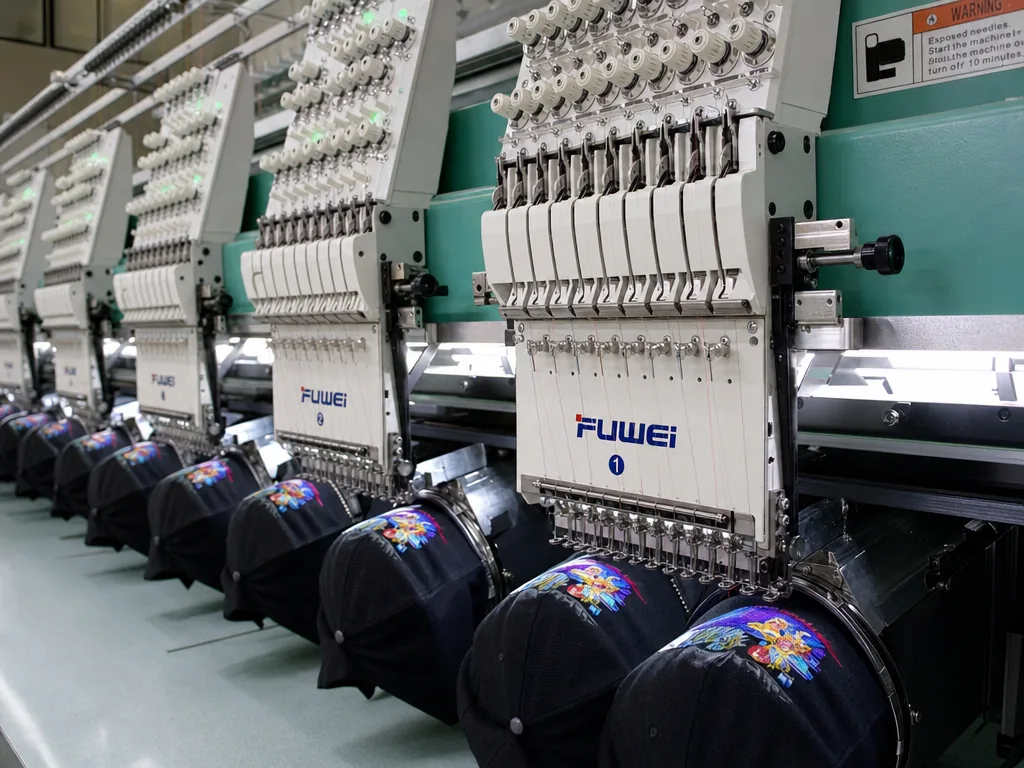
Every week, our sales team answers detailed questions about what's in a cap tech-pack: a specification template for buyers (2026 update) - supplier checklist (2026 update). We wrote this guide so that wholesalers, streetwear brands, corporate buyers and promotional resellers can compare options with full information, and avoid the traps that show up only after production has started.
Why a tech-pack saves you weeks of email back-and-forth
The fastest way to lose two calendar weeks is to send a logo PNG, a reference photo, and “black 6-panel dad hat.” In a cap factory, that can mean 280 gsm enzyme-washed cotton twill, soft buckram, 70 mm pre-curved visor, antique brass slide buckle, tonal sewn eyelets, and 8-row visor stitching. It can also mean brushed chino, unstructured crown, plastic snap, 6-row visor stitching, and a crown sitting 10 mm lower. A cap tech pack template removes that interpretation gap. It should lock the silhouette, panel count, finished crown height, visor length, visor thickness, closure, sweatband width, inside taping, eyelet type, seam construction, fabric weight, fiber content, Pantone TCX code, and logo placement tolerance. If those fields are blank, the pattern master will copy the nearest previous order in the sample room archive, not your brand standard.
A proper tech pack lets pattern making, sourcing, and decoration setup run at the same time, which is where the real schedule gain comes from. With complete specs, a first sample can usually move from 12–14 calendar days to 6–8 because the digitizer is not waiting for embroidery answers while the fabric desk waits for color direction. For embroidery, specify logo width, stitch type, Madeira or Gunold thread code, backing, underlay, density, and machine target, whether Tajima, Barudan, or ZSK. A 90 mm flat front embroidery may look acceptable in a PDF but pucker on 260–300 gsm cotton twill if density is pushed tighter than roughly 0.38–0.42 mm without the correct underlay. Measurements must be finished dimensions, not adjectives: crown height 165 mm ±3 mm, visor length 70 mm ±2 mm, sweatband 30 mm ±1 mm. For color, “forest green” is not a spec; 100% cotton twill, 280 gsm, Pantone 19-5513 TCX, Delta-E under 1.5 against approved lab dip is.
The biggest savings appear after the first sample lands on the buyer’s desk. Without a controlled cap design specification, revision comments usually arrive as opinions: lower crown, darker thread, stiffer visor, smaller logo, more curve, better buckle. That often creates three or four rounds, and each round burns 5–10 days once you include buyer review, re-cutting, re-embroidery, pressing, QC photos, and courier transit. With a tech pack for manufacturer review, corrections become measurable: visor curve radius, logo centerline tolerance, embroidery height, seam allowance, buckle plating, thread Delta-E, and AQL 2.5 defect limits. On a 500-piece order, another sample may cost only $60–$120, but missing a retail drop, sports season, or sea-freight cutoff costs far more. Our standard practice at CrownsForge is to reject sampling tickets missing both a measurement table and a decoration table; otherwise sampling is not controlled development, it is educated guessing.
The seven sections of a complete cap tech-pack
A complete cap tech pack template should have seven controlled sections before any sample is cut: style overview, bill of materials, measurement spec, construction details, decoration artwork, trims/labels, and packing/QC requirements. The style page must name the actual silhouette and fit, not “baseball cap”: 5-panel camper, 6-panel structured snapback, low-profile unstructured dad cap, mid-crown trucker, fitted pro crown, or washed cotton cap with soft handfeel. The BOM needs mill-level details: 16s cotton twill at 260 gsm, 100% polyester mesh at 120 gsm, 600D polyester, nylon taslan, brushed chino twill, or 80/20 wool-acrylic blend. Colors should reference Pantone TCX, TPX, or a physical lab dip with Delta-E under 1.0 for brand colors and under 1.5 for secondary trims. The measurement page should list crown height, head circumference, visor length, visor width, front-panel width, closure length, sweatband width, and button diameter. Realistic bulk tolerances are ±5 mm on circumference, ±3 mm on visor length, ±2 mm on logo placement, and ±1 mm on label position.
Construction and decoration pages are where weak tech packs usually fail. Specify panel count, seam allowance, seam tape width, buckram grade, visor board material and thickness, eyelet size and quantity, button covering, sweatband material, closure type, and stitch count per inch. A useful line item reads: 6-panel structured crown, hard buckram, 12 mm cotton seam tape, 2.0 mm PE visor board, six rows of visor stitching, 30 mm polyester sweatband, and plastic snapback with 7 holes. Decoration specs must include vector artwork, DST/EMB stitch file if available, thread reference such as Madeira Polyneon or Isacord, Pantone conversion, embroidery size, placement from center seam or visor edge, backing type, foam thickness for puff, and maximum stitch count. A 55 mm front logo at 8,000–12,000 stitches behaves very differently on Tajima, Barudan, or ZSK heads than a woven patch or silicone badge. Our standard practice at CrownsForge is to separate flat embroidery, 3D puff, appliqué, woven label, rubber patch, and heat transfer because each has different pressure, backing, dwell time, and rejection criteria.
The last two sections should prevent chargebacks, customs delays, and failed inspections. Trim and label specs must state woven versus printed label, dimensions, fold type, placement, care-label wording, fiber content, country of origin, RN number where applicable, UPC/EAN format, hangtag material, and licensee rules for sports or entertainment programs. Packing instructions should define visor curve, crown insert, tissue use, individual polybag thickness such as 0.03 mm, suffocation warning, carton size, pieces per carton, gross weight target, desiccant, FNSKU/FBA label position, and pallet requirements for DDP shipments. QC requirements should name the standard before quotation: AQL 2.5 for major defects and 4.0 for minor defects is common for promotional and retail cap orders, while licensed programs may require tightened levels. Add tests for colorfastness to rubbing, seam strength, visor symmetry, metal needle detection, barcode scanning, and carton drop where relevant. If sedex-audit-cap-supplier-guide.html">BSCI 2.0, Sedex SMETA 4-Pillar, WRAP, or brand compliance is mandatory, put it in the cap tech pack template early; adding it after PP sample approval can change factory allocation and FOB cost by 3–8%.
Tech sketches: front, side, back, optional underbrim
A cap tech pack template is not production-ready unless the sketches show front, side, back, and underbrim when the visor is visible or contrasted. The front view must fix crown profile, panel count, front seam position, eyelet location, visor curve, and logo placement with millimeter callouts. Do not write “standard 6-panel”; specify low-profile unstructured, mid-profile structured with buckram, high-profile foam trucker, or 5-panel camper, because each uses different panel blocks and seam allowances. I prefer measuring front embroidery from the visor seam centerline and horizontal center seam, not from the crown top, because blocking, steaming, and fabric shrinkage can move the top edge by 3–6 mm. Artwork should be shown at actual size, for example 58 mm wide x 42 mm high, with Madeira thread numbers or Pantone TCX targets, plus execution method: flat embroidery, 3D puff, appliqué, woven patch, rubber patch, or heat transfer. A Tajima or Barudan operator will digitize a 3D puff logo with different density, underlay, pull compensation, needle height, and tearaway backing than a 90 mm flat satin design on 280 gsm brushed cotton twill.
The side sketch should remove guesswork around silhouette and trim placement. Call out visor projection, crown height at center front, side panel seam angle, eyelet diameter, mesh denier if it is a trucker back, sandwich piping thickness, and side logo position measured from the nearest seam and bottom edge. If there is side embroidery, state size, stitch type, and clearance from the visor edge; a 25 mm side mark placed too low will collide with the presser foot when running on ZSK or Barudan heads. The back view must identify closure construction and hardware finish: plastic snapback in matte black, brass buckle with tuck strap, hook-and-loop, elastic webbing, metal clip, or fitted grading such as 56/58/60 cm. “Black closure” is not a specification; dyed cotton strap, POM plastic snap, gunmetal clip, and oxidized brass buckle all price and age differently. For licensed or retail programs, include tolerance notes such as logo placement +/-2 mm and visible hardware color Delta-E under 1.5 against approved sample.
The underbrim view is mandatory when there is contrast color, sublimation artwork, anti-glare black fabric, green cotton twill, reflective film, or moisture-wicking polyester. Label top visor fabric, underbrim fabric, interlining, edge binding, sandwich layer, stitch-row count, and row spacing; common visor stitching is 4, 6, or 8 rows at 6–8 mm spacing, but the visual effect changes sharply between 4-row casual and 8-row sport construction. If the underbrim uses Pantone 17-6030 TCX green, say whether it is cotton twill, polyester, suede, or printed fabric, because shade and handfeel will not match across substrates even when the color code is the same. Add cross-section notes for visor thickness, especially on flat brims, foam inserts, and contrast sandwich designs. Our standard practice at CrownsForge is to treat missing underbrim data as a sampling risk, not a minor omission, because the sample room will default to the fastest available construction unless the tech sketch tells them otherwise.
Fabric and color spec: GSM, weave, Pantone references
A cap tech pack template should identify fabric by construction before color, because “cotton twill” can mean three different mills and three different shrinkage rates. Write specifications like “100% cotton 3/1 twill, 260 gsm ±5%, 16s/2 yarn, reactive dyed, sanforized” or “600D polyester oxford, PU-coated back, 220 gsm ±8%, water-repellent C6 finish.” For structured 6-panel caps, realistic crown ranges are 250–300 gsm cotton twill, 280–340 gsm brushed cotton, 160–190 gsm nylon taslan, and 180–220 gsm recycled polyester twill; anything outside those ranges needs sampling, not guessing. A soft dad cap usually needs enzyme wash or garment wash, but buyers should allow 2–4% garment shrinkage unless the fabric is stabilized before cutting. State grain direction, nap direction for corduroy or suede-touch fabrics, and whether front panels must be cut one-way. Off-grain panels twist after blocking and pressing, making a Tajima, Barudan, or ZSK embroidery run look misregistered even when the machine registration is within 0.5 mm.
Color control should use Pantone TCX textile references, not screenshots, RGB values, or Pantone C paper chips. Specify “Pantone 19-0303 TCX Jet Black” or “Pantone 18-1664 TCX Fiery Red,” then back it with a physical TCX chip or approved fabric swatch for any shade tied to brand approval. For bulk-dyed fabric, practical tolerance is Delta-E ≤1.0 for premium retail, ≤1.5 for normal branded caps, and ≤2.0 for low-cost promotional orders; pigment dye, garment wash, fluorescents, heather yarns, and piece-dyed fabric still need visual approval because lab dips shift after steaming, washing, and top pressing. Our standard practice at CrownsForge is to check the master shade under D65 daylight, then verify TL84 store light and A incandescent for metamerism before releasing cutting. Separate every color callout: crown, visor top, underbill, sandwich piping, eyelets, top button, sweatband, seam tape, snapback, buckle, embroidery thread, woven label, and inside taping. Missing one small item can add $80–$150 in rework or delay bulk cutting by a week.
Decoration spec: technique, placement, dimensions, color count
Decoration specs fail when the buyer names a logo but not the build. A usable cap tech pack template should call out the exact technique and its production limits: flat embroidery, 3D puff, twill appliqué, woven patch, merrowed patch, laser-cut patch, chenille, silicone badge, PVC badge, heat transfer, or a hybrid such as “woven patch with 2 mm raised satin border.” For embroidery, give stitch type, target stitch count, thread standard, color count, and any digitizing constraints: “front logo, flat fill + satin, 8,500-9,200 stitches, 5 colors, Madeira Polyneon 40 wt or Gunold equivalent.” That matters because letters under 4 mm cap height, satin columns under 1.2 mm, and negative spaces under 0.8 mm usually collapse or fill in once the cap is hooped on Tajima, Barudan, or ZSK heads. If the artwork crosses the front center seam on a structured 6-panel, say whether the file should be split, compensated, or shifted to one panel. 3D puff needs even tighter rules. State foam type and thickness—2 mm EVA for moderate lift, 3 mm for bold block shapes—and note that thin serifs, distressed outlines, and enclosed counters under roughly 1.5 mm do not survive trimming cleanly. If you want appliqué or patches, specify patch base material, edge finish, backing, attachment method, and safe detail limits. A woven patch should include yarn denier, border style, heat-cut or laser-cut edge, and minimum line weight; artwork drawn at 0.25 mm in Illustrator often vanishes on the loom, while 0.6-0.8 mm is realistic. Rubber/PVC and silicone badges also need hardness, thickness, and attachment details because a 1.5 mm soft badge sewn on differs materially from a 2.5 mm molded badge with post-and-heat backing in both cost and feel.
Placement should be dimensioned from sewing landmarks, not from a flat sales mockup. The spec should read like a machine setup: “front center, 50 mm W x 30 mm H, aligned to front seam, bottom edge 22 mm above visor seam, rotation 0 degrees.” For side hits, identify wearer’s left or wearer’s right, then measure from the nearest seam and state the maximum usable height after panel curvature. Back decoration must say whether it sits above the arch opening, above a snapback, above a metal buckle, on the strap itself, or on a closure tab; usable height can drop from about 35 mm over an open-back arch to 16-18 mm on a cotton strap. On 5-panel foam truckers, front placement tolerance is different again because the single front panel gives more width but distorts faster under high-density stitching. Color control belongs in the same decoration block. List every thread or print color with Pantone references—TCX for fabric/thread targets, C or U for printed patches, PVC, silicone, or heat-transfer inks—and state whether nearest Madeira, Coats, or Gunold card match is acceptable. For brand-critical shades, ask for Delta-E under 2.0 against the approved standard, but don’t pretend spectro data solves everything; thread luster, twill direction, and brushed cotton nap can shift the visual read. Add approval gates that suppliers can actually execute: thread chart confirmation, patch strike-off or embroidery sew-out, then PP sample before bulk. At CrownsForge, we lock decoration only after the paper pattern placement and first sewn sample match, because a 3 mm shift on a front logo is obvious in bulk and expensive to rework.
Packaging and label spec: polybag, hangtag, sticker, carton
Packaging lines fail when the cap tech pack template treats labels as “artwork” instead of controlled specifications. Start with the unit pack: LDPE, CPP, or recycled PE polybag; thickness 0.03–0.05 mm for normal retail and 0.06 mm if Amazon FBA handling is expected; adhesive flap versus heat seal; ventilation holes if the buyer allows them; and suffocation warning text when the opening exceeds 5 in. For ocean freight from Ningbo or Shanghai, specify 1–2 g silica gel per cap, cobalt-free, packed away from metal eyelets to avoid staining. Label placement should be measured in millimeters: hangtag through left rear seam with 1.5 mm black nylon loop, UPC/EAN sticker 35 x 25 mm on polybag lower-right face, size sticker centered on crown top only if retail display requires it. Include GS1 barcode type, magnification, minimum quiet zone, FNSKU rules, Walmart ASN label position, and country-of-origin wording exactly as approved; a factory should never rebuild compliance labels from a blurry PDF screenshot.
Carton specs should be written for compression, scanning, and customs clearance, not just “standard export carton.” A common baseball cap load is 25 pcs per inner bundle, 100 pcs per 5-ply K=A carton, about 58 x 45 x 38 cm, with gross weight kept under 14–15 kg for manual handling. Structured snapbacks, foam truckers, high-crown styles, and heavy 3D-puff embroidery often need 50 pcs per carton, crown support paper, or front-panel dividers so the buckram does not collapse in a hot container. List carton ply, ECT or burst target, sealing tape width, strapping requirement, carton mark format, PO, style code, color, size curve, quantity, N.W./G.W., carton dimensions, COO mark, and destination label location. For palletized DDP or retail DC shipments, add pallet size, max stack height, stretch-film turns, corner boards, and fumigation-free plywood or plastic pallet. Our standard practice at CrownsForge is to inspect packaging under AQL 2.5 for wrong labels and AQL 4.0 for carton cosmetic defects, because one incorrect carton mark can delay FOB release longer than a minor stitch issue.
Frequently Asked Questions
What file format should I send for my logo?
Vector files (AI, EPS, PDF) are ideal. High-resolution PNG or JPG at 300 dpi on transparent background works as a fallback. Provide Pantone color references for accurate reproduction.
How long does production take?
Sampling takes 7 to 12 days. Bulk production runs 20 to 30 days depending on quantity, fabric availability and decoration complexity. Inspection and packing adds another 3 to 5 days before shipment.
What logo decoration techniques do you offer?
3D puff embroidery, flat embroidery, woven patch, leather patch, PVC patch, screen printing, sublimation, applique and laser etching, all in-house with no subcontracting.
Do you support sustainability certifications?
Yes. We work with GOTS organic cotton, GRS-certified recycled polyester, OEKO-TEX Standard 100 fabrics, and are BSCI and Sedex audited. Certification documentation can be provided per order.
What is the minimum order quantity (MOQ) for custom hats?
Our standard MOQ is 100 pieces per design and color, with sampling available from 1 piece. For complex multi-color logos or premium fabric upgrades, the MOQ can be lowered with a small per-piece surcharge.
How does ordering custom patch trucker hat work?
When evaluating custom patch trucker hat, the key considerations are construction quality, decoration capability, MOQ flexibility and lead time. Technique (3D puff / flat embroidery / patch), placement (front center, side, back), dimensions (e.g. 5cm wide × 3cm tall), stitch count if known, color count and Pantone references. Without a tech-pack, your factory invents details that contradict your assumptions. With one, sampling lead time drops from 14 days to 7 and revision rounds drop from 4 to 1.
How does ordering baseball cap custom work?
When evaluating baseball cap custom, the key considerations are construction quality, decoration capability, MOQ flexibility and lead time. Without a tech-pack, your factory invents details that contradict your assumptions. With one, sampling lead time drops from 14 days to 7 and revision rounds drop from 4 to 1. Tech sketches, fabric spec, color spec, decoration spec, construction spec (panels, closure, eyelets, sweatband), packaging spec, label/hangtag spec.
How does ordering custom baseball cap motorcycle helmet work?
When evaluating custom baseball cap motorcycle helmet, the key considerations are construction quality, decoration capability, MOQ flexibility and lead time. Without a tech-pack, your factory invents details that contradict your assumptions. With one, sampling lead time drops from 14 days to 7 and revision rounds drop from 4 to 1. Tech sketches, fabric spec, color spec, decoration spec, construction spec (panels, closure, eyelets, sweatband), packaging spec, label/hangtag spec.
How does ordering custom bucket hat embroidered work?
When evaluating custom bucket hat embroidered, the key considerations are construction quality, decoration capability, MOQ flexibility and lead time. Without a tech-pack, your factory invents details that contradict your assumptions. With one, sampling lead time drops from 14 days to 7 and revision rounds drop from 4 to 1. Tech sketches, fabric spec, color spec, decoration spec, construction spec (panels, closure, eyelets, sweatband), packaging spec, label/hangtag spec.
Need a low-MOQ test order?
We help emerging brands launch with as few as 100 pieces. Premium fabric, in-house embroidery, retail-ready packaging.
Start a small orderRelated guides
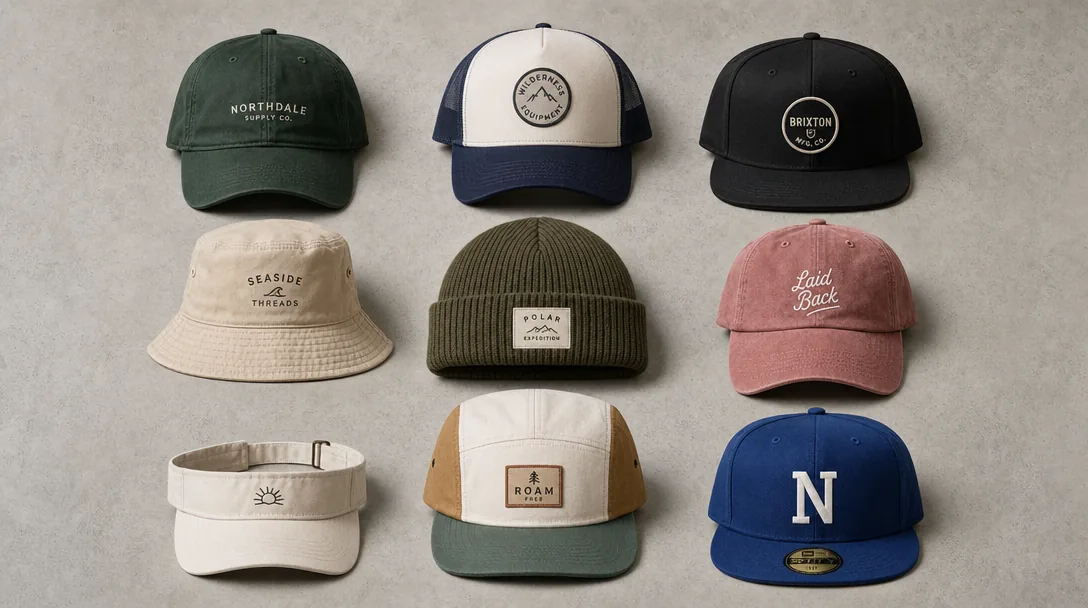
Private Label vs White Label Caps: Which Model Fits Your Brand? - Cost & MOQ Breakdown
Read article →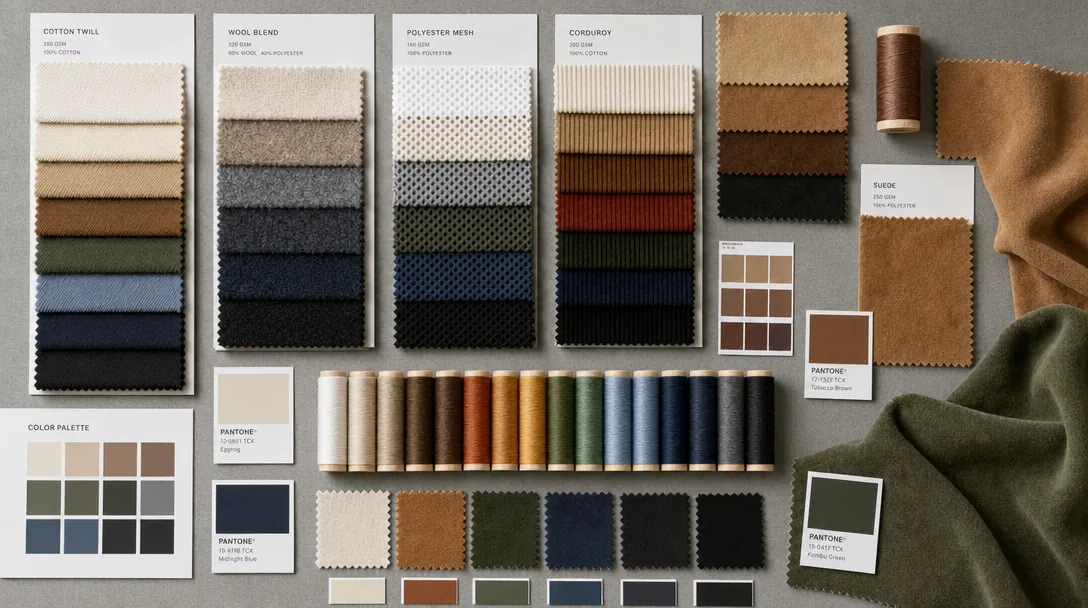
Bucket Hat Corduroy Decoration QC Checklist for Custom Hat Buyers - Supplier Checklist
Read article →Camouflage Bucket Hat: Properties, Costs and How to Spec It Right
Read article →Sourcing custom hats does not have to be complicated. With the right manufacturing partner, clear specifications and a small upfront investment in sampling, you can launch a retail-quality product in 30 to 45 days.