
Cap Factory AQL Inspection Plan for Importers
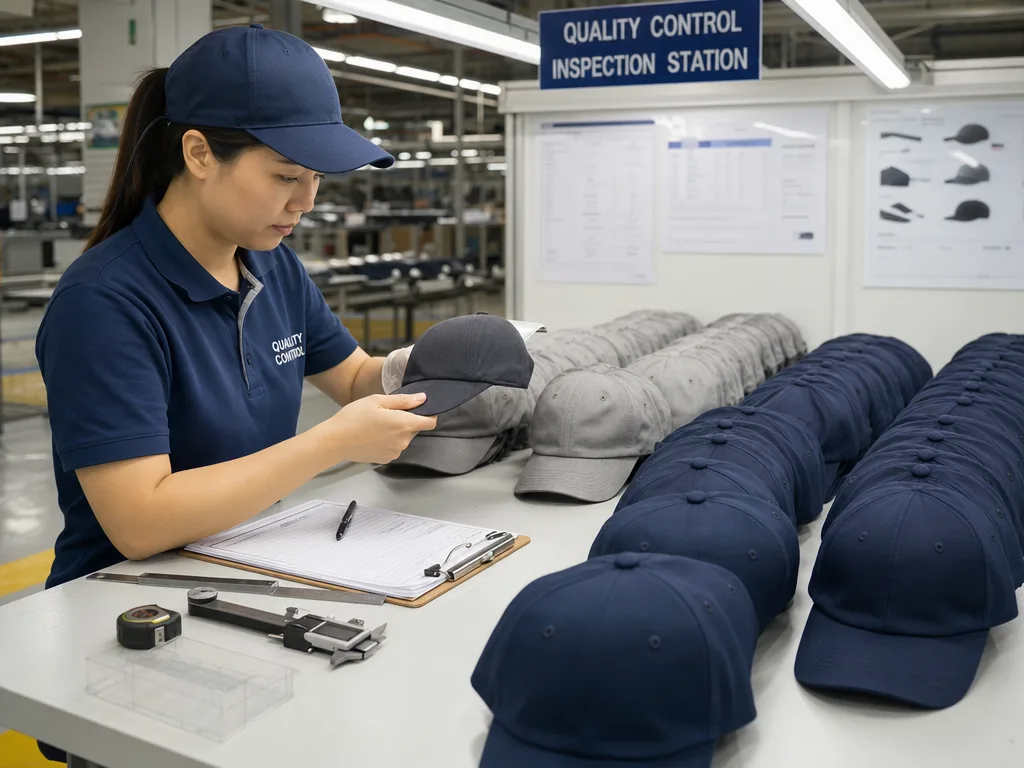
Cap Factory AQL Inspection Plan for Importers is one of the most-asked questions we receive from international buyers, and for good reason. With dozens of factories competing for your order and an alphabet soup of technical terms in every supplier quote, even experienced importers can feel lost. This guide consolidates what we have learned producing custom hats for clients in 40+ countries.
What cap factory aql inspection means in real production
A cap factory aql inspection is the acceptance gate between “looks good on a photo” and “safe to ship 5,000 units under your PO.” In a real RFQ, it should define the defect categories, sample size, and pass/fail criteria before sampling starts, not after production is already moving. For headwear, I look at the critical points buyers usually miss: crown symmetry within 3 mm, visor curve consistency, stitch density on 6-panel panels, embroidery registration, sweatband attachment strength, and color match against Pantone TCX with Delta-E ideally under 2.0 for branded programs. A decent custom hat manufacturer will also tell you which issues are classified as critical, major, and minor under AQL 2.5, because a loose button or exposed thread is not treated the same as a broken back closure.
Before you approve samples, verify the factory’s production stack, not just the sample room. Ask whether the panels are cut by laser or die-cut, what fabric weight is being quoted—210 gsm cotton twill, 300D polyester, or 100% washed cotton—and which thread type is used, usually polyester 120D for embroidery durability. If the supplier is a serious private label hat supplier or custom cap factory, they should state the exact embroidery machine brand, like Tajima, Barudan, or ZSK, plus the stitch count target for the logo. This matters because the sample can hide production variation; a headwear factory China often makes one perfect pre-production sample, then loses control on bulk if the digitizing file, needle gauge, or cap frame settings are not locked.
For importers, cap factory aql inspection should also cover packing and carton logic before bulk approval. Verify whether each dozen is polybagged with size stickers, whether carton marks match the PO, and whether the inner pack protects structured fronts from crush during sea freight. Our standard practice at CrownsForge is to confirm carton count, gross weight, and headspace in the master carton because a 0.5 kg variance can signal mixed lots or moisture uptake in cotton fabric. If you are dealing with a custom hat manufacturer China, ask for in-line inspection photos from sewing, embroidery, and final trim stages, then compare them against the approved golden sample. That is how you catch the problems that AQL paperwork alone will not show: uneven visor sandwiches, misaligned center seams, and closure hardware that fails after one pull test.
Specs to request before a quote
If you want a real quote from a custom hat manufacturer, send a spec sheet that leaves no room for guesswork. For cap dimensions, I want crown height, brim length, front panel width, and head circumference broken out by size, not “one size fits all.” For a six-panel structured cap, specify whether the crown is 11.5 cm or 12.5 cm, the visor board thickness, stitch count on the visor, and sweatband width. Tolerances matter because a headwear factory China that actually runs QC will hold something like ±0.5 cm on circumference and ±0.3 cm on brim length; if the buyer gives no tolerance, disputes start at packing. Materials should be written in measurable terms: cotton twill 260 gsm, polyester 150D, wool blend 85/15, mesh in denier, hook-and-loop tape width, and lining weight. If you are comparing bids from a private label hat supplier, ask for the same construction across all offers so the price difference reflects labor, not hidden downgrades.
Decoration files are where weak briefs fall apart. A capable custom hat manufacturer china should ask for vector artwork in AI, EPS, or PDF, plus Pantone TCX or Pantone C callouts, stitch counts, and placement drawings in millimeters from seam lines. For embroidery, I want the digitized file preview, thread brand, needle count, and a note on whether the logo uses flat embroidery, 3D puff, or applique; on caps, a 0.8 mm shift is visible, so placement should be controlled tightly. If there is printing, request the ink type, curing method, and wash resistance target. For cartons, state inner pack quantity, master carton dimensions, corrugate grade, carton burst strength, polybag thickness, warning label language, and palletization if you need export protection. A factory that knows cap factory aql inspection should also be able to show inspection photos, pre-production samples, inline QC records, and a finished sample with measurement report before you approve mass production.
The AQL level should be named in the quote, not left implied. For headwear, AQL 2.5 is common for major defects and AQL 4.0 for minor defects, but the buyer should state whether the lot is checked under ANSI/ASQ Z1.4 or a client-specific standard, and whether the acceptance criteria apply to appearance, measurements, sewing, and labeling separately. A serious factory will provide evidence: raw material mill certificates if requested, lab dip approvals, embroidery sew-outs, carton drop-test results, and photos of actual in-line checkpoints, not just a clean sales sample. In a headwear factory China, I also expect a QC flow showing needle detection if metal accessories are used, needle breakage log, and final random inspection records by size ratio. If the supplier cannot show these documents, they are not ready for a proper cap factory aql inspection, and the quote is just a number on paper, not a controlled production offer.
Factory risks and quality checks
The biggest factory risk is not one dramatic defect; it is a pile of small misses that each look acceptable on the line and become expensive once cartons are packed. In a cap factory aql inspection, I look first at shape, stitching density, logo registration, and color consistency because those are the defects buyers notice immediately. Common problems include crooked front panels on a structured 6-panel cap, uneven crown height, loose thread tails, missed bar tacks on sweatbands, poor visor curve, and embroidery that is off by 1.5 to 2.0 mm from spec. On custom hat runs, I also watch for fabric shade variation between dye lots, especially on brushed cotton twill, nylon, and recycled polyester. A real headwear factory china should be checking seam allowance, panel symmetry, stitch SPI, and carton labeling, not just counting pieces.
Inspection has to start with approved reference samples, not at final packing. For any custom cap factory, the gold sample, pre-production sample, and inline first-article check need to match on Pantone TCX color, logo size, placement from center front, and trim specs like hook-and-loop length or metal buckle plating. If the buyer approves embroidery, I expect a stitch-out card with thread brand, needle size, backing type, and a measured sew-out density, because a custom hat manufacturer china can otherwise swap materials mid-run and create shade or tension problems. Our standard practice at CrownsForge is to lock every critical point before mass production: bill of materials, artwork file, measurement sheet, and carton mark. That prevents the usual rework loop where production finishes 80 percent of the order before anyone notices the crown is 5 mm too shallow or the visor insert is too soft.
To prevent late shipment, the inspection plan has to be tied to production timing, not treated like a final-day checklist. A practical cap factory aql inspection uses AQL 2.5 for major defects and 4.0 for minor defects on random cartons, but the better control is inline checks at 10 percent, 50 percent, and 90 percent completion so faults are caught before trim and packing. In a private label hat supplier workflow, I always recommend pre-shipment verification of carton count, size ratio, polybag thickness, moisture control, and shipping marks, because a missed label or wrong dozen breakdown can delay customs or warehouse intake even when the product itself is fine. Rework gets expensive fast: unpicking embroidery, replacing sweatbands, and re-pressing crowns can add 0.15 to 0.60 USD per cap, plus 2 to 4 days of labor. The cleanest prevention is a locked sample, a written inspection checklist, and immediate line correction the same day the defect appears.
MOQ, lead time, and cost drivers
MOQ changes the whole cost structure because the sewing line is paid by setup, not just by pieces. For a custom hat manufacturer or custom cap factory, a 300-piece order and a 3,000-piece order can use the same embroidery digitizing, screen preparation, thread matching, and sample approval time, but the smaller run spreads those fixed costs over far fewer units. On a standard 6-panel structured cap, I see FOB China unit price swing from about $2.40–$3.10 at 3,000 pcs to $4.20–$6.00 at 300 pcs, depending on panel count, brim insert, and decoration complexity. If you are buying from a private label hat supplier or headwear factory China, ask what is truly fixed cost versus variable labor, because that is where margin disappears.
Trim choices are the biggest silent cost driver after labor. A basic cotton twill cap with self-fabric strap and plastic buckle is cheap; add woven labels, inner seam tape, sandwich visor, metal closure, sandwich piping, or a higher stitch-count 3D puff logo and the line time goes up immediately. In a custom hat manufacturer China setup, every extra operation is measurable: a flat embroidery logo might add 4–6 minutes, a complex patch application 2–3 minutes, and a TPU label plus side embroidery another 1–2 minutes. Packaging matters too. A polybag, size sticker, carton mark, and master carton export pack may only add $0.08–$0.20 per piece, but retail-ready inserts, barcode labels, hangtags, and individual boxes can push that to $0.35–$0.90. For a cap factory AQL inspection, those packaging details also create more inspection points and more rework risk if the pack-out spec is loose.
Testing and shipping are where importers often underbudget. Color approval against Pantone TCX with Delta-E control, needle and thread break testing, seam strength checks, and carton drop testing all add time before cargo leaves the floor. If you require a higher inspection level, such as AQL 2.5 for major defects and 4.0 for minor defects, the sorting labor rises, especially on mixed-color or multi-SKU orders. Freight can move the landed cost by more than the factory quote: a 20-foot container from Ningbo to the U.S. West Coast may add roughly $0.35–$0.70 per cap at 5,000 pieces, while air freight can multiply that several times. The practical rule is simple: if the unit price looks unusually low, check whether the quote excluded testing, extra trim labor, packing materials, and the cap factory AQL inspection rework allowance; those are usually the costs that appear later in the shipment and eat the margin.
How CrownsForge manages this order type
For this order type, the first thing we lock down is the sampling ladder, because most headaches start there. As a custom hat manufacturer, our standard practice is PP sample, size set, then pre-production sample before bulk cutting; for licensed programs or private label hat supplier work, we also freeze Pantone TCX references, stitch density, bill curve, and closure spec in the approval file. On the quality side, a cap factory aql inspection is not a one-time checkpoint. We run in-process checks on panels, visor inserts, sweatband attachment, and embroidery registration, then final random inspection to AQL 2.5 for major defects and 4.0 for minor defects unless the buyer specifies tighter limits. That matters in a headwear factory China because one bad needle break or mis-trimmed applique can turn into a full carton issue fast.
Documentation is where many buyers either save or lose time. Every order gets a spec sheet, approved sample photos, carton packing plan, and a defect reference sheet with pass/fail boundaries, so the QC team is not guessing at the line. For custom hat manufacturer China programs, we record thread lot, fabric lot, and trim source; if a buyer asks for proof, we can trace back to the batch level instead of sending vague answers. Our cap factory AQL inspection reports normally include inspection quantity, defect classification, measurement results, carton count, and photo evidence of any nonconformance. If the order is FOB, we also align the final inspection date with loading so there is no gap between release and shipping. That is the difference between a real custom cap factory and a shop that just counts cartons.
Communication and reorder support are built around avoiding drift from the approved standard. Buyers get one point of contact for sampling, production, and shipment updates, plus response timing that is realistic for factory work, not office slogans; if embroidery density or crown depth changes, we flag it before production keeps going. For repeat programs, we keep the approved block, embroidery file, and packaging spec so a reorder does not start from zero. In practice, that means a private label hat supplier can restock the same silhouette in 7 to 14 days faster than a new style, depending on fabric availability and trim lead time. For importers running seasonal replenishment, that continuity is usually more valuable than chasing a slightly cheaper unit price, because one clean reorder with the same fit, shade, and closure quality is what keeps chargebacks and customer complaints down.
Frequently Asked Questions
Can I order a sample before bulk production?
Yes. We strongly recommend approving a pre-production sample before mass production. Samples are charged at 35 to 60 USD each plus express shipping, fully refundable against confirmed bulk orders over 500 pieces.
Do you support sustainability certifications?
Yes. We work with GOTS organic cotton, GRS-certified recycled polyester, OEKO-TEX Standard 100 fabrics, and are BSCI and Sedex audited. Certification documentation can be provided per order.
How long does production take?
Sampling takes 7 to 12 days. Bulk production runs 20 to 30 days depending on quantity, fabric availability and decoration complexity. Inspection and packing adds another 3 to 5 days before shipment.
What file format should I send for my logo?
Vector files (AI, EPS, PDF) are ideal. High-resolution PNG or JPG at 300 dpi on transparent background works as a fallback. Provide Pantone color references for accurate reproduction.
Which shipping methods do you support?
We support FOB, CIF and DDP shipping. Air express for samples and small orders, sea LCL for 100 to 500 pieces, sea FCL for 5,000+ pieces. Door-to-door DDP available for US, EU, UK, Canada and Australia.
How do I find a reliable custom waterproof cap manufacturer?
When evaluating custom waterproof cap manufacturer, the key considerations are construction quality, decoration capability, MOQ flexibility and lead time. Explain cap factory aql inspection in the context of a custom headwear RFQ, with the production details a buyer should verify before sampling. Cover dimensions, materials, tolerances, decoration files, carton requirements, AQL level, and the evidence a capable factory should provide.
How do I find a reliable custom hat manufacturer usa?
When evaluating custom hat manufacturer usa, the key considerations are construction quality, decoration capability, MOQ flexibility and lead time. Explain cap factory aql inspection in the context of a custom headwear RFQ, with the production details a buyer should verify before sampling. Cover dimensions, materials, tolerances, decoration files, carton requirements, AQL level, and the evidence a capable factory should provide.
How does ordering custom made trucker hat work?
When evaluating custom made trucker hat, the key considerations are construction quality, decoration capability, MOQ flexibility and lead time. Explain cap factory aql inspection in the context of a custom headwear RFQ, with the production details a buyer should verify before sampling. Cover dimensions, materials, tolerances, decoration files, carton requirements, AQL level, and the evidence a capable factory should provide.
What should buyers know about china cap?
When evaluating china cap, the key considerations are construction quality, decoration capability, MOQ flexibility and lead time. Explain cap factory aql inspection in the context of a custom headwear RFQ, with the production details a buyer should verify before sampling. Cover dimensions, materials, tolerances, decoration files, carton requirements, AQL level, and the evidence a capable factory should provide.
Ready to start your custom hat project?
Send us your tech-pack, sketch or even just an inspiration photo. We will respond with a detailed quotation and digital mock-up within 24 hours.
Request a free quoteRelated guides
Ball Caps for Women: A 2026 Sourcing Playbook for International Buyers
Read article →
Custom Rope Hat Wholesale Bulk: A 2026 B2B Sourcing Guide
Read article →
Cool Bucket Hats for Guys: A Vertical-Specific Sourcing Guide
Read article →We hope this guide demystifies cap factory aql inspection plan for importers and helps you move forward with confidence. If you have questions specific to your project, our English-speaking sales engineers are one message away.