
Bulk Trucker Hats Fabric And Trim Spec Guide for Custom Hat Buyers
Bulk Trucker Hats Fabric And Trim Spec Guide for Custom Hat Buyers is one of the most-asked questions we receive from international buyers, and for good reason. With dozens of factories competing for your order and an alphabet soup of technical terms in every supplier quote, even experienced importers can feel lost. This guide consolidates what we have learned producing custom hats for clients in 40+ countries.
Why bulk trucker hats fabric and trim spec guide needs a separate sourcing plan
A buyer searching for a bulk trucker hats fabric and trim spec guide is usually past the mood-board stage and trying to lock a factory-ready BOM before asking for bulk custom trucker hats pricing. That matters because truckers look simple, but the cost is split across front-panel fabric, mesh, visor board, sweatband, closure, embroidery, taping, and carton packing. A generic cap RFQ that says “cotton front, mesh back, embroidered logo” will get you wide quotes because one supplier may assume 160 gsm twill, another may quote 10 oz canvas, and a third may use low-cost polyester mesh that bags out after heat pressing. For custom bulk trucker hats, I want the buyer to specify fabric weight, color standard such as Pantone TCX or lab-dip Delta-E under 1.0, mesh denier, foam thickness if used, visor stiffness, and closure type before unit price is compared. Otherwise the cheapest quote is often just a thinner cap, not a better deal.
Trucker sourcing differs from ordinary six-panel dad hats because the back mesh, front structure, and decoration method interact more aggressively. A 5-panel foam trucker with 3 mm laminated foam can take a bold screen print or heat transfer, but it may pucker under dense embroidery above 8,000 stitches unless the digitizing is adjusted for low pull compensation. A structured cotton-poly front with buckram can handle bulk custom embroidered hats on Tajima or Barudan heads, but the mesh color, side seam tension, and crown height need confirmation by pre-production sample, not only by artwork. Our standard practice at CrownsForge is to treat the trim page as a production control document: plastic snapback material, sweatband composition, seam tape width, eyelet omission, visor sandwich color, and label placement are all signed off with the sample. That saves roughly 5–10 days compared with correcting trim issues after cutting has started.
The biggest decisions affecting branded bills custom hat cost are not always the visible logo. A standard polyester mesh trucker with cotton twill front and flat embroidery may land around $2.20–$3.80 FOB Yiwu at 1,000 pieces, while heavy canvas, rope trim, custom printed seam tape, woven private labels, and a contrast undervisor can push it to $4.50–$7.00 before duty and freight. Lead time also changes: stock fabric colors can support 25–35 day production after sample approval, while custom-dyed mesh or Pantone-matched twill can add 10–18 days because mills need minimum dye lots and shrinkage testing. Compliance planning is separate again. A serious custom hat manufacturer should be able to map materials to buyer requirements such as azo-free dyes, nickel-free metal trims, REACH/SVHC declarations, CPSIA for youth programs, and factory audits like sedex-audit-cap-supplier-guide.html">BSCI 2.0 or Sedex SMETA 4-Pillar. That is why a bulk trucker hats fabric and trim spec guide belongs before the purchase order, not after the first sample disappoints someone.
Factory capability checks before quoting
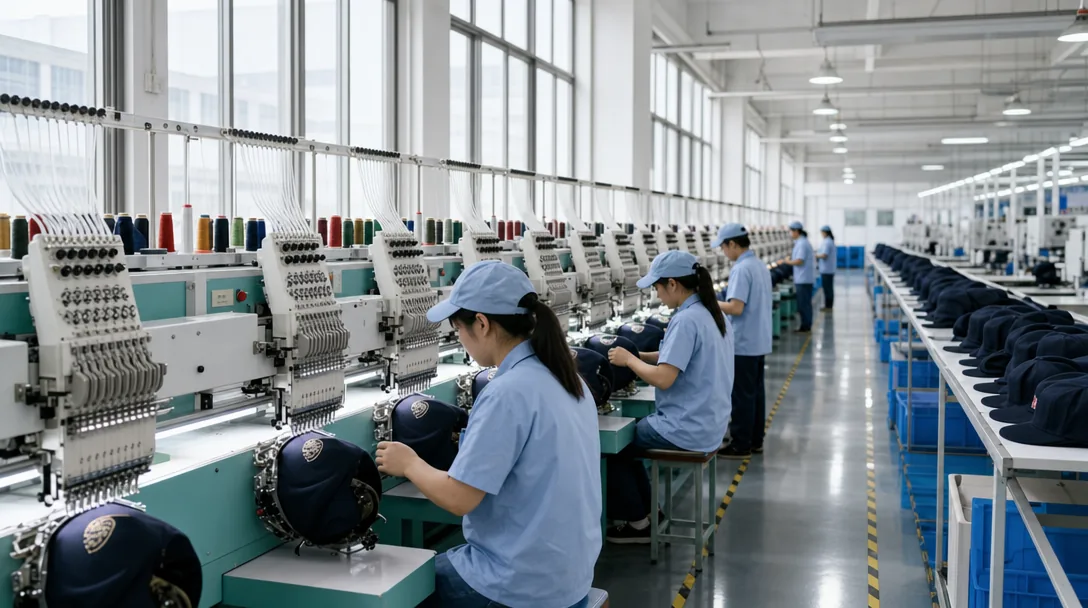
A quote for custom bulk trucker hats is only useful if the factory can prove its decoration limits before pricing. Ask for the embroidery room’s machine list, not just “we can embroider.” A serious custom hat manufacturer should be able to state whether they run Tajima, Barudan, or ZSK heads, their maximum stitch area on a 5-panel foam front versus a 6-panel structured front, and their normal stitch ceiling before puckering starts. On 100% polyester foam fronts, I usually keep dense front logos under 8,000–10,000 stitches unless we add heavier backing; on cotton twill fronts, 12,000–15,000 stitches is more realistic. For bulk custom embroidered hats, request a digitized stitch file preview, thread chart, and one physical sew-out photographed flat and on a cap block. If the supplier cannot explain 3D puff foam thickness, satin stitch width, or why tiny 2 mm letters fail on mesh-backed caps, they are guessing at your cost.
Fabric and panel construction checks should happen before anyone discusses branded bills custom hat cost, because the wrong front panel changes the whole hat. A proper bulk trucker hats fabric and trim spec guide should identify front fabric by fiber, weight, and finish: 260–320 gsm cotton twill, 150D polyester foam laminate, brushed canvas, ripstop nylon, or recycled polyester with GRS documentation. Mesh should be specified by denier and hand feel, not just “soft mesh”; 100D–150D polyester mesh behaves differently from stiffer nylon mesh when joined to a curved back panel. Confirm whether the factory can make 5-panel high crown, 6-panel mid crown, seamless foam front, or structured buckram front with fused interlining. Closure options also need real hardware samples: 7-hole plastic snapback, brass buckle, hook-and-loop, elastic strap, or recycled plastic snap. Pantone TCX fabric matching should be controlled to Delta-E under 1.5–2.0 for premium programs, though mesh lots often land closer to Delta-E 2.5.
Sample room capability separates factories from trading desks. Before approving bulk custom trucker hats, ask how many sample technicians handle pattern correction, embroidery placement, patch pressing, brim curve, and crown height adjustment. For woven patches, PVC patches, leather patches, sublimated patches, and heat-transfer logos, the supplier should provide temperature, pressure, and dwell-time settings; a common leatherette patch press is around 150–160°C for 12–18 seconds, but foam-front truckers can collapse if the operator over-presses. Our standard practice at CrownsForge is to issue one pre-production sample with a measured spec sheet covering crown height, visor length, sweatband width, seam allowance, and closure tolerance before cutting bulk fabric. Audit readiness matters too: BSCI 2.0, Sedex SMETA 4-Pillar, needle-control logs, metal detection records, and AQL 2.5 final inspection reports should be available without drama. Communication is the last filter in this bulk trucker hats fabric and trim spec guide: if the merchandiser cannot answer trim, MOQ, lead time, and FOB/DDP packaging questions within 24 hours, production will not get faster after deposit.
MOQ, pricing and sample approval
MOQ should be quoted in bands, not as one magic number, because fabric cutting, mesh dyeing, and embroidery setup all behave differently at 144, 300, 500, and 1,000 pieces. For bulk custom trucker hats, I usually treat 144 pcs as a development MOQ, 300 pcs as the first efficient production band, and 500–1,000 pcs as the point where unit cost starts moving down meaningfully. A basic 5-panel foam trucker with polyester mesh may run about US$3.20–4.80 FOB Ningbo at 300 pcs, while cotton twill front panels, sandwich visor, woven label, and metal buckle can push it to US$5.20–7.50. Decoration setup is separate: embroidery digitizing is commonly US$30–80 per logo, 3D puff may add US$0.30–0.70 per cap, and woven patches need mold or loom setup around US$50–120. In any bulk trucker hats fabric and trim spec guide, buyers should separate cap body cost, decoration cost, trim cost, and packaging cost before comparing suppliers.
PPS approval is where many custom bulk trucker hats go wrong, because buyers approve the silhouette but ignore measurable details. A proper pre-production sample should lock crown height within ±3 mm, visor length within ±2 mm, mesh gsm or denier, sweatband width, back closure type, seam tape color, and embroidery position. For color, I do not accept “navy” or “cream” as production language; use Pantone TCX for fabric, Pantone C for printed trims, and allow Delta-E under 1.5 for critical brand colors or under 2.0 for standard promotional orders. Embroidery needs a stitch count and density check, not just artwork approval. A 55 mm front logo may need 8,000–12,000 stitches on flat embroidery, while 3D puff often needs wider satin columns and fewer tiny details. Our standard practice at CrownsForge is to run PPS on the actual Tajima, Barudan, or ZSK head selected for production, then photograph thread sheen, backing, and inside finish before bulk release.
Lead time depends less on sewing speed than on unresolved trims and approvals. For bulk custom embroidered hats using stock fabric and stock mesh, a realistic timeline is 5–7 days for digital mockup and digitizing, 7–10 days for PPS, and 20–30 days for bulk after sample approval. Custom-dyed cotton twill, recycled polyester mesh, printed seam tape, rubber patches, or private-mold buckles can add 10–20 days. Packaging also changes the schedule and branded bills custom hat cost: a standard polybag may add US$0.05–0.08, a barcode sticker US$0.03–0.06, a custom carton mark is minor, but individual retail boxes can add US$0.35–0.90 and increase carton volume for FOB or DDP freight. A serious custom hat manufacturer should confirm AQL 2.5 final inspection criteria before production, including embroidery loose threads, visor symmetry, sweatband stains, closure function, and carton drop condition. Build one approval calendar and do not start bulk until PPS, Pantone references, stitch file, trims, and packing method are signed off.
Quality inspection and shipping risk
AQL inspection is where many bulk trucker hats get protected or rejected, so define it before cutting fabric. For custom bulk trucker hats, I normally use AQL 2.5 for major defects and AQL 4.0 for minor defects, with 100% checking on logo placement for licensed or retail programs. Critical defects include broken needles, mold, wrong legal label, unsafe staples, or mixed customer cartons. Major defects include embroidery off-center by more than 3 mm, bill shape distortion, mesh holes, panel puckering, sweatband twisting, or size outside tolerance. Crown height should usually stay within ±5 mm, bill length within ±3 mm, and back strap position within ±4 mm. If the buyer only approves a nice pre-production sample but never signs a written tolerance sheet, the factory and buyer will argue later over what “acceptable” means.
Color and embroidery risks should be tested, not judged under warehouse lighting. Fabric shade should be checked against Pantone TCX or a physical lab dip with a Delta-E target under 1.5 for solid cotton twill and under 2.0 for heather, washed, or recycled polyester fabrics. Mesh colorfastness needs dry and wet crocking tests, especially for black, navy, red, and fluorescent yarns; a grade 4 result is acceptable for most promotional hats, while premium retail should push for 4–5. Embroidery defects are usually caused before the Tajima, Barudan, or ZSK heads start running: bad digitizing density, wrong backing, loose hooping, or thread color substitution. For bulk custom embroidered hats, inspect thread breaks, bird-nesting, fill gaps, satin column width, 3D puff trimming, and logo tilt. In our CrownsForge QC files, every approved logo has stitch count, Madeira/Isacord thread codes, backing type, and machine tension notes attached to the reorder sheet.
Shipping risk is mostly documentation discipline. Carton markings should show PO number, style code, color, quantity, carton number, gross/net weight, carton size, and country of origin; for Amazon FBA or retail DC delivery, add barcode labels and carton position rules before packing starts. FOB Ningbo or Shanghai keeps freight control with the buyer and is cleaner for importers with their own forwarder, while DDP is easier for smaller branded bills custom hat cost planning but hides duty, port congestion, and final-mile surcharges inside one number. A realistic DDP air quote for 500 caps to the U.S. can add $2.20–$4.80 per cap, while sea freight becomes more sensible above 2,000–3,000 pieces if the delivery window allows 30–45 days. A proper bulk trucker hats fabric and trim spec guide should preserve the approved sample photos, fabric gsm, mesh denier, button color, snapback mold, bill insert thickness, embroidery file, carton layout, and final inspection report so reorders do not drift season by season.
Buyer checklist for the next RFQ
A firm RFQ for trucker caps starts with a construction sheet, not a mood board. Send the cap profile first: 5-panel foam trucker, 5-panel structured, 6-panel mid-profile, or Richardson-style 112 clone; then list crown height in cm, visor type, seam tape color, sweatband material, closure, and mesh spec. For fabric, do not write “cotton front” unless you are fine with price drift. State 100% cotton twill 260 gsm, poly-cotton 65/35 at 230 gsm, brushed chino, foam laminated polyester, or recycled polyester with GRS request. Mesh should include fiber, denier if known, hole size preference, and stiffness target. This is the backbone of a bulk trucker hats fabric and trim spec guide because each one of these choices moves tooling, wastage, MOQ, and packing cost.
Send artwork in production format before asking any custom hat manufacturer for a fixed price. For embroidery, we need vector AI, EPS, or clean PDF, plus thread color references using Madeira, Isacord, or Pantone TCX where possible; a JPG logo pulled from Instagram is not enough for digitizing. Include logo size in mm, placement, stitch type preference, and whether puff embroidery, flat embroidery, woven patch, leather patch, PVC patch, or heat transfer is required. Bulk custom embroidered hats can swing from about $0.35 for a small flat front logo to $1.80 or more for high-density 3D puff with side embroidery, depending on stitch count and thread changes on Tajima, Barudan, or ZSK heads. If you have an approved sample, send front, side, back, inside, and bill underside photos under neutral light.
Your RFQ should also include quantity breaks, delivery term, destination, compliance needs, and inspection standard. Ask for pricing at 144, 300, 600, 1,200, and 3,000 pcs if you are unsure; the branded bills custom hat cost changes sharply once fabric cutting and embroidery setup are spread across larger lots. State FOB Ningbo/Shanghai, EXW Yiwu, DDP Los Angeles, or DDP EU, and include carton mark requirements if the order ships to Amazon FBA or retail DCs. For custom bulk trucker hats, confirm whether you need BSCI 2.0, Sedex SMETA 4-Pillar, CPSIA, Prop 65, REACH, or recycled-content paperwork. Our standard practice at CrownsForge is to quote against AQL 2.5 major / 4.0 minor assumptions unless the buyer specifies tighter inspection, because lower defect tolerance means more inline QC time and a different real cost.
Working with CrownsForge
QC and export coordination start before cutting fabric, not after cartons are packed. We inspect incoming twill, mesh, buckram, snaps, and sweatband rolls for shade banding, oil marks, mesh holes, and shrinkage; then inline inspectors check panel symmetry, bill alignment, stitch density, sweatband seam catching, and embroidery placement tolerance within 2 mm on the front panel. Final inspection is normally AQL 2.5 for major defects and AQL 4.0 for minor defects, with carton drop checks, barcode scans, polybag warning text, and metal detection when required by sports-team or retail programs. A custom hat manufacturer handling export should also coordinate HS code, carton cube, FOB or DDP terms, and audit paperwork such as BSCI 2.0 or Sedex SMETA 4-Pillar. For the bulk trucker hats fabric and trim spec guide workflow, the cleanest handoff is a single tech pack plus approved physical sample; verbal approvals are where factories lose money and buyers lose delivery weeks.
Frequently Asked Questions
What logo decoration techniques do you offer?
3D puff embroidery, flat embroidery, woven patch, leather patch, PVC patch, screen printing, sublimation, applique and laser etching, all in-house with no subcontracting.
What file format should I send for my logo?
Vector files (AI, EPS, PDF) are ideal. High-resolution PNG or JPG at 300 dpi on transparent background works as a fallback. Provide Pantone color references for accurate reproduction.
Can I order a sample before bulk production?
Yes. We strongly recommend approving a pre-production sample before mass production. Samples are charged at 35 to 60 USD each plus express shipping, fully refundable against confirmed bulk orders over 500 pieces.
How long does production take?
Sampling takes 7 to 12 days. Bulk production runs 20 to 30 days depending on quantity, fabric availability and decoration complexity. Inspection and packing adds another 3 to 5 days before shipment.
Do you support sustainability certifications?
Yes. We work with GOTS organic cotton, GRS-certified recycled polyester, OEKO-TEX Standard 100 fabrics, and are BSCI and Sedex audited. Certification documentation can be provided per order.
How does ordering custom embroidered trucker hat work?
When evaluating custom embroidered trucker hat, the key considerations are construction quality, decoration capability, MOQ flexibility and lead time. Explain the buyer intent behind bulk trucker hats fabric and trim spec guide, when it differs from generic hat sourcing, and what decisions affect cost, lead time and compliance. Describe how CrownsForge manages bulk trucker hats fabric and trim spec guide programs with sampling, decoration, QC and export coordination.
What should I know about custom trucker hats bulk?
When evaluating custom trucker hats bulk, the key considerations are construction quality, decoration capability, MOQ flexibility and lead time. Explain the buyer intent behind bulk trucker hats fabric and trim spec guide, when it differs from generic hat sourcing, and what decisions affect cost, lead time and compliance. Describe how CrownsForge manages bulk trucker hats fabric and trim spec guide programs with sampling, decoration, QC and export coordination.
What's the MOQ for custom embroidered trucker hats no minimum?
When evaluating custom embroidered trucker hats no minimum, the key considerations are construction quality, decoration capability, MOQ flexibility and lead time. Explain the buyer intent behind bulk trucker hats fabric and trim spec guide, when it differs from generic hat sourcing, and what decisions affect cost, lead time and compliance. Describe how CrownsForge manages bulk trucker hats fabric and trim spec guide programs with sampling, decoration, QC and export coordination.
What should I know about custom rope hat wholesale bulk?
When evaluating custom rope hat wholesale bulk, the key considerations are construction quality, decoration capability, MOQ flexibility and lead time. Explain the buyer intent behind bulk trucker hats fabric and trim spec guide, when it differs from generic hat sourcing, and what decisions affect cost, lead time and compliance. Describe how CrownsForge manages bulk trucker hats fabric and trim spec guide programs with sampling, decoration, QC and export coordination.
Ready to start your custom hat project?
Send us your tech-pack, sketch or even just an inspiration photo. We will respond with a detailed quotation and digital mock-up within 24 hours.
Request a free quoteRelated guides
Rave Bucket Hat: A Vertical-Specific Sourcing Guide
Read article →
Custom Made Trucker Hat: The 2026 Sourcing & Manufacturing Playbook
Read article →
Promotional Caps & Corporate Gifts: Bulk Custom Hats for Brand Events
Read article →Sourcing custom hats does not have to be complicated. With the right manufacturing partner, clear specifications and a small upfront investment in sampling, you can launch a retail-quality product in 30 to 45 days.