
Bulk Trucker Hats Fabric And Trim Spec Guide for Custom Hat Buyers - Cost & MOQ Breakdown
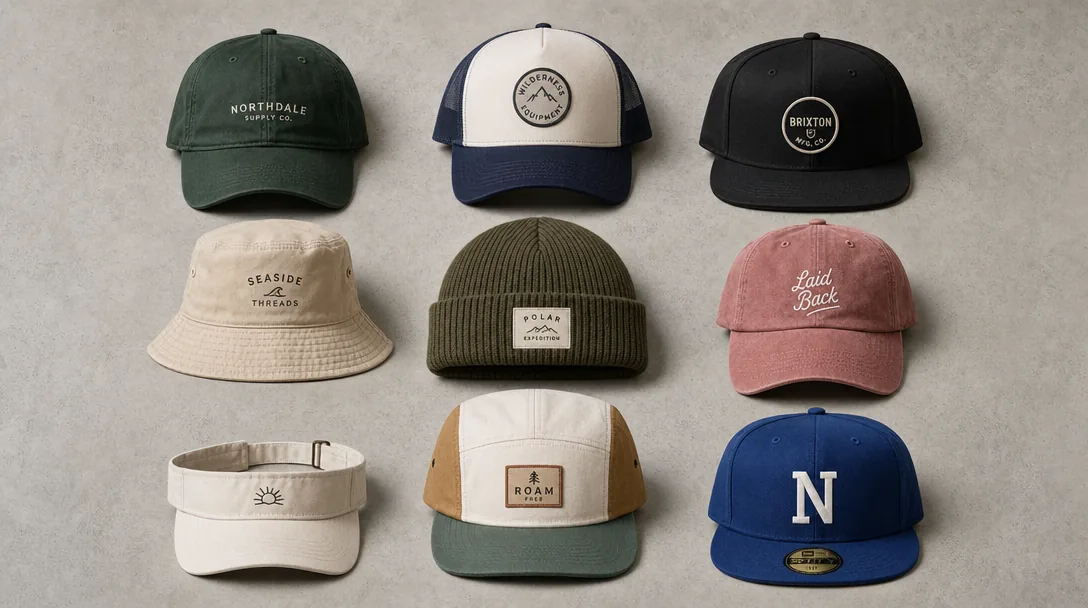
Every week, our sales team answers detailed questions about bulk trucker hats fabric and trim spec guide for custom hat buyers - cost & moq breakdown. We wrote this guide so that wholesalers, streetwear brands, corporate buyers and promotional resellers can compare options with full information, and avoid the traps that show up only after production has started.
Why bulk trucker hats fabric and trim spec guide needs a separate sourcing plan
A bulk trucker hats fabric and trim spec guide has to function as a sourcing map, not a style note. A trucker cap usually breaks into five buying lines: front panel fabric, mesh back, visor build, closure, and internal trims such as sweatband, seam tape, and label. Each line carries its own MOQ, lead time, defect risk, and price break. Swap a front panel from 230 gsm cotton twill to 195 gsm poly-cotton and you are not making a cosmetic tweak; you are changing embroidery stability, hand feel, and FOB by roughly $0.18 to $0.35 per piece at 5,000 units. Mesh is equally sensitive. A 100% polyester mesh in 75D to 100D yarn can vary widely in open area and stiffness, which changes breathability, crown recovery after packing, and how clean the cap sits on the head.
The visor and closure are where buyers usually get surprised, because both affect appearance and tooling. A curved visor with cardboard stiffener is cheaper than a PE board or molded plastic insert, but it behaves differently under heat and pressure, so that decision needs to be locked before bulk cutting starts. If the front panel color has to match the visor under D65 light, the spec should call out Pantone TCX and a Delta-E target of 1.0 to 1.5; otherwise the cap reads off-tone on retail racks even when the supplier claims the shade is close. Snap closures are not interchangeable either: custom-color plastic snaps often need injection tooling and a 10- to 15-day setup, while metal buckles add plating cost and typically lift unit price by about $0.09 to $0.16 depending on finish and plating thickness. Split those approvals early, or the MOQ problem only shows up after sampling.
Lead-time risk usually sits in the mesh and trim, not the embroidered front. Stock black, white, and navy mesh can usually ship within 7 days from mills around Shaoxing and Hangzhou, but custom-dyed mesh often needs a 200 kg dye lot and adds 12 to 15 days before cutting. That matters because embroidery digitizing should be frozen before fabric orders are released; a front panel that is too light, too soft, or too stretchy will distort once thread density climbs past about 12,000 stitches per panel on Tajima, Barudan, or ZSK heads. The practical sequence is to lock artwork and stitch count first, then approve fabric weights and trim samples, then place the bulk PO. Done in that order, a 45-day program stays close to 45 days instead of sliding past 70 because one buckle, one mesh lot, or one color approval was sourced out of sequence.
Factory capability checks before quoting
Do not ask for price until the factory proves it can actually build the spec you are sending. In a real bulk trucker hats fabric and trim spec guide, the first check is machine and sample-room capability: Tajima, Barudan, or ZSK heads with 12 to 15 needles, 800 to 1,000 SPM, and stable registration on dense fills up to about 250,000 stitches without constant thread breaks or bobbin burn. If your logo has letter heights under 6 mm, require a pre-production strike-off and a measured color target, not a vague promise that it will be "close." For branded colors, Delta-E under 2.0 is the workable standard; once you move into 3,000 to 10,000 piece territory, a factory that cannot hold that range will turn a small shade shift into a rejection fight. Ask whether they can form your silhouette in-house too, because 5-panel foam-front, 6-panel structured, and unstructured cotton twill caps use different blocking and molding setups. If they are borrowing dies or improvising crown shaping, expect schedule slippage and a tooling surcharge around $0.15 to $0.30 per unit.
Trim is where a lot of weak suppliers hide the real cost. Snapback, Velcro, and metal buckle closures are not line-for-line substitutes, because each one changes back-strap stock, rivet count, stitch order, and final QC time. Custom trim usually pushes MOQ to 500 to 1,000 pieces per colorway once you add woven labels, branded loops, or special buckle plating, and that number is not negotiable just because the quotation says otherwise. Spell out the build: front panels are typically 100% cotton twill or 100% polyester brushed canvas at 180 to 220 gsm, while mesh should be 100% polyester, usually 150D to 300D, with openness matched to the target price point. For the visor, ask whether the insert is cardboard, plastic, or EVA, and whether the bill is pre-curved or heat-shaped after sewing; that decision alone can move cost by roughly $0.08 to $0.12 per hat. A competent sample room should turn a corrected embroidery or 3D puff prototype in 5 to 7 business days, with stitch-density changes written into the record instead of guessed at the machine.
Audit and inspection checks are where weak factories usually give themselves away. If a supplier claims sedex-audit-cap-supplier-guide.html">BSCI 2.0 or Sedex SMETA 4-Pillar, ask for the current report with the audit date, scope, and listed nonconformities, not a logo pasted into a sales deck. You also want their QC method in writing: AQL 2.5 is standard for major defects, but the real issue is how they classify critical defects on open seams, crooked visors, bad closures, loose thread tails, or visible color variance. On the material side, the sales team should be able to explain 210T versus 230T mesh, whether Pantone TCX is matched by dyed yarn or printed trim, and how much lead time a re-dyed component adds before sewing can start. If those answers stay vague, you are probably dealing with a trading desk rather than the plant. The reason this matters is simple: hidden rework on bills, back straps, and embroidery setup can add $0.20 to $0.45 per unit after the order is already supposedly locked, which is exactly the kind of surprise a good quote should prevent.
MOQ, pricing and sample approval
MOQ is the lever that changes the whole quote, so pin it down before comparing suppliers. In a bulk trucker hats fabric and trim spec guide, a 300 to 500 piece order is the usual entry point for a basic 5-panel foam front or cotton twill crown with standard polyester mesh. At that level, expect about $2.80 to $4.20 FOB per cap because cutting loss, thread handling, and setup are still heavy on a small run. Once you move to 1,000 to 3,000 pieces, the same build usually drops into the $1.90 to $3.10 FOB range, assuming you are not adding molded PVC patches, sandwich brims, or unusual closures. The cost jump is rarely just decoration; it is also extra knife time, slower sewing on mixed trims, and more inspection at panel joins, visor seams, and snapback points.
A decoration quote is only usable if it separates machine time from prep work. A 10,000-stitch front logo on a Tajima, Barudan, or ZSK head is standard, but digitizing, path cleanup, and density correction still run about $20 to $60 per design, or $35 to $90 when the art has small serif text, tight counters, or multiple cap sizes. For color control, use Pantone TCX for fabric panels and the coated system for prints or patches, then check against a realistic Delta-E target under 2.0 for cut fabric and under 3.0 for sewn components. That matters because thread, mesh, and woven labels never match a fan deck exactly. On cap embroidery, 3.8 to 4.2 stitches per mm is the normal band; pushing past 4.5 usually causes foam fronts to pucker, seam lines to shift, and the crown to collapse around the stitch field.
PPS approval is where you catch the expensive mistakes before they become scrap. A proper pre-production sample should confirm crown height, front panel stiffness, mesh gauge, visor curve, sweatband width, seam tape, closure hardware, and label placement before bulk cutting starts. Small trim changes still move the number: a woven sandwich bill, contrast eyelets, or a custom snapback clip can add about $0.08 to $0.35 per piece, while packaging usually adds another $0.12 to $0.45 depending on polybag, size sticker, insert card, and hangtag. Seven to 12 days is realistic for sampling, 18 to 25 days is normal for bulk on a repeat order, and 30 to 40 days is more honest when fresh fabric sourcing, lab dips, or a second PPS round is needed. Our standard practice is to lock trim specs before approval, because last-minute label or closure swaps are what blow up both the price and the ship date.
Quality inspection and shipping risk
Shipping risk is mostly carton discipline and document matching, not some abstract freight problem. Every master carton should carry the style code, colorway, size breakdown, carton number, gross and net weight, country of origin, and the exact quantity inside; those markings need to match the packing list, commercial invoice, and export declaration line for line. Under FOB, the buyer takes freight and insurance risk once the load is handed to the carrier at port, so the forwarder needs to understand VGM cutoffs, HS code filing, and cubic measurement accuracy, not just quote a low ocean rate. Under DDP, the seller absorbs destination clearance, last-mile delivery, and duty volatility, which is why quotes usually carry a 12% to 20% cushion. A good bulk trucker hats fabric and trim spec guide should also lock the carton spec, the polybag gauge, and the approved label artwork so the shipment does not fail on paperwork after passing QC.
The inspection file has to define rejection handling before a single carton is sealed. If a lot misses tolerance, the corrective action should name the defect class, the rework method, the sample size for recheck, and the pass threshold under the same AQL plan, usually AQL 2.5 for majors and 4.0 for minors on apparel-style goods. That matters for trucker hats because the common failures are measurable: crown height off by 3 to 5 mm, visor curve inconsistent by more than 1.0 cm, mesh color drifting past Delta-E 2.0, or embroidery registration wandering on a Tajima, Barudan, or ZSK head. Rework needs to say whether a crown panel is resewn, a visor insert is swapped, or a whole batch is re-sampled. Without that, the factory will argue the tolerance after the cartons are already on the floor, which is where small mistakes become chargebacks.
Final pack checks are where weak specs usually show up. Buyers should require carton compression limits, 3-ply or 5-ply board spec, tape pattern, polybag thickness in microns, silica gel count, and whether each hat ships with a hangtag, care label, or barcode sticker in a fixed position. Moisture is a real issue on sea freight, so a packed carton should stay below 12% moisture content in the paper components and be sealed cleanly enough that crushed bills or damp crowns do not appear at destination. Our standard practice is to archive PPS photos, measurement sheets, fabric and thread references, trim Pantones, carton specs, and failed inspection notes with the PO so the next reorder does not drift half a size, one shade, or a different carton count. That record turns the spec into a control document, not just a quote attachment.
Buyer checklist for the next RFQ
A usable RFQ starts with a completed bulk trucker hats fabric and trim spec guide, not a logo file and a guess. Lock the architecture first: 5-panel or 6-panel, target crown height in millimeters, front panel construction, back mesh type, bill curve or flat profile, and closure style. State the order quantity by colorway and whether the front needs foam, hard buckram, or lighter fusible interfacing for embroidery support. A 5-panel foam-front trucker with a 130 mm crown is not the same build as a soft 6-panel with a 110 mm crown and flat bill, and the price gap is commonly 15% to 30% once labor and material inputs are real. If the buyer leaves structure open, the factory is quoting assumptions, not a production number.
The RFQ also needs the files and dimensions production actually uses. Send vector artwork in AI, EPS, or layered PDF, plus Pantone TCX or Pantone C references for every visible color, including underbill, mesh, and trim if they matter. Add embroidery placement in millimeters, final logo size, and stitch count if you have it; dense fills, satin columns, and small text change digitizing time on Tajima, Barudan, and ZSK heads. Include close-up references for the closure, sweatband width, woven label, seam tape, and private-label packing. If the bill needs print or embroidery, specify whether the panel is structured or soft, because underlay, registration risk, and unit cost all move with that decision.
The last part is production control, and it is where many RFQs fall apart. State MOQ per color, target fabric weight in gsm, mesh density in denier, and any shade tolerance, usually Delta-E under 2.0 for replenishment programs. If the account needs audited production, name the standard up front, such as BSCI 2.0 or Sedex SMETA 4-Pillar, so the factory knows what documents and factory records to prepare. Ask for a pre-production sample, a size spec sheet, and a quote split by unit price, embroidery digitizing, labeling, carton packing, and freight terms like FOB or DDP. That level of detail turns the RFQ into a build sheet, which is how you get a quote a factory can actually hold instead of a placeholder that changes after sampling.
Working with CrownsForge
For a bulk trucker hats fabric and trim spec guide to work at scale, lock the crown fabric, mesh, sweatband, and closure before anyone starts digitizing the logo. A 100% cotton twill front panel at 190 to 240 gsm is the cleanest option when the buyer wants better hand feel and steadier dye control; a polyester-cotton twill at 210 to 230 gsm is usually safer on shrinkage and heat-press stability. Back mesh should not be left vague. Specify 100D to 150D polyester mesh with a defined aperture, typically 6 x 6 for a retail look or 8 x 8 for a lighter promotional build. The BOM should also call out underbill fabric, interior seam tape, woven label, size tab, and closure hardware. Those trim choices move unit cost by roughly $0.08 to $0.45 per cap, which is meaningful on 5,000 to 20,000 piece orders and is exactly where vague specs turn into margin leakage.
Sampling should be treated as a production trial, not a presentation sample. The first round needs to verify logo placement, Pantone TCX thread mapping, and stitch density on Tajima, Barudan, or ZSK embroidery heads, because dense fills can crush foam fronts or pull twill off grain. On foam-front truckers, I would usually keep embroidery under 7,000 to 9,000 stitches unless the front panel has the right backing and underlay; beyond that, the face can collapse after steam shaping and trimming. Measure crown height, brim curve, snapback spacing, and panel symmetry on the sample, because a cap that sits fine on a table can still drift once the line runs 1,000 units. Our standard practice is to quote blank cap cost, decoration, and packaging separately so buyers can see where the money is going instead of getting one blended number.
QC and export should run as one chain. Inspect to AQL 2.5 for major defects and watch shade drift, mesh skew, loose threads, crooked snaps, and off-center embroidery before cartons are sealed. Keep a sealed golden sample, a measurement sheet with crown height, visor length, and snapback spacing, plus carton marks tied to the PO so the factory, inspection team, and freight forwarder are working from the same reference. BSCI 2.0 or Sedex SMETA 4-Pillar status matters when the order is going into retail or licensed channels, but the real test is whether the lot can ship without rework, claims, or chargebacks. Final packout, HS code paperwork, and FOB or DDP handoff should be coordinated together, because that is what lets buyers compare MOQ, sampling lead time, and landed cost across vendors without guessing what was left out of the quote.
Frequently Asked Questions
How long does production take?
Sampling takes 7 to 12 days. Bulk production runs 20 to 30 days depending on quantity, fabric availability and decoration complexity. Inspection and packing adds another 3 to 5 days before shipment.
Do you support sustainability certifications?
Yes. We work with GOTS organic cotton, GRS-certified recycled polyester, OEKO-TEX Standard 100 fabrics, and are BSCI and Sedex audited. Certification documentation can be provided per order.
What file format should I send for my logo?
Vector files (AI, EPS, PDF) are ideal. High-resolution PNG or JPG at 300 dpi on transparent background works as a fallback. Provide Pantone color references for accurate reproduction.
What is the minimum order quantity (MOQ) for custom hats?
Our standard MOQ is 100 pieces per design and color, with sampling available from 1 piece. For complex multi-color logos or premium fabric upgrades, the MOQ can be lowered with a small per-piece surcharge.
Can I order a sample before bulk production?
Yes. We strongly recommend approving a pre-production sample before mass production. Samples are charged at 35 to 60 USD each plus express shipping, fully refundable against confirmed bulk orders over 500 pieces.
How does ordering custom embroidered trucker hat work?
When evaluating custom embroidered trucker hat, the key considerations are construction quality, decoration capability, MOQ flexibility and lead time. Explain the buyer intent behind bulk trucker hats fabric and trim spec guide, when it differs from generic hat sourcing, and what decisions affect cost, lead time and compliance. Describe how CrownsForge manages bulk trucker hats fabric and trim spec guide programs with sampling, decoration, QC and export coordination.
What should I know about custom trucker hats bulk?
When evaluating custom trucker hats bulk, the key considerations are construction quality, decoration capability, MOQ flexibility and lead time. Explain the buyer intent behind bulk trucker hats fabric and trim spec guide, when it differs from generic hat sourcing, and what decisions affect cost, lead time and compliance. Describe how CrownsForge manages bulk trucker hats fabric and trim spec guide programs with sampling, decoration, QC and export coordination.
What's the MOQ for custom embroidered trucker hats no minimum?
When evaluating custom embroidered trucker hats no minimum, the key considerations are construction quality, decoration capability, MOQ flexibility and lead time. Explain the buyer intent behind bulk trucker hats fabric and trim spec guide, when it differs from generic hat sourcing, and what decisions affect cost, lead time and compliance. Describe how CrownsForge manages bulk trucker hats fabric and trim spec guide programs with sampling, decoration, QC and export coordination.
What should I know about custom rope hat wholesale bulk?
When evaluating custom rope hat wholesale bulk, the key considerations are construction quality, decoration capability, MOQ flexibility and lead time. Explain the buyer intent behind bulk trucker hats fabric and trim spec guide, when it differs from generic hat sourcing, and what decisions affect cost, lead time and compliance. Describe how CrownsForge manages bulk trucker hats fabric and trim spec guide programs with sampling, decoration, QC and export coordination.
Looking for a reliable hat manufacturer in China?
CrownsForge has produced custom hats for 800+ brands across 40 countries. From 100-piece launches to 100,000-piece retail programs, we deliver on time and on spec.
Get in touchRelated guides
Custom Leather Patch Hat Low Minimum: A 2026 B2B Sourcing Guide
Read article →
Mens Beanies: Properties, Costs and How to Spec It Right
Read article →
Bulk Trucker Hats Export Shipping Checklist for Custom Hat Buyers - Cost & MOQ Breakdown - Supplier Checklist
Read article →We hope this guide demystifies bulk trucker hats fabric and trim spec guide for custom hat buyers - cost & moq breakdown and helps you move forward with confidence. If you have questions specific to your project, our English-speaking sales engineers are one message away.