
Bucket Hat Corduroy Retail Packaging Guide for Custom Hat Buyers
Every week, our sales team answers detailed questions about bucket hat corduroy retail packaging guide for custom hat buyers. We wrote this guide so that wholesalers, streetwear brands, corporate buyers and promotional resellers can compare options with full information, and avoid the traps that show up only after production has started.
Why bucket hat corduroy retail packaging guide needs a separate sourcing plan
A buyer searching for a bucket hat corduroy retail packaging guide is usually past the “can you make this hat?” stage and is trying to protect sell-through margin at the shelf, warehouse, or TikTok unboxing level. Corduroy is not like a flat cotton twill cap: the wale direction, pile crush, lint pickup, and color shading under retail lighting all affect perceived quality before the customer even touches the product. A 14-wale or 21-wale corduroy bucket hat packed too tightly in a master carton can arrive with pressure marks around the crown that steaming will not fully remove. For a corduroy hat brown shade, we normally control fabric color by Pantone TCX plus Delta-E under D65 light, because brown shifts badly between warm store lighting and daylight photography. That is why packaging needs to be sourced alongside fabric, trims, and folding method, not treated as a last-week carton decision.
Generic hat sourcing focuses on pattern, fabric, logo execution, and FOB price; retail packaging adds a second bill of materials and a second quality risk. A loose polybag may cost $0.03–$0.06, but a printed frosted zipper bag, hangtag, barcode sticker, silica gel, tissue insert, and reinforced carton divider can add $0.22–$0.65 per piece before labor. If the buyer wants FSC paper belly bands, soy-ink hangtags, or a plastic-free organic cotton hat presentation, lead time often extends 7–12 days because packaging suppliers need plate setup, color proofing, and barcode verification. At CrownsForge, our standard practice is to lock the folding sample, inner pack, and export carton drop-test format before bulk cutting corduroy, because changing pack height later can change carton cube and DDP freight cost by 8–18%.
Compliance also changes once packaging becomes retail-ready. Promotional buyers may accept a master polybag and neutral carton, but department stores, licensed sports channels, and Amazon FBA need UPC/EAN placement, suffocation warnings, country-of-origin labels, carton marks, and sometimes CPSIA or Prop 65 review depending on trims and coatings. If the same line includes a corduroy bucket hat, cotton beanie men styles, and an organic cotton hat, each SKU needs separate barcode control and mixed-carton rules to avoid chargebacks. Inspection should not stop at AQL 2.5 for stitching and embroidery; packaging defects need their own checklist for crushed brim shape, lint contamination, wrong sticker position, unreadable barcode scan, and carton compression. A proper bucket hat corduroy retail packaging guide therefore affects unit cost, packing labor, sampling timeline, audit trail, and final landed margin—not just how the product looks in a bag.
Factory capability checks before quoting
Capability checks should happen before price, because a cheap quote means nothing if the factory cannot control corduroy distortion. For a bucket hat corduroy program, ask which embroidery machines they run and how they stabilize wale fabric: Tajima, Barudan, or ZSK heads are all workable, but the operator must use the right backing, hoop tension, and needle size, usually 75/11 or 80/12 depending on logo density. A 6,000-stitch flat embroidery on corduroy can look clean; a 14,000-stitch filled badge often sinks between the ribs unless digitized with underlay compensation. For patches, confirm whether they can do woven labels, merrowed edge patches, faux leather, rubber PVC, chenille, and heat-transfer badges, and ask for pull-test results after pressing. A real sample room should show stitch files, strike-offs, Pantone TCX references, and Delta-E tolerance, not just photos from old orders.
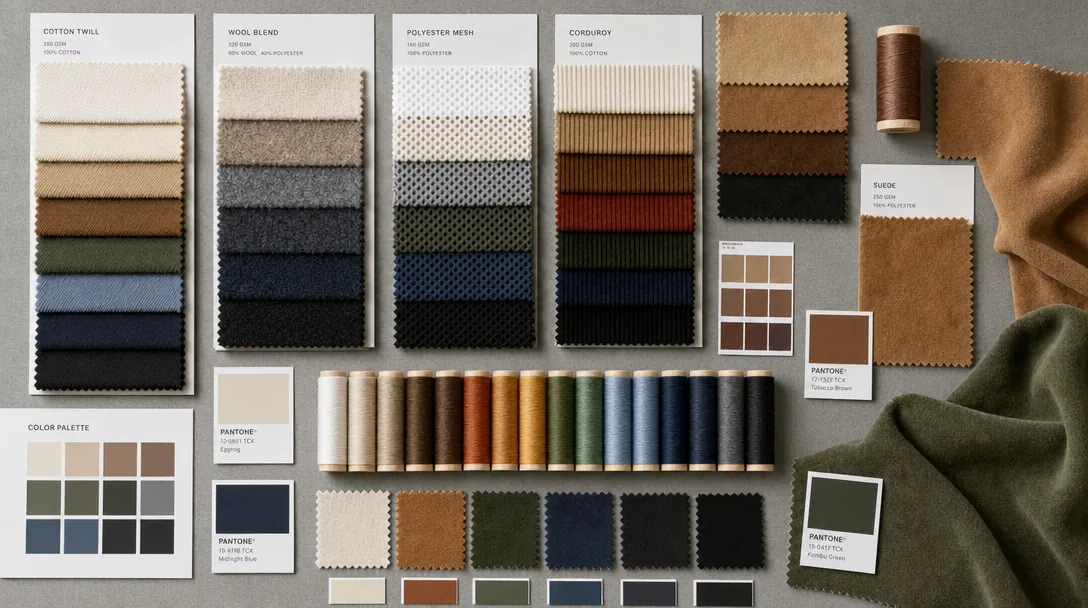
Fabric and construction checks are where many corduroy bucket hat projects fail. You need to know the corduroy count, weight, fiber content, and shrinkage: common retail grades are 8-wale or 11-wale cotton corduroy at 260–320 gsm, while organic cotton hat programs need GOTS or OCS transaction documents if the claim will appear on packaging. If the buyer asks for a corduroy hat brown, I would require lab dips under D65 light and compare against Pantone 19-1116 TCX or the buyer’s brand standard, with bulk approval at Delta-E below 1.5 for premium retail. Panel construction also matters: 4-panel bucket hats have fewer seam breaks and better embroidery placement, while 6-panel versions shape better but increase labor by roughly $0.18–$0.35 per piece. Ask whether the brim uses single-needle rows, double rows, or 6–8 concentric stitch lines, because that affects both shape retention and packing deformation.
For a proper bucket hat corduroy retail packaging guide, I would also screen closure options, sample discipline, audit readiness, and communication speed before issuing a firm FOB or DDP quote. Bucket hats usually have no closure, but buyers may request chin cords, stoppers, sweatband size labels, adjustable drawcords, or elastic sweatbands; each option changes the BOM and AQL inspection points. A capable sample room should turn a first proto in 5–7 working days, a salesman sample in 7–10 days after trims arrive, and keep revision notes by version number rather than vague WhatsApp comments. Audit readiness is not cosmetic: ask for current sedex-audit-cap-supplier-guide.html">BSCI 2.0, Sedex SMETA 4-Pillar, fire safety records, needle-control logs, and subcontractor disclosure. Our standard practice at CrownsForge is to confirm all decoration, fabric, packaging, barcode, and carton-drop requirements before quoting, because mixing bucket hats with unrelated items like cotton beanie men in one PO can create very different packing and QC risks.
MOQ, pricing and sample approval
MOQ is where most custom hat buyers underestimate the real cost curve. For a bucket hat corduroy program, I normally quote three bands: 300–499 pcs for market testing, 500–999 pcs for cleaner factory efficiency, and 1,000+ pcs when dye lot, cutting yield, and packaging labor finally stabilize. A 300 pc run can work, but expect a higher unit price because corduroy cutting has nap direction control and more panel waste than flat cotton twill. A basic 8-wale or 11-wale cotton corduroy bucket hat with woven label usually lands around USD 4.20–6.80 FOB Ningbo/Shanghai at 500 pcs, depending on lining, brim stitching, and trims. Decoration setup is separate: embroidery digitizing is typically USD 35–60 per logo, Tajima or Barudan machine setup around USD 25–45 per colorway, and woven label mold or jacquard setup USD 50–90. Small buyers often compare this to an organic cotton hat or cotton beanie men program, but corduroy needs stricter shade and pile control, especially in dark brown, olive, and black.
PPS approval should happen before bulk cutting, not after fabric is already committed. For this bucket hat corduroy retail packaging guide, I would lock five things at PPS stage: crown height tolerance, brim width, panel seam balance, embroidery stitch density, and retail pack-out. Pantone matching should reference Pantone TCX for fabric, not coated paper chips; for a corduroy hat brown, we usually accept Delta-E under 1.5 for lab dip approval, but anything above 2.0 will look like a different SKU under retail lighting. Embroidery density also matters on corduroy because the pile can swallow fine detail. On ZSK or Tajima heads, a front logo often needs 0.38–0.45 mm stitch spacing and underlay adjusted so the letters do not sink into the wale. If the buyer wants tonal embroidery, I always ask for a physical thread card against the approved fabric cutting, because photos hide metamerism. Trims should be approved together: sweatband gsm, care label content, size sticker adhesive, hangtag string, barcode label, and polybag warning print.
Retail packaging changes both MOQ and lead time because it adds suppliers outside the sewing line. A plain OPP bag with suffocation warning is easy at 300 pcs, but printed zip bags usually need 1,000 pcs MOQ, custom kraft boxes often start at 500–1,000 pcs, and FSC hangtags can add USD 0.08–0.18 per hat depending on paper weight and spot UV. Our standard practice at CrownsForge is to run AQL 2.5 final inspection after hats are steamed and shaped, then inspect packaging separately for barcode scan rate, carton mark accuracy, and crush damage. Realistic timing is 5–7 days for artwork cleanup and digitizing, 7–10 days for fabric lab dip or stock-fabric confirmation, 7–12 days for PPS making and buyer comments, then 25–35 days for bulk production after deposit and PPS approval. Add 5–8 days if custom retail packaging is printed, and do not book FOB vessel space until the PPS is signed. A good bucket hat corduroy retail packaging guide should protect launch dates, not just make the unit price look tidy on a spreadsheet.
Quality inspection and shipping risk
Quality failures in a bucket hat corduroy order usually show up after packing, not during sewing, so inspection has to be staged. For retail programs, I would use AQL 2.5 for major defects and AQL 4.0 for minor defects, with carton-pull sampling after final packing instead of only checking loose hats on the line. Crown height, brim width, circumference, and label placement need written tolerances: ±0.5 cm on brim and crown, ±1.0 cm on head circumference, and no more than 2 mm skew on woven labels or leather patches. Corduroy pile direction must be checked under the same light angle because a corduroy hat brown can look like two different shades if panels are cut against nap. For Pantone TCX color approval, I would allow Delta-E under 1.5 for solid dyed fabric and under 2.0 for washed corduroy bucket hat styles, because enzyme or stone washing always opens the shade slightly.
Colorfastness and decoration checks are where buyers save rework money. A bucket hat corduroy fabric should pass dry rubbing at grade 4 and wet rubbing at grade 3–4 under ISO 105-X12; dark brown, black, and burgundy corduroy need extra attention because loose dye can transfer onto white retail tissue or inner sweatbands. If the order includes embroidery, inspect thread breaks, bird-nesting, registration, backing show-through, and puckering around dense logos. Tajima, Barudan, and ZSK heads can all run clean embroidery, but bad digitizing will still sink the panel: keep fill density around 0.38–0.42 mm for medium logos and use cutaway backing when the wale is thick. Our standard practice at CrownsForge is to keep approved embroidery stitch files, thread color codes, and production photos with the reorder file, the same way we archive wash labels and organic cotton hat certification claims.
Shipping risk is mostly documentation discipline. Every export carton should show PO number, style code, color, size ratio, quantity, gross/net weight, carton dimensions, country of origin, and carton sequence, such as 1/38, 2/38. For retail bucket hat corduroy packaging, confirm whether hats are flat-packed, nested with tissue, or supported with paper forms; aggressive compression saves 8–15% freight cost but can crush brim shape and leave corduroy pressure marks. FOB Ningbo or Shanghai gives experienced importers control over forwarders and insurance, while DDP is easier for streetwear brands but often hides brokerage, duty classification, and remote delivery surcharges. Reorder documentation should include carton specs, barcode placement, polybag warning text, hangtag version, Pantone TCX references, fabric gsm, wale count, and approved sample comments. Do not mix unrelated winter styles like cotton beanie men in the same retail carton unless the packing list and customs description are clean.
Buyer checklist for the next RFQ
A firm RFQ starts with the hat spec, not with a target price. For a bucket hat corduroy retail packaging guide, send the finished circumference in cm, brim width, crown height, panel count, lining requirement, and whether the brim needs soft, medium, or reinforced hand feel. For corduroy bucket hat production, we need wale count, fabric weight, fiber content, and color standard: “brown” is not enough, so give Pantone TCX or a physical swatch, with acceptable Delta-E tolerance, usually under 1.5 for repeat orders. If you are comparing an organic cotton hat option against regular cotton corduroy, state whether you need GOTS/OCS transaction certificates or only marketing-level recycled/organic claims. Add order quantity by color and size, sample quantity, required delivery window, incoterm, and destination ZIP/postcode for FOB Ningbo/Shanghai, DDP, or express courier pricing.
Before asking for a confirmed quote, send vector logo files in AI, EPS, or PDF, plus actual placement photos marked with dimensions from seam or brim edge. Embroidery quotes need stitch type, thread color, 2D or puff, patch material, and maximum logo width; a Tajima or Barudan run can price very differently if the same logo is 6,000 stitches versus 18,000 stitches. If you want woven labels, printed taping, hangtags, barcode stickers, or size loops, provide artwork with dielines and Pantone references. For retail packaging, specify polybag thickness, compostable bag requirement, carton packing ratio, carton mark layout, suffocation warning language, and whether Amazon FBA carton rules apply. Photos of the desired presentation help more than long descriptions: front, side, inside, brim underside, label close-up, packaging front/back, and carton label are the minimum useful set.
The commercial checklist should include compliance, inspection, and payment assumptions because they affect unit cost and lead time. State if the order needs BSCI 2.0, Sedex SMETA 4-Pillar, REACH, CPSIA, Prop 65, or brand-license audit documents before sampling starts. Tell the supplier your inspection level, commonly AQL 2.5 major / 4.0 minor, and whether the buyer, a third party, or the factory QC team performs final inspection. Our standard practice at CrownsForge is to quote tooling, sample, bulk, packaging, and freight as separate lines so buyers can see what changes when they switch from a corduroy hat brown retail pack to a simpler bulk pack, or when they add adjacent styles like cotton beanie men programs. The cleanest RFQ ends with target ex-factory date, ship mode, payment terms, and approval flow: lab dip, pre-production sample, size set if needed, then sealed PP sample before bulk cutting.
Working with CrownsForge
Packaging has to be engineered at sampling stage, not added after bulk sewing, because corduroy crush marks are hard to recover once the wale is flattened. For a bucket hat corduroy retail packaging guide program, CrownsForge normally builds the first proto with the actual hangtag position, size sticker, belly band, inner support paper, and export carton spec so the buyer can see shelf presentation and shipping risk together. For 8-wale or 11-wale cotton corduroy at 260–320 gsm, we test whether the brim needs a PP ring, kraft insert, or simple tissue stuffing; the wrong insert can leave a circular pressure line after 30 days in carton. Decoration is locked at the same time: Tajima or Barudan embroidery for front logos, woven clip labels on the side seam, or a leather patch if the buyer wants a heavier streetwear look. Pantone TCX matching is checked under D65 lighting, and we reject lab dips beyond Delta-E 1.5 for visible colorways like corduroy hat brown.
Sampling should answer commercial questions before the PO is written: folded or open-pack, individual polybag or FSC paper sleeve, UPC placement, carton cube, and whether the buyer needs retail-ready cartons for 3PL intake. A corduroy bucket hat packed flat can save roughly 18–25% carton volume versus shaped packing, but it raises the risk of brim memory, especially on thicker cotton corduroy with a fused sweatband. For small brand runs, a realistic packaging cost is USD 0.18–0.35 per unit for standard polybag, sticker, and hangtag; FSC kraft boxes, printed belly bands, and silica gel can push it to USD 0.55–0.90. If the range includes an organic cotton hat claim, the packaging artwork and transaction paperwork must align with the certificate scope; I have seen shipments delayed because the hangtag said organic while the packing list only described conventional cotton headwear.
QC is split between hat construction, decoration, and retail presentation because a clean stitch line does not help if the product arrives creased or mislabeled. Inline checks cover panel symmetry, brim circumference, sweatband join, embroidery pull, loose threads, and shade lot separation; final inspection usually follows AQL 2.5 for major defects and AQL 4.0 for minor defects unless the buyer requires tighter sports-license standards. For export coordination, we confirm HS code, carton marks, barcode scans, polybag suffocation warnings, and destination rules before booking FOB Ningbo or Shanghai, DDP air, or DDP sea. BSCI 2.0 and Sedex SMETA 4-Pillar documentation can be prepared for larger retailers, but buyers should request it before sampling so factory allocation is clean. A proper bucket hat corduroy retail packaging guide also prevents category confusion: cotton beanie men programs may tolerate compression packing, while bucket hats need controlled brim recovery and carton stacking limits.
Frequently Asked Questions
How long does production take?
Sampling takes 7 to 12 days. Bulk production runs 20 to 30 days depending on quantity, fabric availability and decoration complexity. Inspection and packing adds another 3 to 5 days before shipment.
Do you support sustainability certifications?
Yes. We work with GOTS organic cotton, GRS-certified recycled polyester, OEKO-TEX Standard 100 fabrics, and are BSCI and Sedex audited. Certification documentation can be provided per order.
What file format should I send for my logo?
Vector files (AI, EPS, PDF) are ideal. High-resolution PNG or JPG at 300 dpi on transparent background works as a fallback. Provide Pantone color references for accurate reproduction.
What is the minimum order quantity (MOQ) for custom hats?
Our standard MOQ is 100 pieces per design and color, with sampling available from 1 piece. For complex multi-color logos or premium fabric upgrades, the MOQ can be lowered with a small per-piece surcharge.
Can I order a sample before bulk production?
Yes. We strongly recommend approving a pre-production sample before mass production. Samples are charged at 35 to 60 USD each plus express shipping, fully refundable against confirmed bulk orders over 500 pieces.
What should buyers know about organic cotton bucket hat?
When evaluating organic cotton bucket hat, the key considerations are construction quality, decoration capability, MOQ flexibility and lead time. Explain the buyer intent behind bucket hat corduroy retail packaging guide, when it differs from generic hat sourcing, and what decisions affect cost, lead time and compliance. Describe how CrownsForge manages bucket hat corduroy retail packaging guide programs with sampling, decoration, QC and export coordination.
What should buyers know about brown corduroy bucket hat?
When evaluating brown corduroy bucket hat, the key considerations are construction quality, decoration capability, MOQ flexibility and lead time. Explain the buyer intent behind bucket hat corduroy retail packaging guide, when it differs from generic hat sourcing, and what decisions affect cost, lead time and compliance. Describe how CrownsForge manages bucket hat corduroy retail packaging guide programs with sampling, decoration, QC and export coordination.
What should buyers know about bucket hat men nike?
When evaluating bucket hat men nike, the key considerations are construction quality, decoration capability, MOQ flexibility and lead time. Explain the buyer intent behind bucket hat corduroy retail packaging guide, when it differs from generic hat sourcing, and what decisions affect cost, lead time and compliance. Describe how CrownsForge manages bucket hat corduroy retail packaging guide programs with sampling, decoration, QC and export coordination.
What should buyers know about acrylic beanie hat?
When evaluating acrylic beanie hat, the key considerations are construction quality, decoration capability, MOQ flexibility and lead time. Explain the buyer intent behind bucket hat corduroy retail packaging guide, when it differs from generic hat sourcing, and what decisions affect cost, lead time and compliance. Describe how CrownsForge manages bucket hat corduroy retail packaging guide programs with sampling, decoration, QC and export coordination.
Looking for a reliable hat manufacturer in China?
CrownsForge has produced custom hats for 800+ brands across 40 countries. From 100-piece launches to 100,000-piece retail programs, we deliver on time and on spec.
Get in touchRelated guides
Corduroy Hat: Properties, Costs and How to Spec It Right
Read article →
Cap Fabric Guide: Cotton Twill, Wool Blend, Polyester & Performance Materials
Read article →
Country Hats For Men Sample Approval Process for Custom Hat Buyers
Read article →We hope this guide demystifies bucket hat corduroy retail packaging guide for custom hat buyers and helps you move forward with confidence. If you have questions specific to your project, our English-speaking sales engineers are one message away.