
Bucket Hat Corduroy Decoration QC Checklist for Custom Hat Buyers - 2026 Buyer's Guide
Bucket Hat Corduroy Decoration QC Checklist for Custom Hat Buyers - 2026 Buyer's Guide is one of the most-asked questions we receive from international buyers, and for good reason. With dozens of factories competing for your order and an alphabet soup of technical terms in every supplier quote, even experienced importers can feel lost. This guide consolidates what we have learned producing custom hats for clients in 40+ countries.
Why bucket hat corduroy decoration qc checklist needs a separate sourcing plan
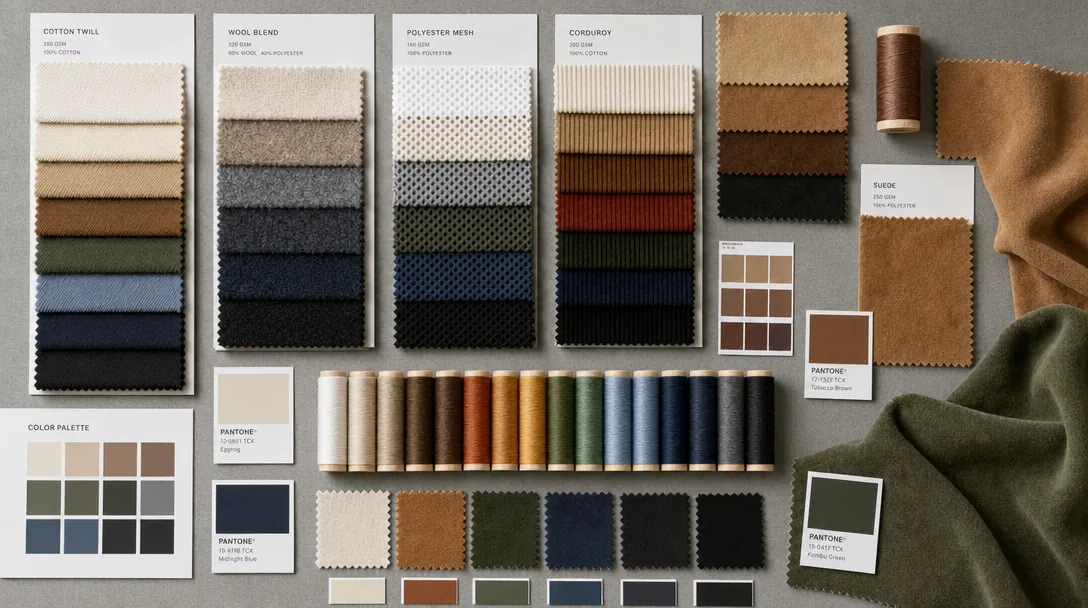
A separate sourcing plan is not optional because corduroy defects usually start upstream and then get amplified by decoration. That is why a credible bucket hat corduroy decoration qc checklist cannot be copied from brushed twill, chino, or canvas programs. A 6-wale cotton corduroy at 280-320 gsm behaves nothing like a 14-wale mini-cord at 200-230 gsm: the wider wale has deeper channels, higher pile rebound, and much more risk of stitch sink, seam grin, and topstitch drift over the brim. If the mill spec does not lock wale count, pile height, base cloth composition, and wash shrinkage before digitizing, the failures are predictable—satin columns drop into the grooves, crown seams show shading breaks where nap direction flips, and brim rows wander because presser-foot feed changes across the ribs. Dark shades are even less forgiving. A lab dip can pass visually, then cut parts still show side-to-side shading after napping and garment wash. For fashion colors matched to Pantone TCX, serious buyers usually hold bulk within Delta-E 1.0-1.5 under D65, then physically inspect nap direction and panel-to-panel shade before sewing, because once the bucket profile is blocked and pressed, crushed pile around the brim edge can make a minor shade shift look like a major defect.
Decoration method should be chosen from panel testing, not from swatches or artwork alone. On Tajima, Barudan, and ZSK heads, flat embroidery on corduroy normally needs stitch density reduced to roughly 0.35-0.40 mm spacing, underlay strengthened, and satin columns opened beyond 2.5-3.0 mm; finer detail simply disappears into the wale. Heat transfer can hold cleaner small type, but it creates a different QC burden: platen temperatures around 145-155°C and dwell times of 10-15 seconds can flatten pile, glaze the surface, or cause adhesive edge lift after humidity conditioning or even one home-laundry cycle if the finish chemistry is not stable. Commercially, the sourcing plan matters just as much. A 5,000-stitch front embroidery may add $0.18-$0.35 per piece in volume, while a woven patch with merrow border and stitch-down often lands at $0.45-$0.90 after trim loss, extra handling, and slower line speed are counted. Our standard practice is to freeze the decoration only after pre-production samples confirm logo legibility, wale direction, brim curvature, and pressing tolerance, then inspect bulk to AQL 2.5 with extra checkpoints for pile crush, embroidery registration, brim symmetry within 3 mm, and carton compression so the corduroy nap is not permanently marked in transit.
Factory capability checks before quoting
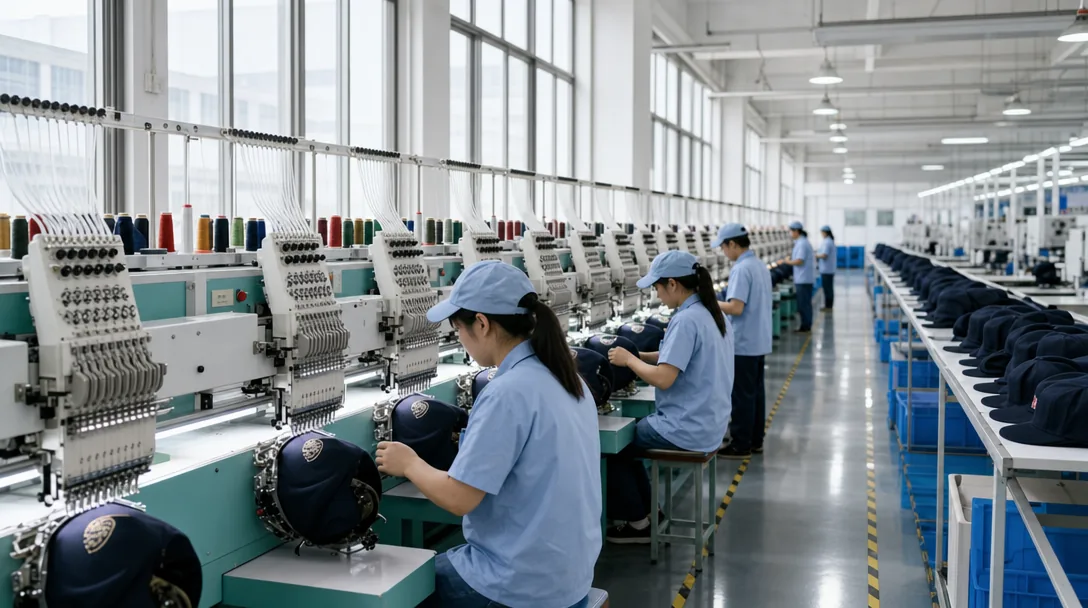
Do not request pricing until the factory proves it can decorate corduroy without crushing pile, shifting wale direction, or printing backing shadow through the shell. In a usable bucket hat corduroy decoration qc checklist, the first screen is technical capability, not catalog photos: ask what wale counts they run on bucket bodies, what gsm range they stabilize, and what decoration size limits they impose on curved side panels versus front panels. A competent supplier should answer with numbers such as 8 to 12 wale cotton corduroy at 220 to 280 gsm, with 40D to 75D cut-away or tear-away support selected by stitch density, and embroidery run on Tajima, Barudan, or ZSK heads with cap-frame settings adjusted for low-profile curves. Ask for macro photos of the embroidery edge and inside-out construction shots. You are looking for tunneling, pile flattening, jump-stitch residue, bobbin show-through, and puckering around dense fills above roughly 0.35 to 0.40 mm stitch spacing. If the style uses woven patches, TPU badges, chenille, or faux leather appliqué, require written placement tolerance; on a sloped bucket side wall, anything beyond +/-2.0 mm will usually fail final visual review.
Construction capability is the second filter, because corduroy that looks clean in roll form can look cheap after sewing if wale direction drifts between crown, side band, and brim. Ask whether the sample room can hold brim width at 5.5 to 7.0 cm with seam allowance variance within +/-1.5 mm, whether they build both unstructured and lightly fused versions, and what brim stitch count they use to control waviness without over-compressing the nap. A serious factory should also specify sweatband material, brim interlining weight, top-button finishing, and pressing temperature, since dark shades like navy, brown, and forest expose pile shading, glazing, and steam marks fast. Shade approval should be checked in a light box against Pantone TCX with an agreed Delta-E tolerance, typically under 1.0 to 1.5 for body panels from the same lot, not judged under warehouse fluorescents. Before quoting, also test operational discipline: who owns the PP sample, how revision comments flow into BOM and stitch-count estimates, and whether likely bulk failures such as logo distortion, brim ripple, shell-to-binding shade variation, and placement drift are flagged before cutting. A factory that can discuss AQL 2.5, needle control, broken-needle logs, and sedex-audit-cap-supplier-guide.html">BSCI 2.0 or Sedex SMETA 4-Pillar execution details is usually giving a manufacturing answer rather than a sales answer.
MOQ, pricing and sample approval
MOQ on a corduroy bucket hat is driven more by fabric and trim risk than by pure sewing capacity. A basic 8-wale cotton corduroy style with one flat embroidery location, woven main label, care label, and standard polybag usually lands at 300-500 pieces per colorway; once you add split sizes, contrast underbrim, custom eyelets, metal toggles, retail box inserts, or branded carton labels, the workable minimum often jumps to 800-1,200 pieces because every extra component adds its own sourcing lead time, shade band, and defect mode. If the shell fabric is GOTS-certified or yarn-dyed to a custom Pantone TCX, mills may require 300-500 meters per shade, which pushes MOQ up before cutting starts. Pricing should be broken into fixed and variable buckets: embroidery digitizing commonly runs $25-60 per file, woven patch setup $80-150, embossed PU badge tooling from $120, and packed ex-factory unit cost for a mid-weight corduroy bucket hat is often $2.80-4.90 depending on wale count, decoration, and packing method. A usable bucket hat corduroy decoration qc checklist should force suppliers to separate setup charges, trim surcharges, carton specs, and unit price, because many “cheap” quotes recover margin later through sample fees, trim overage, or upgraded packaging.
Pre-production sample approval is where most avoidable failures should die. The PPS needs measurable tolerances: brim width within plus or minus 3 mm, crown height within 3-5 mm, embroidery placement from side seam within 2-3 mm, label position within 3 mm, and clear confirmation that wale direction runs consistently across crown and brim so the shade does not flip under warehouse light. Do not approve color from phone photos; use physical Pantone TCX references and require tolerance targets, ideally Delta-E below 1.5 on trims and below 2.0 on dyed corduroy, because pile direction can make the same panel read darker after pressing or packing. Embroidery deserves its own checkpoint since corduroy ribs swallow detail that looks fine on twill. On Tajima or Barudan heads, small fills often need about 0.38-0.42 mm density, stronger edge-walk, and firmer underlay to keep borders from sinking into the pile.
Lead times become fiction once trims keep changing after sample signoff. A realistic path is 5-7 days for artwork and digitizing, 7-10 days for PPS, 3-5 days for one correction round, then 25-35 days for bulk after deposit and final approval; lab dips, FSC hangtags, custom jacquard tape, or retail-ready boxes can easily add another 5-10 days. Packaging belongs inside the approval gate because it affects both defect rate and freight math. Lock inner pack quantity, carton size, burst strength, brim support, silica gel requirement, and shipping term before bulk starts, then recalculate carton cube if you move from flat-packed polybags to retail boxes, because ocean freight and DDP last-mile cost can shift materially. Our standard practice is to treat PPS approval and bulk approval as separate controls: the sample confirms construction intent, but finished goods still need inspection to AQL 2.5, with specific attention to pile shading, embroidery edge clarity, brim distortion after carton compression, and label placement drift in mass production.
Quality inspection and shipping risk
A practical bucket hat corduroy decoration qc checklist lives or dies at final random inspection, because that is where wearable defects and shipment risk show up together. Set bulk release to ANSI/ASQ Z1.4, General Inspection Level II, with AQL 2.5 for major defects and 4.0 for minor, then inspect the dimensions buyers actually get claims on: finished circumference, brim width, crown height, panel balance, and wale direction. On an adult 58 cm bucket hat, ±1.0 cm on head circumference and ±0.5 cm on brim width or crown height is a realistic tolerance; outside that range, the fit changes enough to trigger returns. Corduroy is less forgiving than chino twill because the wale exaggerates panel mismatch, seam grin, and topstitch wobble, so inspectors should confirm vertical rib alignment across side panels, even seam bite, and visible topstitch spacing variation no greater than 1.5 mm between comparable panels. If the PO specifies organic cotton corduroy, check transaction certificates and trim traceability for the sweatband, seam tape, lining, and care label stock as well, because undocumented substitutions usually happen in the support materials, not the shell.
Most failures on corduroy bucket hats come from color and decoration, not tensile strength. Dark shades like coffee, olive, and navy read differently on the rib crown and rib valley, so bulk should be checked against an approved physical standard under a D65 light box, with Delta-E kept below 1.5 for repeat orders and below 2.0 for first production. Ask for usable test data, not vague pass statements: AATCC or ISO 105 dry crocking at grade 4 minimum, wet crocking at 3-4 minimum, and laundering results that do not crush the pile or create streaky abrasion lines. Embroidery needs tighter scrutiny on corduroy because the pile swallows detail and pushes outlines off register; treat registration drift above 1.0 mm, exposed bobbin, hoop burn, needle cuts, loose thread tails over 3 mm, and puckering around dense fills below 0.40 mm stitch spacing as actionable defects. On Tajima or Barudan machines, some damage only shows after steaming and carton pressure, so final inspection should include unpacked visual checks plus carton and label verification against booking data: PO, style, color, size, country of origin, carton sequence, and gross/net weight. One routing-label error for FBA or a 3PL can add $0.35 to $1.20 per unit in relabeling, while mixed carton counts often trigger a full recount at destination. At CrownsForge, we also archive the approved PPS comments, measurement report, fabric lot, Pantone TCX reference, embroidery file revision, and packing list version, because that paper trail is what prevents a technically acceptable reorder from becoming commercially unusable.
Buyer checklist for the next RFQ
A quote only gets clean when the RFQ names the cost drivers that usually surface after sampling. For a corduroy bucket hat, list shell fabric as its own spec line: fiber content, wale count, finished weight, dye method, and wash finish—for example, 100% cotton 11-wale corduroy, 270 gsm finished, reactive dyed, enzyme washed, Pantone 18-1027 TCX target. Then lock the build data that changes material yield and operator minutes: crown height in mm, brim width, panel count, brim insert material and thickness, sweatband composition, eyelet construction, and chin cord setup such as 5 mm braided polyester with a spring cord lock. Any usable bucket hat corduroy decoration qc checklist should also state wale direction for every crown panel and brim section; inconsistent nap lay is an immediate visual defect under retail lighting and often gets missed until inline inspection. Compliance language needs the same precision. Do not ask for “eco” or “export compliant” and expect accurate pricing. Call out the exact requirement: GOTS transaction certificate, OCS scope plus TC, CPSIA tracking label format, REACH SVHC screening, or California Proposition 65 testing if the goods are U.S.-bound. State MOQ by colorway, target price basis such as FOB Ningbo or ex-factory, destination country, carton pack, and in-hands date so the supplier prices the correct routing instead of building in risk margin. Our standard practice is to ask buyers to define inspection thresholds in the RFQ: AQL 2.5 for major defects, plus explicit defect criteria for nap shading, seam grin, brim edge waviness above 3 mm, and shade variation above Delta-E 1.5 on brand-sensitive programs.
Decoration specs are where many bucket hat orders lose a full week. Send artwork as AI, EPS, or editable PDF, plus a placement sheet with width, height, and location in millimeters from fixed landmarks such as side seam, brim edge, or eyelet centerline. If the logo is embroidery, specify the decoration type, maximum stitch count, thread brand if relevant, and whether knockdown underlay is permitted on the pile. On Tajima, Barudan, or ZSK heads, dense fills on 8-wale or 11-wale corduroy can sink into the ribs and close up fine detail unless the digitizer adjusts pull compensation, lowers fill density, and converts text under 4 mm height to satin columns or a woven patch. Those are RFQ decisions, not corrections to make after the first sew-out fails. Attach QC references that remove subjectivity during bulk inspection. Include close-up photos or marked callouts for seam finishing, brim topstitch count, label positions, patch edge margin, and acceptable backing show-through. If color is tightly managed, request fabric lab dips and embroidery thread cards with tolerance limits—Delta-E below 1.5 for licensed or brand-governed work, below 2.0 for most promotional programs. Packing specs should be just as concrete: carton dimensions, units per carton, inner polybag requirement, barcode symbology, and country-of-origin labeling language. A complete file set—tech pack, vector art, Pantone TCX references, legal label text, and packaging spec—is the fastest way to keep a bucket hat corduroy decoration qc checklist practical instead of theoretical, and to avoid surprise charges for redigitizing, brim reinforcement changes, wash rework, or third-party testing.
Working with CrownsForge
A reliable bucket hat corduroy decoration qc checklist starts before bulk cutting, because corduroy failures are usually baked in at fabric approval, not discovered at final audit. For bucket hat programs, CrownsForge normally locks wale count, pile direction, shrinkage, and fusible compatibility during sampling; 8-wale, 11-wale, and micro-cord all behave differently once crown panels are joined and the brim gets 6 to 8 rows of topstitching. We require mill data for fiber content, finished width, gsm tolerance, and colorfastness when the shell is specified as organic cotton or cotton-spandex blend, then verify lot-to-lot consistency against the PPS using handfeel, wale clarity, and measured shrinkage after wash or steam setting. For color, buyers asking for a brown matched to a Pantone TCX standard need realistic tolerances: lab dips should hold Delta-E below 1.5, while bulk fabric is more credibly controlled below 2.0 because the pile reflects light differently across the ribs. Decoration approval has to be tied to panel engineering. On Tajima or Barudan heads, we check pull compensation, underlay density, thread tension, and stitch direction so the embroidery does not sink into the ribs, tunnel across the wale, or drift into crown seam allowances and eyelet zones.
Bulk quality is won in-line. First-piece approval at sewing, first-piece approval at decoration, and a mid-line audit when 20% to 30% of output is complete catch more defects than any end-of-line sort. A usable bucket hat corduroy decoration qc checklist should call out nap direction consistency across all panels, needle cutting on the ribs, skipped brim topstitching, uneven brim quilting, logo registration, loose trims, and seam alignment within a practical tolerance of plus or minus 3 mm at matched points. Embroidery on corduroy is unforgiving: if the backing is too light, say below roughly 60 to 80 gsm for a medium-weight shell, or the underlay is too aggressive, the pile collapses and the logo edges look choked. We routinely adjust stitch count, density, and backing spec on ZSK or Barudan runs before bulk release rather than trying to trim defects later. Packing and shipment also belong on the checklist. Finished goods should be audited to AQL 2.5 unless the PO sets a tighter limit, with assortment checks, barcode scan verification, carton drop testing, and metal detection when required by the buyer. Corduroy bucket hats should not be packed at generic high density; 48 or 72 pieces per carton can permanently crush the pile or emboss the embroidery, so higher-value orders often need lower pack-out and crown support to arrive saleable.
Frequently Asked Questions
How long does production take?
Sampling takes 7 to 12 days. Bulk production runs 20 to 30 days depending on quantity, fabric availability and decoration complexity. Inspection and packing adds another 3 to 5 days before shipment.
Can I order a sample before bulk production?
Yes. We strongly recommend approving a pre-production sample before mass production. Samples are charged at 35 to 60 USD each plus express shipping, fully refundable against confirmed bulk orders over 500 pieces.
What is the minimum order quantity (MOQ) for custom hats?
Our standard MOQ is 100 pieces per design and color, with sampling available from 1 piece. For complex multi-color logos or premium fabric upgrades, the MOQ can be lowered with a small per-piece surcharge.
Do you support sustainability certifications?
Yes. We work with GOTS organic cotton, GRS-certified recycled polyester, OEKO-TEX Standard 100 fabrics, and are BSCI and Sedex audited. Certification documentation can be provided per order.
What logo decoration techniques do you offer?
3D puff embroidery, flat embroidery, woven patch, leather patch, PVC patch, screen printing, sublimation, applique and laser etching, all in-house with no subcontracting.
What should buyers know about organic cotton bucket hat?
When evaluating organic cotton bucket hat, the key considerations are construction quality, decoration capability, MOQ flexibility and lead time. Explain the buyer intent behind bucket hat corduroy decoration qc checklist, when it differs from generic hat sourcing, and what decisions affect cost, lead time and compliance. Describe how CrownsForge manages bucket hat corduroy decoration qc checklist programs with sampling, decoration, QC and export coordination.
What should buyers know about brown corduroy bucket hat?
When evaluating brown corduroy bucket hat, the key considerations are construction quality, decoration capability, MOQ flexibility and lead time. Explain the buyer intent behind bucket hat corduroy decoration qc checklist, when it differs from generic hat sourcing, and what decisions affect cost, lead time and compliance. Describe how CrownsForge manages bucket hat corduroy decoration qc checklist programs with sampling, decoration, QC and export coordination.
What should buyers know about bucket hat men nike?
When evaluating bucket hat men nike, the key considerations are construction quality, decoration capability, MOQ flexibility and lead time. Explain the buyer intent behind bucket hat corduroy decoration qc checklist, when it differs from generic hat sourcing, and what decisions affect cost, lead time and compliance. Describe how CrownsForge manages bucket hat corduroy decoration qc checklist programs with sampling, decoration, QC and export coordination.
What should buyers know about acrylic beanie hat?
When evaluating acrylic beanie hat, the key considerations are construction quality, decoration capability, MOQ flexibility and lead time. Explain the buyer intent behind bucket hat corduroy decoration qc checklist, when it differs from generic hat sourcing, and what decisions affect cost, lead time and compliance. Describe how CrownsForge manages bucket hat corduroy decoration qc checklist programs with sampling, decoration, QC and export coordination.
How should a bucket hat look?
Because the bucket hat has a clean, well-structured design with beautiful piping details, it's like it was made to be dressed up. A more casual bucket hat look would be to bend the brim up in the front. In order to achieve a more formal look, keep the hat-brim turned down and pair it with an elevated outfit.
Need a low-MOQ test order?
We help emerging brands launch with as few as 100 pieces. Premium fabric, in-house embroidery, retail-ready packaging.
Start a small orderRelated guides
Blank Hats MOQ And Pricing Plan for Custom Hat Buyers
Read article →Ball Caps for Women: A 2026 Sourcing Playbook for International Buyers
Read article →
5-Panel vs 6-Panel Caps: Construction, Use Cases and Cost Compared
Read article →Sourcing custom hats does not have to be complicated. With the right manufacturing partner, clear specifications and a small upfront investment in sampling, you can launch a retail-quality product in 30 to 45 days.