
Promotional Hat Pricing Tiers: What $2, $4 and $7 Each Get You - 2026 Buyer's Guide
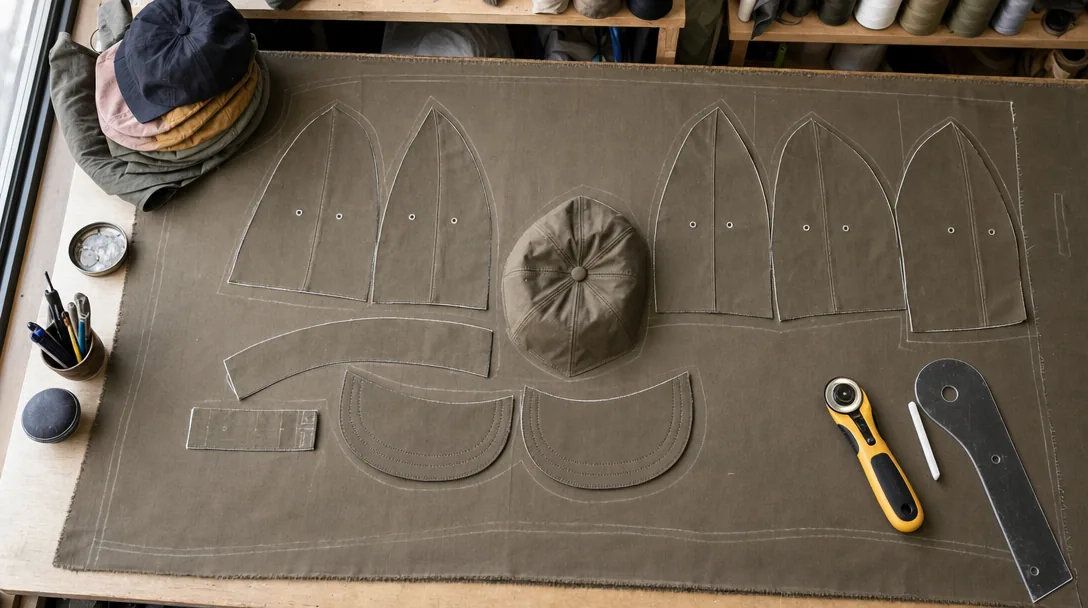
Every week, our sales team answers detailed questions about promotional hat pricing tiers: what $2, $4 and $7 each get you - 2026 buyer's guide. We wrote this guide so that wholesalers, streetwear brands, corporate buyers and promotional resellers can compare options with full information, and avoid the traps that show up only after production has started.
The $2 tier: how it's possible and what it sacrifices
A true $2 promotional cap pricing tier only works when the factory is building the fastest possible spec with almost no customization. In practice that means a 5-panel foam-front trucker: 100% polyester foam laminated to tricot on the front, polyester mesh back, pre-curved PE visor insert, plastic snap closure, and partial buckram only at center front. The front foam is usually 3-4 mm, the mesh commonly 120-150 gsm, and the decoration budget is extremely tight—typically one-location flat embroidery at roughly 3,000-5,000 stitches, or a simple 1-color screen print if the logo allows it. To keep FOB China around $2.00-$2.40, the order normally needs to be at least 1,000-2,000 pieces per color, from stock colors, with no custom dye lot, no special closure, and no manual finishing. Machines like Tajima or Barudan can run these logos quickly, but only because the design is simplified for speed: larger satin columns, light fill density, fewer thread changes, and minimal trims between heads.
What you give up first is material feel and consistency. The cap will feel noticeably lighter and cheaper than 10x10 cotton twill, brushed chino, or 300-320 gsm heavy polyester, and the visor board is more prone to warping than HDPE if cartons sit in humid conditions. Sweatbands are usually self-fabric or thin polyester tricot rather than cotton terry; seam taping is basic; crown symmetry varies more because the front panel and mesh are less stable during sewing. Color control is also looser. If you submit a Pantone TCX target, many factories at this price point will match against stock fabric with visible lot-to-lot drift rather than make a buyer-approved lab dip, so a Delta-E under 2.0 is unrealistic. Embroidery detail is another constraint: foam compresses under the needle, so small text, thin outlines, and tight registration tend to look rough unless the logo is redrawn for cap production.
QC and packing at this level are functional, not retail-ready. Standard packing is usually 25 pieces per polybag, 150-200 pieces per export carton, with no individual tissue stuffing, no insert cards, and no shelf presentation. AQL 2.5 may still appear on the PO, but the real inspection focus is count, obvious logo defects, broken stitches, open seams, and major panel mismatch—not fine cosmetic grading on every unit. At CrownsForge, our standard advice is that once a buyer adds woven labels, interior heat-transfer branding, custom seam tape, hangtags, terry sweatbands, or stricter shade control, the cap exits the $2 bracket immediately. This tier is best for election runs, trade-show giveaways, school events, and short-life promotions where landed cost matters more than long-term wear, branding nuance, or repeat-order color precision.
The $4 tier: where most promotional programs land
At $4.00-$4.80 FOB China on 1,000-3,000 pieces, you are no longer buying a disposable giveaway; you are buying a cap that can survive real program use without the shape collapsing by the second event. The usual spec is a 6-panel structured promotional cap in 65/35 cotton-poly twill at 220-240 gsm, buckram-backed front panels, a 1.8-2.0 mm PE visor insert, polyester sweatband, and PP snap closure. That combination matters because it holds up in transit: better crown memory after carton compression, cleaner seam alignment, and less visor warping after humid ocean freight. In promotional cap pricing, this is the tier where consistency starts to matter more than ornament. Buyers are paying for repeatability across a sales team rollout, distributor replenishment, or stadium promo, not for premium fabric or fashion details. Decoration is the real dividing line. A well-run factory can hold clean flat embroidery or a simple 3D puff logo at roughly 7,000-8,000 stitches on Tajima or Barudan heads, provided the artwork stays disciplined: 3-5 thread colors, reasonable satin columns, no oversized fill areas, and one front hit. Once the brief adds metallic thread, side logo, back arch, sandwich visor text, or dense tatami fills, the quoted cap is not really a $4 cap anymore. For color control, ask for Pantone TCX references on dyed twill and accept a realistic Delta-E target below 2.0 on fabric; thread-to-fabric matching across different materials under D65 light and retail lighting will drift. The better suppliers at this level normally inspect to AQL 2.5 major and 4.0 minor, with practical checkpoints like visor centering within 3 mm, skipped stitches, snap integrity, sweatband join quality, and front-panel symmetry.
Packing stays plain, and that is usually the right decision. One cap per polybag, optional hangtag or size sticker, then 144 pieces per export carton is standard for distributor programs and regional fulfillment. I would rather see the extra $0.40-$0.80 over entry-level spent on tighter sewing control, stable buckram tension, and better visor forming than on shelf-ready packaging that gets discarded on arrival. Weak buckram tension is one of the fastest tells of a sloppy line: one front panel crowns high, the adjacent panel sinks, and perfectly acceptable embroidery suddenly reads crooked because the face of the cap is distorted. That is why the $4 band carries so much volume in promotional cap pricing. It is not exciting, but it is dependable when the order is 5,000 pieces and procurement starts opening random cartons. You should expect straighter top-button setting, fewer twisted side seams, cleaner edge binding inside the sweatband, and noticeably lower reject rates than the sub-$3 tier. Factories running this level well are usually operating basic process discipline rather than luxury trim: in-line QC during sewing, needle-change logs on embroidery heads, and final packed-goods checks before container loading. For most branded giveaways, that discipline is what prevents expensive surprises after delivery.
The $7 tier: premium retail-grade promotional
At the $7 ex-factory band, promotional cap pricing shifts from mass giveaway economics to retail-adjacent build quality. The common spec is a 6-panel structured cap in 260-320 gsm cotton twill, 10-12 oz cotton/poly canvas, or a 15-18 oz wool/acrylic blend with hard buckram and a pre-curved PE board visor. At this level, you should expect measurable control: shade matching within Delta-E 1.0-1.5 to the approved Pantone TCX reference, top button centering within about 1.5 mm, cleaner seam alignment, and far fewer twisted visors or collapsed front panels. The real upgrade is not just heavier fabric. It is more stable fusing, sharper pattern cutting, and better operator consistency on the sewing line, which is what keeps the crown shape looking correct after packing and wear. A $7 cap should not read like a promotion-first product the moment it comes out of the carton. Compared with the $4 tier, you are buying tighter stitch density, cleaner crown memory, and better trim selection, not just a nicer hand feel. That is why this tier is often used for brewery merch, golf events, resort retail, and sponsor programs where the cap has to sit next to entry-level branded headwear without looking obviously cheaper. In practical terms, promotional cap pricing at this level starts reflecting construction tolerances and finishing discipline rather than simply logo application.
Decoration and trim are usually what justify the jump. A front logo in this tier is commonly 8,000-12,000 stitches run on Tajima, Barudan, or ZSK heads, with 3 mm EVA foam for 3D embroidery, sharper underlay, and registration clean enough to hold small counters and narrow outlines open. For patch work, a genuine leather, microfiber, or high-grade PU patch should be laser cut or die cut, debossed, and stitched with a consistent 1.5-2.0 mm margin that tracks evenly over the crown curve. This is also the range where details stop looking generic: matching seam tape, woven flag label, moisture-wicking polyester sweatband, metal buckle, antique brass clasp, and an undervisor matched to the approved colorway instead of default stock black. QC and packing are what keep a $7 cap looking like a $7 cap on arrival. Once decoration gets more premium, crushed crowns, scuffed embroidery, and off-center placements destroy perceived value fast. The workable standard is individual polybagging, crown support, barcode or size stickers, and retail hangtags, with cartons typically packed 100-144 pieces depending on profile and brim curvature. A serious factory should check embroidery placement to +/-2 mm, visor symmetry, closure function, and color against approved swatches during inline inspection and final audit, with AQL 2.5 as the minimum sensible final standard. At this tier, the biggest buyer risk is not overspending on unit cost; it is approving a clean sample and receiving bulk goods that photograph poorly for e-commerce, team stores, or limited merch drops.
What changes the per-piece cost the most
Fabric spec moves promotional cap pricing more than most buyers realize, and the biggest quote gaps usually come from the bill of materials, not factory margin. A basic 5-panel promo cap in 180-220 gsm brushed cotton twill or 150-180 gsm polyester twill can land near entry-level pricing, but stepping up to 260-300 gsm enzyme-washed chino twill, 75D-150D peach-finish microfiber, or certified recycled RPET commonly adds $0.35-$1.20 per piece before decoration. Small trims widen that spread fast: a PP snap closure is typically $0.06-$0.10, while a self-fabric strap with brass buckle runs closer to $0.22-$0.38; PE visor board is cheaper than higher-density EVA inserts, and a standard polyester sweatband costs less than moisture-wick tape. On the factory floor, cheaper open-weave twill also distorts more during cutting and sewing, which increases puckering, panel mismatch, and rejection rates under AQL 2.5 even when the BOM looks similar on paper.
Decoration is the next big cost swing because machine minutes and defect risk scale faster than stitch count suggests. A straightforward front logo at 5,000-7,000 stitches on Tajima or Barudan heads is often a $0.28-$0.45 add-on at 1,000-plus pieces, but 3D puff, side embroidery, and back arch can push total decoration cost to $0.85-$1.60 once digitizing cleanup, thread trims, backing, and in-line QC are included. Construction matters just as much as artwork: unstructured fronts, thin ripstop, and lightweight polyester do not hold dense satin columns or foam cleanly like structured cotton twill with proper buckram. That is where “cheap” caps stop being cheap, because thread breaks, needle changes, and embroidery rework drive real cost harder than the stitch file alone.
Quantity, color fragmentation, and packing usually determine whether a program stays efficient or gets expensive in a hurry. A 1,200-piece run in one body color is materially cheaper than six colorways of 200 because each split creates separate fabric lots, thread changes, approval standards, carton assortments, and higher setup waste. If the buyer also wants Pantone TCX matching with a practical Delta-E tolerance, extra lab dips and shade-band checks add cost that stock black, navy, or khaki simply do not carry. Packaging is the last overlooked lever: standard export packing might be 25 pieces per polybag into a master carton, while individual polybags, barcode labels, hangtags, size stickers, or retail inserts can add $0.05-$0.40 per cap without improving the product itself. In practice, setup burden is heavy at 144 pieces, efficiency improves around 500, and promotional cap pricing usually stabilizes in the 1,000-3,000 piece range unless the spec is overloaded with color splits or retail-ready packing.
When to choose $2 vs $7 — and when to mix
Choose the $2 tier when cost per reach matters more than retention. For trade-show handouts, school open days, charity 5Ks, and street-team seeding, the cap only needs to look clean on day one and survive a handful of wears. In factory terms, that usually means a 5-panel foam trucker or basic brushed cotton twill cap in the 180-220 gsm range, a stock PE snapback, standard sweatband, and decoration capped at a 1-color screen print or flat embroidery around 4,000-5,000 stitches. Keep to stock body colors like black, navy, white, or red, use existing visor and closure components, and avoid Pantone TCX dyeing, woven labels, seam-tape printing, or metal trims. At 5,000-10,000 pieces, FOB China around $2.10-$2.80 is realistic. In promotional cap pricing, this is the volume tier: broad distribution, acceptable appearance, and no money wasted on details the end user will never notice.
Step up to $7 when the cap is carrying the brand, not just the logo. This is the right band for retail staff kits, influencer sends, sponsor gifts, and executive event packs where handfeel, shape retention, and finish quality are visible. You are typically moving into 260-300 gsm chino twill, enzyme-washed cotton, recycled performance polyester, or wool-blend front panels, with moisture-wicking sweatbands, custom inside taping, loop labels, and upgraded closures like metal buckles or silicone pull tabs. Embroidery should run on properly tuned Tajima or Barudan heads with tighter registration, cleaner edge coverage, and fewer thread breaks; fabric matching should be controlled to a practical Delta-E tolerance, not a vague "close enough" stock shade. A well-made $6.20-$7.00 cap that still holds crown shape after 15-20 wears usually returns more brand value than several disposable units ever will.
The smartest buy is often a tier mix, not a single spec forced across every audience. A common structure is a $2.30 giveaway cap for booth traffic, a $4.20-$5.00 mid-tier unit for staff, resellers, or bundled promos, and a $6.50-$7.00 hero cap for VIPs, campaign photography, or limited drops. That split protects landed cost while putting the best product in the hands of the people who actually influence perception. The discipline comes from writing separate tech packs for each SKU: fabric weight, stitch-count ceiling, closure spec, visor style, carton ratio, polybag requirement, and inspection level should all be locked before sampling. Our standard practice is to hold bulk goods to AQL 2.5, because promotional cap pricing gets expensive fast when giveaway units are overbuilt or premium units are under-specified.
The hidden cost: setup, sampling, freight
The unit price is rarely the real price. On paper, cheap promotional hats can look like a $2.20 buy, but once you add artwork setup, pre-production sampling, and freight, the landed number often climbs 15% to 40%. For embroidery, a clean left-chest-style cap logo usually needs digitizing at around $40 per design; if the art has gradients, small text under 4 mm, or 3D puff callouts, expect extra cleanup time and a revised stitch file. For screen print, most factories charge about $30 per color for plate making, so a 3-color front print immediately adds $90 before a single cap is sewn. This is where buyers misread promotional cap pricing: they compare factory unit quotes without normalizing the one-time charges across the order quantity.
Sampling is the second place budgets leak. A real pre-production sample run for bulk promotional caps is not just one hat pulled off the line; it usually includes pattern confirmation, decoration test, thread or ink matching, and QC photos against the approved spec sheet. In practice, that costs $40 to $80 per sample, and more if you need branded inner taping, woven labels, or a specific Pantone TCX match on specialty fabric. If you are buying low cost custom caps at 144 pieces, a $60 sample adds $0.42 per cap by itself. Spread over 5,000 wholesale promotional caps, the same sample cost becomes almost irrelevant. Our standard practice is to tell buyers to amortize every non-recurring charge across the full PO before judging whether one promotional hat manufacturer is actually cheaper than another.
Freight is the line item that destroys a lot of “factory-direct” math, especially on lower-value caps. Air freight commonly adds $0.20 to $1.50 per cap depending on carton density, destination, and whether the cap ships with a support insert to protect the crown shape; sea freight is usually closer to $0.05 to $0.15 per cap, but only if the order volume is large enough to use cubic space efficiently and the delivery window can absorb 25 to 40 days in transit. A 600-piece order of low-profile cotton twill caps can tolerate sea freight; a rush event order for structured polyester wholesale promotional caps usually cannot. Serious buyers calculate landed cost by combining ex-factory price, setup, sample approvals, freight, duty, and local delivery, because that is the only way promotional cap pricing means anything in 2026.
Frequently Asked Questions
Do you support sustainability certifications?
Yes. We work with GOTS organic cotton, GRS-certified recycled polyester, OEKO-TEX Standard 100 fabrics, and are BSCI and Sedex audited. Certification documentation can be provided per order.
Can I order a sample before bulk production?
Yes. We strongly recommend approving a pre-production sample before mass production. Samples are charged at 35 to 60 USD each plus express shipping, fully refundable against confirmed bulk orders over 500 pieces.
What is the minimum order quantity (MOQ) for custom hats?
Our standard MOQ is 100 pieces per design and color, with sampling available from 1 piece. For complex multi-color logos or premium fabric upgrades, the MOQ can be lowered with a small per-piece surcharge.
How long does production take?
Sampling takes 7 to 12 days. Bulk production runs 20 to 30 days depending on quantity, fabric availability and decoration complexity. Inspection and packing adds another 3 to 5 days before shipment.
What logo decoration techniques do you offer?
3D puff embroidery, flat embroidery, woven patch, leather patch, PVC patch, screen printing, sublimation, applique and laser etching, all in-house with no subcontracting.
What should I know about bulk custom trucker hats?
When evaluating bulk custom trucker hats, the key considerations are construction quality, decoration capability, MOQ flexibility and lead time. 100% polyester foam-front trucker, 5-panel construction with partial buckram, single-color 1cm flat embroidery, no sweatband upgrade, polybag-only packaging. MOQ 1000+. Cotton-poly 6-panel structured, 3D puff or flat embroidery (up to 8000 stitches), polyester sweatband, plastic snap closure, polybag with hangtag.
How do I find a reliable custom hat manufacturer usa?
When evaluating custom hat manufacturer usa, the key considerations are construction quality, decoration capability, MOQ flexibility and lead time. 100% polyester foam-front trucker, 5-panel construction with partial buckram, single-color 1cm flat embroidery, no sweatband upgrade, polybag-only packaging. MOQ 1000+. Cotton-poly 6-panel structured, 3D puff or flat embroidery (up to 8000 stitches), polyester sweatband, plastic snap closure, polybag with hangtag.
How does ordering custom made trucker hat work?
When evaluating custom made trucker hat, the key considerations are construction quality, decoration capability, MOQ flexibility and lead time. 100% polyester foam-front trucker, 5-panel construction with partial buckram, single-color 1cm flat embroidery, no sweatband upgrade, polybag-only packaging. MOQ 1000+. Cotton-poly 6-panel structured, 3D puff or flat embroidery (up to 8000 stitches), polyester sweatband, plastic snap closure, polybag with hangtag.
How much does cheap baseball hats in bulk typically cost?
When evaluating cheap baseball hats in bulk, the key considerations are construction quality, decoration capability, MOQ flexibility and lead time. 100% polyester foam-front trucker, 5-panel construction with partial buckram, single-color 1cm flat embroidery, no sweatband upgrade, polybag-only packaging. MOQ 1000+. Cotton-poly 6-panel structured, 3D puff or flat embroidery (up to 8000 stitches), polyester sweatband, plastic snap closure, polybag with hangtag.
Ready to start your custom hat project?
Send us your tech-pack, sketch or even just an inspiration photo. We will respond with a detailed quotation and digital mock-up within 24 hours.
Request a free quoteRelated guides
Launching a Hat Brand: Marketing Playbook for the First 12 Months
Read article →
Embroidery Hats Machine: When to Use It, Costs, and What to Ask Your Factory
Read article →Custom Hats for Corporate, Business and Branded Merchandise Programs - Cost & MOQ Breakdown
Read article →Sourcing custom hats does not have to be complicated. With the right manufacturing partner, clear specifications and a small upfront investment in sampling, you can launch a retail-quality product in 30 to 45 days.