Fitted Hats Sizes: A Vertical-Specific Sourcing Guide
Every week, our sales team answers detailed questions about fitted hats sizes: a vertical-specific sourcing guide. We wrote this guide so that wholesalers, streetwear brands, corporate buyers and promotional resellers can compare options with full information, and avoid the traps that show up only after production has started.
Baseball Hats Women
Women’s baseball hats are usually built on the same six-panel or five-panel production line as men’s, but the fit spec is where buyers get burned. If you’re sourcing baseball hats women, do not assume a smaller circumference alone solves it; the crown depth, front panel stiffness, and sweatband stretch matter just as much. For fitted hats sizes, ask the factory for a graded size chart in centimeters and inches, not just S/M/L labels, and request a sample set with at least three internal measurements: internal circumference, front-to-back depth, and side-to-side opening. For fitted hats custom orders, I want the bill curve, crown height, and panel seam tolerance written into the tech pack, because a 3 mm change in seam allowance can make a hat feel one full size off once the sweatband is stitched in.
Manufacturing-wise, most baseball hats custom programs start with buckram or sandwich buckram for structure, cotton twill or brushed chino fabric at 240–280 gsm, and a polyester or cotton-poly sweatband depending on price point. If the buyer wants baseball hats vintage styling, we usually soften the finish with garment wash or enzyme wash, but that changes shrinkage and can move the fit after packing. For fitted hats 59fifty-style builds, the factory should specify a rigid front, flat visor insert, and size lock control at the back seam; for women’s programs, I usually recommend a slightly shorter crown than standard baseball hats for men so the silhouette does not look top-heavy. MOQ for decent factory pricing is often 200–300 pieces per colorway and size run, with basic embroidery starting around USD 2.20–3.50 FOB and structured fitted builds closer to USD 3.80–5.80, depending on stitch count, fabric, and label package.
The quality checks that matter are simple but non-negotiable: inspect panel symmetry, visor snapback memory, embroidery density, and sweatband stitching, then do a wear test on multiple head sizes before approving bulk. The most common defects are warped visors, uneven front panels, twisted seam lines, loose threads around the eyelets, and size drift after steaming or washing. For a broader fitted hats sizes decision, I always push buyers to test their women’s size curve against the rest of the line, because a run that works for baseball hats for men may fail at the low end if the internal band is too stiff or the crown too tall. If the factory is serious, they should support AQL 2.5 inspection, give shrinkage results after wash, and confirm color tolerance under Pantone TCX with Delta-E under 2.0 on all trim and embroidery threads.
Baseball Hats Fitted
Baseball hats fitted are built differently from strapback or snapback caps because the crown and sweatband have to land on a precise head circumference, usually mapped in 1/8-inch increments. For fitted hats sizes, factories should quote by size run, not just by style, and ask for the target head circumference in centimeters, the inner sweatband tension, and the finished crown depth. A real production sheet should specify shell fabric, typically 100% cotton twill or wool-blend melton for fitted hats 59fifty-style builds, plus visor board thickness, buckram stiffness, and stitch density. If you are ordering baseball hats custom, you also need embroidery placement in millimeters, front panel structure, and whether the closure area is fully closed-back or uses hidden elastic inserts, because those details change fit and cost.
Typical MOQ for baseball hats for men in fitted programs starts around 300 to 500 pieces per colorway per size run if the factory is doing standard blanks, but custom fabric, tonal embroidery, or special washing can push that to 1,000 pieces. In China, factory ex-works pricing for a basic structured fitted cap usually lands around USD 2.80 to 5.50 depending on fabric weight, panel count, and whether it needs custom woven labels, taping, or undervisor printing; a wool-blend fitted hats custom order with 3D embroidery can climb to USD 6.50 to 9.00. If you are comparing baseball hats vintage finishes, ask whether the wash is garment-dyed, enzyme-washed, or sand-washed, because each process affects shrinkage and colorfastness. CrownsForge’s standard practice is to quote size-by-size MOQ separately so buyers do not discover too late that one odd size becomes dead stock.
The biggest quality failures on fitted hats sizes are inconsistent crown circumference, off-center embroidery, and sweatband contraction after steaming or washing. Measure finished hats on a calibrated sizing block, not by hand; check at least 10 pieces per size against a tolerance of +/- 3 mm on circumference and +/- 2 mm on crown height. For inspection, ask for AQL 2.5 on major defects and verify seam puckering, visor curve symmetry, and color matching against Pantone TCX or Delta-E under D65 light. Buyers often overlook shrinkage testing on cotton twill and wool blends, but even 1.5% shrink can make a borderline size unwearable. If the broader sourcing decision is about which fitted hats sizes to carry, start with the mid-range sizes that cover the largest head-circumference band, then validate sell-through before adding the outliers that usually create returns and clearance inventory.
Baseball Hats Custom
Baseball hats custom are usually built on one of three construction paths: structured six-panel with buckram, unstructured washed twill, or a fitted block that mirrors fitted hats 59fifty sizing. For a buyer, the key spec is not just crown shape but headform tolerance, because a 1/8-size drift changes how the hat sits on the forehead and whether it feels tight at 7 3/8 versus loose at 7 1/2. Ask for shell fabric by weight and fiber content, for example 100% cotton twill at 260-300 gsm, polyester twill at 220-240 gsm, or wool-blend fabric if you want a more traditional baseball hats vintage look. On embroidery, request the exact machine type, stitch count, backing, and thread standard; a good factory will quote Tajima, Barudan, or ZSK heads, not vague “auto embroidery.” If you are sourcing fitted hats custom, insist on a size set against a taped headform, not a generic crown sample, because fitted hats sizes are judged by internal circumference, sweatband stretch, and seam placement, not just outer appearance.
From a sourcing standpoint, typical MOQ for baseball hats custom is 200-500 pcs per colorway for stock fabrics, but true cut-and-sew fitted programs often start at 300-600 pcs per size run because each fitted block needs separate cutting and banding control. Pricing varies hard by decoration and fabric: a simple embroidered cotton cap can land around $3.20-$5.50 FOB, while a fully custom fitted program with woven label, sandwich visor, and complex patchwork often runs $5.80-$9.80 FOB before freight. If you want baseball hats for men in larger head sizes, build the order around an actual size curve; the common mistake is overbuying 7 1/4 and underbuying 7 5/8, which leaves dead inventory. Our standard practice is to sample in at least three adjacent sizes, then check Delta-E against approved Pantone TCX, visor curve symmetry, stitch density, and sweatband recovery after 24 hours on a form.
Quality problems are usually obvious if you know where to look: off-center front panels, visor wave, inconsistent crown depth, poor taping at the inner seams, and sweatbands that shrink after steam pressing. On fitted hats sizes, the worst defect is circumference drift after wash or heat exposure; a hat that measures correct out of the box can lose 3-5 mm if the fabric is over-pressed or the sweatband adhesive is weak. Ask for AQL 2.5 inspection on major defects and require a pre-production sample plus a size approval sample for each key size, especially if you are comparing baseball hats custom against retail references. If the style is meant to compete with fitted hats 59fifty, check buckram stiffness, top button height, visor sandwich alignment, and rear seam tension; if it is meant to read more like baseball hats vintage, allow softer handfeel but still control crown symmetry. The broader sourcing decision is simple: start with the fit profile first, then lock the decoration and fabric, because a great logo on the wrong fitted block still produces returns.
Fitted Hats Custom
Fitted hats custom are built very differently from adjustable caps, and that matters the moment you start sourcing by fitted hats sizes. The cap body is usually cut from wool blend, polyester twill, or acrylic-wool melton, then assembled in size-specific blocks rather than relying on a back closure to absorb error. If you want a true fitted profile, ask the factory for crown height, brim curvature, panel count, sweatband type, and exact size range in U.S. numbering, because a 7 1/4 that measures 58.0 cm on paper can still land off by 3 to 4 mm after steaming and pressing. For baseball hats custom programs, I always tell buyers to define the spec sheet in millimeters, not just “S/M/L,” and to confirm whether the factory is building to fitted hats 59fifty-style dimensions or a looser vintage block used for baseball hats vintage looks.
On the production side, fitted hats custom usually run on low to mid MOQ because each size needs its own cutting and QC pass. A realistic factory MOQ is often 144 to 300 pieces per colorway, with 24 to 48 pieces per size spread depending on whether the factory holds pre-cut blocks. In China, ex-factory pricing for a standard six-panel fitted cap with basic embroidery is often USD 4.20 to 7.80 at 300 to 500 pcs, while structured wool blends, 3D puff, or woven patches push it into the USD 8.50 to 12.00 range. If you need premium wool-viscose, contrast undervisor, or custom taping, budget higher. CrownsForge’s standard practice is to quote separately for sample, bulk, and size-set testing because fit issues are usually not visible in a flat artwork approval.
The quality checks that actually matter are size tolerance, crown symmetry, stitch density, and sweatband consistency. I would inspect at AQL 2.5 with special attention to the center seam, visor underlay, and head circumference drift across the size run; if the factory is off by more than ±0.5 cm on fitted hats sizes, returns start fast, especially for baseball hats for men who expect a precise fit. Watch for warped front panels, uneven brim curve, embroidery puckering, and dye lot variation measured by Delta-E if you are doing dark fashion colors. For retail programs, ask the factory to provide one pre-production size set, a wash-and-shape test, and a final measurement report by size. That is the practical link between fitted hats custom sourcing and the broader sizing decision: if the size curve is wrong, even perfect artwork will not save the order.
Fitted Hats 59fifty
A proper fitted hats 59fifty program starts with the block, not the logo. If the crown shape is wrong, no amount of embroidery will save it. For this style, buyers should specify panel fabric, crown height, buckram grade, visor curve, sweatband width, and exact circumference in fitted hats sizes, usually mapped in 1/8-size increments from 6 7/8 to 8. In factory terms, you want the spec sheet to call out shell cloth by composition and weight, such as 100% acrylic wool-look blend at 280–320 gsm or brushed cotton twill at 260–300 gsm, plus stitch density, eyelet count, and front panel structure. For baseball hats custom programs, I always tell buyers to request a physical fit sample on the intended blocks before confirming bulk, because a 2–3 mm variance at the sweatband changes wearability fast.
Manufacturing a fitted hat is more exacting than making strapback or snapback styles because there is no adjustment margin. A decent factory will cut panels on die sets, fuse the front with buckram, stitch on Tajima, Barudan, or ZSK heads, then steam-set and cool on size-specific blocks. For fitted hats custom orders, typical MOQ is 300–500 pieces per colorway per size run, but if you need multiple fitted hats sizes across a full range, expect 600–1,200 units before pricing becomes sane. FOB China pricing usually lands around USD 3.20–5.80 for simple 6-panel construction, and USD 5.80–8.50 for heavier embroidery, contrast undervisor, or vintage wash treatments. For baseball hats vintage looks, ask for garment dye or enzyme wash controls, because shade drift and crown distortion are common if the wash process is not disciplined.
The quality issues that matter are measurable: crown symmetry, brim curvature consistency, center-front embroidery registration, sweatband join strength, and size tolerance across the run. AQL 2.5 is normal for general inspection, but for fitted hats 59fifty I would tighten critical dimensions to ±1/8 size and reject any piece with visible panel skew, puckering around dense stitch areas, or misaligned inner taping. Buyers sourcing baseball hats for men often overlook perspiration bleed, colorfastness, and shrinkage after heat exposure, which is a mistake if the product will sit in retail windows or ship into humid markets. CrownsForge’s standard practice is to confirm size master, material swatches, and pre-production embroidery strike-offs before bulk, because once a fitted program goes into sewing, bad sizing is expensive to correct and impossible to fix at the packing stage.
Baseball Hats Vintage
Vintage baseball hats are usually not “vintage” in the sense of old stock; they’re made to look broken-in, washed, and slightly irregular while still being built to a spec. The factory usually starts with a structured crown in cotton twill, brushed chino, or pigment-dyed canvas, then applies garment wash, enzyme wash, or stone wash to soften the hand and knock back the color. If you want baseball hats vintage that still hold shape, ask for a low-profile crown, 6-panel construction, a pre-curved visor, and a sweatband that won’t shrink after washing. For fitted hats custom projects, the important part is whether the factory cuts the crown to a real size block or just stretches one mold across multiple sizes. That is where fitted hats sizes get messy fast, especially on baseball hats for men where head circumference varies more than buyers expect.
For sourcing, request a full tech pack with crown height in mm, visor length, panel fabric weight, thread spec, closure type if any, and exact size grading in CM or US hat sizes. A proper factory can sample fitted hats 59fifty-style builds with size steps such as 6 7/8 through 7 5/8, but MOQ usually starts around 300 to 500 pcs per colorway if you want multiple sizes, and 200 to 300 pcs per color if you accept a single size run. Basic factory pricing for baseball hats custom can land around $2.20 to $4.50 FOB for simple washed cotton builds, while higher-end embroidery, contrast undervisor, or heavy distressing can push it to $5.50 to $7.50. The cost jumps when you demand tighter tolerance on crown depth, repeatable wash shade, and better sweatband materials like 100% cotton or poly/cotton with anti-shrink finishing.
The main quality failures are obvious to anyone who has inspected a few thousand units: uneven wash color, puckered embroidery, crooked front panels, visor warping, weak seam density, and size drift after steam or wash testing. On fitted hats sizes, I would check circumference tolerance within ±0.5 cm, crown symmetry, and whether the hat still fits after a 30-minute humidity recovery test. Also inspect the internal buckram, because cheap stiffener makes the front panel collapse in a week, especially on baseball hats vintage with heavy enzyme wash. CrownsForge’s standard practice is to approve a pre-production sample, then do in-line AQL 2.5 checks for stitching, measurement, and shade consistency before bulk packing. If the sizing program is wrong, the whole line is wrong; that is why sourcing baseball hats vintage should always start with fit data, not decoration.
Working with CrownsForge for fitted hats sizes programs
The fastest way to get fitted hats sizes wrong is to treat them like one-size blank caps. For a real program, we start with a size run, not a mood board: typically 6 7/8 through 7 5/8 in 1/8-inch increments for fitted hats 59fifty-style blocks, then we check crown depth, sweatband tension, and oval shape against the target market. Our standard sampling cycle is 7 to 10 days for first proto samples and 10 to 14 days for revised fit samples, assuming artwork is approved and the fabric is in stock. For first-time buyers ordering baseball hats custom or fitted hats custom, I usually recommend a 30 to 50 piece pilot run before committing to a full-size matrix, because you want to catch fit drift, shrinkage behavior, and embroidery distortion before the production line is locked.
MOQ flexibility matters more than people admit, especially for baseball hats for men where demand often splits across two or three head sizes instead of the full range. A workable starting MOQ is usually 100 to 200 pieces per colorway when the crown fabric is standard cotton twill or wool-blend, and slightly higher if you want specialty washes or heavier sandwich visors like baseball hats vintage styles. Decoration is handled in-house with Tajima, Barudan, and ZSK heads, plus flat embroidery, 3D puff, woven labels, applique, and leather patches depending on the spec. We digitize for stitch density, pull compensation, and center-front curvature instead of forcing a generic file onto every panel, because fitted caps punish sloppy digitizing harder than dad caps do.
Compliance and order control are what keep a fitted program from turning into a dispute later. For branded headwear, we work to sedex-audit-cap-supplier-guide.html">BSCI 2.0 or Sedex SMETA 4-Pillar audit expectations when the buyer requires it, and fabric/color approvals are handled with Pantone TCX references plus Delta-E checks on bulk lots before cutting. Our standard quality gate is AQL 2.5 for major defects and 4.0 for minor defects, with in-process checks at panel sewing, buckram insertion, visor stitching, and final size verification. The order workflow is simple: tech pack review, fit sample, color lab dip, pre-production sample, bulk approval, then production and carton QC. That structure de-risks fitted hats sizes sourcing because it keeps each decision tied to a measurable checkpoint instead of relying on vague “looks good” approvals.
Frequently Asked Questions
What logo decoration techniques do you offer?
3D puff embroidery, flat embroidery, woven patch, leather patch, PVC patch, screen printing, sublimation, applique and laser etching, all in-house with no subcontracting.
Can I order a sample before bulk production?
Yes. We strongly recommend approving a pre-production sample before mass production. Samples are charged at 35 to 60 USD each plus express shipping, fully refundable against confirmed bulk orders over 500 pieces.
What is the minimum order quantity (MOQ) for custom hats?
Our standard MOQ is 100 pieces per design and color, with sampling available from 1 piece. For complex multi-color logos or premium fabric upgrades, the MOQ can be lowered with a small per-piece surcharge.
How long does production take?
Sampling takes 7 to 12 days. Bulk production runs 20 to 30 days depending on quantity, fabric availability and decoration complexity. Inspection and packing adds another 3 to 5 days before shipment.
What file format should I send for my logo?
Vector files (AI, EPS, PDF) are ideal. High-resolution PNG or JPG at 300 dpi on transparent background works as a fallback. Provide Pantone color references for accurate reproduction.
How does ordering custom new era 59fifty fitted hats work?
When evaluating custom new era 59fifty fitted hats, the key considerations are construction quality, decoration capability, MOQ flexibility and lead time. Cover everything buyers ask about baseball hats custom: how it's manufactured, what specs to request from a factory, typical MOQ and pricing, common quality issues to inspect for, and how this ties back to the broader fitted hats sizes sourcing decision. Cover everything buyers ask about fitted hats custom: how it's manufactured, what specs to request from a factory,…
How does ordering custom baseball hats for men work?
When evaluating custom baseball hats for men, the key considerations are construction quality, decoration capability, MOQ flexibility and lead time. Cover everything buyers ask about baseball hats custom: how it's manufactured, what specs to request from a factory, typical MOQ and pricing, common quality issues to inspect for, and how this ties back to the broader fitted hats sizes sourcing decision. Cover everything buyers ask about baseball hats women: how it's manufactured, what specs to request from a factory,…
What should buyers know about nike bucket hats for men?
When evaluating nike bucket hats for men, the key considerations are construction quality, decoration capability, MOQ flexibility and lead time. Cover everything buyers ask about baseball hats women: how it's manufactured, what specs to request from a factory, typical MOQ and pricing, common quality issues to inspect for, and how this ties back to the broader fitted hats sizes sourcing decision. Cover everything buyers ask about baseball hats fitted: how it's manufactured, what specs to request from a factory,…
How does ordering custom leather patch hats work?
When evaluating custom leather patch hats, the key considerations are construction quality, decoration capability, MOQ flexibility and lead time. Cover everything buyers ask about baseball hats custom: how it's manufactured, what specs to request from a factory, typical MOQ and pricing, common quality issues to inspect for, and how this ties back to the broader fitted hats sizes sourcing decision. Cover everything buyers ask about fitted hats custom: how it's manufactured, what specs to request from a factory,…
Looking for a reliable hat manufacturer in China?
CrownsForge has produced custom hats for 800+ brands across 40 countries. From 100-piece launches to 100,000-piece retail programs, we deliver on time and on spec.
Get in touchRelated guides
Custom Logo Hats: When to Use It, Costs, and What to Ask Your Factory
Read article →
China vs Vietnam vs Bangladesh: Cap Manufacturing Countries Compared 2026
Read article →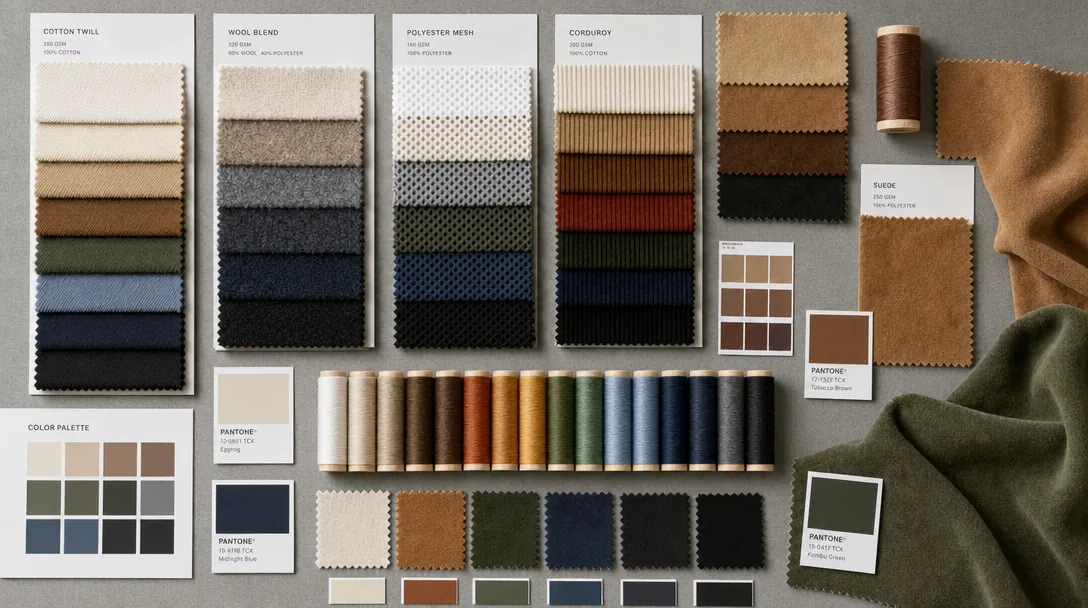
Corduroy Hat: Properties, Costs and How to Spec It Right
Read article →Sourcing custom hats does not have to be complicated. With the right manufacturing partner, clear specifications and a small upfront investment in sampling, you can launch a retail-quality product in 30 to 45 days.