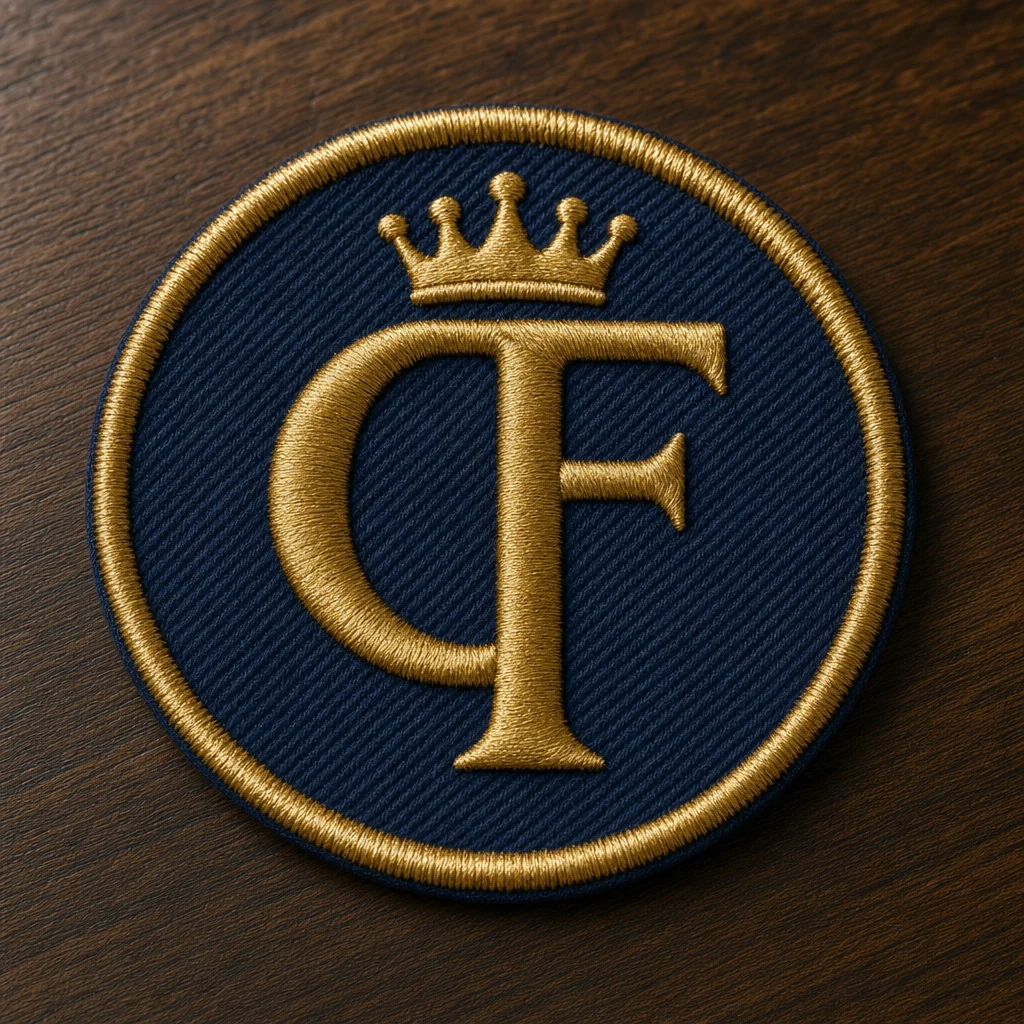
Embroidery Stitch Count & Thread Density: A Cost-and-Quality Reference - 2026 Buyer's Guide
Every week, our sales team answers detailed questions about embroidery stitch count & thread density: a cost-and-quality reference - 2026 buyer's guide. We wrote this guide so that wholesalers, streetwear brands, corporate buyers and promotional resellers can compare options with full information, and avoid the traps that show up only after production has started.
What stitch count actually measures
Stitch count is the exact number of needle penetrations in the final machine file at production size, not a number inferred from vector art. For an embroidery stitch count cap quote, that distinction matters because the count is created by digitizing choices: satin columns versus tatami fill, edge-run or center-walk underlay, pull compensation, overlap, stitch angle, sequence, and whether the design is built for a flat panel or a finished cap frame. I have seen buyers approve pricing from an AI or EPS logo, then watch the count jump 10% to 15% once the file is rebuilt for a structured 6-panel crown. On a 50 mm front logo, 4,500 to 7,500 stitches is a normal range; at 70 mm with small lettering, filled areas, and 3 to 5 color changes, 12,000 to 18,000 stitches is common. On high-profile caps, the crown curve and center seam usually force extra edge support and compensation, which is why cap files almost always run higher than the same art sampled on a flat twill swatch.
What stitch count does not tell you is whether the embroidery is technically sound. Two files can both read 10,000 stitches and perform completely differently: one may use tatami at 0.40 to 0.45 mm spacing with clean underlay and efficient pathing, while the other is over-digitized with heavy overlaps, excessive lock stitches, and too much top-thread coverage. The count alone will not predict puckering on 180 gsm washed chino, poor coverage on brushed cotton twill at 260 to 300 gsm, or tunneling over foam-backed panels. That is why serious cap factories check stitch density per cm², column width, and actual sew-out behavior instead of buying on count alone. Machine time is where stitch count becomes measurable cost. On Tajima, Barudan, or ZSK cap heads running 40 wt thread—typically 120D polyester or rayon—a good planning rule is about 1 minute per 1,000 stitches in clean conditions, then another 10% to 20% for trims, color changes, cap loading, thread breaks, and operator handling. A 6,000-stitch front logo usually occupies one head for roughly 6.5 to 7 minutes; an 18,000-stitch file with multiple trims can push past 20 minutes and raise defect risk at the same time. Our standard practice is to review any front-panel file above 15,000 stitches for distortion, seam interference, and repeatability before bulk approval, because once registration starts drifting at AQL 2.5, the count is already too high for that cap build.
Thread density and visual reading
Premium reading on an embroidery stitch count cap is set by stitch density per square centimeter, not by the headline total. For a standard 90 to 110 mm front logo on a structured six-panel cap, flat tatami fill usually lands best at 38 to 46 stitches/cm² on 260 to 320 gsm cotton twill, brushed chino, or 210D to 300D polyester. Under about 34 to 36 stitches/cm², grin-through becomes obvious on white, stone, and heather panels because the base fabric starts telegraphing under 5000K inspection light. Satin columns need a different rule: clean outlines and block letters generally sew best at 0.30 to 0.38 mm spacing, with practical coverage around 70 to 95 stitches/cm² depending on column width, stitch angle, and pull direction. Any digitizer who gives one density number for both fill and satin is guessing.
The cap body decides how far you can push density before quality collapses. A buckram-backed structured front in a 350 to 380 gsm acrylic-wool blend can tolerate tighter fills than a washed 220 to 260 gsm bio-cotton dad cap, where excess penetrations create crown ripple, seam tunneling, and a stiff hand. On the floor, we get better visual coverage from edge-run plus zigzag underlay than from brute-forcing tatami from 42 up to 50 stitches/cm²; pull compensation of 0.2 to 0.4 mm on small text usually matters more than adding raw stitches. Two logos can both be 8,000 stitches, but the cleaner sew-out uses zone-based density, shorter satin lengths on curves, and proper underlay sequencing. Low density reads as directional gaps, weak borders, and inconsistent sheen; over-density shows up as panel distortion, needle heat, and thread breaks on Tajima or Barudan heads once production hits 800 to 900 rpm.
Cost gets distorted when buyers price only by total stitches. In Yiwu production, a simple flat front logo in the 5,000 to 8,000 stitch range might add $0.18 to $0.32 per cap at 500 pieces, but dense fill, two underlay layers, trims, color changes, or 3D puff can push actual embroidery cost to $0.45 to $0.75 because runtime, machine stoppage, and rejection risk rise faster than stitch count. Puff is the easiest place to see this: with 2 to 3 mm EVA foam, satin usually performs best around 0.35 to 0.45 mm spacing at 650 to 750 rpm on Tajima, ZSK, or Barudan multi-heads. Go tighter and the needle slices foam; go looser and the foam flashes through after trimming. Our standard practice is to approve against three hard data points: sew-out photos under neutral light, density by stitch type, and the exact cap shell used for sampling. If a supplier cannot state whether the fill was digitized at 40 or 46 stitches/cm², they are still running by feel rather than process control.
How factories actually price stitch count
Factories do not quote cap embroidery by a forensic stitch-by-stitch formula; they quote around machine minutes, setup touches, and reject risk. On a standard 6-panel structured baseball cap, most export factories in Zhejiang and Guangdong fold one front logo into the base price up to about 8,000 to 10,000 stitches, then apply surcharges in bands instead of exact arithmetic. In real FOB terms, a brushed cotton twill cap at 500 to 2,000 pcs might stay at $3.80 to $4.20 whether the logo is 6,500 or 8,800 stitches, because both files still fit the same line-speed assumption. Once the design passes the factory’s internal embroidery stitch count cap, pricing usually steps up by $0.02 to $0.05 per extra 1,000 stitches, or by a rounded $0.10 to $0.25 once the file breaks 10,000, 12,000, or 15,000 stitches. CrownsForge uses this banded method because it reflects actual capacity planning better than pretending every 300 stitches changes cost.
Thread itself is cheap; machine occupancy is what the buyer is paying for. A 40 wt trilobal polyester thread from Madeira or Gunold costs very little compared with time on an 8-head Tajima or 12-head Barudan cap machine running a cap frame. An 8,000-stitch front logo on buckram-backed twill usually sews in roughly 4.5 to 6.0 minutes including trims and two or three color changes; a 14,000-stitch file can stretch to 8 to 10 minutes, with more thread breaks if the digitizer used short fills, tight density, or narrow satin columns over the center seam. That is why a cap quoted at $4.00 with an 8,000-stitch logo often moves to $4.20 to $4.30 at 14,000 stitches even when the factory shows only one all-in FOB number.
The stitch total alone is a weak predictor of cost. Two DST files can both read 12,000 stitches, but the one built at 0.40 to 0.45 mm fill spacing with too many trims, poor travel path, and aggressive density will sew slower and reject harder than a cleaner file using proper edge walk, zigzag underlay, compensation, and realistic stitch lengths. On caps, that difference shows up as puckering, flagging, birdnesting, center-seam deflection, and registration drift, especially on washed chino, 210 to 230 gsm cotton twill, or foam-front truckers. Serious factories review the DST, EMB, or native digitizing file before locking embroidery pricing; the checkpoints are jump count, color changes, underlay type, minimum text height, backing spec, and whether the design can hold production speed without pushing rejects above AQL 2.5. A disciplined 10,500-stitch logo will often cost less to run than a sloppy 9,200-stitch file.
Stitch direction, pull compensation and registration
Pull compensation is where an embroidery stitch count cap stops being a quoting exercise and becomes a stability problem. On 260-300 gsm brushed cotton twill, satin borders usually need 0.15-0.25 mm compensation; on melton wool, heather acrylic-wool, or raised brushed fleece fronts, 0.25-0.40 mm is normal because fiber loft closes counters and rounds corners. Foam-front truckers need to be digitized as a separate substrate entirely: the same 3.0 mm knockout text that holds on chino twill can plug or spread on 2-3 mm EVA-backed polyester unless columns are widened and densities are backed off. On a structured 6-panel cap, the center-front seam and buckram can push narrow columns off line by 0.3-0.5 mm, especially when the design straddles the seam or uses serif details below 1.2 mm column width. Stitch direction matters just as much as compensation because reflected light changes how buyers read edge quality at retail distance. A fill at 0 degrees flashes differently than one at 45 or 60 degrees, particularly in viscose rayon 120D/2; matte trilobal polyester 75D/2 hides the glare better but still shows poor angle planning. I typically separate adjacent fills by 15-30 degrees and avoid stacking too many dense sections in the same travel direction, otherwise the cap front turns into a rigid badge that fights the frame. Once thread load gets near 0.85-1.00 g per 10 cm2 on the front panel without sufficient cutaway or cap backing, puckering, needle heating, and deflection show up fast. That is why two 9,000-stitch files can run completely differently: one sews clean at 650 spm on Tajima or Barudan cap drives, while the other needs 500-550 spm because short stitches, steep angle shifts, and tight turns amplify thread breaks and distortion.
Registration is the clearest line between a production-safe file and one that only looked good on screen. On structured buckram-backed fronts, color-to-color registration should hold within 0.3-0.5 mm; on washed unstructured cotton, 0.5-0.8 mm is the realistic factory range, not a failure. Once you add keylines under 1.0 mm, appliqué borders, or knockout text below roughly 4.5 mm cap height, the digitizer needs trap and overlap built in from the start. A black fill over a white underlayer usually needs 0.2-0.4 mm overlap to prevent haloing after relaxation. Metallic thread is even less forgiving: run it after a dense fill without sequence control and it drags, flattens, and loses line accuracy faster than standard 120D/2 polyester. Bad registration leaves visible clues long before final inspection: underlay peeking at corners, fills walking past satin borders, and each color stop landing slightly farther off center across the crown seam. No ZSK, Barudan, or Tajima head can rescue bad pathing once the design is fighting cap curvature. Our standard practice is to test cap files on the actual shell fabric, backing stack, and hooping method before bulk approval, because stitch count alone does not predict sewability. In a 1,000-piece run, a file with marginal registration can quietly add $0.08-$0.20 per cap in stoppages, rework, and reject risk under AQL 2.5, even when the quoted stitch count looked efficient on paper.
3D puff stitch density vs flat embroidery
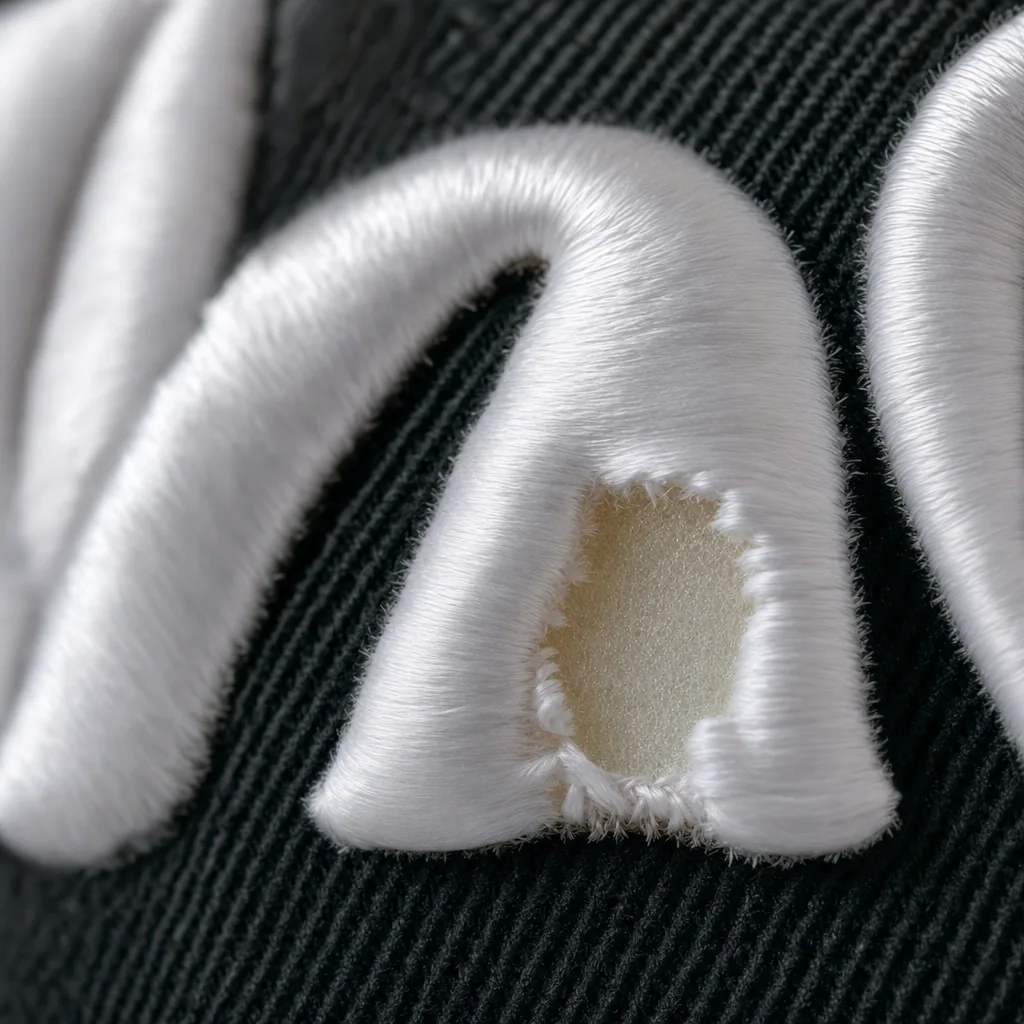
The fastest way to ruin a raised logo is to over-digitize it. For 3D puff on a front panel, 2 mm EVA foam is standard for clean block letters, while 3 mm is usually reserved for bolder shapes with satin columns wide enough to cover and trap the foam properly. In practical digitizing terms, puff fills generally land around 50 to 70 stitches/cm², with stitch length, column width, and cap fabric doing more work than raw density. Push a puff file up to flat-fill density and the top stitches start cutting the foam, collapsing the loft, and creating sharp edges that crack after packing. On an embroidery stitch count cap, that failure often does not show on the machine table; it shows after the caps are bagged, cased, and shipped, when the logo comes out hard, flattened, and visibly over-sewn. Good operators on Tajima, Barudan, or ZSK cap frames know the fix is not “more coverage.” It is wider spacing, clean top travel, proper underlay strategy, and a slower run speed around 650 to 750 rpm so the foam stands instead of being strangled.
Flat embroidery is a different discipline because the thread itself has to create the body, coverage, and edge definition. On standard cap logos, usable flat density is more often 60 to 90 stitches/cm², with small satin text or tight color fills occasionally running higher in isolated zones if the base fabric is stable enough. Once you get above roughly 85 to 90 stitches/cm² on lightweight 210 gsm cotton twill or soft brushed twill, the risk climbs fast: thread breaks, needle heat, puckering, and visible tunneling. Underlay matters as much as top density here—edge-run plus zigzag for fills, center-walk for satin columns, and pull compensation adjusted for acrylic serge versus washed cotton. Reusing one file for both methods is the classic low-cost digitizing mistake: a puff file sewn flat looks weak and undercovered, while a flat file sewn over foam crushes the loft and reads like a stiff patch. That is why experienced factories separate puff and flat files at sampling, then check coverage, foam recovery, and edge cleanliness before approving bulk, instead of trusting stitch count alone as a pricing shortcut.
When to bill back digitizing setup to your customer
Bill back digitizing once, on the first production order, and tie it to an approved machine file plus a signed sew-out. For cap programs that usually means a production `.DST` run file, with the editable source kept as `.EMB` or native ZSK format for future revisions. A defensible one-time charge for a front logo is usually $35 to $85: about $35 to $45 for a clean 5,000 to 8,000-stitch flat design, $50 to $65 for a 9,000 to 12,000-stitch logo with small text under 4 mm cap height, and $70 to $85 when 3D puff, center-seam compensation, or heavy fill across a structured buckram front is involved. That fee covers actual engineering, not admin. The digitizer is setting pull compensation, edge-run and zigzag underlay, satin column width, stitch angle, trim path, and density—typically around 0.35 to 0.45 mm for standard fills, then backed off further on thick 270 gsm cotton twill or acrylic-wool blends to avoid flagging, puckering, and needle heat. On an embroidery stitch count cap order, those choices directly affect machine minutes, reject rate, and whether the sample sews cleanly on Tajima, Barudan, or ZSK heads at 700 to 850 rpm.
Do not rebill digitizing on repeat orders unless the file must be materially rebuilt. If the logo, finished dimensions, placement, stitch type, and cap construction are unchanged, rerunning 300 pieces or 3,000 pieces is production, not new setup. A competent factory should have the approved file name, stitch count, color sequence, Pantone reference, needle order, and sample approval date logged in the ERP or order archive. A second setup fee is reasonable only when the embroidery geometry or sewing surface changes enough to require re-digitizing: reducing width from 110 mm to 85 mm, converting flat fill to 3D puff, moving from front panel to side panel, changing from brushed chino to 8-wale corduroy, or adding a merrowed patch border. In those cases, $20 to $60 is normal because density maps, underlay structure, and trim sequence often need rework to prevent tunneling, birdnesting, registration drift, or edge collapse. What is not legitimate is charging “setup” again for file retrieval. On a 300-piece reorder, a recycled $50 fee quietly adds $0.17 per cap with no improvement in sew quality, lead time, or AQL 2.5 outcomes, which is exactly why any embroidery stitch count cap quotation should state: one-time digitizing on initial order, waived on exact repeats, rechargeable only for art revision or construction change.
Frequently Asked Questions
How long does production take?
Sampling takes 7 to 12 days. Bulk production runs 20 to 30 days depending on quantity, fabric availability and decoration complexity. Inspection and packing adds another 3 to 5 days before shipment.
Do you support sustainability certifications?
Yes. We work with GOTS organic cotton, GRS-certified recycled polyester, OEKO-TEX Standard 100 fabrics, and are BSCI and Sedex audited. Certification documentation can be provided per order.
What file format should I send for my logo?
Vector files (AI, EPS, PDF) are ideal. High-resolution PNG or JPG at 300 dpi on transparent background works as a fallback. Provide Pantone color references for accurate reproduction.
What is the minimum order quantity (MOQ) for custom hats?
Our standard MOQ is 100 pieces per design and color, with sampling available from 1 piece. For complex multi-color logos or premium fabric upgrades, the MOQ can be lowered with a small per-piece surcharge.
Can I order a sample before bulk production?
Yes. We strongly recommend approving a pre-production sample before mass production. Samples are charged at 35 to 60 USD each plus express shipping, fully refundable against confirmed bulk orders over 500 pieces.
How does ordering custom hat embroidery near me work?
When evaluating custom hat embroidery near me, the key considerations are construction quality, decoration capability, MOQ flexibility and lead time. Total stitches in the embroidery file (DST or EMB) generated by digitizing artwork at production size. A 5cm-wide simple logo runs 4,000-7,000 stitches; a 7cm complex logo with 3+ colors runs 12,000-20,000 stitches. Machine time is roughly 1 minute per 1,000 stitches per head. Stitches per cm² determines how filled-in the embroidery looks. Industry standards: tatami fill…
How does ordering new era custom embroidery work?
When evaluating new era custom embroidery, the key considerations are construction quality, decoration capability, MOQ flexibility and lead time. Total stitches in the embroidery file (DST or EMB) generated by digitizing artwork at production size. A 5cm-wide simple logo runs 4,000-7,000 stitches; a 7cm complex logo with 3+ colors runs 12,000-20,000 stitches. Machine time is roughly 1 minute per 1,000 stitches per head. Stitches per cm² determines how filled-in the embroidery looks. Industry standards: tatami fill…
How does ordering baseball cap custom work?
When evaluating baseball cap custom, the key considerations are construction quality, decoration capability, MOQ flexibility and lead time. Most factories quote a flat decoration fee per cap if stitch count is under 8,000-10,000. Above that, add $0.02-$0.05 per 1,000 stitches over the threshold. So a 14,000-stitch logo on a $4.00 cap might quote $4.20-$4.30 vs. $4.00 for an 8,000-stitch logo. Total stitches in the embroidery file (DST or EMB) generated by digitizing artwork at production size. A 5cm-wide simple…
What should buyers know about new era hats near me?
When evaluating new era hats near me, the key considerations are construction quality, decoration capability, MOQ flexibility and lead time. Total stitches in the embroidery file (DST or EMB) generated by digitizing artwork at production size. A 5cm-wide simple logo runs 4,000-7,000 stitches; a 7cm complex logo with 3+ colors runs 12,000-20,000 stitches. Machine time is roughly 1 minute per 1,000 stitches per head. Stitches per cm² determines how filled-in the embroidery looks. Industry standards: tatami fill…
Looking for a reliable hat manufacturer in China?
CrownsForge has produced custom hats for 800+ brands across 40 countries. From 100-piece launches to 100,000-piece retail programs, we deliver on time and on spec.
Get in touchRelated guides
Snapback vs Fitted vs Adjustable: Cap Closure Systems Compared
Read article →
Sustainable Custom Hats: Eco-Friendly Materials, Recycled Fabrics & Certifications
Read article →
Switching Hat Manufacturers Mid-Program Without Losing Quality - Supplier Checklist
Read article →We hope this guide demystifies embroidery stitch count & thread density: a cost-and-quality reference - 2026 buyer's guide and helps you move forward with confidence. If you have questions specific to your project, our English-speaking sales engineers are one message away.