
Custom Hat Barcode Labeling for Retail and Amazon Shipments
Every week, our sales team answers detailed questions about custom hat barcode labeling for retail and amazon shipments. We wrote this guide so that wholesalers, streetwear brands, corporate buyers and promotional resellers can compare options with full information, and avoid the traps that show up only after production has started.
What custom hat barcode labeling means in real production
Custom hat barcode labeling is not just slapping a sticker on a polybag. In real production, it means every hat, carton, or master case carries a scannable code that ties back to the SKU, colorway, size, PO number, and sometimes the Amazon FNSKU or retail UPC/GTIN. If you are sourcing from a custom hat manufacturer, you need to state whether the barcode is on the individual retail hangtag, the sewn-in care label, the polybag, or the shipping carton, because each option changes labor, material, and scan reliability. Our standard practice at CrownsForge is to lock the barcode format before sample approval, not after, because a Code 128 on a matte label behaves differently from a glossy EAN-13 sticker once it passes through sorting and warehouse handling.
For a custom cap factory or private label hat supplier, the important production details are barcode symbology, label size, print contrast, and placement tolerance. Amazon shipments usually need clean, high-contrast 300 dpi printing with verified FNSKU readability, while retail cartons may require GS1-128 or UPC-A depending on the buyer’s system. You should ask for the exact label stock, adhesive type, and whether the code is generated from your ERP, a spreadsheet, or the factory’s WMS, because mismatched data creates receiving errors fast. On the floor, we check that the scanner reads from at least 30 to 40 cm, the label does not wrinkle on curved visor cartons, and the code sits clear of seams, stitches, and folding edges.
Before sampling, a buyer should verify the full hat barcode labeling spec in the RFQ: code type, data string, label dimensions in millimeters, placement diagram, carton pack-out, and whether mixed-size packs need unique barcodes. In a headwear factory China setup, the cheapest mistake is assuming the factory will “handle it”; the expensive mistake is discovering your barcode label conflicts with retail compliance or Amazon prep rules after mass production starts. Ask for a pre-production scan report, a digital label proof, and one physical pilot carton with the final sticker stock. If the supplier cannot tell you the difference between a retail UPC, an Amazon FNSKU, and an internal warehouse barcode, they are not ready for scale, no matter how good the sample cap looks.
Specs to request before a quote
When asking for a quote on custom hat barcode labeling, start with the physical spec, not the price. A retail-ready barcode label for headwear usually needs a finished size like 50 x 30 mm or 60 x 40 mm, depending on whether you’re carrying SKU, size, country of origin, and FNSKU/UPC in the same panel. I’d ask the supplier to confirm label stock, adhesive type, and face material up front: coated paper is cheap but can scuff in transit, while PP synthetic or PET gives better durability for Amazon shipments and humid warehouses. For hats, the practical tolerance is ±1.0 mm on die-cut labels and ±0.5 mm on print registration if you want barcodes to scan cleanly the first time. A capable custom hat manufacturer should also tell you whether the label is hand-applied, machine-applied, or packed loose for your DC to apply later, because that changes labor cost and carton count.
For decoration files, don’t accept “just send logo.” A real private label hat supplier should request vector artwork for the barcode label in AI, EPS, or editable PDF, plus a barcode proof in Code 128, EAN-13, UPC-A, or FNSKU format with verified quiet zones. If you need printed care content or fiber content, ask for text locked to the correct country-specific wording before sampling. On the packing side, carton specs matter as much as the label: request master carton dimensions, gross weight, case pack, inner polybag count, and whether cartons are 5-ply or 7-ply with an edge crush test rating suitable for export. For a headwear factory China-side, I expect them to state if they are using export cartons around 55 x 45 x 35 cm, what palletization method they use, and whether carton marks are printed or stickered so you can match Amazon FBA inbound rules.
A competent custom cap factory should give evidence, not promises. For custom hat barcode labeling, I want a pre-production sample photo showing the exact barcode placement on the hat and carton, a barcode scan test report, and a print proof with measurable ΔE color tolerance if the label has brand colors. Ask for AQL level in writing; for this kind of packing work, AQL 2.5 for major defects and 4.0 for minor defects is a reasonable starting point, but if the barcode is mission-critical I’d tighten barcode readability to 100 percent scan acceptance on the pilot batch. CrownsForge’s standard practice is to provide carton photos, label placement images, and an inspection checklist with lot numbers, so the buyer can trace any mismatch back to the packing line. If the factory cannot show sample approval records, material datasheets, or a packing SOP, they are not ready for retail or Amazon shipments, no matter how low the quote looks.
Factory risks and quality checks
The biggest risk in custom hat barcode labeling is not the label itself, it is the mismatch between production data, carton markings, and the retail SKU list. I have seen 5,000 caps get held because the GTIN on the hangtag was right, but the FNSKU sticker was printed from an outdated Excel file. At a custom cap factory, the first quality gate should be data verification: style code, color name, size, carton count, and barcode symbology all checked against the buyer’s PO before anything is packed. For Amazon shipments, we usually treat the label spec as a controlled document, because one wrong SKU or an unreadable 1D barcode can trigger receiving delays, chargebacks, or full carton re-labeling.
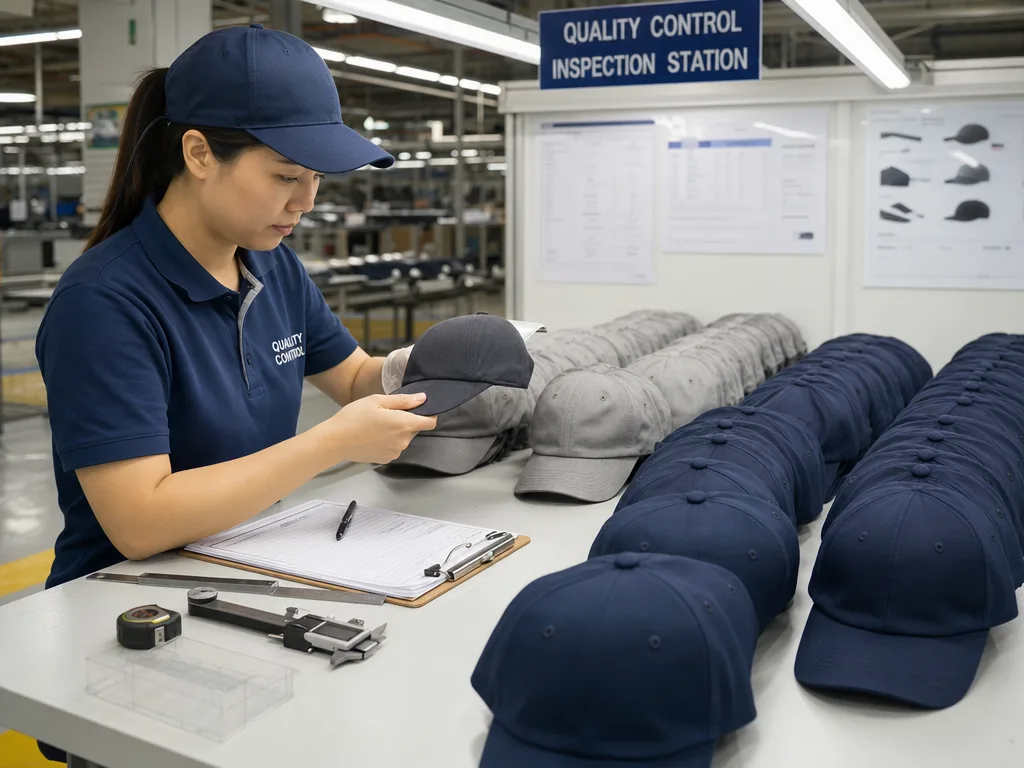
A proper inspection plan should cover both product defects and labeling defects. On the product side, look for crooked embroidery, loose threads, oil marks from the hooping table, skipped stitches on Tajima or Barudan heads, and panel distortion after washing or steaming. On the labeling side, check barcode contrast, quiet zone width, adhesive strength, and placement consistency on polybags and master cartons. Our standard practice at CrownsForge is to approve a signed golden sample first, then run a pre-production sample with the exact label stock, printer, and carton format. If the buyer wants private label hat supplier packaging, the sample set should include one finished cap, one retail polybag, one inner carton, and one master carton so the whole pack-out sequence can be checked before bulk work starts.
To prevent rework and late shipment, the factory needs in-line checks, not just final inspection. A headwear factory China should verify the first 20 pieces off each machine, then audit every carton at packing with a scanner that reads the barcode at actual warehouse speed, not just on a phone camera. For retail programs, I insist on AQL 2.5 for major defects and a separate scan test on 100% of labeled cartons before pallet wrap. If the buyer changes the barcode format after production starts, stop the line immediately; relabeling 20,000 units on the back end costs far more than a one-day pause. The cleanest shipments come from locking artwork, carton dimensions, and label placement early, then issuing a packing sheet that the warehouse team can follow without interpretation.
MOQ, lead time, and cost drivers
MOQ is the first thing that changes the math for custom hat barcode labeling. If you are ordering 300 to 500 pieces, the barcode sticker itself may only cost a few cents, but the setup work does not scale down: label file checking, SKU mapping, carton mark review, scan testing, and pack-out supervision still eat labor. In a real custom cap factory, that means your unit cost can jump $0.20 to $0.60 just from low-volume handling, especially if each colorway or size run needs separate retail tags. A private label hat supplier will usually price better once you cross 1,000 to 3,000 pieces per SKU because printing, bundling, and carton consolidation get simpler. The hidden cost is rework: if your UPC or Amazon FNSKU is wrong, the whole batch can be delayed at the packing table while workers peel and reapply labels one by one.
Trim choices matter more than most buyers expect because every extra component adds a labor step. Woven neck labels, sew-in size tags, hangtags with retail strings, polybags with suffocation warnings, and tamper seals all affect cycle time. A headwear factory China buyer ordering basic six-panel caps with one barcode label may spend far less than someone asking for embroidery, woven label, hangtag, individual polybag, barcode sticker on bag, and master carton label on every unit. On the shop floor, that is a different packing line, not just a different accessory list. Our standard practice at CrownsForge is to separate material cost from labor cost so clients can see where the real money goes; for example, a barcoded retail-ready packout can add $0.15 to $0.40 per hat before freight, depending on whether the label is preprinted or variable data and whether scan verification is required.
Testing and shipping are the other two cost drivers that get ignored until the PO is already open. If you want Amazon shipments, barcode readability and carton label accuracy need spot checks, and an AQL 2.5 inspection on packaging usually adds time even if the hats themselves are fine. A custom hat manufacturer also has to account for export carton strength, master carton packing density, and whether you are shipping FOB or DDP; dense packing lowers volumetric cost, but overstuffed cartons can crush visors and trigger claims. For air freight, a 2-ounce difference per cap can move the landed cost more than the actual barcode material. For ocean freight, lead time is often 25 to 40 days production plus 15 to 30 days transit, but rush jobs with mixed SKUs and label corrections can add a week or more. That is why a custom hat barcode labeling program only works when SKU structure, packing method, and shipping mode are decided before production starts.
How CrownsForge manages this order type
For custom hat barcode labeling, the first thing we lock down is the SKU architecture before anyone sews a panel. At CrownsForge, we build the sample pack with the buyer’s UPC or FNSKU format, carton label spec, and any retail hangtag data so the trim room is not guessing later. If the client is using Amazon, we verify label size, quiet zone, and placement against the actual polybag or master carton; a 10 mm shift can trigger scan failure at inbound. For color, we match the crown, bill, and thread to Pantone TCX and keep Delta-E under 2.0 on approved samples. As a custom hat manufacturer and private label hat supplier, we also document BOM details down to fabric weight, thread count, and closure type so the same SKU can be rebuilt without a second round of approvals.
Every order gets a production file that includes artwork, barcode list, carton packout, and inspection checkpoints. Our standard practice is to run pre-production samples, then in-line checks on embroidery registration, label adhesion, and polybag suffocation warning placement, followed by final AQL 2.5 inspection before cartons leave the headwear factory China floor. We check barcode readability with a scanner, not just by eye, because hat barcode labeling often fails when the print contrast is weak on matte bags or curved tags. If the order is destined for retail, we separate store-ready packs from warehouse packs and keep the carton mark consistent with the buyer’s ASN so receiving teams do not reject mixed lots.
Communication is kept tight because reorder work usually breaks when the spec lives only in someone’s inbox. For repeat programs, we archive the approved sample, barcode file, stitch count, and trim approvals, then quote reorders against the locked spec instead of starting from scratch. That matters for a custom cap factory where a 500-piece rush reorder may need the same barcode sequence, same carton count, and same lot coding as the first shipment. We also flag any change in yarn dye lot, sweatband supplier, or packaging material, because those small shifts can change shade or fit enough to cause chargebacks. For buyers running seasonal drops, we can split production into staggered lots so retail replenishment and Amazon shipments stay synchronized without mixing inventory.
Frequently Asked Questions
What file format should I send for my logo?
Vector files (AI, EPS, PDF) are ideal. High-resolution PNG or JPG at 300 dpi on transparent background works as a fallback. Provide Pantone color references for accurate reproduction.
How long does production take?
Sampling takes 7 to 12 days. Bulk production runs 20 to 30 days depending on quantity, fabric availability and decoration complexity. Inspection and packing adds another 3 to 5 days before shipment.
Do you support sustainability certifications?
Yes. We work with GOTS organic cotton, GRS-certified recycled polyester, OEKO-TEX Standard 100 fabrics, and are BSCI and Sedex audited. Certification documentation can be provided per order.
Which shipping methods do you support?
We support FOB, CIF and DDP shipping. Air express for samples and small orders, sea LCL for 100 to 500 pieces, sea FCL for 5,000+ pieces. Door-to-door DDP available for US, EU, UK, Canada and Australia.
What logo decoration techniques do you offer?
3D puff embroidery, flat embroidery, woven patch, leather patch, PVC patch, screen printing, sublimation, applique and laser etching, all in-house with no subcontracting.
How do I find a reliable custom waterproof cap manufacturer?
When evaluating custom waterproof cap manufacturer, the key considerations are construction quality, decoration capability, MOQ flexibility and lead time. Explain custom hat barcode labeling in the context of a custom headwear RFQ, with the production details a buyer should verify before sampling. Cover dimensions, materials, tolerances, decoration files, carton requirements, AQL level, and the evidence a capable factory should provide.
How do I find a reliable custom hat manufacturer usa?
When evaluating custom hat manufacturer usa, the key considerations are construction quality, decoration capability, MOQ flexibility and lead time. Explain custom hat barcode labeling in the context of a custom headwear RFQ, with the production details a buyer should verify before sampling. Cover dimensions, materials, tolerances, decoration files, carton requirements, AQL level, and the evidence a capable factory should provide.
How does ordering custom made trucker hat work?
When evaluating custom made trucker hat, the key considerations are construction quality, decoration capability, MOQ flexibility and lead time. Explain custom hat barcode labeling in the context of a custom headwear RFQ, with the production details a buyer should verify before sampling. Cover dimensions, materials, tolerances, decoration files, carton requirements, AQL level, and the evidence a capable factory should provide.
What should buyers know about china cap?
When evaluating china cap, the key considerations are construction quality, decoration capability, MOQ flexibility and lead time. Explain custom hat barcode labeling in the context of a custom headwear RFQ, with the production details a buyer should verify before sampling. Cover dimensions, materials, tolerances, decoration files, carton requirements, AQL level, and the evidence a capable factory should provide.
Need a low-MOQ test order?
We help emerging brands launch with as few as 100 pieces. Premium fabric, in-house embroidery, retail-ready packaging.
Start a small orderRelated guides
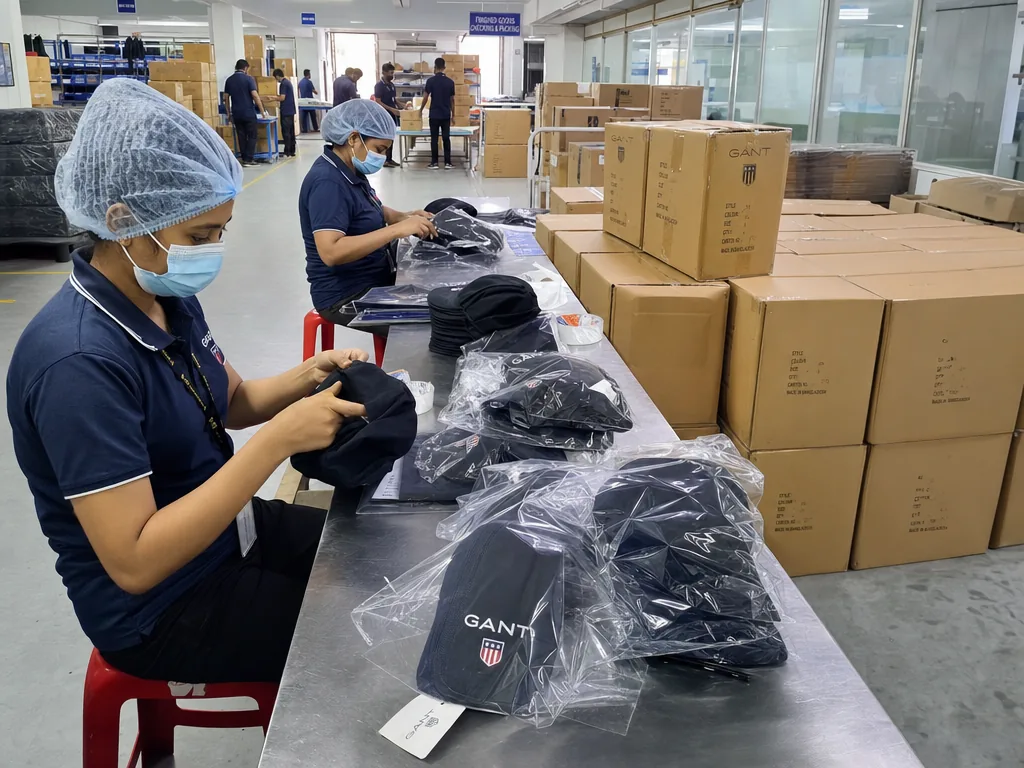
Cap Packaging Options: Retail-Ready, Hangtag, Polybag & Custom Boxes
Read article →
Hat Logo Placement Tolerance: Production Specs for Clean Branding
Read article →Promotional Hat Pricing Tiers: What $2, $4 and $7 Each Get You
Read article →Sourcing custom hats does not have to be complicated. With the right manufacturing partner, clear specifications and a small upfront investment in sampling, you can launch a retail-quality product in 30 to 45 days.