
Country Hats For Men Fabric And Trim Spec Guide for Custom Hat Buyers
Every week, our sales team answers detailed questions about country hats for men fabric and trim spec guide for custom hat buyers. We wrote this guide so that wholesalers, streetwear brands, corporate buyers and promotional resellers can compare options with full information, and avoid the traps that show up only after production has started.
Why country hats for men fabric and trim spec guide needs a separate sourcing plan
Compliance decisions also belong in the sourcing plan, not at the end of production. A custom hat manufacturer making country retail caps for U.S. or EU channels should confirm azo-free dyes, nickel-safe metal trims if using buckles, CPSIA relevance for youth sizes, and whether the buyer requires sedex-audit-cap-supplier-guide.html">BSCI 2.0 or Sedex SMETA 4-Pillar audit coverage. Color control needs the same discipline: washed cotton may carry a Delta-E tolerance of 1.5–2.0 against a Pantone TCX target before washing, but garment wash can shift shade and make exact repeat orders difficult unless a sealed bulk fabric lot is reserved. Packaging choices affect both compliance and landed cost: individual polybags add roughly US$0.03–0.06 per cap but help barcode retail cartons, while recycled paper hangtags, UPC stickers, and silica packs add handling time. A country hats for men fabric and trim spec guide should therefore separate fashion decisions from regulated decisions, then tie both to MOQ, AQL 2.5 inspection points, and FOB versus DDP delivery assumptions.
Factory capability checks before quoting
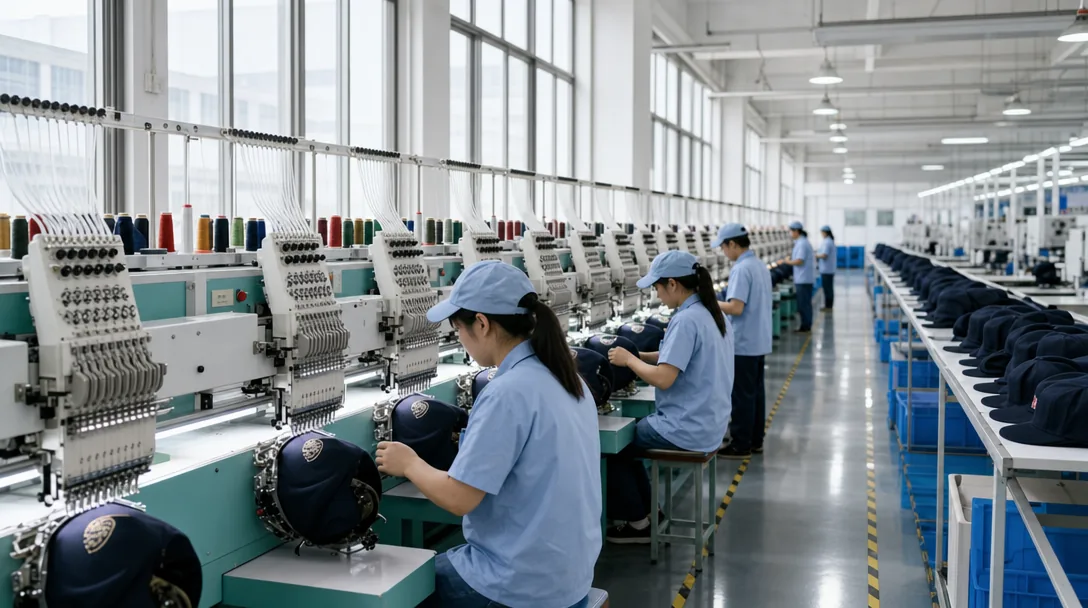
A serious quote for country hats for men starts with capability proof, not a pretty mockup. Ask the factory what embroidery machines they run, how many heads are available, and what stitch density they allow before puckering becomes a problem on foam, twill, or washed cotton. Tajima, Barudan, and ZSK heads can all produce clean work, but the operator’s digitizing standard matters more than the logo on the machine. For bulk custom embroidered hats, I want to see a stitch-out on the real front panel material, with thread color matched against Madeira or Pantone TCX references and a tolerance target around Delta-E 1.5 to 2.0 for critical brand colors. If the design uses a woven patch, leatherette patch, sublimated patch, or merrowed edge, confirm whether the factory makes patches in-house or subcontracts them. Subcontracting is normal, but it adds 3 to 7 days and another quality handoff.
Fabric and construction checks separate a custom hat manufacturer from a trading office. For a country hats for men fabric and trim spec guide, I would verify crown fabric weight, mesh denier, sweatband type, buckram stiffness, visor board thickness, and whether the factory can hold shape across 5-panel, 6-panel, mid-profile, and high-profile trucker builds. Common specs include 10 oz cotton duck, 280 gsm washed cotton twill, 100% polyester foam fronts, 75D to 100D mesh, and PE visor inserts around 1.8 to 2.2 mm. For bulk custom trucker hats, also check closure stock: plastic snapback, brass buckle, hook-and-loop, elastic flexfit, and leather strap all change cost and lead time. A low quote often hides weak trims, especially thin sweatbands, brittle snaps, or visor boards that warp after container heat exposure.
Before approving custom bulk trucker hats, test the sample room like you would test production. Ask for one pre-production sample with your exact fabric, patch, thread, eyelets, button, visor curve, inside taping, and label placement, not a close-enough showroom cap. Our standard practice at CrownsForge is to review sample comments in millimeters, not vague language: crown height plus or minus 3 mm, visor length plus or minus 2 mm, embroidery position plus or minus 1.5 mm. Audit readiness also belongs in the quoting stage. If your buyer requires BSCI 2.0, Sedex SMETA 4-Pillar, GRS, OEKO-TEX Standard 100, or Disney/FAMA-type controls, confirm documents before paying a sample fee. Communication is a production risk too: the factory should return a trim sheet, carton mark draft, AQL 2.5 inspection plan, and lead-time calendar within 24 to 48 hours.
MOQ, pricing and sample approval
A practical country hats for men fabric and trim spec guide should lock trims and packaging before the PPS is signed: snapback material, sweatband gsm, seam tape color, eyelet thread, brim sticker, crown insert, hangtag, barcode label, and carton mark all affect cost and inspection. For bulk custom embroidered hats, AQL 2.5 inspection should include embroidery position tolerance, loose threads, oil stains, crown symmetry, brim centerline, color shading, and barcode scan checks, not just a quick count. Polybags are usually US$0.03–0.06 each, custom hangtags US$0.05–0.12, UPC stickers US$0.02–0.04, and inner cartons add labor if retail packing is required. Our standard practice at CrownsForge is 7–10 days for PPS after artwork and materials are confirmed, then 20–35 days bulk production for 300–3,000 pieces, with another 3–7 days for final inspection and export booking. DDP air can be 6–10 days but expensive; sea freight is safer for margin, usually 25–40 days port-to-door depending on destination.
Quality inspection and shipping risk
Inspection risk on country hats for men starts with defining defects before production, not arguing over cartons at the warehouse door. For bulk custom trucker hats, I normally set final inspection at AQL 2.5 for major defects and AQL 4.0 for minor defects, using ANSI/ASQ Z1.4 general inspection level II. Major defects include wrong fabric, broken snapback, missing sweatband seam, embroidery off-center by more than 3 mm, oil stains over 5 mm, or panel color outside the approved lab dip. Minor defects include loose threads under 10 mm, slight puckering around a 3D puff logo, or visor stitch spacing variation that does not affect appearance at arm’s length. Cap circumference should be controlled within plus or minus 0.5 cm, visor length within plus or minus 3 mm, front panel height within plus or minus 4 mm, and crown symmetry checked on a head form, not just laid flat on a table.
Color and decoration failures are where many custom bulk trucker hats lose margin. Fabric approvals should reference Pantone TCX or a physical swatch, with Delta-E under 1.5 for solid twill and under 2.0 for heather, washed cotton, or pigment-dyed fabric because those materials naturally drift more. For mesh backs, specify denier and gsm, such as 100D polyester mesh at 120–140 gsm, because low-density mesh collapses after steaming. Colorfastness should be tested to rubbing, perspiration, and washing when the hat uses dark navy, black, burgundy, or enzyme-washed cotton; grade 4 is a practical minimum for export orders. Embroidery inspection needs the stitch file, thread chart, and approved pre-production sample beside the inspector. On Tajima, Barudan, or ZSK heads, common defects include thread breaks, bird-nesting, foam showing through 3D puff, satin columns too narrow under 1.2 mm, and fill stitch pulling the front panel out of shape.
Shipping risk is mostly paperwork discipline. Carton markings should show PO number, style code, color, size if applicable, carton sequence, gross weight, net weight, and country of origin; mixed-color cartons need an inner packing list or the receiving warehouse will waste hours sorting. For a country hats for men fabric and trim spec guide, I would also lock the carton size and packing ratio, such as 24 or 48 pieces per export carton with polybags only if the buyer’s retail channel requires them. FOB Ningbo or Shanghai gives experienced importers better control over freight and customs, while DDP is safer for small brands that do not have a broker, but the quote must state duty, tariff code, remote delivery surcharge, and whether Amazon/FBA labeling is included. Reorders of bulk custom embroidered hats should reference the original tech pack, embroidery DST file, thread lot, fabric mill, trim supplier, approved sample photos, carton marks, and inspection report so the custom hat manufacturer is not rebuilding the spec from memory.
Buyer checklist for the next RFQ
A firm RFQ for country hats for men should start with a locked bill of materials, not a mood board. Send the cap style first: 5-panel foam trucker, 6-panel structured trucker, unstructured dad cap, rope cap, or high-crown snapback. Then list crown height in cm, brim type, mesh type, closure, sweatband, taping, eyelets, rope, label placement, and carton pack requirement. For fabric, specify cotton twill weight such as 260 gsm, waxed canvas at 10 oz, polyester foam at 3.5 mm, or nylon taslan by denier. If you only write “brown front with tan mesh,” the factory has to guess. Use Pantone TCX or TPX codes, and state whether Delta-E under 1.5 is required for lab dip approval. For bulk custom trucker hats, small material changes can move cost by $0.25–$0.80 per cap, especially with washed cotton, waxed fabric, suede patches, or imported buckles.
Before asking any custom hat manufacturer for a firm quote, attach the artwork in production-ready formats: AI, EPS, or PDF for logos; DST only if embroidery has already been tested; PNG or JPG is acceptable only as a visual reference. Include logo size in mm, stitch position from center seam or brim edge, thread colors by Madeira or Pantone reference, and decoration method: flat embroidery, 3D puff, woven patch, leather patch, sublimated patch, rubber patch, or heat transfer. For bulk custom embroidered hats, the quote depends heavily on stitch count; a 6,000-stitch left-chest-style logo is not priced like a 14,000-stitch full-front rodeo mark. Send front, side, back, inside, and closure photos of any reference cap, including a ruler in the photo. If the cap must match an existing retail sample, ship one physical hat and approve a counter sample before mass production.
The cleanest RFQ package includes quantity by colorway, size breakdown if fitted, target FOB or DDP destination, required delivery date, compliance needs, and inspection standard. State whether you need BSCI 2.0, Sedex SMETA 4-Pillar, Prop 65 labeling, CPSIA tracking labels, or licensed sports-team documentation. For AQL, use normal inspection Level II with AQL 2.5 for major defects and 4.0 for minor defects unless your brand has a stricter manual. This country hats for men fabric and trim spec guide is only useful if the buyer also states commercial constraints: target landed cost, preferred incoterm, carton marking rules, UPC/FNSKU needs, and whether polybags must be recycled LDPE. Our standard practice at CrownsForge is to separate sampling cost, mold or digitizing cost, unit price, and freight line by line, because custom bulk trucker hats and bulk custom embroidered hats often look cheap until patch molds, hangtags, and air freight are hidden inside the unit price.
Working with CrownsForge
For a country hats for men fabric and trim spec guide program, the first control point is not the logo; it is the bill, crown hand-feel, and sweatband choice. A western retail buyer may ask for 60/40 cotton-poly twill at 210–230 gsm, but a rodeo merch program often performs better with 10 oz washed cotton canvas or 100D polyester foam front because the cap needs to hold shape after dust, sweat, and repeated truck cab storage. Our standard practice at CrownsForge is to build the sample sheet around fabric codes, Pantone TCX color references, thread cards, mesh denier, closure type, visor board thickness, and seam tape color before we open a Tajima, Barudan, or ZSK embroidery file. For country hats for men, I normally push buyers to approve two physical samples: one fit sample with blank trims and one decorated pre-production sample with the exact patch, embroidery density, rope, eyelets, and snapback color.
Decoration planning is where many bulk custom trucker hats go wrong, especially with detailed ranch logos, cattle brands, flag artwork, and small text under curved embroidery. Flat embroidery on twill can run 8,000–12,000 stitches cleanly, but raised 3D puff needs bolder shapes, 2.5–3.0 mm foam, and wider satin columns or the edges will break after trimming. For bulk custom embroidered hats, we check digitizing at 100% scale, not just on a PDF mockup, and we run thread color against the approved Pantone target with a practical Delta-E tolerance of 1.5–2.0 for solid brand colors. Leatherette patches usually cost about $0.35–$0.80 each depending on embossing and heat-transfer backing; woven patches land around $0.45–$1.10, while full front 3D embroidery can add $0.70–$1.50 per cap. Custom bulk trucker hats need these costs locked before sales samples, or the buyer ends up approving a look that cannot hit the landed price.
Quality control and export coordination should be written into the spec, not handled after production starts. A real country hats for men fabric and trim spec guide should include AQL 2.5 for major defects and AQL 4.0 for minor defects, with checkpoints for crown height, visor curve, front panel symmetry, embroidery placement tolerance of plus or minus 2 mm, thread trimming, sweatband puckering, snapback pull strength, and carton moisture level below 12% when possible. As a custom hat manufacturer shipping FOB Ningbo or Shanghai, we also align carton marks, HS code classification, polybag warnings, hangtags, barcode placement, and customer routing guides before final inspection. For larger programs tied to retail or licensed sports channels, buyers should ask whether the factory has current BSCI 2.0 or Sedex SMETA 4-Pillar audit documents, because social compliance delays can hold a finished container longer than any sewing issue.
Frequently Asked Questions
Do you support sustainability certifications?
Yes. We work with GOTS organic cotton, GRS-certified recycled polyester, OEKO-TEX Standard 100 fabrics, and are BSCI and Sedex audited. Certification documentation can be provided per order.
Can I order a sample before bulk production?
Yes. We strongly recommend approving a pre-production sample before mass production. Samples are charged at 35 to 60 USD each plus express shipping, fully refundable against confirmed bulk orders over 500 pieces.
What is the minimum order quantity (MOQ) for custom hats?
Our standard MOQ is 100 pieces per design and color, with sampling available from 1 piece. For complex multi-color logos or premium fabric upgrades, the MOQ can be lowered with a small per-piece surcharge.
How long does production take?
Sampling takes 7 to 12 days. Bulk production runs 20 to 30 days depending on quantity, fabric availability and decoration complexity. Inspection and packing adds another 3 to 5 days before shipment.
What logo decoration techniques do you offer?
3D puff embroidery, flat embroidery, woven patch, leather patch, PVC patch, screen printing, sublimation, applique and laser etching, all in-house with no subcontracting.
How does ordering custom embroidered trucker hat work?
When evaluating custom embroidered trucker hat, the key considerations are construction quality, decoration capability, MOQ flexibility and lead time. Explain the buyer intent behind country hats for men fabric and trim spec guide, when it differs from generic hat sourcing, and what decisions affect cost, lead time and compliance. Cover embroidery, patch, fabric, panel construction, closure options, sample room capability, audit readiness and communication checks.
What should I know about custom trucker hats bulk?
When evaluating custom trucker hats bulk, the key considerations are construction quality, decoration capability, MOQ flexibility and lead time. Explain the buyer intent behind country hats for men fabric and trim spec guide, when it differs from generic hat sourcing, and what decisions affect cost, lead time and compliance. Describe how CrownsForge manages country hats for men fabric and trim spec guide programs with sampling, decoration, QC and export coordination.
What's the MOQ for custom embroidered trucker hats no minimum?
When evaluating custom embroidered trucker hats no minimum, the key considerations are construction quality, decoration capability, MOQ flexibility and lead time. Explain the buyer intent behind country hats for men fabric and trim spec guide, when it differs from generic hat sourcing, and what decisions affect cost, lead time and compliance. Describe how CrownsForge manages country hats for men fabric and trim spec guide programs with sampling, decoration, QC and export coordination.
What should I know about custom rope hat wholesale bulk?
When evaluating custom rope hat wholesale bulk, the key considerations are construction quality, decoration capability, MOQ flexibility and lead time. Explain the buyer intent behind country hats for men fabric and trim spec guide, when it differs from generic hat sourcing, and what decisions affect cost, lead time and compliance. Cover embroidery, patch, fabric, panel construction, closure options, sample room capability, audit readiness and communication checks.
Ready to start your custom hat project?
Send us your tech-pack, sketch or even just an inspiration photo. We will respond with a detailed quotation and digital mock-up within 24 hours.
Request a free quoteRelated guides
Hat Sizing & Fit for International Markets: US, EU, UK, JP Standards
Read article →Private Label vs White Label Caps: Which Model Fits Your Brand?
Read article →
Hat With Patch Fabric And Trim Spec Guide for Custom Hat Buyers
Read article →Sourcing custom hats does not have to be complicated. With the right manufacturing partner, clear specifications and a small upfront investment in sampling, you can launch a retail-quality product in 30 to 45 days.