
Corduroy Hat Vintage Export Shipping Checklist for Custom Hat Buyers - Cost & MOQ Breakdown
For brand owners, wholesalers and procurement teams entering the custom headwear category, corduroy hat vintage export shipping checklist for custom hat buyers - cost & moq breakdown is one of the highest-leverage decisions you will make. Get it right and your unit economics, retail story and reorder cycle all improve. Get it wrong and you carry the cost for years.
Why corduroy hat vintage export shipping checklist needs a separate sourcing plan
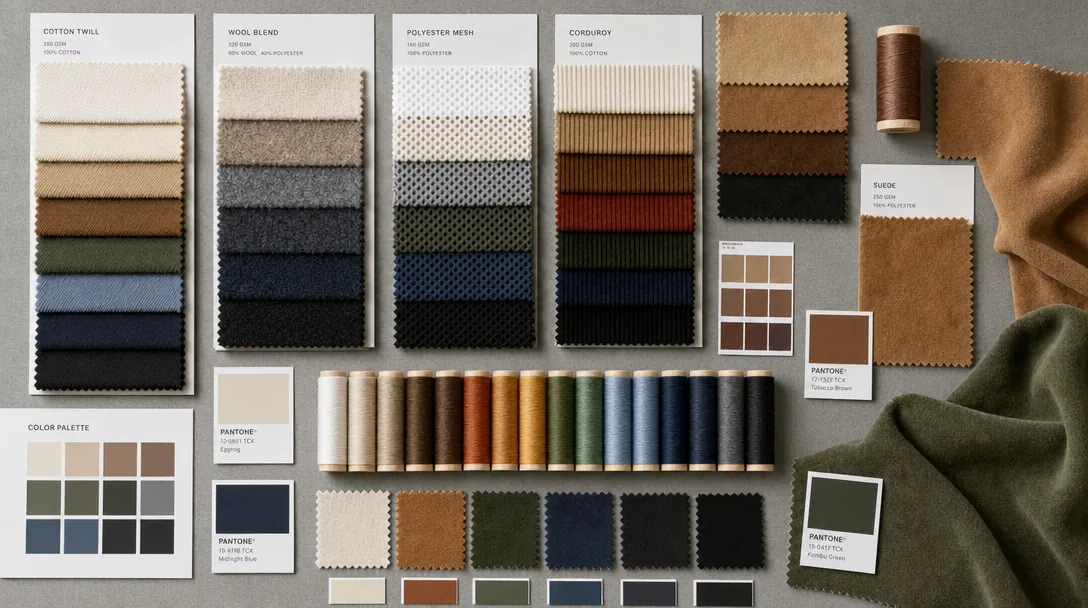
A proper corduroy hat vintage export shipping checklist starts upstream at fabric booking, because corduroy fails in ways standard brushed twill usually does not. The three recurring issues are obvious shade drift between dye lots, inconsistent wash-down after finishing, and pile crush during export packing. On cotton 8-wale and 11-wale corduroy, wale direction and nap pressure show under retail lighting immediately, especially on faded black, olive, tobacco, and rust tones. If the vintage effect comes from enzyme wash, pigment wash, or over-dye, the mill lot has to be locked before bulk and panel cutting direction has to stay consistent; otherwise the salesman sample and production shipment can split visibly after laundry. Shrinkage should be pre-tested by roll, with a practical tolerance around 3% to 5% depending on wash recipe, not guessed from the mill spec sheet. Construction also changes with the wale count, which is why a generic sourcing plan usually misses the real risk points. An unstructured 6-panel dad cap in 280 to 320 gsm 11-wale corduroy behaves very differently from a brushed twill cap: seam bulk increases, crown collapse changes, and embroidery registration gets less stable because the front panel has no buckram to hold the stitch field. On Tajima or Barudan heads, small logos over ribs need heavier underlay, wider satin columns, and slower machine speeds or the nap swallows edge definition. In practice, that means an apparently simple style may need 300 pieces per color for a washed cap, while a vintage corduroy bucket hat often lands closer to 500 if the factory must open a fresh dye lot and balance brim shape after wash.
The shipping side is exactly why the corduroy hat vintage export shipping checklist needs its own controls instead of being buried inside a standard cap SOP. Buyers should sign a shade band against Pantone TCX, then set a realistic trim-matching target such as Delta-E 1.5 to 2.0 for labels, tapes, or visor sandwich details. Packing density matters more than buyers expect: a carton loading standard that is fine for chino caps can leave permanent pressure lines on washed corduroy after 28 to 35 days of ocean transit from South China. Cartons should be built around crown recovery, not maximum fill ratio, and moisture protection should include desiccants during humid-season FOB shipments. AQL 2.5 final inspection is the minimum sensible standard because pile marks, wash-panel shading, and post-laundry metal corrosion are often missed by inline checks. Cost and compliance are tied to those decisions much earlier than most POs reflect. Compared with standard brushed twill, 100% cotton corduroy typically adds about $0.35 to $0.80 per cap, while a vintage wash adds another $0.20 to $0.60 depending on laundry capacity, color depth, and reject rate. If the buyer wants organic claims, GOTS or OCS backup has to match the trim and labeling file, or retailer document review will stall before shipment. Our standard practice is to confirm HS code, country-of-origin marking, polybag warning text, carton compression strength, and retailer-required audit documents such as sedex-audit-cap-supplier-guide.html">BSCI 2.0 or Sedex SMETA 4-Pillar before booking vessel space. Those are not admin details; they directly affect claim exposure, customs delay risk, and whether the hats arrive with the same vintage hand feel that got the approval sample signed.
Factory capability checks before quoting
Do not let a factory quote corduroy until it proves it can sew nap fabric without crushing the ribs, flipping pile direction, or sinking decoration into the wale. A usable corduroy hat vintage export shipping checklist starts with measurable fabric data: for vintage-style 6-panels and buckets, 8-wale to 12-wale cotton corduroy at 240-300 gsm is the safe band, while 14-wale only behaves well when the pattern has reduced seam bulk and tighter crown tolerance. Ask for the mill spec sheet showing fiber content, wale count, finished width, and gsm tolerance within ±5 percent. Color control should be defined, not hand-waved: shell fabric should be approved to Pantone TCX by lab dip at Delta-E below 1.5, while underbill, sweatband, seam tape, and internal binding can usually sit below 2.0 without visual risk. If the supplier cannot explain fabric relaxing time before cutting, nap-direction marking on all panels, or how they prevent shading variation between crown panels and visor, the quote is guesswork.
Decoration and pattern capability decide whether the factory can actually execute a vintage look at production speed. On Tajima, Barudan, or ZSK heads, corduroy embroidery needs more pull compensation, lighter density, and cleaner underlay than 108x58 chino twill; otherwise 3 mm text and fine outlines disappear into the channels. Ask for sew-outs on the exact base cloth—8-wale and 11-wale behave very differently—and request proof of alternative trims such as woven patches, felt applique, chain stitch, debossed PU, or heat-transfer badges, with adhesion notes and edge-finishing standards. Pattern work matters just as much: a competent sample room should already have working blocks for low-profile unstructured 6-panel, soft A-frame 5-panel, and bucket hats, and be able to specify seam allowance, crown depth, visor curve, and top-button construction instead of recycling one baseball-cap pattern. Our standard practice is to check brim insert options like 1.8 mm recycled PE board versus softer EVA, because that choice changes both hand feel and carton packing.
The last filter is operational discipline, because a pretty sample does not guarantee a stable bulk order. Before accepting any price, ask for MOQ broken out by colorway, logo method, and closure type; on corduroy caps, a self-fabric strap with antique brass buckle typically adds $0.18-$0.35 per piece over a plastic snap, while leather straps or fitted sizing usually raise trim MOQ and complicate carton assortment. If the line is sold as organic, verify certification continuity across shell, sweatband, seam tape, labels, and hangtags; many factories can source certified shell fabric but quietly switch to conventional trims when the certified chain gets tight. Reliable suppliers should be able to return a marked-up tech pack within 24-48 hours and back it with current BSCI 2.0 or Sedex SMETA 4-Pillar audit reports, needle-control logs, in-line inspection records, and a final AQL 2.5 plan. If those documents are missing, the quote is not mature enough for export booking.
MOQ, pricing and sample approval
MOQ on a corduroy program is driven by fabric and trims before it is driven by silhouette. If you stay with stock 8-wale or 11-wale 100% cotton corduroy and standard trims, most factories can accept 144 to 300 pieces per colorway for a 6-panel cap, bucket hat, or low-profile snapback because the shell is already greige-dyed or mill-stock and the trim package is interchangeable. Once you specify Pantone TCX lab dips, enzyme wash, branded seam tape, woven labels, custom hangtags, or a plated metal buckle, the real MOQ usually moves to 500 to 1,000 pieces per color. That jump is not arbitrary: dye houses want a usable lot size, label and hardware vendors charge small-run premiums, and wash inconsistency is harder to control on tiny batches. For a buyer building a corduroy hat vintage export shipping checklist, this is the first place margin gets decided. FOB Ningbo pricing follows the same logic. A basic unstructured cap in stock corduroy normally lands around $3.20 to $4.60 at 300 pieces, with standard sweatband, woven flag label, and common closure. A washed vintage program with custom inner tape, satin main label, stickered polybag, and upgraded moisture-wicking sweatband is more realistically $4.90 to $7.20 FOB at the same volume. If you require GOTS-backed or organic cotton fabric, add about $0.35 to $0.90 per piece, plus transaction certificate handling and tighter document control upstream. Packaging is often underestimated: export-ready retail packing with suffocation-warning polybags, barcode labels, silica gel, dividers, and clearer carton marks typically adds another $0.18 to $0.55 per piece before the booking cutoff.
Sample approval is where experienced buyers protect margin. Flat embroidery on Tajima, Barudan, or ZSK heads usually carries a $25 to $60 digitizing charge per logo, while 3D foam, chain stitch, or patch appliqué often pushes setup to $65 to $120 because the file needs extra cleanup and test sewing on ribbed fabric. Corduroy does not tolerate the same stitch density as brushed twill; for vintage graphics, 0.38 to 0.42 mm spacing usually gives cleaner edges and keeps small text from falling between the wales. Thread matching with Madeira or Gunold can generally be held within Delta-E 1.0 to 1.5, but the shell color will shift after enzyme wash or garment wash, so approval should be based on washed bulk standard, not on raw fabric swatches. Do not waive PPS to save three days. A proper pre-production sample should lock crown height, visor curvature, wale direction, embroidery placement, back-strap spec, label position, carton marks, and final retail packaging. Our standard practice is to treat PPS as the control sample for bulk sewing, wash hand-feel, and packing method, because most avoidable claims come from details that were “understood” but never signed off. Sample lead time is usually 7 to 10 days; bulk production is typically 25 to 35 days after PPS approval, assuming trims are in-house and no re-dip is needed. If the corduroy hat vintage export shipping checklist skips this gate, buyers usually pay later through rework, air-ship corrections, or failed AQL 2.5 inspection on appearance and packing.
Quality inspection and shipping risk
The costliest failure in a corduroy shipment is not a crushed carton; it is a container loaded with defects that should have been stopped at final inspection. A usable corduroy hat vintage export shipping checklist should lock inspection at AQL 2.5 for major defects and 4.0 for minor, with the defect list approved before bulk cutting. On vintage corduroy caps and bucket hats, I would classify panel skew over 3 mm, broken topstitch, mismatched wale direction, visible shade variation between adjoining panels, wrong buckle or snap finish, and embroidery thread tails over 3 mm on the front logo as majors if they affect retail appearance. Measurements also need realistic tolerances: crown height and body width within ±0.5 cm, brim width within ±0.3 cm, and finished head circumference within ±1.0 cm. Bucket hats need a separate brim symmetry check, because 8- to 11-wale corduroy makes even a small twist obvious after steaming. If the fabric is enzyme-washed or brushed, inspect after finishing, not before, because pile pressure and wash variation can change both shape and shading.
Color control and pack-out discipline are where margin usually disappears on reorders. For washed or brushed corduroy, lab dips are only a starting point; bulk approval should be done under D65 lighting against the sealed standard with a Delta-E target of 1.5 or below, especially on olive, tobacco, and vintage black, which drift easily between lots. On dark shades, require colorfastness testing for dry crocking, wet crocking, perspiration, and domestic wash, because dye transfer onto sweatbands, contrast topstitch, or woven labels is a routine claim. Embroidery deserves the same scrutiny: check registration drift on Tajima or Barudan heads, backing show-through on unstructured panels, and fill density on raised pile, since artwork digitized like flat cotton twill will sink into corduroy and look patchy after steaming. Cartons should be 5-ply export corrugate for sea freight, with PO, style, color, quantity, carton number, GW/NW, dimensions, COO, and destination mark matching the packing list exactly. Freeze mixed-color ratios before production starts; once a factory starts reallocating leftover panels late in packing, shortage claims and color-assortment disputes are almost guaranteed. FOB usually fits larger runs moving on the buyer’s nominated forwarder, while DDP is often cleaner for 300-800 piece orders where landed-cost predictability matters more than routing control.
Buyer checklist for the next RFQ
A usable RFQ starts with build data, not mood boards. For a practical corduroy hat vintage export shipping checklist, lock the silhouette first: 6-panel baseball cap, 5-panel camper, unstructured dad cap, bucket hat, and whether the front is fused or soft. That choice changes marker yield, visor board thickness, sewing SAM, and carton efficiency. Then state quantity by color and size split. A 288-piece order in one Pantone TCX color prices very differently from 288 pieces spread across 6 SKUs, because lab dips, line changeovers, trim loss, and excess fabric all rise on short runs. Fabric must be called precisely: 8-wale or 11-wale corduroy, 100% cotton or 80/20 cotton-poly, finished weight such as 280-320 gsm, plus any GOTS or OCS requirement. Color should be Pantone TCX or approved swatch; “vintage brown” is not a spec. On washed corduroy, once bulk shade drifts past Delta-E 1.5-2.0 against the approval, you are into claim territory, especially if sweatband, seam tape, and top button no longer match the shell.
Artwork and finishing details decide whether the quote is real or fantasy. Send logos in AI, EPS, or vector PDF, note finished size in millimeters, and specify decoration method: flat embroidery, 3D puff, woven patch, merrowed patch, direct print, or screen print on twill tape. A 90 mm front logo on a Tajima or Barudan head runs very differently from a 55 mm side hit, and corduroy ridge direction can distort small text or satin borders if the digitizing is not adjusted for pile height. If you want a vintage hand feel, specify the finish by process, not vibe: enzyme wash, pigment over-dye, stone wash substitute, sanding, or heavy garment wash. Those treatments can flatten wale definition, shrink crown panels by 2-4%, and shift shade by more than one Pantone step, so include photo references in daylight and indoor light. Also list closure, eyelets, sweatband material, seam tape print, inside labels, hangtags, barcode location, and carton marks so the supplier quotes the actual construction.
Commercial terms and QC requirements belong in the RFQ before sampling starts. State the Incoterm upfront—EXW, FOB Ningbo, CIF Los Angeles, or DDP to a named ZIP code—because landed cost can move by roughly $0.35 to $1.20 per cap depending on route, carton density, and customs handling. Add target ex-factory date, shipment split, master carton limit such as 24 or 48 pcs, and whether you require individual polybags, suffocation warning text, silica gel, or retail boxes. Soft corduroy crowns compress differently from structured caps, so carton dimensions directly affect CBM and ocean-freight efficiency. Then put compliance in writing: REACH, CPSIA, Prop 65 risk control, azo-free dyes, nickel-free metal trims, needle policy, and whether production must be in a BSCI 2.0 or Sedex SMETA 4-Pillar audited factory. Finally, define tolerances and approval path: measurement tolerance such as plus/minus 0.5 cm, color tolerance under Delta-E 2.0 to approved lab dip, and inspection at AQL 2.5 major / 4.0 minor, with digital mockup, fit sample, pre-production sample, and shipment sample clearly required.
Working with CrownsForge
Most failures in a corduroy program happen before bulk cutting, not at final inspection. The sample looks right, but the factory never locks the variables that actually move in production: wale count, wash behavior, logo method, carton density, and tolerance standards. A usable corduroy hat vintage export shipping checklist should state the fabric clearly—8-wale or 11-wale cotton corduroy, typically 220-280 gsm, with crown profile, peak board at 1.8-2.2 mm, sweatband composition, closure type, and approved Pantone TCX reference signed under D65 light. If the style needs enzyme wash, garment wash, or a faded vintage hand, shrinkage must be tested on production yardage after finishing, not copied from mill data. On the floor, I’ve seen unstable lots pull crown height down 3-5 mm and twist panel alignment enough to make front logos sit visibly off center. Muted vintage shades are where buyers get hurt if the spec is loose. Brown, moss, washed navy, and olive lots should be held within Delta-E 1.5-2.0 against the approved lab dip; beyond that, mixed-shade cartons start showing up in bulk, especially when fabric is split across dye lots. A pre-production sample alone is not enough protection. Before cutting, buyers should sign the PPS, embroidery or patch strike-off, wash comments, size set if multiple fits are involved, and packaging spec down to carton dimensions and shipping marks. That matters even more when one PO combines structured 6-panel caps with soft bucket hats, because compression, panel memory, and packing ratios are completely different.
Decoration is where corduroy either reads premium or immediately looks cheap. Direct embroidery on corduroy needs to respect the rib structure: on Tajima, Barudan, or ZSK heads, the digitizing should use reduced stitch density, controlled pull compensation, and minimal underlay so the wales are not crushed flat. If you force dense fills into narrow ribs, you get tunneling, puckering, and a hard front panel that fights the vintage look. Artwork with fine serif detail or text under about 3 mm cap height is usually better executed as a woven patch, microsuede patch, or high-definition heat transfer than pushed through direct embroidery. Our standard practice is to approve a physical strike-off on the actual washed fabric, because corduroy surface change after finishing can alter edge sharpness more than buyers expect. Construction QC has to be just as disciplined as decoration. Corduroy shows every defect: skipped top-stitching on the brim, seam grin, needle cuts, off-center eyelets, and oxidation on metal trims all become more visible after wash and during transit compression. Final inspection should run at AQL 2.5, with checkpoints on head circumference tolerance at plus or minus 5 mm, logo position, shade consistency, bartack strength, visor curve, and carton count accuracy. Packing is not a clerical detail here. Soft bucket hats usually travel better in 12-piece inner packs instead of 24, and export outer cartons should generally stay under 18-20 kg, especially for DDP shipments, to reduce relabeling, warehouse handling damage, and last-mile surcharge exposure.
Frequently Asked Questions
What logo decoration techniques do you offer?
3D puff embroidery, flat embroidery, woven patch, leather patch, PVC patch, screen printing, sublimation, applique and laser etching, all in-house with no subcontracting.
Do you support sustainability certifications?
Yes. We work with GOTS organic cotton, GRS-certified recycled polyester, OEKO-TEX Standard 100 fabrics, and are BSCI and Sedex audited. Certification documentation can be provided per order.
Can I order a sample before bulk production?
Yes. We strongly recommend approving a pre-production sample before mass production. Samples are charged at 35 to 60 USD each plus express shipping, fully refundable against confirmed bulk orders over 500 pieces.
Which shipping methods do you support?
We support FOB, CIF and DDP shipping. Air express for samples and small orders, sea LCL for 100 to 500 pieces, sea FCL for 5,000+ pieces. Door-to-door DDP available for US, EU, UK, Canada and Australia.
What file format should I send for my logo?
Vector files (AI, EPS, PDF) are ideal. High-resolution PNG or JPG at 300 dpi on transparent background works as a fallback. Provide Pantone color references for accurate reproduction.
What should buyers know about organic cotton bucket hat?
When evaluating organic cotton bucket hat, the key considerations are construction quality, decoration capability, MOQ flexibility and lead time. Explain the buyer intent behind corduroy hat vintage export shipping checklist, when it differs from generic hat sourcing, and what decisions affect cost, lead time and compliance. Describe how CrownsForge manages corduroy hat vintage export shipping checklist programs with sampling, decoration, QC and export coordination.
What should buyers know about brown corduroy bucket hat?
When evaluating brown corduroy bucket hat, the key considerations are construction quality, decoration capability, MOQ flexibility and lead time. Explain the buyer intent behind corduroy hat vintage export shipping checklist, when it differs from generic hat sourcing, and what decisions affect cost, lead time and compliance. Describe how CrownsForge manages corduroy hat vintage export shipping checklist programs with sampling, decoration, QC and export coordination.
What should buyers know about bucket hat men nike?
When evaluating bucket hat men nike, the key considerations are construction quality, decoration capability, MOQ flexibility and lead time. Explain the buyer intent behind corduroy hat vintage export shipping checklist, when it differs from generic hat sourcing, and what decisions affect cost, lead time and compliance. Describe how CrownsForge manages corduroy hat vintage export shipping checklist programs with sampling, decoration, QC and export coordination.
What should buyers know about vintage bucket hat mens?
When evaluating vintage bucket hat mens, the key considerations are construction quality, decoration capability, MOQ flexibility and lead time. Explain the buyer intent behind corduroy hat vintage export shipping checklist, when it differs from generic hat sourcing, and what decisions affect cost, lead time and compliance. Describe how CrownsForge manages corduroy hat vintage export shipping checklist programs with sampling, decoration, QC and export coordination.
How to ship vintage hats?
In general, you can safely package most hats inside cardboard boxes. You should wrap them in a protective layer or place enough packing material inside to protect the hat from any residue that leaks onto the box. Most hats have a hard brim, visor, bill, or crown that must retain its shape during shipping.
How to clean a thrifted corduroy hat?
As long as it's not a vintage hat, needing special care, spot clean the hat with mild, diluted detergent before submerging it completely in water. Let it soak for up to 15 minutes. Then, rinse the hat thoroughly in warm or cold water before gently patting it dry with a towel, reshaping it and leaving it to air dry.
Can I ship hats in poly mailers?
You can wrap the hat in tissue paper or place it in a plastic bag for added protection against moisture or dust. Make sure it fits comfortably without being overstuffed. If you're using a poly mailer, you might add a small piece of bubble wrap for extra protection.
What size box to ship a hat in?
Something I learned this year: ship your hats in 16x16x6 boxes.
How to ship a hat without a box?
In some instances, maybe you don't need a box. Instead of always using a box, you can choose to ship soft and bendable hats in a plastic shipping bag with some protective material. This method can save you on shipping costs, but you do lose the protection of the box to keep the shape of the hat.
Need a low-MOQ test order?
We help emerging brands launch with as few as 100 pieces. Premium fabric, in-house embroidery, retail-ready packaging.
Start a small orderRelated guides
Bucket Hat Women: Properties, Costs and How to Spec It Right (2026 Update)
Read article →
Reflective Trim Running Cap Bulk: A 2026 B2B Sourcing Guide
Read article →
Fitted Hats For Men MOQ And Pricing Plan for Custom Hat Buyers
Read article →Sourcing custom hats does not have to be complicated. With the right manufacturing partner, clear specifications and a small upfront investment in sampling, you can launch a retail-quality product in 30 to 45 days.