
Cap Defect Catalog: 32 Production Issues to Inspect For - Cost & MOQ Breakdown (2026 Update)
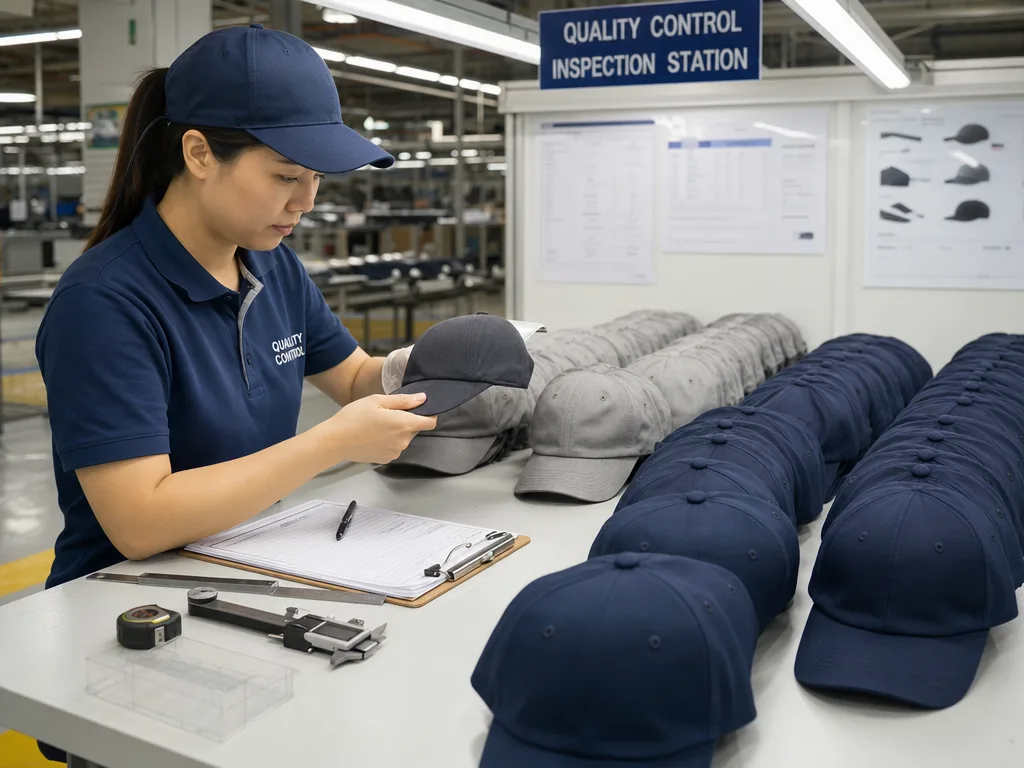
Cap Defect Catalog: 32 Production Issues to Inspect For - Cost & MOQ Breakdown (2026 Update) is one of the most-asked questions we receive from international buyers, and for good reason. With dozens of factories competing for your order and an alphabet soup of technical terms in every supplier quote, even experienced importers can feel lost. This guide consolidates what we have learned producing custom hats for clients in 40+ countries.
How to read this catalog
Read this catalog by commercial risk, not by the order a cap is sewn. Inspect the zones that make or break first acceptance in under three seconds: front panel appearance, logo execution, visor shape, button centering, eyelet symmetry, back closure, and overall silhouette on a flat table. The same flaw can shift from minor to major depending on placement. A 2 mm oil spot hidden under the sweatband on a $2.20 brushed-cotton promo dad cap may pass as minor; the identical spot on the front panel of a retail 6-panel snapback is a major reject because it hits the primary merchandising zone. That is why the 32 entries are grouped by where hats actually fail in-line and at final inspection—crown panels, seams, visor, embroidery, closure, labeling, and packing—not by generic quality theory. If you are using this as a working checklist for cap production defects, start with customer-facing areas first; those are the defects that trigger most chargebacks, RTV claims, and delayed balance payments.
Severity is the second filter, and under AQL 2.5 it should be defined before bulk inspection starts, not argued at the table. Critical defects have zero acceptance: broken needle contamination, sharp burrs on metal buckle hardware, mold growth, mixed size or color assortments in export cartons, or incorrect fiber-content and country-of-origin labeling. Major defects are where most inspections fail because the allowance disappears fast: panel skew above 3 mm, visible visor twist, embroidery loose trims on the face, closure malfunction, or shade variation beyond the approved standard—typically Delta-E above 1.5 to 2.0 under D65 lighting against the signed lab dip or Pantone TCX reference. Use each entry as a decision tool, not a glossary: check visibility at 50 cm, functional impact after wear or pull test, repairability, and rework economics. A brim 5 mm out of spec can sometimes be reblocked with heat and pressure; a front logo stitched poorly on Tajima, Barudan, or ZSK heads usually cannot be salvaged once tunneling, registration drift, or satin edge bite is visible. Most expensive cap production defects start upstream in fabric, buckram, and trim approval, not at final packing.
Panel and crown defects (8 categories)
Most crown claims start at the seam, not the embroidery. On 6-panel caps in 180–220 gsm brushed cotton twill, 8–10 oz chino, or 300–350 gsm melton blends, puckering usually comes from a bad stitch package: #11 needle where #14 is needed, 40 wt polyester pulled too tight, or SPI pushed past 9–10 on curved joins. The result is tunneling, seam grin, and a front profile that no longer matches the approved sample. On structured caps, mismatch between shell shrinkage and 0.35–0.50 mm fusible buckram shows up after fusing and steam forming; the front panel develops washboard waves and center-front artwork can drift 1.5–3.0 mm off spec. In cap production defects, I classify crown-seam waviness longer than 25 mm, bobbin exposure on any visible panel seam, or button-point mismatch above 2 mm as major defects because they distort both fit and decoration placement.
Fabric faults need to be grouped with panel defects because buyers read them on the crown first. Slubs, missing picks, bowing, skewed twill lines, and inconsistent nap direction are usually mill-origin issues, not sewing-floor mistakes, so roll inspection should happen before cutting under D65 or TL84 lighting with one approved dye lot per PO. Shade variation between adjacent panels is especially unforgiving on peach-brushed cotton, suede-touch microfiber, and dark melange wool blends; on navy, black, or charcoal, Delta-E above 1.5 is already visible, and above 2.0 it becomes a routine rejection at final inspection. The remaining high-frequency crown faults are assembly related: eyelets off location by more than 1 mm, loose eyelet stitching caused by weak underlay or poor clamp pressure on Tajima or Barudan eyelet setups, and early pilling triggered by low-twist yarn, over-sanding, hoop abrasion, or carton rub. For fashion caps above about $4.50 FOB, visible pilling on the front two panels should be graded major under AQL 2.5.
Brim defects (5 categories)
Brim geometry is the brim defect buyers spot first, and it deserves its own checkpoint in any cap production defects standard. On an adult baseball cap with a defined pre-curve, anything beyond ±2.0 mm against the sealed PPS or golden sample is usually reject territory; on flatter streetwear profiles, even ±1.5 mm side-to-side rise can look wrong once the cap is on head. We do not rely on eye judgment. The practical control is a metal visor gauge taken from the approved sample, checking crown-to-tip length, left/right edge height, and curve depth at three fixed points. The common failure is upstream: die-cut visor inserts drifting out of tolerance, PE board rebounding after humid storage above 65% RH, or steam pressing 8-12°C over the validated setpoint, which permanently changes arc memory on cotton twill, brushed chino, and recycled polyester blends.
Stiffness inconsistency is a different brim category from curve drift, and buyers often collapse the two into one complaint. Two caps can look identical at packing, but one loses shape after a week because the insert mix was wrong—1.8 mm paperboard substituted into a style approved on 2.5 mm virgin PE—or because the fusing bond failed within 5-8 mm of the edge. A usable control point is a 20-piece three-point bend comparison per lot against the golden sample, with insert spec locked by thickness, density, and flex recovery rather than by vague “hard” or “soft” hand-feel notes. Under AQL 2.5, shape-retention failure is a major defect when the brim collapses in normal wear; on low-cost promo caps under 300 gsm brushed cotton, small hand-feel variance may still pass as minor if geometry holds.
Undervisor appearance and visor stitching are the other two brim categories that create expensive claims because they often pass carton inspection and fail at first wear. Color mismatch on the undervisor usually comes from mixed dye lots in poly twill, suede microfiber, or the classic green cotton undervisor; if the target is a Pantone TCX reference, the factory should be checking under D65 with Delta-E below 1.5 on solid wovens and below 2.0 on brushed surfaces where nap diffuses light. On printed undervisors, misregistration beyond 1.5 mm off centerline is obvious and is normally caused by unstable nesting or poor panel fixation before brim binding, not the print head. Visor stitching failures—skips, floating loops, row wander, and thread breaks—show up most on six-row and eight-row bills sewn on Juki or Brother post-bed machines when tension is off, needles are blunt, or the binder is worn. At the bill tip, layer count spikes and operators accelerate to hit output, so row spacing opens beyond a 1.0 mm visual tolerance. Rework after the brim is set typically costs $0.18-$0.40 per cap, and salvage drops fast on dark twill because needle marks and press shine are hard to hide.
Embroidery defects (6 categories)
Color mismatch and misregistration cause the quickest chargebacks because the logo is the product on an embroidered cap. Thread approval should be locked to a physical Pantone standard—TCX for textile-led programs, or Pantone C/U when the logo spec comes from print branding—and checked under D65 lighting at 6500K. A phone photo is useless; camera white balance hides lot drift and sheen differences. Most buyers start rejecting visible Delta-E above 2.0, while licensed sports and collegiate programs often push critical shades like red, navy, and athletic gold below 1.5. The common factory-side failure is not the thread brand itself—Madeira Polyneon, Gunold Poly, and FUJIX King Star are generally stable—but unauthorized substitution. If a repeat PO was sampled in polyester and bulk runs in rayon, the higher sheen changes the perceived color immediately, even when the hue is nominally close.
Misregistration gets worse the moment speed outruns the cap frame and digitizing. On Tajima, Barudan, and ZSK cap drivers, once operators push past about 800-850 spm on curved 6-panel fronts, pull compensation errors start opening white gaps, stacking satin borders, and blurring 4-6 mm letters. On a practical cap production defects checklist, color-to-color registration on outlined logos should stay within 0.5 mm, and small front placements should hold within ±2 mm from center seam and button line. Anything looser is obvious at retail. Weak digitizing creates the next three defect categories: poor density, wrong underlay, and tension imbalance. Fill stitch spacing looser than 0.50 mm on twill lets the base fabric grin through; denser than about 0.35 mm on buckram-backed structured crowns creates a hard, ropey surface, frequent thread breaks, and a front panel that feels like cardboard. Puckering is usually the combined result of overpacked fills, incorrect cutaway backing weight, and bad top-to-bobbin tension—not something final inspection can “fix” after sewing.
The sixth defect category is finishing, and it is where sloppy production gets exposed fast. Clean embroidery means jump threads trimmed flush, backing cut without nicking shell fabric, no loose tails inside the crown, and no thread nests around start-stop points. On brushed cotton chino, washed twill, and 210D nylon, poor trimming leaves whiskers that catch light and make the logo look fuzzy even when the stitching itself is sound. Caps with inside taping and sweatbands also need the embroidery backside checked for abrasion risk; long thread tails and stiff backing corners will start generating wear complaints after only a few uses. In our standard practice, embroidery is inspected to AQL 2.5 with special attention to center alignment, rotation, thread lot consistency, and backside cleanliness before packing. Rework on embroidery-heavy styles typically adds $0.20-$0.65 per cap, but the real damage is MOQ loss: once 5-8% of a 1,200-piece run needs remake, the order stops behaving like standard bulk production and starts costing like fragmented sampling.
Patch defects (4 categories)
Patch defects are expensive because they land on the visual focal point, and unlike a loose thread, most cannot be cleaned up after assembly. The first category is placement error. On a structured 6-panel cap, a front patch shifted more than 2.5 mm off crown center, more than 2.0 mm above or below approved height, or rotated beyond 2° should be treated as rejectable. On 5-panel foam truckers, I tighten horizontal tolerance to about +/-2.0 mm because the front panel acts like a billboard and any drift is obvious at 1 meter. Good operators do not center by feel. They reference the front seam, visor midpoint, and crown height using a steel positioning jig, laser guide, or heat-press registration marks before stitch-down or transfer. In cap production defects inspections, skewed placement is usually logged as major because the cause is rarely isolated: it often traces back to panel cutting variance, mis-set crown blocking, visor asymmetry, or loading a pre-curved cap into a flat platen fixture.
The second and third categories are adhesive bleed and bond failure. Hot-melt backings on TPU, faux leather, woven damask, and printed twill patches start causing trouble when press settings drift above roughly 145-150°C, dwell runs past 10-12 seconds, or pressure is uneven across buckram-backed fronts. On 180-220 gsm cotton twill or peach-finish polyester, that shows up as gloss, dark wet-out, or a sticky halo that grabs carton lint within 24-48 hours. I would only accept glue squeeze-out under 0.5-1.0 mm if it can be removed without staining; otherwise it belongs in the cap production defects report under AQL 2.5 as a major visual issue. The fourth category is edge and appearance failure: merrow unraveling on woven badges, jagged die-cut lines on leather, lifting corners on PVC, or color mismatch beyond Delta-E 2.0-2.5 against approved Pantone TPX/TCX standards. Our standard practice is first-article approval plus incoming patch checks for color, cut line, and peel strength, because once 500 caps are patched on a Tajima or Barudan line, rework usually costs more than remanufacturing the lot.
Sweatband defects (3 categories)
Loose sweatband attachment is a functional failure, not a cosmetic nib, because the damage starts exactly where the inside bottom seam sees the highest stack height: sweatband, crown shell, seam tape, buckram return, and rear closure overlap. On a standard 6-panel baseball cap, the failure points are predictable—the back seam, side-panel joins, and the sweatband overlap joint where thickness can jump from 2 plies to 5 or 6. If the operator drops below roughly 9-11 SPI on the bottom-seam operation, skips the back-tack, or runs excessive presser-foot pressure, the needle perforates rather than secures the band, and you see 20-50 mm lifting after wash testing or a few wears. In cap production defects, any open sweatband seam above 10 mm should be booked as a major defect under AQL 2.5 because the cap immediately loses comfort, sweat absorption, and perceived durability. Rework is expensive because you are reopening a closed assembly after visor setting and top-buttoning, which risks twisting the crown or telegraphing fresh needle marks through the shell. In Zhejiang, realistic repair cost is usually $0.12-$0.28 per cap on strapback and snapback styles, rising to $0.25-$0.40 once the cap is fully finished, stickered, and packed with inserts. A second sweatband category is material mismatch, and it shows up constantly on OEM orders when the approved trim was cotton but bulk arrives in 65/35 poly-cotton jersey, polyester tricot, or brushed microfiber due to trim-mill color MOQs of 3,000-5,000 meters. Our standard practice is to verify against the signed PP swatch by burn test, GSM check, and visual luster under D65 light: cotton twill sweatbands typically land around 140-180 gsm, while tricot substitutions are lighter, slicker, and often visibly shinier.
Sweatband size inconsistency creates more fit claims than many buyers realize because the shell can pass external measurement while the internal circumference is still wrong. On fitted caps and structured 6-panel styles, a relaxed sweatband at 54 cm instead of 56 cm materially changes forehead pressure, crown seating, and visor alignment on the face. The root cause is usually poor tension control during cutting and joining: elasticized band rolls fed too tight, two lines using different overlap allowances such as 8 mm versus 12 mm, or inconsistent steam-setting after sewing. This is one of the cap production defects that should never be judged by eye; the band has to be measured after the cap relaxes, not straight off the machine when residual tension is still hiding the error. Use ANSI/ASQ Z1.4 sampling at AQL 2.5, let samples rest flat for at least 30 minutes, then measure finished inner circumference against the approved size spec. For premium licensed or retail programs, I would hold the tolerance to plus or minus 0.5 cm; once the spread inside one lot exceeds 1.0 cm, you are outside normal process variation and into sorting risk. Sweatband variance is often missed because factories focus on visible stages like Tajima or Barudan embroidery, but fit inconsistency causes more relabeling, re-inspection, and customer complaints than most stitch defects. On orders below 500 pieces, mixed-size cartons can easily add 2-4 production days, and if replacement bands are required the direct recovery cost typically lands at $0.18-$0.40 per cap before airfreight, chargebacks, or delayed-delivery penalties are counted.
Closure defects (3 categories)
Closure failures generate claims faster than most cap production defects because the buyer checks fit before they ever study seam shape or embroidery. The highest-risk bucket is snapback function. Every stud has to lock cleanly through all 7 or 8 positions, not just the center holes operators naturally test. On standard PP or HDPE snaps, I look for full tooth engagement, no half-bite, and no whitening, stress marks, or radial cracking at the male stud base after 3 open-close cycles. If the first or last positions fail while the middle positions pass, the root cause is usually dimensional drift in the molded snap set or distortion introduced when the back opening is sewn under uneven sweatband tension. Under AQL 2.5, unusable adjustment positions are a major defect because the stated size range is false. Replacing a bad snap in-line costs roughly $0.03-$0.08 per cap; once the sweatband is closed, labels attached, and goods packed, true rework cost commonly climbs to $0.15-$0.22 including carton reopening, repressing, and added QC labor.
The second closure category is hardware appearance and integrity. Color mismatch is common on resin snaps because too many factories approve against a supplier master chip instead of an actual molded production sample. A crown can be approved to Pantone TCX and still look off if the black snap reads warm or blue; on brushed cotton twill or 20 oz wool-blend melton, a Delta-E above 2.0 is visible under D50 lighting. Metal buckle closures fail differently: bent center bars, burrs, plating scratches, weak rivet setting, and patchy antique finishes usually come from poor die-casting, thin electroplating, or bulk transport in woven sacks instead of partition trays. The third category is strap construction, especially self-fabric straps and hook-and-loop. Loose attachment almost always traces to short back-tacks, low stitch density below 7-8 SPI, bad box-X geometry, or thread damage from overheated needles on heavy fabrics above 240 gsm. A proper strap should hold 7-10 lb pull without seam grin, skipped stitches, or buckle distortion; hook-and-loop should be kept clean of lint and nap before final test, or first-use holding power drops and the customer reports premature wear.
Packaging defects (3 categories)
Packaging errors are cheap to prevent and expensive to fix, so I treat them as three separate cap production defects: unit-pack defects, trim-and-ticket defects, and outer-carton identification defects. They fail for different reasons and create different costs. A cap can pass sewing, embroidery, shaping, and AQL 2.5 visual inspection, then still become nonconforming because the polybag is torn, the suffocation warning is missing, or the carton mark does not match the PO. For EU and UK retail programs, the bag itself is often a compliance component, not just protection. Buyers commonly require 30-50 micron LDPE or PP bags with a recycle logo, resin ID, country of origin, and a buyer-approved suffocation warning with minimum font height and exact wording. If one item is missing, the shipment may be held for rebagging or over-labeling. That is why packaging needs its own checkpoint with approved artwork, film thickness tolerance, and sealing standard, instead of a vague final pack check after pressing.
Unit-pack defects usually start with bad bag spec, not bad labor. A high-crown structured 6-panel with buckram front, PE visor, and 58-60 cm finished circumference will routinely burst a 0.03 mm side-seal bag if the opening width is undersized or the packer forces the visor into the weld line. Common failures are split side seals, weak bottom welds, trapped moisture from bagging before the cap cools after steam shaping, wrong bag dimensions, and missing vent holes where the buyer specified perforation. Trim-and-ticket defects are retail-facing and easy to miss in bulk: hangtags omitted, string guns punched through the sweatband seam tape, size stickers placed outside a ±3 mm location tolerance, barcode labels covering the front logo, or mixed UPCs inside one style run. Outer-carton defects create the highest downstream cost because they stop receiving at the warehouse: wrong PO, wrong style-color-size code, carton quantity mismatch, mixed assortments, or thermal-transfer marks with poor contrast that cannot scan. Our standard practice is 100% ship-mark verification on first-run SKUs; origin relabeling is usually $0.03-$0.12 per cap, but destination relabeling under DDP can easily cost $300-$1,500 per shipment before detention or delivery delays.
Frequently Asked Questions
Which shipping methods do you support?
We support FOB, CIF and DDP shipping. Air express for samples and small orders, sea LCL for 100 to 500 pieces, sea FCL for 5,000+ pieces. Door-to-door DDP available for US, EU, UK, Canada and Australia.
How long does production take?
Sampling takes 7 to 12 days. Bulk production runs 20 to 30 days depending on quantity, fabric availability and decoration complexity. Inspection and packing adds another 3 to 5 days before shipment.
Do you support sustainability certifications?
Yes. We work with GOTS organic cotton, GRS-certified recycled polyester, OEKO-TEX Standard 100 fabrics, and are BSCI and Sedex audited. Certification documentation can be provided per order.
What is the minimum order quantity (MOQ) for custom hats?
Our standard MOQ is 100 pieces per design and color, with sampling available from 1 piece. For complex multi-color logos or premium fabric upgrades, the MOQ can be lowered with a small per-piece surcharge.
Can I order a sample before bulk production?
Yes. We strongly recommend approving a pre-production sample before mass production. Samples are charged at 35 to 60 USD each plus express shipping, fully refundable against confirmed bulk orders over 500 pieces.
What should buyers know about cotton twill army cap kangol?
When evaluating cotton twill army cap kangol, the key considerations are construction quality, decoration capability, MOQ flexibility and lead time. Sweatband attachment loose, sweatband fabric mismatch (cotton requested but polyester delivered), sweatband size inconsistency (varies cap-to-cap within batch). The 32 defect categories below group by area of the cap (panel, brim, embroidery, etc.) and severity (critical, major, minor under AQL 2.5). Critical defects mean reject. Major defects must remain under the AQL 2.5…
How does ordering baseball cap embroidered custom work?
When evaluating baseball cap embroidered custom, the key considerations are construction quality, decoration capability, MOQ flexibility and lead time. The 32 defect categories below group by area of the cap (panel, brim, embroidery, etc.) and severity (critical, major, minor under AQL 2.5). Critical defects mean reject. Major defects must remain under the AQL 2.5 sample limit. Minor defects are tolerated within wider limits. Stitch puckering on panels, fabric weave irregularity, color shading between panels of supposedly…
How does ordering custom embroidered trucker hat work?
When evaluating custom embroidered trucker hat, the key considerations are construction quality, decoration capability, MOQ flexibility and lead time. The 32 defect categories below group by area of the cap (panel, brim, embroidery, etc.) and severity (critical, major, minor under AQL 2.5). Critical defects mean reject. Major defects must remain under the AQL 2.5 sample limit. Minor defects are tolerated within wider limits. Stitch puckering on panels, fabric weave irregularity, color shading between panels of supposedly…
What should buyers know about kangol bucket hat mens?
When evaluating kangol bucket hat mens, the key considerations are construction quality, decoration capability, MOQ flexibility and lead time. The 32 defect categories below group by area of the cap (panel, brim, embroidery, etc.) and severity (critical, major, minor under AQL 2.5). Critical defects mean reject. Major defects must remain under the AQL 2.5 sample limit. Minor defects are tolerated within wider limits. Stitch puckering on panels, fabric weave irregularity, color shading between panels of supposedly…
What are the defects of plastic bottle caps?
Types of bottle caps defects that can be detected damages (chips, cracks, scratches); deformations (pinches, bents, dents, warping, buckling, roundness loss); missing parts (absence of caps, absence of tamper rings);
What are production defects?
A production defect is any deviation in a manufactured part from its defined specification — dimensional, functional, visual or material. The definition sounds simple; in practice, most disagreements in a quality meeting come from confusing four related terms that are not the same thing.
What are common manufacturing defects?
Manufacturing defects arise during the production process, where an otherwise safe product is rendered dangerous due to errors or irregularities in its manufacturing. This might include issues such as substandard materials, improper assembly, or other deviations from the intended design.
What are the top 3 defects?
How Many Types of Quality Defects Are There? In quality control inspections, quality defects are typically categorized into three main types, Critical defects, Major defects and Minor defects, based on their severity and impact on product performance and safety.
What is CAP in production?
Businesses often use a corrective action plan, or CAP, to determine the steps that can help them find a solution to an issue that's impacting their daily operations. With a CAP, a company may resolve its workflow issues, leading to increased output.
What are three types of defects?
Minor defects are usually cosmetic and not considered to be serious. Major defects may inhibit the product's ability to function as intended and are considered somewhat serious. Critical defects may pose hazards and are considered to be very serious.
Looking for a reliable hat manufacturer in China?
CrownsForge has produced custom hats for 800+ brands across 40 countries. From 100-piece launches to 100,000-piece retail programs, we deliver on time and on spec.
Get in touchRelated guides
Custom Made Trucker Hat: The 2026 Sourcing & Manufacturing Playbook - Supplier Checklist - Supplier Checklist - 2026 Buyer's Guide
Read article →
Negotiating with a China Hat Manufacturer: 12 Tactics That Actually Work - Cost & MOQ Breakdown
Read article →
Custom Leather Patch Hat Low Minimum: A 2026 B2B Sourcing Guide
Read article →We hope this guide demystifies cap defect catalog: 32 production issues to inspect for - cost & moq breakdown (2026 update) and helps you move forward with confidence. If you have questions specific to your project, our English-speaking sales engineers are one message away.