
Cap Defect Catalog: 32 Production Issues to Inspect For - Cost & MOQ Breakdown (2026 Update) - Supplier Checklist
Every week, our sales team answers detailed questions about cap defect catalog: 32 production issues to inspect for - cost & moq breakdown (2026 update) - supplier checklist. We wrote this guide so that wholesalers, streetwear brands, corporate buyers and promotional resellers can compare options with full information, and avoid the traps that show up only after production has started.
How to read this catalog
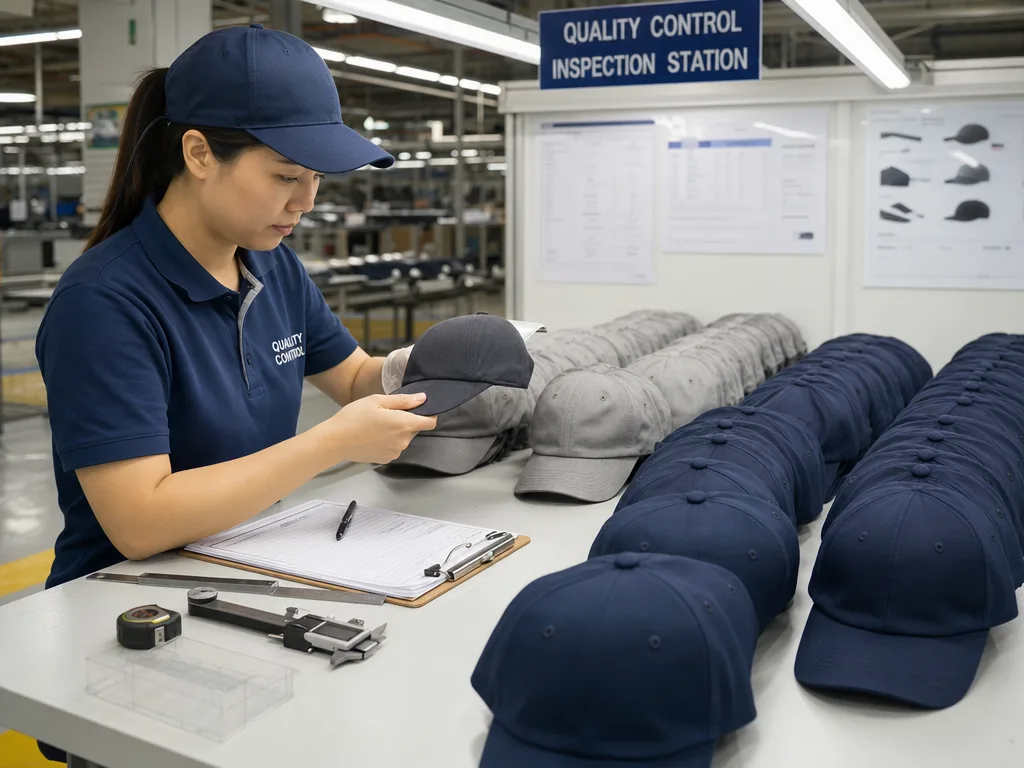
Read the catalog by cap zone and by AQL severity, because most cap production defects leave a process trail. A proper inspector checks front panels first, then side/back panels, visor, sweatband, closure, decoration, labels, and final packing; jumping around is how skewed crowns and bad trims get missed. A wavy front panel usually points to buckram fusing temperature, dwell time, or pressure, not “bad sewing.” Visor twist can come from die-cut tolerance over ±2 mm, wrong board grain direction, uneven binding tension, or heat recovery after pressing. Critical defects are Ac 0 / Re 1 items: broken needle fragments, mold, sharp burrs on metal buckles, loose small parts on kids’ caps, incorrect fiber content, or missing care labeling for regulated markets. Major defects affect saleability or function: crown skew over 5 mm, logo placement off center by more than ±3 mm, broken topstitching, cracked PU patch edges, failed snapback pull test, or visor length outside ±2 mm. Minor defects are controlled cosmetic issues, such as thread tails under 5 mm, slight seam grin, or approved shade variation under Delta-E 1.0 versus the signed lab dip.
Use ANSI/ASQ Z1.4 numbers instead of arguing by opinion. For a 1,200-piece lot under General Inspection Level II, the usual code letter is J, giving an 80-piece sample. At AQL 2.5 for major defects, Ac is 5 and Re is 6; the sixth major defect fails the shipment even if the other 74 sampled caps look clean. At AQL 4.0 for minor defects, the rejection point is normally 8 defects in that same sample size. Critical defects stay zero tolerance. The inspection sheet should record defect name, cap location, severity, count, and photo reference; “embroidery not good” is not usable data for a factory or a buyer. Lock measurable limits before bulk: Pantone TCX or TPX reference, Delta-E tolerance under D65 light, embroidery placement from center seam, stitch density per 10 mm, brim curve radius, top button pull strength, snapback hole engagement, label offset, carton drop-test requirement, and polybag warning text. The same 4 mm off-center logo becomes a dispute unless the pre-production sheet says whether it is minor, major, or rejectable.
Treat this catalog as a manufacturing map, not just a final-inspection checklist. Repeated failures in one area usually mean an upstream control point is loose: eyelet distortion on 230 gsm brushed cotton twill may trace to punching pressure, panel puckering may come from presser-foot pressure or unbalanced thread tension, and snapback back-opening mismatch often starts with pattern grading or shrinkage after steam finishing. Material changes also change defect risk. A 300 gsm cotton canvas holds crown shape better than low-gsm chino twill; 40 wt rayon thread behaves differently from trilobal polyester on Tajima, Barudan, or ZSK heads; PE visor board springs back under heat differently than paperboard. Tag each issue to cutting, fusing, embroidery, sewing, washing, finishing, or packing, then attach a realistic repair cost. Thread trimming may cost $0.03 per cap, re-pressing $0.05–$0.10, patch replacement $0.20–$0.45, re-embroidering panels $0.35–$0.80, and visor distortion often means a full remake. MOQ risk is highest on 300–500 piece custom runs because there are fewer spare panels, less extra dyed fabric, and no room for a second decoration attempt.
Panel and crown defects (8 categories)
The crown defects that cost real money are the ones sewing and pressing cannot hide: seam puckering, fabric weave irregularity, and panel-to-panel shade variation. On 260–320 gsm brushed cotton twill, washed chino, and peach-skin microfiber, puckering usually comes from top/bobbin tension imbalance, dull needles, or an SPI setting too tight for the curve. I still see lines running 8–9 SPI on front-panel joins that should be closer to 6–7 SPI with Tex 27–40 thread and a softer bobbin tension; once the seam tunnels, steam only flattens the surface while the crown still looks collapsed from two meters away. Weave defects are stricter: slubs, skipped yarns, floating ends, barre, and density drift in 16x12 or 20x16 twill need to be caught during 4-point fabric inspection before cutting. Under AQL 2.5 final inspection, visible puckering or weave flaws on the front panels or upper side panels should be recorded as major cap production defects, not downgraded to cosmetic issues.
Shade variation between panels creates more buyer disputes than almost any other crown issue because the lab dip can pass while the finished cap looks pieced together. Pantone TCX approval is only the starting point; the factory has to control Delta-E between adjacent panels after brushing, fusing, washing, and final pressing. Black, navy, charcoal, dark olive, and enzyme-washed khaki are the common offenders because one side panel may read warmer under D65 light or 4000K retail LED. Practical control means block-cutting by dye lot, nap direction, and roll position, then rejecting adjacent-panel drift above Delta-E 1.0–1.5 for premium retail programs and above 2.0 for basic promotional caps. On a 3,000-piece PO, lot segregation and extra bundling usually add $0.03–$0.06 per cap. Post-sewing shade sorting can cost $0.12–$0.20 per cap and still produces short packs, so a mismatched front two-panel crown should be classified as major even if the bulk roll passed color approval.
Panel misalignment, loose eyelet stitching, eyelet thread mismatch, missing ventilation holes, and undersized holes are setup failures, not unavoidable variation. A center-front seam that walks 2–3 mm off the crown line will make a six-panel cap look twisted once the visor is attached and the logo is centered. Embroidered eyelets should be round, fully locked, and consistent; adult caps usually need 4–6 mm finished ventilation holes, while heavy wool blends, acrylic melton, and 600D polyester require clean punching to prevent fray after 3–5 wash cycles. On Tajima, Barudan, and ZSK machines, loose or uneven eyelets often trace back to worn thread guides, wrong thread ticket, rushed cone changes, poor backing selection, or skipped first-piece approval. Prevention is cheap: seam alignment notches, a go/no-go hole gauge, needle-change records, and first-article signoff normally add less than $0.02 per cap. Rework after assembly is ugly because enlarged holes, needle scars, and distorted panels remain visible even after restitching.
Brim defects (5 categories)
Brim faults are among the most visible cap production defects because the customer handles the visor before they notice crown symmetry or interior finishing. The five failures worth separating are: curve out of tolerance, stiffness mismatch, undervisor color/print error, stitching failure, and edge or sandwich distortion. Curve control should be checked against an approved acrylic visor template, not by eye. For a structured baseball cap or pre-curved snapback, a practical tolerance is ±2 mm measured at left tip, center nose, and right tip after shaping, then rechecked after 24 hours under carton load. A brim that passes fresh off the steam block can relax or over-spring once packed. Insert material is usually the root cause: 1.8 mm recycled PE board, 2.0 mm HDPE, and 2.2 mm virgin PE can share the same silhouette on the cutting table but respond very differently to heat and pressure.
Stiffness mismatch is what makes a run feel cheap even when the sewing is clean. If the heat-press recipe drifts from roughly 18 to 28 seconds dwell, or platen temperature varies by 10–15°C across shifts, the same visor can come out limp in one carton and overly rigid in the next. On orders above 5,000 pcs, carton-to-carton hand-feel checks are necessary because mixed insert lots are common when suppliers substitute board without updating the BOM. Undervisor problems are mostly color and registration issues. Pantone 3435 C in coated print is not the same target as a 3435 TCX-matched cotton twill, and the QC sheet should state whether approval is based on ink drawdown, fabric lab dip, or physical sample. Under D65 lighting, Delta-E above 1.5 is visible to trained inspectors; above 2.0 is usually rejected on licensed team or premium streetwear programs. Printed undervisors show 1.5–3.0 mm misregistration immediately, especially on stripes, camo, and edge-to-edge art.
Stitching and edge construction are the easiest brim defects to score during inline and final inspection. On a standard 6-panel cap with 8 to 12 visor stitch rows, row spacing should hold within ±1 mm, skipped stitches on the top face should be zero, and loose thread tails longer than 3 mm should be trimmed before packing or logged as workmanship defects under AQL 2.5. Wandering rows usually trace back to incorrect presser-foot pressure, worn Nm 130/21 or 140/22 needles, or operators running thick sandwich brims without resetting upper and bobbin tension. Machines matter here: old post-bed setups hide feed inconsistency that newer programmable units catch earlier. The fifth category, edge distortion, includes puckered binding, exposed PE insert, uneven sandwich stripe width, and twisted visors caused by insert shift inside the brim pocket. Our standard practice is to inspect the first 32 pcs after visor closing and again after final steam shaping, because twist often appears only after blocking. Minor restitching or thread cleanup may cost $0.03–$0.12 per cap, but replacing a closed visor usually lands around $0.18–$0.45 and can force practical MOQ to 1,000–1,500 pcs per colorway when custom inserts or molded curve tools are involved.
Embroidery defects (6 categories)
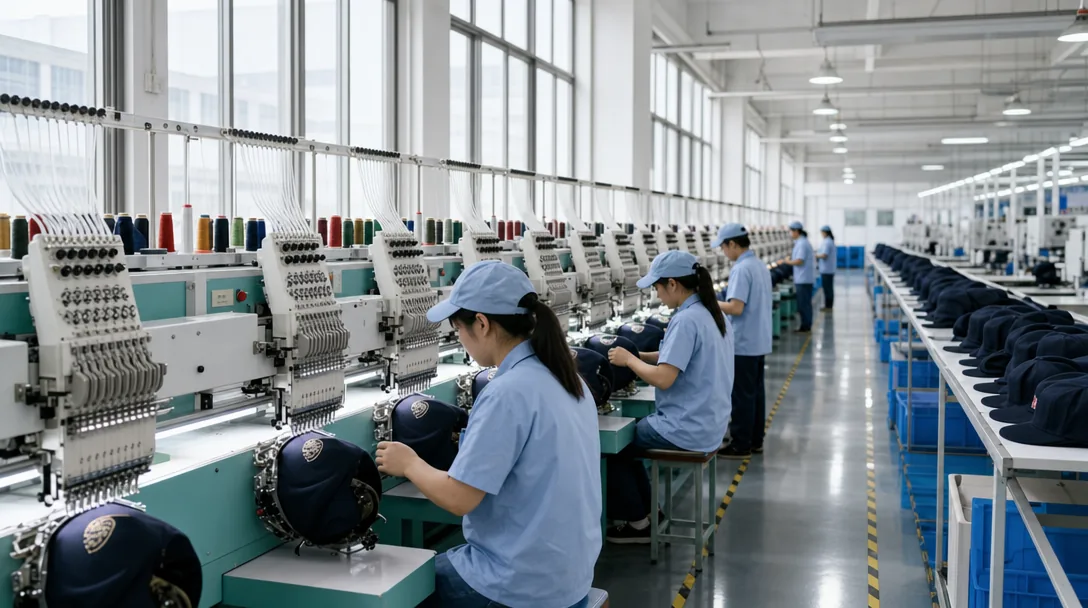
Embroidery creates some of the most expensive cap production defects because the cap may look acceptable at arm’s length but fail once the logo is checked against the approved strike-off. The first defect category is thread color drift. Polyester or rayon thread should be approved under D65 lighting against Pantone TCX for fabric-driven colors or Pantone Coated when the brand guide is print-based; matching from an old cone beside the Tajima machine is not control. For licensed sports, school, and streetwear logos, visible drift above Delta-E 1.5–2.0 on navy, scarlet, royal blue, Kelly green, and athletic gold should be treated as a major defect because those shades shift noticeably between dye lots. The second category is registration error. On a curved 6-panel crown, a 0.8–1.2 mm gap between fill and satin outline already makes small lettering look soft; above 1.5 mm is usually a reject. Common causes are uneven hoop tension, loose buckram, cap-frame loading variation, and digitizing that ignores push-pull distortion on Barudan, Tajima, or ZSK cap frames.
The third and fourth categories are density failure and poor thread cleanup, both of which usually start before bulk sewing. A flat DST file reused for cap embroidery without revised underlay, pull compensation, stitch angle, and density will not behave correctly over a curved front panel. With standard 40-weight polyester thread, many front logos run around 0.35–0.45 mm stitch spacing, but brushed cotton twill, washed canvas, nylon taslan, foam fronts, and heather polyester need different backing and underlay choices. Too open, and shell color or underlay shows through the fill; too dense, and the panel becomes hard, shiny, needle-burned, or full of thread breaks. Poor trimming is the cleaner but still costly defect: loose jump threads, bird-nesting, and long tails on the reverse side can snag the sweatband seam or show through on unlined 5-panels. At CrownsForge, the standard is to inspect the embroidery face and reverse before blocking or final pressing, because defects are harder to judge once the crown shape is set.
The fifth and sixth categories are crooked placement and puckering, and both should be classified as major visual defects under an AQL 2.5 inspection plan unless the buyer has approved a looser tolerance. For adult caps, front embroidery should normally be centered within ±2 mm of the crown seam or approved centerline, with baseline height measured from the visor seam against the graded spec. A logo that is 3–4 mm off center sounds minor in a spreadsheet, but on a structured cap it is obvious at retail. Crooked placement usually comes from inconsistent manual loading, missing center marks, warped fused panels, or operators chasing output on multi-head machines. Puckering is a different failure: the stitch field overpowers the fabric and leaves tunneling, ripples, or panel collapse after the cap leaves the frame. Lightweight nylon, washed cotton, foam truckers, and unstructured dad caps are the highest-risk styles. Severe puckering, exposed underlay, or off-center logos often require panel replacement, adding roughly $0.35–$0.80 per cap and delaying shipment two to five days.
Patch defects (4 categories)
Patch defects are one of the most visible cap production defects because buyers spot them before they notice seam puckering or interior labeling. Placement is the first failure mode to police: on a standard 6-panel front crown, I treat a patch centerline drift beyond ±3 mm from the approved spec as major, and beyond ±2 mm on licensed logos or symmetrical artwork where the eye catches imbalance immediately. Tilt matters just as much; if the patch reads visibly out of square at a 50 cm viewing distance, it fails even if the raw measurement is technically close. The right control is a hard acrylic placement template matched to crown height and visor curve, not operator judgment. First-piece approval should be followed by checks on the first 32 caps off line, then hourly in-line, then final sampling under ANSI/ASQ Z1.4 at AQL 2.5. Most placement rejects come from warped heat-press lower beds, front seams used as false center references, or inconsistent buckram tension on unstructured versus structured blanks.
Adhesive bleed and edge quality are the second major patch-defect cluster, and they separate a clean retail cap from a cheap promotional piece. Hot-melt film squeeze-out, PSA halo, or spray-glue overspray is major if visible at 50 cm or if wiping with a neutral cleaner leaves a stain ring on cotton twill, brushed chino, or wool blend fronts in the 280-320 gsm range. The root causes are usually press settings outside adhesive spec—typically over 145-160°C or dwell time above 12-15 seconds—plus die-cut tolerance worse than ±0.5 mm or too much glue used to compensate for poor sewing fixtures. On leather, microfiber suede, and PU patches, rough edges are just as costly: dull dies create feathering, bonded leather can split after 20-30 flex cycles, and bad edge paint leaves exposed fiber bloom. Woven and PVC patches need different inspection logic. Woven patches fail on fraying, weak merrow lock, and loose satin borders, especially with 75D-150D yarns wrapped over curved 5-panel crowns. PVC fails on molded detail and color; approved chips should be checked under D65 light, with Delta-E under 1.5 for retail and under 2.5 for promo programs. Rework usually runs $0.12-$0.45 per cap, but once glue stains the crown or a PVC patch is molded off-color, the unit is normally scrap.
Sweatband defects (3 categories)
Loose sweatband attachment is a wear-life failure, not a cosmetic flaw, because the band takes the first load every time the wearer pulls the cap on. On a structured 6-panel cap, the sweatband must be caught evenly into the lower crown seam, with the lockstitch or chainstitch normally sitting 2.5–3.5 mm from the band edge. Any loose run over 15 mm, repeated skipped stitches, exposed raw edge, or separation under light thumb pressure should be treated as a major defect under AQL 2.5. The common shop-floor causes are dull DBx1 needles, incorrect presser-foot pressure, poor feeding around the rear arch, and operators rushing the band operation after peak attachment when the cap body is already bulky. Rework before final blocking and pressing usually costs about $0.08–$0.18 per cap in Zhejiang. After packing, it can double because the visor, inner seam tape, and crown shape must be protected from extra needle marks and handling distortion.
Sweatband fabric mismatch is one of the easiest cap production defects to prevent, but only if the BOM is written like a manufacturing document. “Black sweatband” is not a spec; it can mean cotton twill, polyester twill, TC blend, brushed tricot, moisture-wicking mesh, or cheap nonwoven tape. A usable spec should list fiber content, finished width, weight, shade, and performance: for example, 100% cotton twill, 32 mm finished width, 180–240 gsm, Pantone 19-4007 TCX, Delta-E ≤1.5 against approved bulk, and shrinkage under 3% after washing. Polyester bands at 120–180 gsm usually hold color better and dry faster, but they feel slicker and can make a premium cotton cap feel cheaper. Incoming QC should check shade under D65 light, width with a steel rule, handfeel against the signed swatch, and fiber by burn test or lab confirmation for licensed programs. CrownsForge keeps the approved sweatband swatch on the production traveler so warehouse, cutting, inline QC, and final inspection use one reference.
Sweatband length inconsistency becomes a fit complaint before the buyer ever notices the stitching. For adult adjustable caps, cut length is commonly 560–580 mm before closing, but the tolerance should follow the construction: ±3 mm for fitted caps and ±5 mm for snapback, strapback, or hook-and-loop styles unless the tech pack states tighter limits. A band that is too long creates puckering at the lower crown seam and a wavy opening; a short band pulls the rear arch inward and makes the cap feel tight even when the crown panel measurements are correct. Root causes include uneven cutting stacks, elastic or moisture-wicking tape stretched during feeding, mixed size blocks, and operators trimming by eye at the closing seam. Inline QC should measure 5 pieces per operator every two hours with the cap relaxed on the table, not pulled flat. In final inspection, classify the issue as major when it changes circumference, twists the back opening, or creates visible seam distortion; repeat retail buyers will catch this immediately during fit checks.
Closure defects (3 categories)
Snapback failure is a functional major defect, not a trim blemish: if the cap will not hold size, it cannot ship as first quality. Inspect all 7 or 8 holes, because rails often lock in the middle but fail at the last two positions where peg alignment and rear-opening centering are least forgiving. Typical causes are worn injection molds producing male pegs under about 3.8 mm, flash on the female rail, short-shot plastic, brittle recycled PP, or a back opening sewn off-center by more than 2 mm. Under AQL 2.5, any snap that releases under normal hand tension should be logged as a major cap production defect; high closing force is minor only when every hole engages fully with no whitening, stress cracks, or peg deformation. Do a 5–7 kg closure pull check after pressing, not before, because steam and handling expose weak rails. The savings from low-grade PP is usually only $0.01–$0.03 per cap, while air-freighting replacement closures or reworking finished caps can run $0.18–$0.45 per unit.
Closure color mismatch deserves its own inspection line because the back of the cap is visible in shelf displays, e-commerce try-on photos, and team uniform checks. Approve soft straps against Pantone TCX or a fabric lab dip, molded snaps against a physical resin chip or coated Pantone reference, and metal buckles against a signed finish card. Under a D65 light box, I use Delta-E under 1.5 for dyed cotton/polyester straps and under 2.0 for molded plastic, because resin lots drift more than woven fabric. Black, navy, khaki, stone, and pastel pink are the highest-risk colors; a “black” snap from one PP supplier can read brown next to 16x12 cotton twill and blue next to polyester ripstop. For metal closures, inspect bent prongs, sharp burrs, plating scratches, oil residue, and strap-cutting edges. Nickel-free antique brass, gunmetal, or matte black electroplated buckles normally add $0.04–$0.10 per cap, so the PO should state finish, nickel compliance, plating thickness, and partition-tray packing.
Soft closure defects usually start at sewing, then get hidden until the wearer pulls the strap hard. Fabric straps should be attached at 10–12 SPI with at least a 6-stitch back-tack; 7–8 SPI on 10 oz cotton twill, 280 gsm polyester, or brushed cotton is too weak for repeated adjustment through a tri-glide. Keep seam allowance around a D-ring, slider, or tuck strap at 8 mm minimum, and specify heat-cut ends for polyester/nylon webbing or clean-folded ends for cotton straps to prevent fraying. A random 7 kg hand pull test after steam shaping is more reliable than testing flat panels, because heat can relax marginal stitching. Hook-and-loop closures add a handling defect: the hook tape may arrive strong, then lose grip after lint from brushing, thread trimming, or Tajima/Barudan embroidery cleanup contaminates it. Inspect before anyone “fixes” it with compressed air. Record weak grip, crooked tape placement, raw strap edges, buckle insertion damage, and skipped stitches as separate cap production defects because each requires a different corrective action.
Packaging defects (3 categories)
Packaging defects should be classified into three buckets: unit pack failure, retail identification error, and master carton marking error. Unit pack failure is not “just a bag issue” if it exposes the cap to dust, humidity, carton dye transfer, or oil from handling. A 0.03–0.05 mm LDPE/PP polybag with a small corner split can remain minor under AQL 2.5 if the crown, visor edge, embroidery, suede patch, and closure are still protected; once the cap surface is exposed, I record it as major because secondary staining is hard to prove after transport. Missing suffocation warnings, LDPE 4 / PP 5 recycle marks, country-of-origin text, or retailer-required symbols are compliance defects, not cosmetic defects. For EU and UK private-label programs, especially Germany and France, incorrect material marking can delay warehouse intake even when sewing quality passes. Among cap production defects, packaging is the one most often ignored because the cap looks saleable while the shipment is still blocked from release.
Retail identification defects usually come from loose work instructions, not technical difficulty. Hangtags need one approved attachment point—rear buckle, sweatband seam, eyelet tape, or a dedicated loop—and it must be consistent across the PO. Punching a tag string through brushed cotton twill, washed canvas, or a panel seam can pull yarns during removal and turn a packaging mistake into a visible fabric defect. Visor sticker position should be controlled from an approved template: ±3 mm for flat-brim snapbacks, ±5 mm for curved dad caps. A sticker sitting 15–20 mm off center looks cheap on shelf and will trigger disputes in licensed sports, college, and promotional orders. Barcode labels require scan testing, not just visual approval. GS1-128, EAN-13, UPC-A, and FNSKU labels printed on weak thermal stock may look readable but fail at 30–50 cm under DC scanners. Our standard practice at CrownsForge is to match SKU, color, size, PO, carton sequence, and barcode data before final sealing, because retagging finished caps creates lint, handling marks, and avoidable labor cost.
Master carton marking defects disrupt logistics faster than most sewing defects because a warehouse cannot route cartons it cannot identify. A compliant 100 x 150 mm carton label should show PO number, style code, color name, size ratio if applicable, carton count, units per carton, gross/net weight, carton dimensions, destination mark, and country of origin. Blurred thermal print, weak adhesive, wrong FNSKU, mismatched carton count, or an incorrect destination code should be treated as major; missing retailer-mandated shipping marks can become critical for Amazon FBA, department-store DCs, and DDP shipments where the forwarder will not correct factory data for free. Rework at factory level looks cheap—roughly $0.03–$0.12 per cap for repacking and $0.20–$0.60 per carton for relabeling—but replacement printed polybags, UPC stickers, hangtags, and branded cartons often carry 3,000–10,000 piece MOQs. That is why packaging artwork, label data, carton layout, and scan quality should be checked at pilot run and inline inspection, not discovered during final AQL when the order is already packed.
Frequently Asked Questions
Do you support sustainability certifications?
Yes. We work with GOTS organic cotton, GRS-certified recycled polyester, OEKO-TEX Standard 100 fabrics, and are BSCI and Sedex audited. Certification documentation can be provided per order.
Can I order a sample before bulk production?
Yes. We strongly recommend approving a pre-production sample before mass production. Samples are charged at 35 to 60 USD each plus express shipping, fully refundable against confirmed bulk orders over 500 pieces.
What is the minimum order quantity (MOQ) for custom hats?
Our standard MOQ is 100 pieces per design and color, with sampling available from 1 piece. For complex multi-color logos or premium fabric upgrades, the MOQ can be lowered with a small per-piece surcharge.
How long does production take?
Sampling takes 7 to 12 days. Bulk production runs 20 to 30 days depending on quantity, fabric availability and decoration complexity. Inspection and packing adds another 3 to 5 days before shipment.
What logo decoration techniques do you offer?
3D puff embroidery, flat embroidery, woven patch, leather patch, PVC patch, screen printing, sublimation, applique and laser etching, all in-house with no subcontracting.
What should buyers know about cotton twill army cap kangol?
When evaluating cotton twill army cap kangol, the key considerations are construction quality, decoration capability, MOQ flexibility and lead time. Sweatband attachment loose, sweatband fabric mismatch (cotton requested but polyester delivered), sweatband size inconsistency (varies cap-to-cap within batch). The 32 defect categories below group by area of the cap (panel, brim, embroidery, etc.) and severity (critical, major, minor under AQL 2.5). Critical defects mean reject. Major defects must remain under the AQL 2.5…
How does ordering baseball cap embroidered custom work?
When evaluating baseball cap embroidered custom, the key considerations are construction quality, decoration capability, MOQ flexibility and lead time. The 32 defect categories below group by area of the cap (panel, brim, embroidery, etc.) and severity (critical, major, minor under AQL 2.5). Critical defects mean reject. Major defects must remain under the AQL 2.5 sample limit. Minor defects are tolerated within wider limits. Stitch puckering on panels, fabric weave irregularity, color shading between panels of supposedly…
How does ordering custom embroidered trucker hat work?
When evaluating custom embroidered trucker hat, the key considerations are construction quality, decoration capability, MOQ flexibility and lead time. The 32 defect categories below group by area of the cap (panel, brim, embroidery, etc.) and severity (critical, major, minor under AQL 2.5). Critical defects mean reject. Major defects must remain under the AQL 2.5 sample limit. Minor defects are tolerated within wider limits. Stitch puckering on panels, fabric weave irregularity, color shading between panels of supposedly…
What should buyers know about kangol bucket hat mens?
When evaluating kangol bucket hat mens, the key considerations are construction quality, decoration capability, MOQ flexibility and lead time. The 32 defect categories below group by area of the cap (panel, brim, embroidery, etc.) and severity (critical, major, minor under AQL 2.5). Critical defects mean reject. Major defects must remain under the AQL 2.5 sample limit. Minor defects are tolerated within wider limits. Stitch puckering on panels, fabric weave irregularity, color shading between panels of supposedly…
What are the defects of plastic bottle caps?
Types of bottle caps defects that can be detected damages (chips, cracks, scratches); deformations (pinches, bents, dents, warping, buckling, roundness loss); missing parts (absence of caps, absence of tamper rings);
What are production defects?
A production defect is any deviation in a manufactured part from its defined specification — dimensional, functional, visual or material. The definition sounds simple; in practice, most disagreements in a quality meeting come from confusing four related terms that are not the same thing.
What are common manufacturing defects?
Manufacturing defects arise during the production process, where an otherwise safe product is rendered dangerous due to errors or irregularities in its manufacturing. This might include issues such as substandard materials, improper assembly, or other deviations from the intended design.
What are the top 3 defects?
How Many Types of Quality Defects Are There? In quality control inspections, quality defects are typically categorized into three main types, Critical defects, Major defects and Minor defects, based on their severity and impact on product performance and safety.
What is CAP in production?
Businesses often use a corrective action plan, or CAP, to determine the steps that can help them find a solution to an issue that's impacting their daily operations. With a CAP, a company may resolve its workflow issues, leading to increased output.
What are three types of defects?
Minor defects are usually cosmetic and not considered to be serious. Major defects may inhibit the product's ability to function as intended and are considered somewhat serious. Critical defects may pose hazards and are considered to be very serious.
Ready to start your custom hat project?
Send us your tech-pack, sketch or even just an inspiration photo. We will respond with a detailed quotation and digital mock-up within 24 hours.
Request a free quoteRelated guides
Ball Caps for Women: A 2026 Sourcing Playbook for International Buyers
Read article →
5-Panel vs 6-Panel Caps: Construction, Use Cases and Cost Compared
Read article →
Custom Made Trucker Hat: The 2026 Sourcing & Manufacturing Playbook (2026 Update) (2026 Update) - 2026 Buyer's Guide - 2026 Buyer's Guide
Read article →Sourcing custom hats does not have to be complicated. With the right manufacturing partner, clear specifications and a small upfront investment in sampling, you can launch a retail-quality product in 30 to 45 days.