
Buckram vs Foam vs Unstructured: Cap Crown Construction Compared - Cost & MOQ Breakdown
For brand owners, wholesalers and procurement teams entering the custom headwear category, buckram vs foam vs unstructured: cap crown construction compared - cost & moq breakdown is one of the highest-leverage decisions you will make. Get it right and your unit economics, retail story and reorder cycle all improve. Get it wrong and you carry the cost for years.
What buckram is and why it matters
Buckram is the hidden frame that decides whether a cap keeps a clean front profile or collapses above the sweatband after a few wears. In factory terms, buckram cap construction usually means a woven polyester base cloth coated with thermoplastic resin, fused to the two front panels before the crown is stitched and pressed on an aluminum block. The common working range in China is about 0.40-0.70 mm, with finished weights around 120-220 gsm depending on yarn count, weave density, and resin loading. Light buckram in the 0.40-0.45 mm range is enough for school teams, event merch, and cost-driven promotional caps. Once you move to 0.60-0.70 mm, the cap stands taller on shelf, resists panel collapse during carton compression, and recovers shape better after 30-45 days in ocean transit. Polyester has replaced cotton on most volume programs because it is more stable under humidity swings and gives tighter lot-to-lot consistency; if the front panel shifts even 2 mm during fusing, you will see it immediately in crown symmetry and visor alignment.
What matters is not stiffness alone but how buckram interacts with the shell fabric and decoration method. Medium to heavy buckram behind 100% acrylic twill, poly-cotton twill, or 8x8 brushed cotton twill creates a flatter embroidery field, cleaner seam memory, and better support for 3D puff on Tajima, Barudan, or ZSK heads. Put the same spec behind washed chino or peach-finish cotton, and the crown often feels overengineered, with the reinforcement fighting the fabric’s natural drape. That is why experienced factories lock the buckram decision before digitizing approval; many “bad shape” sample rounds are really material-structure mismatches, not embroidery problems.
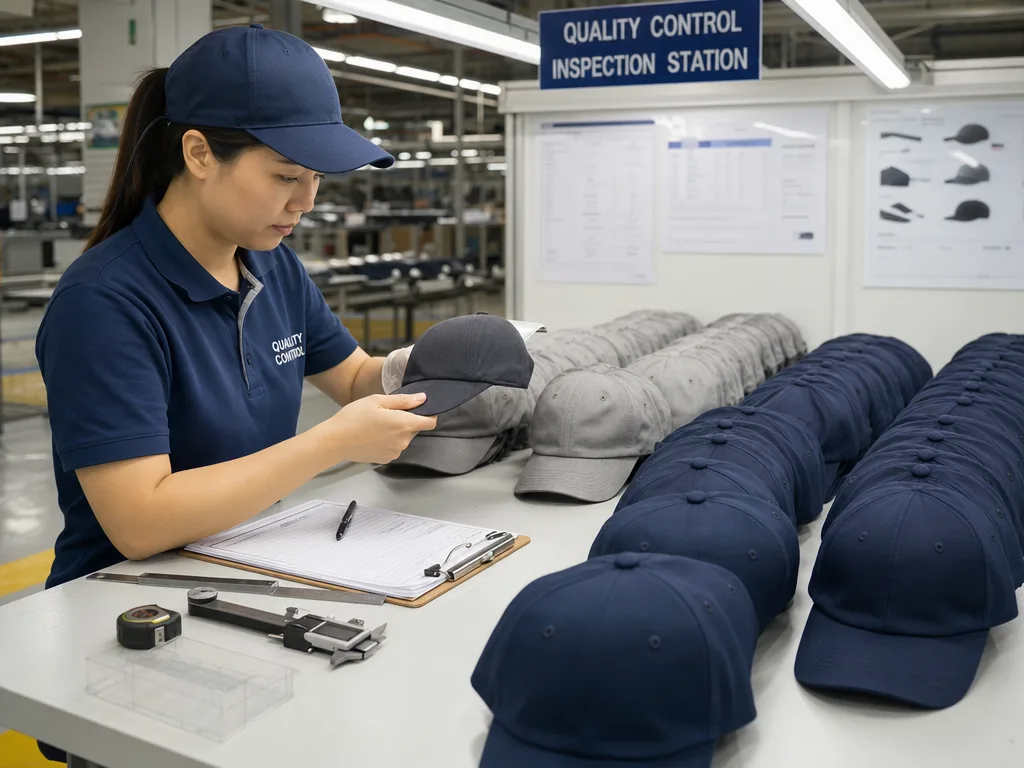
The cost difference is small, but the process window gets tighter as rigidity increases. Moving from light to heavy polyester buckram typically adds only $0.02-$0.06 per cap on a 3,000-10,000 piece order, yet it raises the risk of fusing defects if platen temperature, dwell time, or pressure are not controlled within a narrow range. Common failures are bubbling, resin strike-through, panel torque, and front seams drifting off center, all of which can trigger rejects under AQL 2.5. Our standard practice is to check front-panel height, center-seam verticality, and post-pack recovery after a 24-hour carton compression test, because a structured baseball cap is judged less by hand feel than by repeatable shape across thousands of units. Cotton buckram still has a place in heritage programs, but buyers choosing it should expect more variation and a softer break-in curve.
Foam-front construction (trucker caps)
Foam-front trucker caps hold shape with a 3-5 mm closed-cell EVA or PE foam laminate behind the face fabric, not woven buckram, and that changes the crown behavior immediately. Compared with classic buckram cap construction, a foam front stands taller at the forehead, keeps a boxier silhouette through carton compression, and shows a harder break line where the front panel meets the crown. In bulk production, 3 mm foam is still the default for promotional 5-panel and 6-panel truckers because it runs faster on ordinary single-needle lines, feeds more cleanly into the sweatband join, and usually saves about $0.05-$0.10 per cap against 5 mm foam at 1,000 units, depending on laminate density and face fabric. The tradeoff is visual presence: 5 mm reads fuller on shelf and masks minor waviness in the front panel, but it also increases seam bulk, raises needle-heating risk, and needs lower presser-foot pressure or the foam will crush and telegraph through the fabric.
Decoration is where foam-front construction earns its keep. On Tajima and Barudan embroidery heads, 5 mm foam gives 3D puff logos more lift because the needle penetrates a compressible base before the satin column locks the edge, so bold lettering holds relief better after packing and transit. For flat embroidery, screen print, or heat transfer, 3 mm is usually the safer production spec because it reduces panel bounce, limits needle deflection, and keeps registration steadier across long runs. The failure points are predictable: weak lamination adhesive can separate under needle heat, dense fill stitching can cause tunneling, and low-denier brushed polyester faces tend to distort faster than tighter twill or tricot-backed polyester.
Foam-front truckers are cost-efficient, but they are not automatically the cheapest answer in a buckram cap construction versus foam versus unstructured comparison. Mesh backs reduce fabric cost, yet the laminated front panel and taller crown increase packing cube, so freight per thousand units can end up higher than a low-profile unstructured cap even when FOB piece price looks competitive. In China, realistic MOQs are about 144-300 pieces per colorway for stock white foam and stock mesh, then 500-1,000 pieces once you specify custom-dyed mesh, Pantone TCX matching, or front fabrics held to Delta-E under 1.5. QC should check foam thickness variance, front-edge symmetry, center-front seam grin, and compression recovery after master-carton loading; at CrownsForge, we still inspect trucker runs to AQL 2.5 because a creased or asymmetrical foam crown is a first-quality failure, regardless of whether the embroidery passes.
Unstructured construction (dad hats)
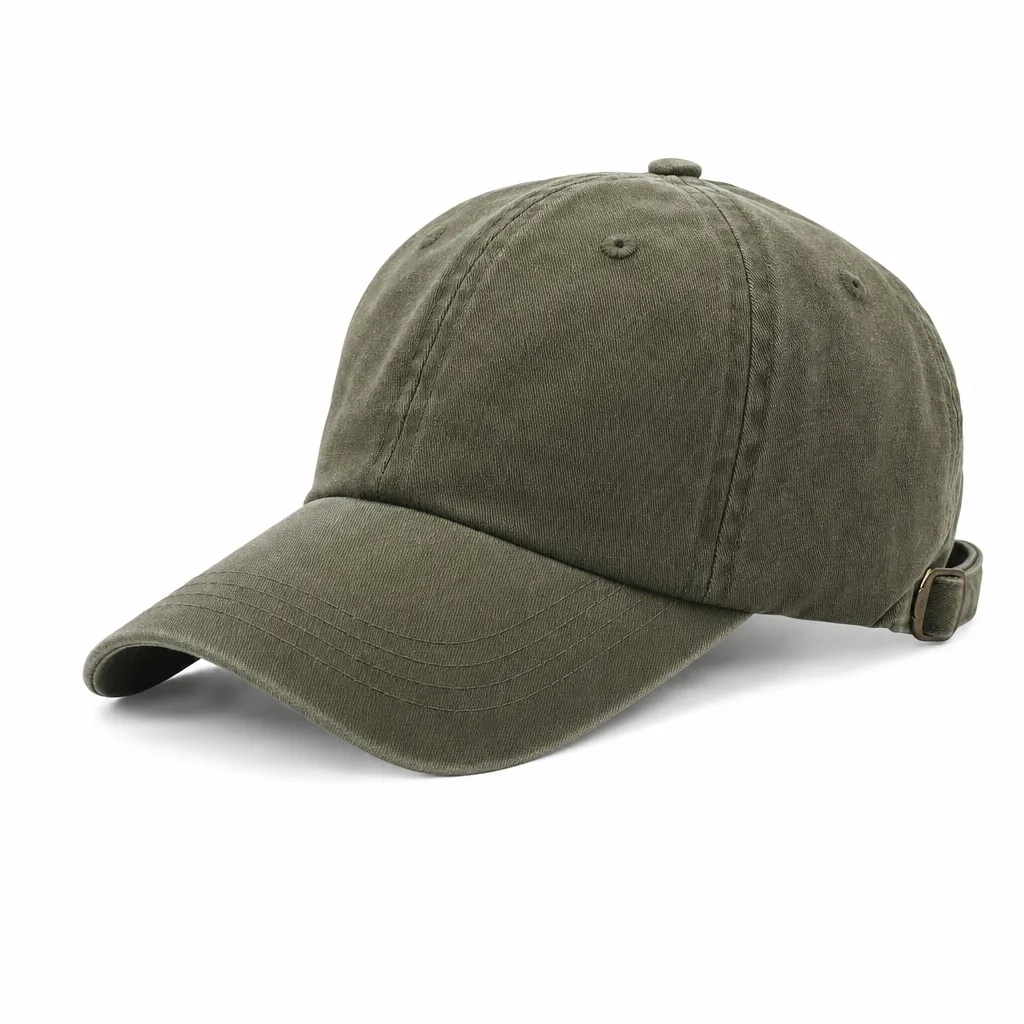
Unstructured dad hats work because the front panels are left honest: no buckram, no foam laminate, and in most programs no fusible support behind the face fabric. The shell collapses naturally off-head, which is exactly what buyers want in pigment-washed chino, brushed cotton twill, and garment-washed 220-260 gsm cotton. On the factory side, that simpler build removes one trim item and one prep operation, usually saving about $0.08-$0.18 per cap against basic buckram cap construction on a standard 6-panel style. The gap stays narrow because visor board, shell fabric, sweatband, closure, embroidery, and freight still carry most of the FOB. Realistically, unstructured caps land about 4%-9% lower in FOB than entry structured caps, not the fantasy 20% some vendors claim. You also avoid a common failure point: no bubbling from poor fusing temperature, no partial delamination after enzyme wash, and less stiffness variation when interlining lots are inconsistent. The compromise is decoration capacity, especially on the front face. A soft panel will not hold 3D puff, thick PVC, heavy merrowed emblems, or a large 90 x 50 mm woven patch with the same stability as buckram cap construction. On Tajima or Barudan embroidery heads, the panel can torque in the frame, and lighter fabrics around 180-220 gsm will pucker fast if stitch density or edge-walk underlay is too aggressive. In production, I would keep flat embroidery on the front under roughly 7,000-8,000 stitches, use lower-density fill, and favor small left-front logos, low-center placements, or lightweight woven labels. If the body fabric is a stock washed twill or brushed chino, many factories can open at 144-300 pieces per colorway because there is less trim dependency; once you add custom-matched internals, developed closures, and structured components, practical MOQ usually shifts closer to 300-500.
The real advantage of unstructured construction is not just lower cost; it is that the silhouette is supposed to look relaxed. Minor panel memory, soft crown collapse, and light handling marks are far less visible on a dad hat than on a structured cap that is expected to stand upright on a shelf. That makes the style more forgiving in packing and transit, especially with enzyme-washed or pigment-dyed fabrics where a broken-in handfeel is part of the spec. It also means size and comfort tend to read better on head, because the crown settles instead of fighting the wearer with a rigid front wall. Quality control still needs to stay disciplined. I would inspect unstructured caps to AQL 2.5 with special attention to seam alignment, top-button centering within about 3 mm, eyelet spacing, visor symmetry, strapback function, and embroidery puckering on the front panel. Color should still be checked against the approved standard, ideally within commercial tolerance and with obvious shade-banding rejected lot by lot. What changes is the pass-fail standard for crown posture: a slightly collapsed face is normal on an unstructured dad hat, while the same condition on buckram cap construction would be a straight construction defect. That distinction sounds obvious, but plenty of inspection teams miss it and over-reject perfectly good soft crowns.
How crown construction interacts with decoration
Decoration quality is usually decided by the front panel before the first stitch lands. In buckram cap construction, the two front panels are backed with a fused nonwoven interlining, typically 160 to 220 gsm, which creates a firm needle bed for embroidery and patch application. That rigidity is why 3D puff holds a crisp vertical wall instead of collapsing into a rounded, swollen edge. On Tajima, Barudan, or ZSK machines running around 650 to 800 spm, a 2.0 to 3.0 mm EVA foam under block letters or athletic scripts wider than 80 mm is far more stable on buckram than on soft crowns because the panel resists needle bounce and fabric distortion. Flat embroidery also cleans up better: fill density can usually stay near 0.40 mm with sharper satin borders, less tunneling, and fewer registration misses on multi-layer logos. The same stability helps woven patches, appliqué, and thin PU or leather patches, especially after carton compression, 65 to 80 percent RH exposure, and 30 to 45 days in ocean freight, when softer front panels are more likely to show rippling or edge read-through.
Foam and unstructured crowns need different artwork logic because the decoration is fighting loft or drape instead of working with a stable face. Most foam-front builds use polyester tricot or jersey laminated over 3 to 5 mm polyurethane foam, which gives strong visual volume but softer edge definition under dense stitching. Files digitized for buckram cap construction usually have to be reworked with lighter fills, wider column spacing, and more pull compensation; otherwise the embroidery sinks, edges bite, and small counters close up. Foam does outperform on sublimation because a white polyester face can be printed before assembly, then finished with a light satin outline. Unstructured crowns are less forgiving than either option: without buckram, the panel follows the forehead, so heavy fills, leather patches above about 1.2 mm, or tall puff embroidery often create visible puckering beside the center seam. The safer spec is flat embroidery below roughly 55 mm high, density around 0.45 to 0.50 mm, and lightweight trims that respect the drape of washed cotton twill, nylon taslan, or brushed canvas. In costing terms, adding structure often increases factory cost by about $0.20 to $0.45 per cap, but it buys a much wider decoration tolerance window and lowers reject risk at AQL 2.5.
Per-piece cost differential by construction
The fastest way to move unit cost without changing decoration is crown structure, and in China the quoting baseline is still buckram cap construction. For a standard 6-panel baseball cap, that usually means two front panels backed with 150-220 gsm buckram or non-woven interlining, sometimes with a light fusible layer around 25-35 gsm to stabilize shape before seaming. That extra structure is not expensive by itself—often only $0.06-$0.12 in material—but it adds handling at three points that matter on the line: front panel alignment, crown shaping during seaming, and visor joining so the cap keeps a clean profile after carton pressure. At 1,200-3,000 pieces per colorway, a retail-grade structured cap in 210-240 gsm cotton twill or poly-cotton, with flat embroidery, woven label, and standard hook-and-loop or snapback closure, typically lands around $2.80-$3.30 FOB. If the same silhouette moves to a higher streetwear spec—260-300 gsm brushed twill, denser sweatband, cleaner top-stitching, tighter embroidery registration, and stricter panel symmetry—the quote usually climbs to $4.10-$5.10 FOB because labor tolerance, not just fabric cost, gets tighter.
Foam-front truckers only look cheaper if the decoration and packing spec stay simple. Replacing shell-plus-buckram with 2-4 mm laminated polyester foam and switching the back to 100-140 gsm mesh can shave roughly $0.12-$0.28 per cap against a comparable structured 6-panel, especially on lines already set up for trucker assembly. But that saving disappears fast when the front gets heavy 3D embroidery: Tajima and Barudan heads often need lower speed to avoid foam drag, stitch tunneling, and heat marking, and low-density foam will wrinkle at the side seam or show compression after export packing. Unstructured cotton caps are usually the most dependable cost-down option, commonly $0.18-$0.38 below the structured baseline, because you remove the front support layer, skip fusing, and reduce internal build complexity. The catch is quality control. A soft dad cap in 180-240 gsm washed chino or twill is less forgiving on pattern cutting, thread tension, and wash consistency; if the buyer wants a relaxed crown that still matches Pantone TCX within Delta-E 1.0-1.5 and clears AQL 2.5 without panel-shape claims, the sewing room has to stay disciplined even though the bill of materials is lighter.
Durability and wash characteristics
For long-term shape retention, buckram cap construction still outperforms foam and unstructured crowns, but only if the interlining is specified like an engineering component rather than a generic stiffener. On a reliable 6-panel structured cap, I would expect woven cotton or poly-cotton buckram in the 180-240 gsm range, backed with a thermoset resin system and fused into the two front panels under controlled heat and dwell time before blocking. That build typically holds an acceptable front profile through about 25-35 cold home-laundry cycles, with only minor collapse if the cap is reshaped wet and air-dried. The weak point is always cheap resin and underweight buckram. Once you drop below roughly 150 gsm, especially on low-grade polyester buckram, the failure curve gets steep: after 10-15 wash cycles the panel edge starts to break down, seam grin becomes visible, and the crown-to-visor transition begins to roll forward. Buyers routinely confuse “structured” with durable, but AQL inspection will not catch long-term resin fatigue unless the wash protocol is defined up front.
Foam fronts fail differently. A standard trucker crown usually uses 2-4 mm polyurethane foam laminated to tricot or jersey, and the real durability issue is compression recovery, not just wash resistance. In carton-loaded transit, low-density foam under about 28-32 kg/m3 tends to take a set, leaving permanent crease memory even when the cap looks fine coming off the sewing line. After repeated use and washing, you also see lamination instability, face-fabric pilling, and whitening where abrasion telegraphs through the foam. Unstructured crowns avoid those interlining failures entirely, so wash performance depends mostly on shell fabric behavior and finishing. A 220-260 gsm washed chino twill or a 120-160 gsm nylon taslon crown will soften with wear, but distortion usually comes from shrink imbalance between shell, sweatband, and seam tape rather than from the crown panels themselves. That is the practical ranking: buckram cap construction preserves silhouette best, foam preserves height until compression damage sets in, and unstructured crowns keep their look only if the buyer actually wants a broken-in profile.
Frequently Asked Questions
What file format should I send for my logo?
Vector files (AI, EPS, PDF) are ideal. High-resolution PNG or JPG at 300 dpi on transparent background works as a fallback. Provide Pantone color references for accurate reproduction.
What logo decoration techniques do you offer?
3D puff embroidery, flat embroidery, woven patch, leather patch, PVC patch, screen printing, sublimation, applique and laser etching, all in-house with no subcontracting.
Which shipping methods do you support?
We support FOB, CIF and DDP shipping. Air express for samples and small orders, sea LCL for 100 to 500 pieces, sea FCL for 5,000+ pieces. Door-to-door DDP available for US, EU, UK, Canada and Australia.
How long does production take?
Sampling takes 7 to 12 days. Bulk production runs 20 to 30 days depending on quantity, fabric availability and decoration complexity. Inspection and packing adds another 3 to 5 days before shipment.
Do you support sustainability certifications?
Yes. We work with GOTS organic cotton, GRS-certified recycled polyester, OEKO-TEX Standard 100 fabrics, and are BSCI and Sedex audited. Certification documentation can be provided per order.
How does ordering baseball cap custom logo work?
When evaluating baseball cap custom logo, the key considerations are construction quality, decoration capability, MOQ flexibility and lead time. Buckram-structured 6-panel: baseline cost. Foam-front trucker: -$0.15 to -$0.30 per cap (cheaper foam + cheaper mesh back). Unstructured dad hat: -$0.20 to -$0.40 per cap (no buckram, no fusing). Construction is a meaningful cost lever for buyers comparing $3 retail-grade vs $5 streetwear-grade. Buckram is a stiff woven fabric impregnated with adhesive, fused to the inside…
What should buyers know about cotton twill baseball cap?
When evaluating cotton twill baseball cap, the key considerations are construction quality, decoration capability, MOQ flexibility and lead time. Buckram is a stiff woven fabric impregnated with adhesive, fused to the inside of front panels to maintain the crown's structured shape. Polyester buckram is the modern standard; cotton buckram still appears in heritage/retail brands. Buckram thickness ranges 0.4-0.7 mm; thicker = stiffer = more retail-grade feel. Buckram-structured 6-panel: baseline cost. Foam-front…
What should buyers know about nike heritage cotton twill cap?
When evaluating nike heritage cotton twill cap, the key considerations are construction quality, decoration capability, MOQ flexibility and lead time. Buckram is a stiff woven fabric impregnated with adhesive, fused to the inside of front panels to maintain the crown's structured shape. Polyester buckram is the modern standard; cotton buckram still appears in heritage/retail brands. Buckram thickness ranges 0.4-0.7 mm; thicker = stiffer = more retail-grade feel. Buckram-structured 6-panel: baseline cost. Foam-front…
What should buyers know about vintage washed baseball cap?
When evaluating vintage washed baseball cap, the key considerations are construction quality, decoration capability, MOQ flexibility and lead time. Buckram-structured 6-panel: baseline cost. Foam-front trucker: -$0.15 to -$0.30 per cap (cheaper foam + cheaper mesh back). Unstructured dad hat: -$0.20 to -$0.40 per cap (no buckram, no fusing). Construction is a meaningful cost lever for buyers comparing $3 retail-grade vs $5 streetwear-grade. Buckram is a stiff woven fabric impregnated with adhesive, fused to the inside…
What is a buckram on a cap?
Buckram is the stiff material or fabric behind a hat's front panels that provides shape and structure. The buckram helps to ensure the hat holds its shape over time and maintains a sleek appearance.
What are the disadvantages of using buckram?
Buckram's rigidity is a disadvantage when flexibility is needed. It is not suitable for applications that require soft draping or fluid movement. Many types of buckram are not washable because the stiffening agents can be compromised by washing. As a result, dry cleaning is often recommended.
What is a buckram used for?
And form a base for cloth. For these applications 46-in wide buckram is perfect for adding stabilizer in the exact shape needed to form your project.
What is the front of a cap made of?
The brim, bill or visor is the part of the cap extending outwards from the crown's front. It is typically made of a stiff material, such as plastic or cardboard, to maintain its shape. The brim serves the practical purpose of shielding the wearer's eyes from the sun, but it also adds a stylish element to the cap.
Need a low-MOQ test order?
We help emerging brands launch with as few as 100 pieces. Premium fabric, in-house embroidery, retail-ready packaging.
Start a small orderRelated guides
BSCI vs Sedex vs WRAP vs WCA: Compliance Audit Standards Compared (2026 Update)
Read article →
Primark Bucket Hat: A Vertical-Specific Sourcing Guide
Read article →
Custom Hat Embroidery: The 2026 Sourcing & Manufacturing Playbook - Supplier Checklist
Read article →We hope this guide demystifies buckram vs foam vs unstructured: cap crown construction compared - cost & moq breakdown and helps you move forward with confidence. If you have questions specific to your project, our English-speaking sales engineers are one message away.